BTC $71,453.32 -4.17%
ETH $2,017.17 -2.90%
BNB $654.32 -4.68%
XRP $1.03 -2.67%
SOL $81.41 -4.22%
TRX $0.3154 -0.52%
DOGE $0.0659 -3.93%
ADA $0.1724 -2.64%
BCH $225.57 -2.58%
LINK $10.07 -3.44%
HYPE $71.79 -1.95%
AAVE $114.23 -7.26%
SUI $0.8040 -3.98%
XLM $0.1491 -0.36%
ZEC $957.36 -4.43%
AAPL $355.01 -0.22%
AMZN $267.67 +0.47%
GOOGL $299.01 +1.84%
MSFT $523.29 +0.39%
META $624.00 -0.85%
NVDA $166.01 -4.66%
TSLA $397.72 +1.67%
SNDK $936.21 -4.28%
INTC $61.12 -2.24%
SPCX $140.38 +0.49%
MU $798.66 -1.70%
AMD $584.83 +5.60%

transparency

All
Article
Flash

Gate October Transparency Report: Launching Gate Money to Connect Diverse Assets, Spot Trading Share Growth Ranks Second in the World

Gate released the transparency report for October 2026. The report shows that in October, Gate officially launched Gate Money around the strategic concept of "One Gate, Everything Money," integrating global bank accounts, fiat currencies, digital assets, stocks, and payment services. Eligible users can open a global electronic bank account of the same name online. Currently, users can enjoy SWIFT cross-border payment services for four major fiat currencies: USD, EUR, GBP, and AED, with both account management fees and withdrawal fees reduced by 50%, streamlining the entire process from "account opening --- funds --- assets --- consumption."In the future, this service plans to expand to markets in Europe, Australia, Dubai, and support the receipt of over 60 local currencies. In terms of trading and wealth management ecosystem, CoinDesk's monthly "Exchange Review" shows that Gate's derivatives trading volume in October reached $394 billion, maintaining its position as the third largest global centralized exchange (CEX); spot trading volume grew against the trend by 2.1% to $49.8 billion, with a market share increase ranking second globally. Idle Money's holdings exceeded $340 million, Launchpool's monthly staking amount surpassed $575 million, and the additional rewards from Idle Money increased significantly by 61.04% month-on-month.While rapidly expanding its business, Gate continues to solidify its security foundation, with total reserves rising to $8.688 billion in October, a month-on-month increase of 5.7%, and the overall reserve ratio rising to 118.49%, ensuring comprehensive protection of user asset security with ample excess reserves.

USDD released the October monthly transparency report: reserve assets reached 2.21 billion USD, and Smart Allocator's cumulative earnings exceeded 33.59 million USD

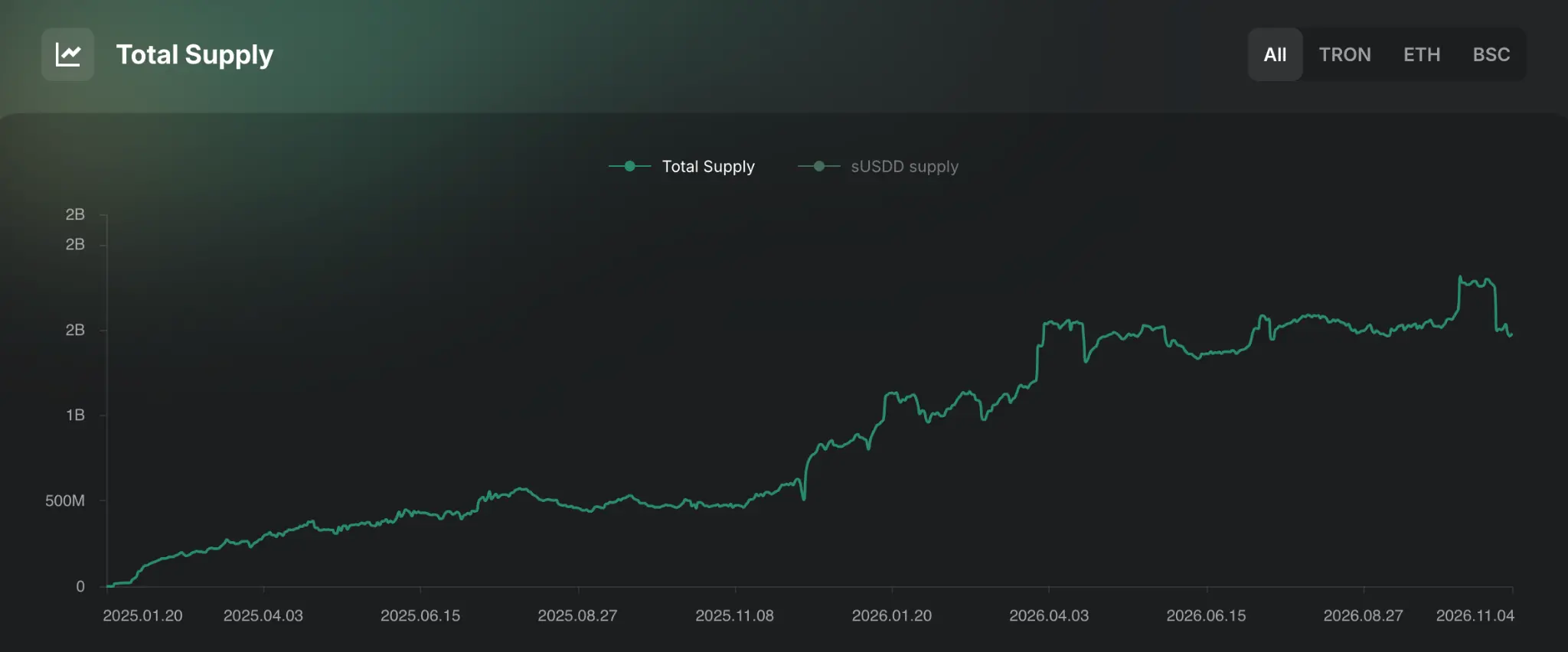
On November 6, the decentralized over-collateralized stablecoin USDD recently released its monthly transparency report for October 2026. The report shows that as of October 31, the circulation of USDD was approximately 1.5 billion, with reserve assets reaching 2.21 billion USD and a collateralization rate maintained at 146.99%.In October, the average daily minting volume of USDD increased by 10.5% month-on-month. During the period from October 12 to 19, the market capitalization of USDD grew by 180.3 million USD, leading the stablecoin market. On October 12, the circulation of USDD once exceeded 1.81 billion USD, and the Total Value Locked (TVL) surpassed 2.51 billion USD, both setting historical highs.In terms of revenue and ecological development, the investment return of USDD Smart Allocator in October increased by 8.5% month-on-month, with the average daily capital deployment scale growing by 15%. By the end of the month, the cumulative revenue reached 33.59 million USD. Meanwhile, the TVL of USDD Earn on the BNB Chain increased by 62.9% month-on-month. USDD continues to deepen cooperation with platforms such as Binance Wallet, Gate DEX, Morpho, and Pendle, further expanding DeFi revenue scenarios.In addition, the treasury data disclosed by USDD for the third quarter of 2026 shows that the treasury surplus increased by 27.1% month-on-month, and the treasury balance exceeded 30 million USD for the first time. USDD stated that it will continue to promote ecological construction around the two core scenarios of earning and transferring, and will continuously enhance asset transparency through public reserve addresses and on-chain data dashboards.

Bitget released the Q3 transparency report, with a total quarterly trading volume reaching 1.86 trillion USD

According to official news from Bitget, the platform has released its transparency report for the third quarter of 2026. The report shows that Bitget's Q3 total trading volume reached $1.86 trillion, with a cumulative monthly trading volume growth of 21.2% from July to September. Among them, the trading volume of crypto derivatives reached $409.19 billion, a month-on-month increase of 31.5%; the trading volume of crypto spot increased by 65.7%; and CFD trading volume reached $376.32 billion, an increase of 39.7%.In terms of product layout, Bitget launched a Unified Trading Account (UTA) that incorporates over 370 assets into a unified margin system, including more than 100 tokenized U.S. stocks, with a collateral valuation ratio of up to 95%, further optimizing the cross-asset trading and fund management experience. At the same time, the platform has extended the application scope of the AI trading tool GetAgent Playbook to tokenized U.S. stocks and launched the stablecoin yield product Cash Plus, enriching users' asset management and yield options.Regarding the security system, Bitget has been releasing monthly reserve reports since December 2022, and as of September 2026, it has released 47 consecutive reports, with all asset reserve ratios maintained above 100%. In this quarter, Bitget further upgraded its Proof of Reserves (PoR) mechanism, expanding the coverage of reserve verification from the original 4 cryptocurrencies to 19 major assets. This upgrade also expanded the platform-level reserve disclosure and individual asset verification scope, allowing users to check the reserve ratio, reserve scale, and on-chain distribution of various assets through the PoR page, and independently verify whether personal holdings are included in the reserve snapshot based on the Merkle Tree, further enhancing the transparency and verifiability of reserve information.

first_img American financial tycoon Don Wilson questions Hyperliquid's information priority, position transparency, and six other core issues

The founder and CEO of trading company DRW, Don Wilson, published an article raising several questions about the New York Stock Exchange's parent company's push to introduce the decentralized perpetual contract platform Hyperliquid to the U.S. market. He also expressed gratitude to CFTC Chairman Selig and the Trump administration for making such experiments possible and stated that only the market can determine whether an arrangement is useful.Don Wilson: What are the benefits of trading perpetual contracts on a regulated exchange in an on-chain manner? He believes the main advantage of on-chain trading is the reduction of friction in a trustless, identity-verification-free environment, or receiving the purchased assets in real-time through atomic transactions; however, perpetual contracts themselves are not assets, so the latter benefit does not apply.He also specifically mentioned Stan Druckenmiller, asking whether he is aware that positions and transactions on Hyperliquid can be tracked in real-time and whether he sees this as an advantage. Additionally, he noted that Hyperliquid's priority fee mechanism allows participants to pay to see information earlier or to move their orders ahead in the queue, and he inquired whether this aligns with CFTC core principles.Don Wilson further asked whether the liquidity of offshore order books can be merged with onshore order books; if not, whether listing perpetual contracts on regulated exchanges using traditional centralized order books is preferable to bearing the inefficiencies brought by on-chain matching.Previously, Intercontinental Exchange (ICE) and trade[XYZ] announced plans to deploy a perpetual contract market covering crypto assets, stocks, commodities, foreign exchange, and other physical assets for U.S. traders based on Hyperliquid infrastructure, pending regulatory approval, with ICE operating the regulated market and clearing framework.

first_img Hyperliquid Co-Founder: Self-Custody and Transparency are the True Advantages of On-Chain Finance

According to The Block, Jeff Yan, co-founder of the decentralized perpetual contract trading platform Hyperliquid, stated during a fireside chat at the Korea Blockchain Week 2026 that around-the-clock trading is not the essential difference between on-chain trading venues and traditional exchanges. He pointed out that cryptocurrencies do not need to adhere to traditional market opening hours because these assets inherently possess international attributes, and some traditional exchanges have already begun to actively extend their trading hours.Yan emphasized that the more enduring value of on-chain finance comes from allowing users to retain control and custody of their funds, which helps to avoid a common single point of failure risk. In his view, once a counterparty, intermediary, or even custodian encounters issues, the ability to self-custody becomes particularly crucial.In addition, transparency constitutes another distinct feature of on-chain trading. Although it does not have a strong appeal in serving ordinary consumers, it is essential for building trust in the entire system. In a system controlled solely by a private organization, users cannot obtain the same level of trust and neutrality guarantees.He also mentioned that for assets lacking publicly available prices during the closing hours of traditional exchanges, continuous trading remains necessary. He cited commodities, stocks, and Pre-IPO targets that had already traded on Hyperliquid before the reference market opened as examples to illustrate that the demand is indeed real.

Bitget August Transparency Report: Institutional Business Completes Multiple Product and Infrastructure Upgrades

Bitget released its transparency report for August 2026, disclosing its latest progress in the construction of a multi-asset trading ecosystem. In terms of U.S. stock tokens, taking rNVDA as an example, its daily trading volume reached $38.5 million, with over 4,200 users completing approximately 112,800 transactions, of which about 36% of the trading volume occurred outside regular U.S. trading hours, reflecting that rToken is becoming a core tool for investors to break through traditional trading time constraints and achieve 24/7 global asset allocation.On the institutional business front, Bitget launched an institutional-level CFD liquidity solution aimed at quantitative teams, proprietary trading firms, funds, brokers, and high-net-worth professional traders, supporting high-frequency quantitative trading, arbitrage between futures and spot, and automated trading scenarios such as EA.At the same time, the platform launched FCN (Fixed Coupon Notes), bringing traditional financial structured products into the tokenized U.S. stock market, becoming the first cryptocurrency exchange to combine the FCN structure with USDT settlement and U.S. stock rToken delivery. As related products and trading infrastructure continue to improve, Bitget is further strengthening its capabilities in institutional-level services, multi-asset coverage, and liquidity.In addition, third-party data shows that Bitget performs outstandingly in terms of liquidity and execution efficiency for tokenized stocks and stock perpetual contracts. In a liquidity benchmark test targeting the five stock spot markets of MSTR, SPY, QQQ, CRCL, and NVDA, DeFiLlama recorded Bitget with the lowest median bid-ask spread of 0.83 basis points and the deepest order book liquidity among all sample markets. In execution benchmark tests covering 36 stock perpetual contracts and 8 types of metal and commodity perpetual contracts, Bitget maintained a significant lead in approximately 90% of trading pairs.

hot_img U.S. Senator demands that Waller disclose his conversations with Trump, questioning the transparency of the Federal Reserve

Nick Timiraos, the chief economic reporter for The Wall Street Journal and known as the "mouthpiece of the Federal Reserve," recently wrote that Federal Reserve Chairman Kevin Warsh is facing intense scrutiny from Congress. On Wednesday local time, four members of the Senate Banking Committee, led by Senator Chris Van Hollen, jointly sent a letter to Warsh, demanding that he publicly disclose all communication details with President Donald Trump.Earlier reports indicated that Warsh had maintained frequent phone contact with Trump since taking office, but the publicly available schedule from the Federal Reserve does not record any related calls during Warsh's early days in office. Lawmakers believe that this "selective transparency" could raise concerns about government interference in monetary policy.Kevin Hassett, the director of the White House Council of Economic Advisers, previously stated that Warsh has long engaged in economic discussions with Trump but claimed that Trump would not pressure the Federal Reserve. Trump later denied the related reports, stating that he had only had a brief conversation with Warsh a few days prior.Currently, the Federal Reserve has stated that it will continue to delay the disclosure of the chairman's schedule according to established rules. The market is watching to see if Warsh will provide additional information and whether this matter will affect public confidence in the independence of the Federal Reserve.

app_icon
ChainCatcher Building the Web3 world with innovations.