BTC $77,362.16 +0.90%
ETH $2,274.02 +1.13%
BNB $697.67 -0.06%
XRP $1.28 +2.27%
SOL $92.83 +1.03%
TRX $0.3212 +0.65%
DOGE $0.0752 +1.49%
ADA $0.1902 +0.79%
BCH $274.20 -0.61%
LINK $11.01 -1.01%
HYPE $85.19 +1.26%
AAVE $126.94 +0.56%
SUI $0.8941 +2.62%
XLM $0.1621 -0.14%
ZEC $1,222.35 +7.91%
AAPL $331.25 +0.56%
AMZN $250.47 +1.33%
GOOGL $279.92 -0.28%
MSFT $518.70 +1.81%
META $622.69 +2.10%
NVDA $208.33 +2.17%
TSLA $396.91 -1.82%
SNDK $1,135.50 +4.04%
INTC $61.12 +1.09%
SPCX $141.21 +2.79%
MU $863.65 +2.63%
AMD $517.47 +9.73%

kor

All
Article
Flash

Analysis: Suspected North Korean hackers transferred approximately 1.46 million USD through the cross-chain bridge between Jupiter Lend and Circle, with Jupiter stating that the source of the funds has not been cut off

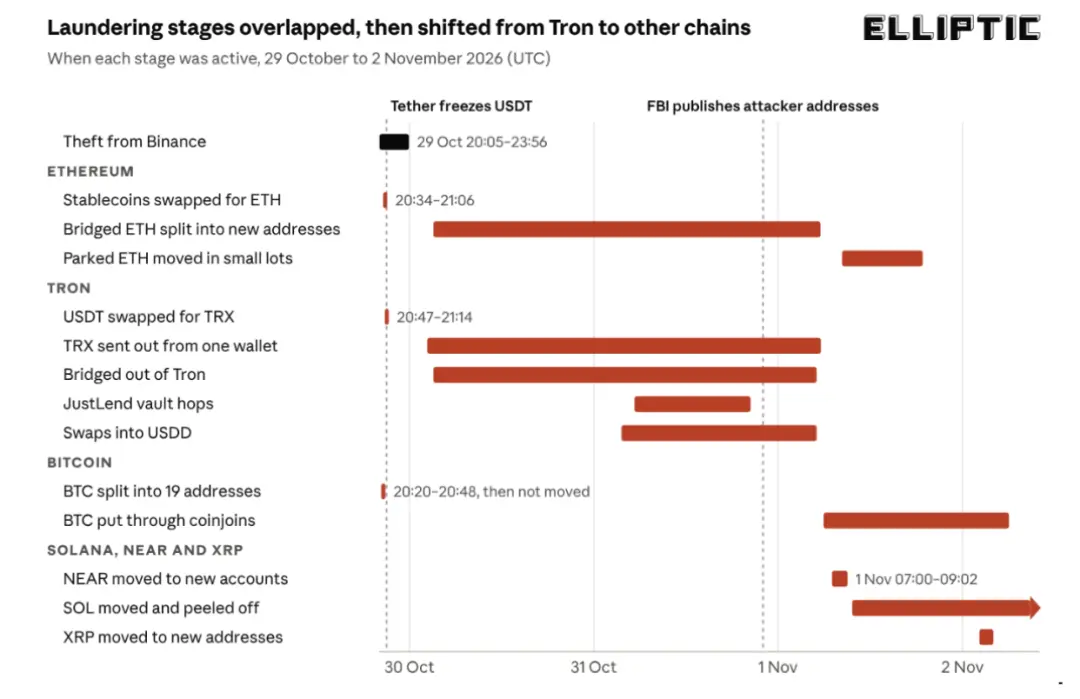
On-chain analyst @FabianoSolana posted that suspected North Korean hackers transferred approximately $1.46 million through the Jupiter Lend and Circle cross-chain bridge. According to his analysis, the funds were initially transferred from a Solana wallet address marked by the FBI (starting with AffzFD), then dispersed to about 35 temporary addresses via intermediary wallets before being re-aggregated and deposited into Jupiter Lend. A few minutes later, a similar amount was withdrawn by another new wallet.Subsequently, the funds were exchanged for USDC and transferred out of Solana through the Circle cross-chain bridge, returning to a new address on the Solana network via Noble and dYdX. The related funds were transferred out in approximately 16 transactions totaling about $1.4634 million, and then returned in 19 transactions, with a difference of about $10 between the amounts transferred out and returned. According to the analyst, the related funds have not been frozen.In response, Jupiter's Chief Operating Officer Kash Dhanda stated that based on the current investigation results, the attackers only performed deposit and withdrawal operations through Jupiter Lend, which is different from the previous Aave incident where stolen stablecoins were borrowed and could not freeze the assets. The flow of related funds can still be fully tracked through LP tokens, and the relationship of the funds has not been severed, so it cannot be concluded that the attackers used Jupiter Lend to launder the source of the funds. The Jupiter security team has been monitoring the flow of related funds in real-time. As of the time of publication, Circle has not publicly responded to the reasons for the aforementioned fund transfer and why they have not been frozen.

The Information investigates the smuggling chain of high-end HBM in South Korea

The Information investigated the smuggling chain of high-end storage chips in South Korea and interviewed a dealer in Shenzhen in his 20s. He originally worked at a chip company and transitioned to the chip black market business by leveraging his network. Having been in the industry for only three years, he is now dressed in luxury brands and busy connecting buyers and sellers every day. The United States will begin to restrict exports of advanced high-bandwidth memory (HBM) to China starting at the end of 2024, but the rules have loopholes: HBM exports are restricted when sold separately, but if packaged together with processors, it may be judged based on the processing power of the processor to determine if it crosses the regulatory line.A smuggler in his 40s controls a chip design company that specializes in designing cheap and lower-performance server processors. These chips are rarely purchased but are used as a pretext for procuring high-end HBM from South Korea. Packaging factories place HBM from Samsung and SK Hynix on the same substrate as these processors and declare exports under the category of low-performance processors. After the goods enter mainland China via Hong Kong, workshops reheat and remove the HBM, while the cheap processors are discarded, and any mishandling during disassembly could damage the memory.A stack of HBM3E in the Chinese black market was priced at only a few hundred dollars a year ago, but it has now risen to about 4,000 dollars. An AI chip typically requires 6 to 8 stacks, costing between 24,000 to 32,000 dollars just for the memory. Some of the memory ultimately flows to Huawei customers. Huawei's next-generation Ascend 960DT is scheduled to launch in the first quarter of 2027, but there is a shortage of domestic HBM supply, and Huawei has asked some customers to procure memory on their own. With the increase in imitators, the aforementioned smuggler responsible for procuring chips from South Korea plans to sell his controlling stake in the company next year, fearing that the spread of the route will attract strict scrutiny from regulatory authorities in South Korea and the United States.

North Korea denies involvement in last year's Bybit theft, claiming the United States misled public opinion

According to the Korean Central News Agency, North Korea mentioned in its denial of involvement in the theft related to Binance that last year the United States linked the hacking incident at the cryptocurrency exchange platform Bybit to North Korea. The Korean Central News Agency stated that the United States misled international public opinion, creating the illusion that cyber fraud occurring around the world was all orchestrated by North Korea, which is a serious political provocation against North Korea. North Korea firmly opposes any attempts to politicize cyber issues and use them as a means of interfering in the internal affairs of other countries, stating that this is the consistent policy position of the Democratic People's Republic of Korea government.The Korean Central News Agency also stated that it is necessary for the international community to reflect again on the fact that the current U.S. government announced the confiscation of illegally stolen cryptocurrency assets, acting as a national strategic reserve as soon as it took office last year. The Korean Central News Agency suggested that if the stolen massive cryptocurrency funds were to be recovered, one might discover clues related to the hacking incident. On February 21, 2025, Bybit experienced a large-scale theft incident, with a total value of approximately $1.5 billion. The U.S. FBI and several on-chain analysis agencies subsequently attributed the incident to the North Korean Lazarus Group (TraderTraitor).

South Korea plans to impose an 11% tax on profits from perpetual contracts of U.S. stocks traded on overseas exchanges starting next year

According to a report by South Korea's "Daily Economic News," the Ministry of Economy and Finance has decided to classify perpetual contracts linked to U.S. stocks as overseas stock derivatives, bringing them under the scope of capital gains tax. Starting next year, profits earned from investing in such products through overseas cryptocurrency exchanges will be subject to an 11% tax rate, calculated after deducting a basic exemption of 2.5 million Korean won from annual earnings, which is half of the tax rate for overseas spot stocks (22%).The report states that U.S. stock perpetual contracts are derivatives traded through overseas cryptocurrency exchanges like Binance, tracking U.S. stocks such as Nvidia, Apple, and Tesla. Since the Financial Services Commission of South Korea has not permitted perpetual contracts, South Korean investors can only participate through overseas exchanges. According to industry statistics, the trading volume of such products across 19 global exchanges from January to August this year was approximately $1 trillion. The South Korean government plans to monitor investors' relevant trading records at overseas exchanges and tax them accordingly. The news cites sources from South Korean government departments, but has not yet received official confirmation from the Ministry of Economy and Finance.
app_icon
ChainCatcher Building the Web3 world with innovations.