The truth about Trump's son's Bitcoin game: he made a staggering $100 million while retail investors lost $500 million
 Core Viewpoint

 The Trump family has a family skill: to exaggerate and make something sound bigger than it actually is.
Original Title: How Eric Trump Got Rich From Bitcoin While Losing Investors A Fortune
Original Author: Dan Alexander, Forbes
Translation: Peggy, BlockBeats
This time, Eric Trump brought this method into the cryptocurrency circle. He packaged his Bitcoin company as a "money printing machine," claiming that the company could mine Bitcoin at nearly half the market price.
But when Forbes reporter Dan Alexander opened the books, the story revealed another side: 70% of the Bitcoin held by the company was not mined but purchased through stock issuance; the real comprehensive costs were far higher than the numbers Eric mentioned; the financing structure that made the balance sheet look prettier might also mean that all the Bitcoin mined by the company so far would have to be used in bulk to pay for mining equipment bills in the future.
The numbers ultimately pointed to a more direct conclusion: Eric's personal wealth increased by about $90 million, while ordinary investors collectively lost about $500 million.
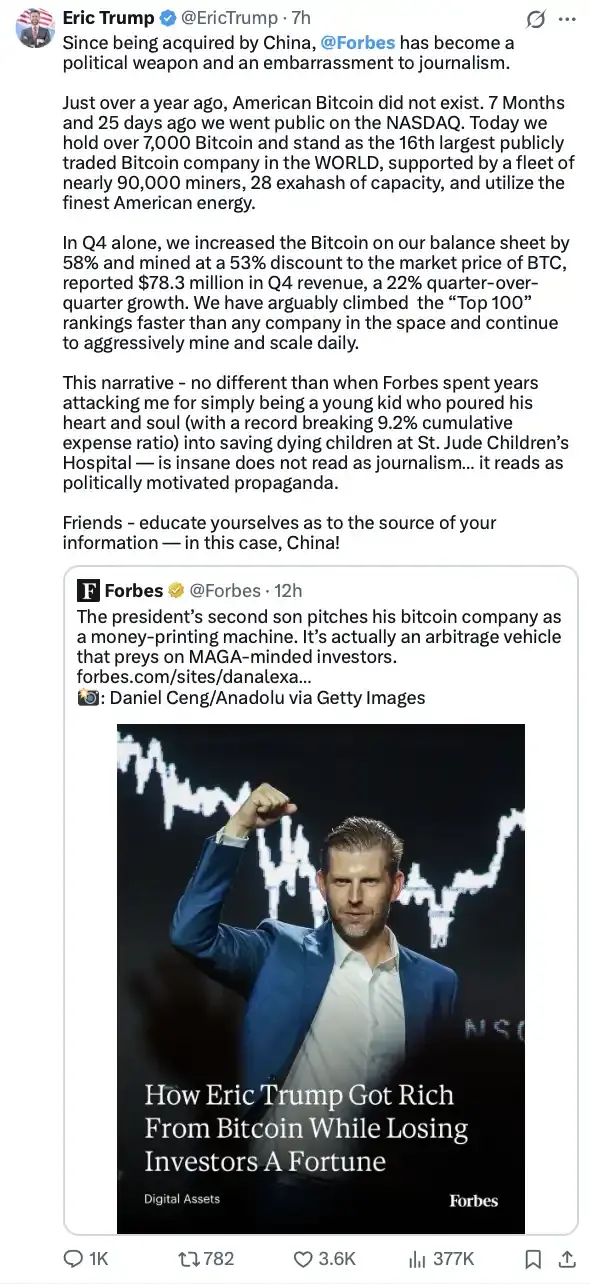
After the report was released, Eric Trump quickly retaliated on X, accusing Forbes of being acquired by China, claiming the report was politically driven propaganda, and presenting a series of operational data in rebuttal: 7,000 Bitcoins, nearly 90,000 mining machines, and fourth-quarter revenue of $78.3 million. Along the way, he also dug up an old story from twenty years ago about fundraising for a children's hospital, trying to prove that Forbes had always targeted him as a "good person."
There was only one thing he never directly addressed: where did that $500 million go?
The following is the original text:
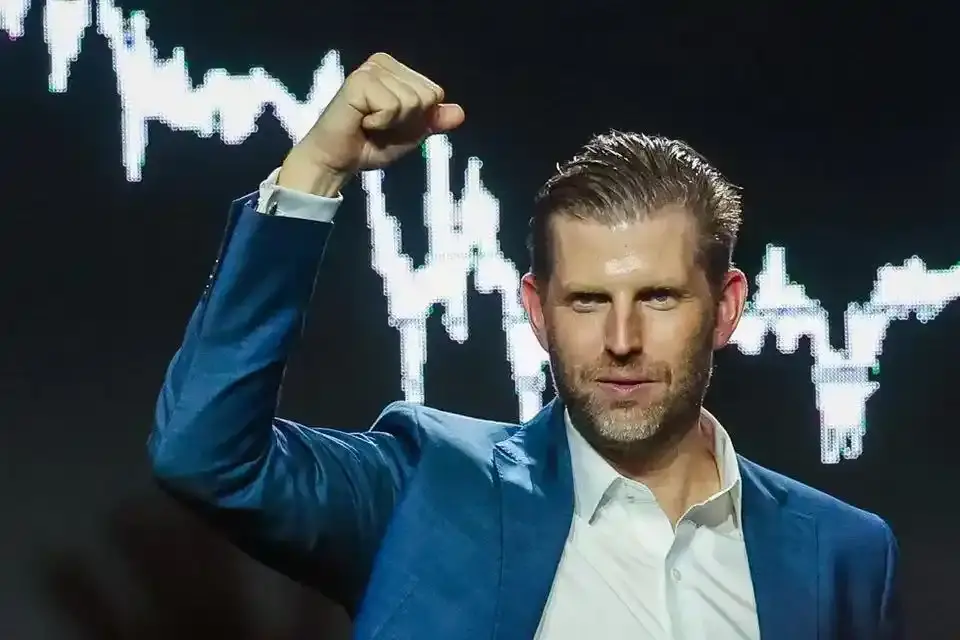
Eric Trump inciting the crowd. Photo: Daniel Ceng/Anadolu via Getty Images
The ability to incite a crowd is not only useful in politics. Just ask Eric Trump: his Bitcoin company attracted a large number of followers and then dumped a bunch of overpriced stocks on them.
In February of this year, Eric Trump appeared energetically on a financial report conference call, ready to do what the Trump family does best—promote.
His company "American Bitcoin" had just been listed for a year and was already trading on NASDAQ. "We are quickly becoming a leader in the Bitcoin world, and I truly believe we have the strongest brand," Eric said, "I want to thank Mike (Mike Ho), Asher (Asher Genoot), Matt (Matt Prusak), and every colleague at American Bitcoin."
Note: Mike Ho, CEO of American Bitcoin, also serves as Chief Strategy Officer of Hut 8. Asher Genoot, Executive Chairman of American Bitcoin, co-founder of Hut 8, led the collaboration deal with the Trump family. Matt Prusak, President of American Bitcoin, a former Hut 8 employee, is stationed by Hut 8.
This ending is quite thought-provoking. Saying "every colleague" is because there are almost no other people at American Bitcoin.
The annual report submitted a month after the financial report conference call shows that the company officially has only two full-time employees, probably just CEO Mike Ho and President Matt Prusak. Perhaps there are a few more—Ho also serves as an executive at another company; someone who worked in investor relations at that company for less than a year now lists themselves as "Chief of Staff" at American Bitcoin on LinkedIn; another woman stated she has been the company's social media manager since January of this year. (Executive Chairman Asher Genoot, Ho, and three independent directors make up a five-person board.)
The Trump family figured out a rule early on: making things sound bigger than they actually are can be profitable.
It is said that Donald's father, Fred Trump, deceived regulators and profited by inflating project costs. Donald Trump inflated asset values to banks and media like Forbes, ultimately being ruled by a New York judge to have committed fraud. Eric was also caught up in that lawsuit, being banned from serving as an executive or director of any New York-registered company for two years. Nevertheless, he started anew, registering in Delaware and establishing his company based in Florida, marketing it in a way that would make his ancestors take notice.
Note: Fred Trump, Donald Trump's father, a New York real estate developer, was once suspected of inflating construction costs to extract higher profits.
Eric Trump's latest Bitcoin venture may be selling more of a story than a real business. According to him, American Bitcoin can mine Bitcoin at about half the market price, and is a genuine "money printing machine." But upon closer examination of the numbers, one cannot help but question: can this company actually achieve profitable mining, let alone maintain such an astonishing profit margin? Representatives of Eric Trump, the Trump Organization, and American Bitcoin did not respond to multiple requests for comment from Forbes. There are many who trust the president's son, and real money has already been bet. On September 3, 2025, American Bitcoin went public, at which time the balance sheet had about $270 million in Bitcoin, while investors valued it at $13.2 billion.
In the past eight months, American Bitcoin has continuously used this absurdly high valuation to sell stocks and buy more Bitcoin. The heavily diluted stock price has now dropped 92% from its peak. Eric Trump initially seemed to have spent almost no cost to enter the game, and still thrives today, with his personal wealth estimated to have ballooned from about $190 million to $280 million through a financial alchemy. Other insiders have also profited significantly. In contrast, ordinary investors who believed the sales story and invested real money have collectively lost an estimated $500 million.

Eric Trump (left) presented himself as a charitable figure in his early years, shortly after graduating from college, he initiated fundraising activities at his father's golf course for St. Jude Children's Research Hospital. Photo: Bobby Bank/WireImage
Eric Trump's first true independent project was not an apartment building, but a charity.
In 2006, he graduated from Georgetown University with a degree in finance and management, full of enthusiasm to change the world. At that time, his brother Don Jr. and sister Ivanka had already moved into Trump Tower, engaged in real estate projects. One day while driving on the New Jersey Turnpike, Eric later recalled in an interview with Forbes, another thought suddenly popped into his head: how could he really do something for the world? Thus began his earliest entrepreneurial practice—a nonprofit organization called the "Eric Trump Foundation."
This organization did a lot of good. Rather than being an operational charity, it was more of a fundraising platform, having delivered over $16 million to St. Jude Children's Research Hospital. But as time passed, this organization and even Eric himself began to become increasingly "Trump-like."
Documents obtained by Forbes through a public information request (despite objections from the nonprofit's legal team) show that the organization exhibited dishonest fundraising rhetoric, weak governance structure, and chaotic financial conditions. Eric had claimed to donors that he kept costs to a minimum, almost directing all funds to St. Jude, partly because his father provided the venue at Trump-owned clubs for free, and celebrities agreed to perform "pro bono." However, checks and invoices obtained by Forbes show that over $500,000 flowed to other charities, over $500,000 went to Trump-owned businesses, at least $90,000 was paid to various performers, and over $35,000 was paid to a car service company—passengers included Eric's mother, a reality TV actress, and a van full of people heading to Hooters.
In his father's company, Eric was mainly responsible for hotel operations in his early years, from which he learned a lot, including a key insight: branding a business to make money is far easier than actually building buildings.
The Trump Organization defaulted on loans for its Chicago hotel in 2008, filed for bankruptcy protection for its Atlantic City asset portfolio in 2009, and its Washington D.C. hotel has been losing money for years. Ultimately, the Trump family shifted the expansion strategy of their hotel empire to what is known in the industry as a "light asset" model, focusing on management and brand licensing rather than development.
Another training ground for Eric was his father's golf course investment portfolio, where he witnessed the benefits of unconventional financing structures. In the 1980s and 1990s, golf clubs typically charged deposits when members joined, promising to return them interest-free after thirty years. These liabilities hung on the books, causing many investors to hesitate when selling properties. But Donald Trump was undeterred, ultimately taking on about $250 million in such liabilities, thereby acquiring over a dozen golf properties scattered across the U.S., while keeping these liabilities recorded as zero on his personal balance sheet for years. By the time repayment was due, the value of these properties had far exceeded the amount owed.
In January 2017, Donald Trump took office as president, and Eric and his brother Don Jr. took over their father's asset portfolio. Eric seemed to have little of his own plans, just hoping to follow the established rules. "We are not the kind of company that sells assets," he said in a February 2017 interview with Forbes in an office on the 25th floor of Trump Tower, "We buy them and manage them well." The Trump brothers attempted to expand into new businesses, including launching two mid-range hotel brands, but with little success. Against the backdrop of struggling operations and their father's cash reserves running low, they did a lot of things Eric said he wouldn't do over the next seven years: selling assets, estimated to have cashed out about $411 million.
Then, a new opportunity to make money arose: the 2024 election.
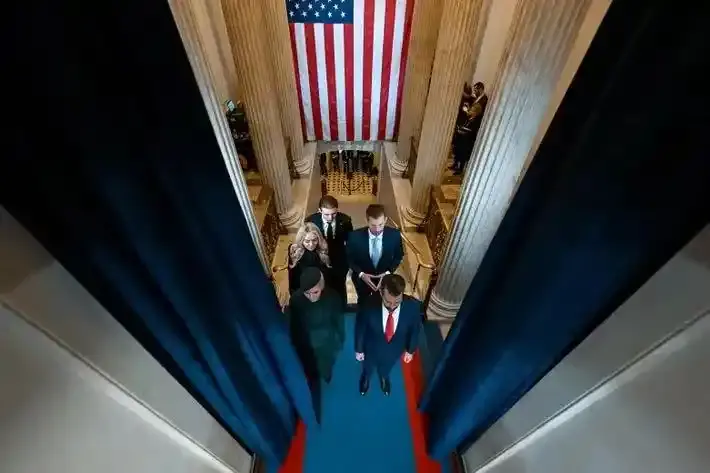
Returning to the White House means business opportunities. The president's children will attend their father's second inauguration on January 20, 2025. Photo: Kenny Holston-Pool/Getty Images
Just two weeks after Donald Trump defeated Kamala Harris, the company that later evolved into American Bitcoin was quietly registered in Delaware. It did not initially start as a cryptocurrency bureau. Dubai developer Hussain Sajwani, who had collaborated with the Trump family on a golf project in Dubai, appeared at Mar-a-Lago, announcing a $20 billion investment in building data centers in the U.S., leveraging the artificial intelligence boom. "That guy knows what he's doing," the incoming president praised. A few weeks later, Trump's two sons disclosed plans to follow this strategy and named the company "American Data Centers," with Eric Trump calling it "crucial for the development of America's AI infrastructure."
A month later, he changed direction. Through mutual friends, Eric and Don Jr. met two entrepreneurs: Asher Genoot and Mike Ho. These two already had a company similar to what the Trump brothers envisioned—a data center giant, Hut 8, which not only had exposure to AI business but also possessed considerable Bitcoin mining power. Shortly after the AI wave hit, the Bitcoin reward for solving each mathematical problem was halved, causing mining costs to soar. Industry-wide, a large amount of computing power was migrating to AI, and Hut 8's institutional shareholders pressured Genoot to follow the trend.
However, Genoot and Ho, leveraging their backgrounds in brand operations and arbitrage trading, came up with a more creative solution: using 20% equity in their Bitcoin mining equipment as bait to persuade the Trump brothers to abandon the data center plan. Then, with the First Family's involvement, they would package this hardware into a publicly traded company, igniting a promotional machine driven by the Trump aura.
This deal structure was tailor-made, seemingly designed for someone familiar with the hotel business. The machine roared day and night, but the operations of American Bitcoin resembled more of a light-asset hotel brand: Hut 8 owned the properties, operated the data centers, handled back-end affairs, and even the executives were sent from Hut 8—Prusak had previously worked at Hut 8, and Ho still serves there while also being the CEO of American Bitcoin and Chief Strategy Officer of Hut 8. This way, the Trump brothers only needed to focus on their strengths: sales.
"I will always remember telling them, 'Listen, the name must have two words,'" Eric Trump later recalled in a CoinDesk video interview, "It must have 'American,' and it must have 'Bitcoin.' One of them said, 'Eric, let's call it American Bitcoin; that's the name.'"
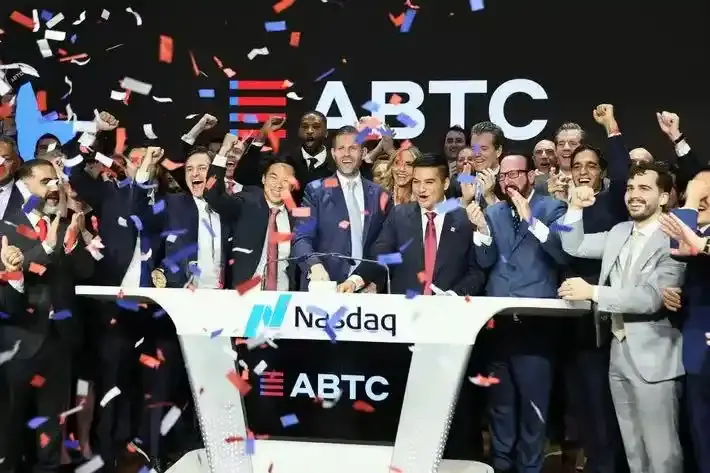
On the day of American Bitcoin's listing, investors enthusiastically pursued it, and Eric Trump's personal wealth was estimated to have briefly surpassed $1 billion. Photo: Michael M. Santiago/Getty Images
Since Eric Trump stepped into the cryptocurrency circle, he has been telling a myth about why he entered the industry. "Every bank in this country blacklisted me," he said at a conference in Wyoming last August. "Because my father is a political figure, we experienced de-banking," he added about a week later in Hong Kong. "Every major bank started closing our accounts," he claimed earlier this year in Palm Beach, "You know what we did? We went out and entered decentralized finance because we realized that was the future of finance."
But that's not the case.
Indeed, Capital One and JPMorgan Chase closed some of Trump's accounts in 2021, six years after Donald Trump entered politics. At that time, the president's reputation was severely damaged due to the Capitol incident and a wide-ranging investigation by the New York Attorney General, which ultimately ruled that the Trump Organization had committed fraud and was likely to re-offend.
Even so, many banks were willing to work with the Trump family—even JPMorgan Chase, shortly after closing some accounts, participated in refinancing two of the largest loans in Trump's asset portfolio. When Trump left the White House, he was in urgent need of support from large lending institutions due to cash shortages and high leverage, and he did receive it: from January 2021 to mid-2022, with the assistance of his sons Eric and Don Jr., he completed nearly $700 million in debt refinancing as part of a comprehensive restructuring of the balance sheet.
So why did Trump really enter the cryptocurrency field? A more reasonable explanation is that he sniffed an opportunity to extend his licensing business, just like selling sneakers and guitars by promoting non-fungible tokens (NFTs). He started with NFT trading cards, launching digital images that depicted Trump as a superhero. The products sold out in a day, ultimately bringing the former president over $7 million in cash and cryptocurrency revenue—every penny is crucial for someone facing a nearly $500 million fraud judgment. (Later, an appellate judge overturned this judgment on the grounds of disputing the penalty amount, but did not deny the finding of Trump's fraudulent behavior.) Subsequent cryptocurrency projects brought in hundreds of millions in additional liquidity, driving the First Family's betting scale to increase, including an independent plan announced last May: to spend about $2 billion on cryptocurrency through Trump Media and Technology Group.
In 2025, accumulating Bitcoin became the hottest trade of the year. Over 200 publicly traded companies scrambled to replicate the strategy of Michael Saylor's company, which accumulated over $50 billion in Bitcoin positions, skyrocketing in market value as prices soared, and recently plummeting. American Bitcoin stood out in this craze for obvious reasons: the aura of the First Family. But on the very day American Bitcoin went public on September 3, 2025, Eric Trump presented a more data-driven argument in a Spaces conversation on X. "The actual cost of Bitcoin we mine every day is about $57,000 to $58,000 each," he said, noting that the market price of Bitcoin at the time was about double that figure, "Our fundamentals couldn't be better."
This argument was quite persuasive, even though the speaker had become accustomed to selectively ignoring unfavorable expenses during charity fundraising events. Over $50,000 does indeed cover the operational costs of American Bitcoin's equipment. But if other expenses are included—including equipment purchases, marketing, and capital allocation—the comprehensive cost would rise to a much higher number, estimated at about $92,000 per Bitcoin at that time, only achievable if cryptocurrency prices remained high.
Including depreciation in the calculations is particularly crucial in the case of American Bitcoin, as it adopted a set of unconventional financing strategies from Hut 8. Between August and September 2025, American Bitcoin spent about $330 million upgrading its mining fleet. However, the company did not pay cash immediately but pledged a batch of Bitcoins and obtained an option regarding the final payment method: if Bitcoin prices rise, the company could pay about $330 million in cash and redeem the pledged Bitcoins; if prices fall, the company could directly offset the payment with the pledged cryptocurrency.
Since this large purchase, Bitcoin has fallen about 30%. This means that, at present, American Bitcoin will likely use the pledged crypto assets to pay for the equipment. But the problem is: the total amount of Bitcoin pledged by American Bitcoin is 3,090 (as of March 25), while the company has only estimated to have mined about 1,800 so far. In other words, if prices do not recover, all the Bitcoin mined by the company so far will be used to offset the equipment costs when the options expire around August 2027, leaving nothing.
Investors may not understand this. The company has about 15 months to decide whether to pay for the equipment with cryptocurrency or cash, during which the mined Bitcoins still remain on the balance sheet. The result is that American Bitcoin appears far more robust than it actually is. The company promotes this batch of Bitcoin reserves as a core selling point to investors while deliberately downplaying one fact: all or most of it will ultimately be used to pay for the machines that mined them.
Beyond the marketing appeal, it is not hard to understand why the Trump family is interested in this payment method—they built a portfolio of golf courses through similar unconventional financing back in the day. That time they won the bet because the value of the assets indeed went up.

Eric Trump has become a regular at major cryptocurrency conferences worldwide, as seen here attending an event in Hong Kong. Photo: Daniel Ceng/Anadolu via Getty Images
About 70% of the cryptocurrency held by American Bitcoin was not mined at all but obtained through selling stocks and directly purchasing Bitcoin on the open market. This is the core secret of American Bitcoin.
Why would Hut 8 be willing to hand over 20% equity in its Bitcoin mining equipment to a newly established data center company? The reason may lie here: in an era where meme stocks are prevalent and MAGA fervor sweeps through, a name like Trump is enough to attract enough "dumb money" to flood in, pushing stock prices to the clouds. Once the stock price is high enough to be illogical, the company can sell its own stock, reinvest the proceeds into Bitcoin, and accumulate mountains of cryptocurrency.
This is an arbitrage game driven by hype: convincing investors that the company is worth a fortune, and then selling shares when they know the stock price is absurd. As long as the profits generated from this arbitrage game exceed the value of that 20% mining equipment equity, it is a profitable deal for the insiders who set it up—what happens to the retail investors who bought shares off-market is another matter.
The sell-off almost started immediately after the listing. Within 27 days of American Bitcoin's listing, at the peak of its popularity, the company sold a total of 11 million shares, cashing out $90 million at an average price of about $8 per share. After deducting intermediary commissions (which amounted to $2 million), American Bitcoin purchased about 725 Bitcoins. Subsequently, as the stock price gradually declined, the sell-off continued. From early October to mid-November, the company again liquidated 7 million shares, cashing out $44 million at an average price slightly above $6 per share. By late November, after a significant drop in Bitcoin prices, the company went all out, concentrating on selling 47 million shares before the end of the year, cashing out about $106 million at an average price of about $2.25 per share.
The sell-off involved not just the company itself. In early December, the lock-up period for early investors was lifted, and the stock price plummeted 48% within two trading days. Notable supporters stepped forward to boost confidence. Cryptocurrency evangelists Cameron and Tyler Winklevoss—who actively engaged with the First Family through donations to Trump-related super PACs and supporting White House gala events—publicly expressed their support.
Note: Cameron and Tyler Winklevoss, twin brothers, are well-known cryptocurrency investors in the U.S. and have close ties to the Trump family, having publicly endorsed American Bitcoin.
Former White House Communications Director Anthony Scaramucci also joined the endorsement ranks. Host Grant Cardone claimed to be a "long-term investor, not a short-term trader," then added that his tweet "does not constitute investment advice." American Bitcoin's official social media account retweeted all of this to its followers. Cardone and the Winklevoss brothers did not respond to requests for comment, and Scaramucci's representative declined to answer.
Note: Anthony Scaramucci briefly served as White House Communications Director under Trump for only 11 days and later transitioned to being a cryptocurrency investor, endorsing American Bitcoin. Grant Cardone is a well-known sales trainer and motivational speaker in the U.S., publicly expressing support for American Bitcoin while stating that related content "does not constitute investment advice."
Bitcoin prices continued to be under pressure, especially after the Federal Reserve paused interest rate cuts in January. The company stuck to its original strategy; according to Forbes' calculations, from January 1 to March 25, American Bitcoin sold a total of 84 million shares, cashing out $111 million, and used this to repurchase about 1,430 Bitcoins. Overall, from the company's establishment to the end of March this year, American Bitcoin's total investment in cryptocurrency was about $525 million, while this batch of coins is currently valued at about $390 million, resulting in a cumulative loss of about $135 million for shareholders.

Eric Trump praised the UAE at a cryptocurrency conference in Dubai last year. "Other countries in the world must remain vigilant about the UAE, and the reason is simple," he told the audience, "They will always give you a 'yes'." Photo: Giuseppe Cacace/AFP via Getty Images
American Bitcoin's mining operations continue. However, as Bitcoin prices have fallen 31% since the company's listing, the economic calculations are becoming increasingly difficult. Optimizing the new mining machine fleet has reduced operational costs to about $47,000 per Bitcoin. However, the comprehensive cost—including management fees, amortization, and depreciation—is still estimated at about $90,000 per Bitcoin, exceeding the current market price of Bitcoin by about $13,000. The stock price has already dropped another 29% this year.
If investors no longer believe the "money printing machine" story, where will Eric Trump's company go? The president's son can pray for a significant rebound in Bitcoin prices—after all, it is a highly volatile asset. According to Forbes' calculations, if prices rise by 35%, American Bitcoin could pay for the equipment in cash, preserve the pledged cryptocurrency, and turn that $135 million trading loss into a small profit. At that point, Eric could easily claim that everything was part of the plan.
Of course, if he doesn't want to bet the company's success or failure entirely on luck, there may be another route: seeking a few overseas financiers eager to lend a helping hand. Sheikh Tahnoon bin Zayed Al Nahyan of the UAE has already established connections with another Trump cryptocurrency project, providing an estimated $375 million to the president and his sons. This investment has performed modestly in terms of financial returns so far, but the UAE has indeed gained support from President Trump in advancing its artificial intelligence initiatives. Reports indicate that this Gulf nation is currently seeking some form of relief from the economic pressures caused by the war with Iran.
The last recorded residence of American Bitcoin CEO Mike Ho was in the UAE, as of November 2023, although company representatives did not respond to inquiries about his current whereabouts. In any case, Ho appeared in the Gulf nation last October, where he was interviewed by a reporter from Arabian Gulf Business Insight, during which he mentioned contacts with ADQ Investment Group and TAQA Energy Company—both of which are associated with Sheikh Tahnoon. A spokesperson for American Bitcoin informed Forbes in October that Ho was referring to early communications prior to the establishment of American Bitcoin. However, recordings obtained by Forbes recently indicate that American Bitcoin is open to overseas collaborations.
"I have met with many sovereign wealth funds here through Hut 8, as well as in the name of American Bitcoin," Ho said in the recording, "Conversations are always ongoing." When asked if he was considering starting Bitcoin mining operations in the region, Ho responded, "We are always looking at this area. I have had conversations with ADQ and TAQA. We have studied their portfolios. The UAE has a lot of excess electricity, and Bitcoin mining is a good way to monetize that excess power."
These words come from someone who is well aware of the readily available arbitrage opportunities.
 Risk warning