When the United States discusses cryptocurrency infrastructure plans, what is the Asia-Pacific region discussing?
 Core Viewpoint

 The rise in the East and the fall in the West may not necessarily be a relocation of market value, but it is likely an opportunity for compliance dividends.
Author: Chloe, ChainCatcher
As the world's attention is focused on the United States pushing the Clarity Act, a new wave of funding and market layout is quietly surging in the Asia-Pacific (APAC) region.
The Asia-Pacific region has 60% of the world's population, a youthful demographic, a high smartphone penetration rate, and a fear of fiat currency inflation, making it the most fertile ground for cryptocurrency. Japan is known for its robust compliance, South Korea is a speculative casino, and Singapore is an institutional safe haven. The current crypto landscape in APAC may be shifting from East to West.
Macroeconomic Data: Why is APAC the Center of the World?
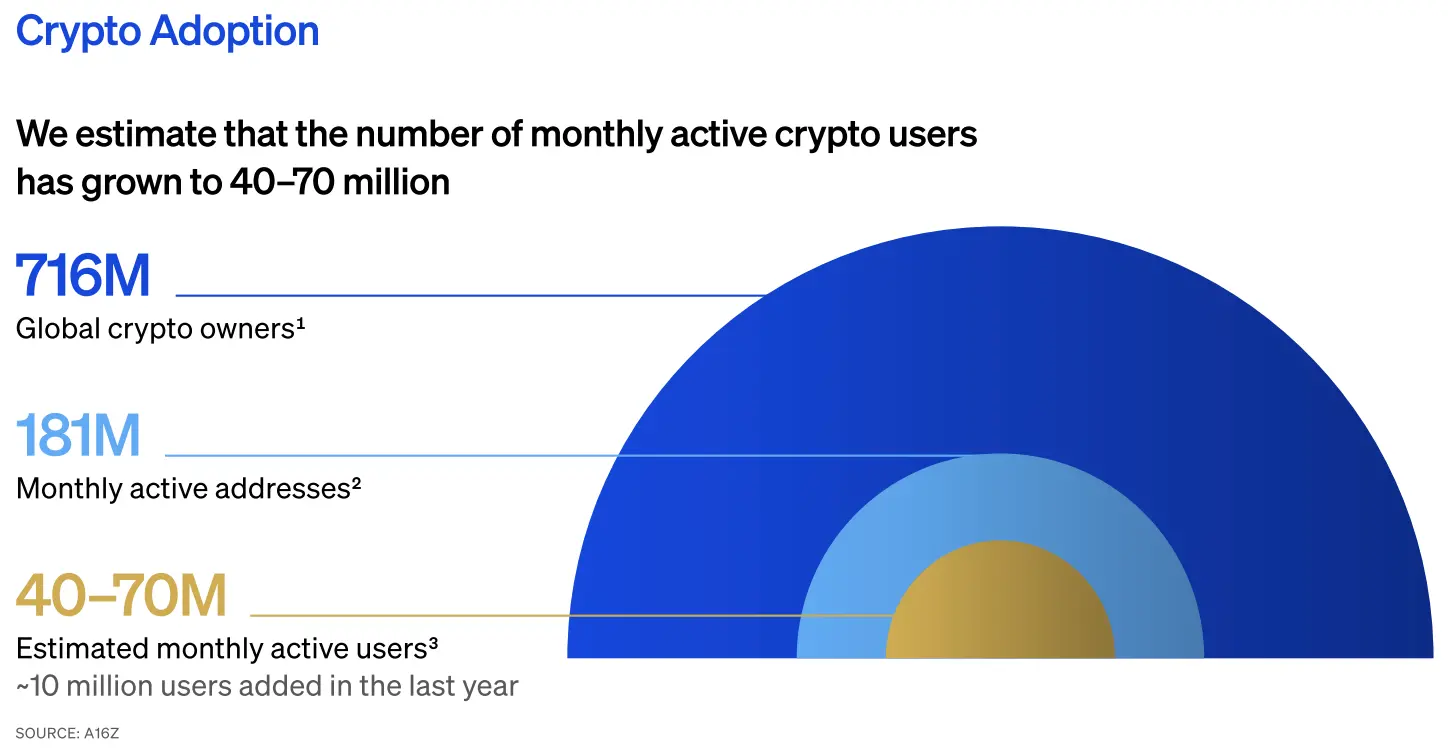
According to Bitgo's latest report for 2026, the number of global cryptocurrency owners will exceed 700 million by 2026, with an estimated 40 to 70 million active users in the crypto space each month. This is an increase of about 10 million compared to last year.
In the ranking of the top ten countries for cryptocurrency adoption, seven of them are in the Asia-Pacific region, indicating the potential and development of cryptocurrencies in this area, both in terms of user base and actual usage.
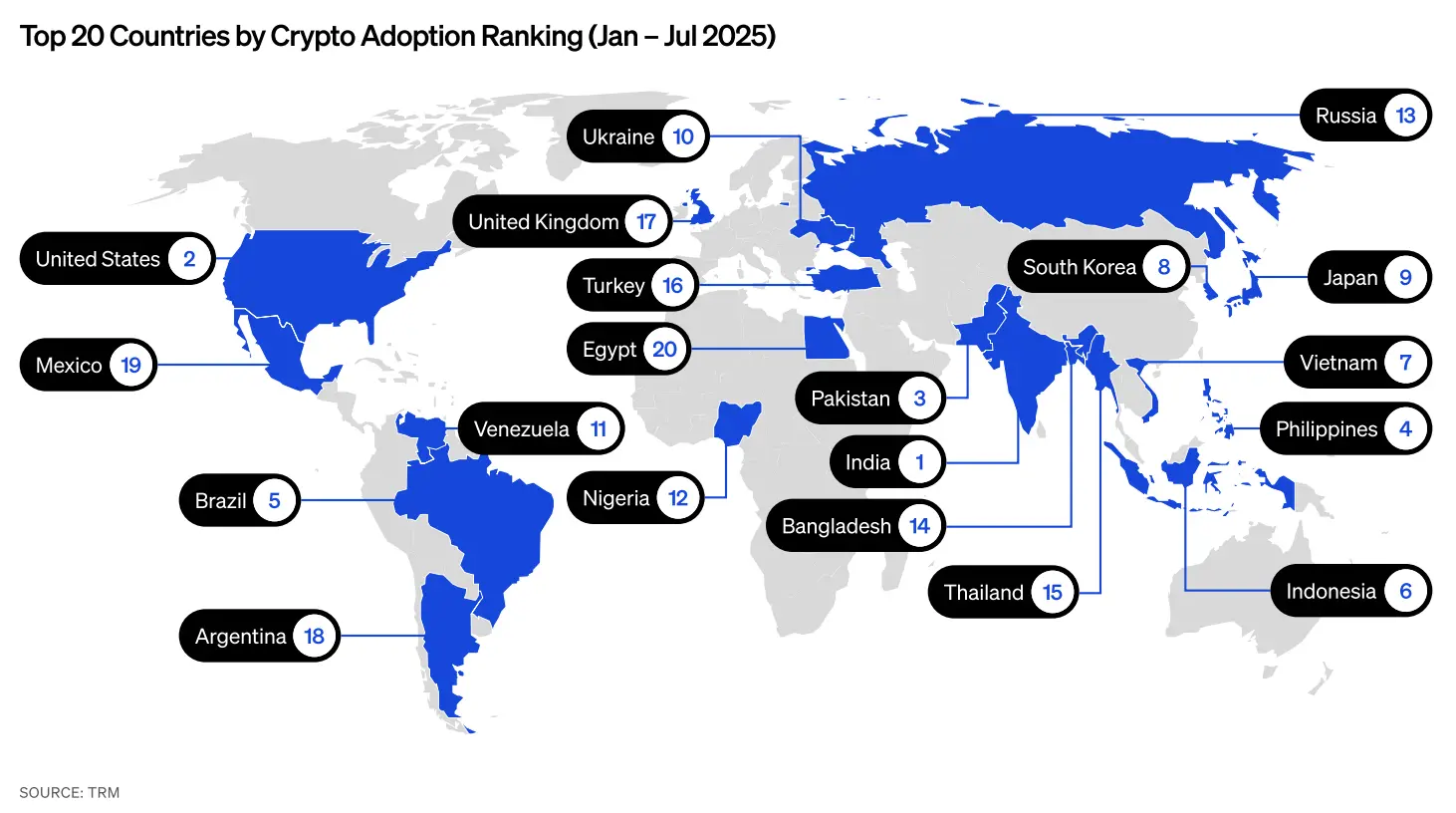
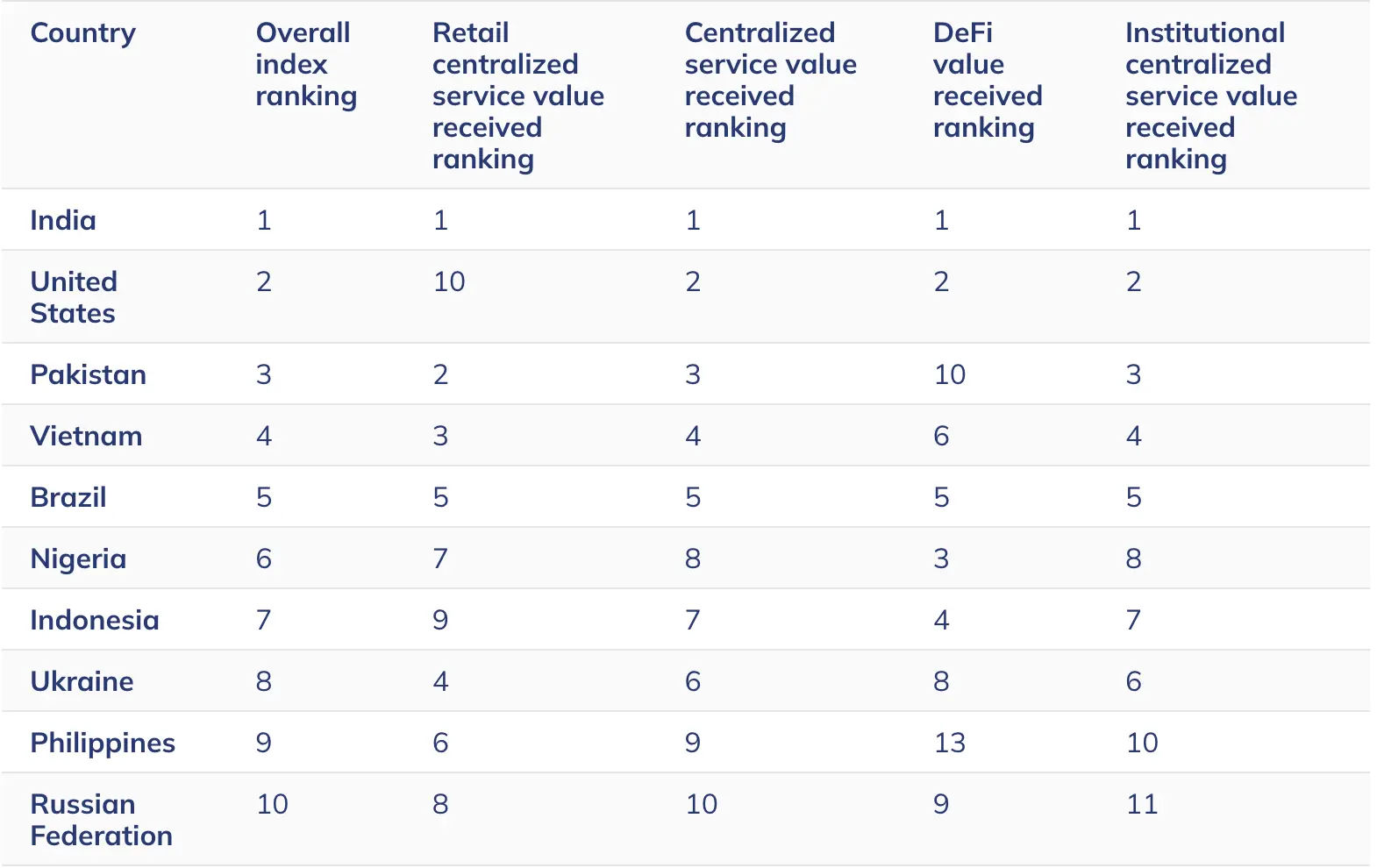
Additionally, according to Chainalysis' 2025 Global Cryptocurrency Adoption Index, India ranks first, followed by the United States, Pakistan, Vietnam, and Brazil, with five APAC countries making the top ten: India, Pakistan, Vietnam, Indonesia, and the Philippines.
In terms of momentum growth, the on-chain transaction volume in the Asia-Pacific region surged from $1.4 trillion to $2.36 trillion in the 12 months ending June 2025, a year-on-year increase of 69%, making it the fastest-growing region globally, compared to just 27% growth the previous year, effectively doubling the speed within a year.
In other words, while North America relies on ETFs and institutional entry to drive "compliance-driven" growth, the Asia-Pacific region is propelled by real retail trading, cross-border remittances, and demand for stablecoins to drive "usage-driven" growth.
These two growth curves are fundamentally different; the former is a transfer of existing funds, while the latter is an influx of new users.
Vietnam: From Gray Market to National Team Experiment on Closed Platforms
Over the past decade, Vietnam has been one of the highest cryptocurrency adoption markets globally, yet it has also been one of the most unregulated. According to Chainalysis data, Vietnam's global cryptocurrency adoption rate ranked first for two consecutive years in 2021 and 2022, with over 20% (approximately 17 million people) of the population holding digital assets.
However, this vast market has long operated outside the legal framework, with the public conducting P2P transactions through overseas exchanges like Binance and OKX, making it impossible for the state to tax or prevent money laundering.
This situation began to change in the second half of 2025. On June 14, 2025, the Vietnamese National Assembly passed the Digital Technology Industry Law, becoming the first country in the world to establish a dedicated legal framework for the digital technology industry, with the law officially taking effect on January 1, 2026.
The law distinguishes digital assets into two categories: "virtual assets" and "cryptographic assets," and requires that activities involving cryptographic assets comply with cybersecurity and anti-money laundering regulations.
Shortly after, on September 9, the Vietnamese government issued Resolution 05/2025/NQ-CP, launching a five-year pilot program for cryptocurrency trading. However, the thresholds for this pilot are extremely high: the minimum registered capital for companies must be 100 trillion Vietnamese dong, three times the minimum registered capital for commercial banks, and all cryptocurrency issuance, trading, and settlement must be conducted in Vietnamese dong, with shareholders required to have two consecutive years of profitability before applying.
The core logic of this system is a closed platform: while opening up, it locks all risks and funds domestically. Currently, domestic players such as TCEX under Techcombank, VIXEX under VIX Securities, and DNEX under HVA Group are lining up to apply for licenses. Dunamu, the parent company of South Korea's largest exchange Upbit, has also signed an MOU with MB Bank under the Vietnamese Ministry of Defense to export the South Korean exchange model and technology to create the first national-level digital asset exchange.
In March 2026, the market experienced a policy shift, with the Vietnamese Ministry of Finance revealing in internal documents that authorities plan to prohibit citizens from trading digital assets on overseas platforms like Binance and OKX, requiring all activities to be directed towards the officially regulated domestic system.
This is not without reason; there may be a national project with a clear timeline behind it. According to recent reports, the Deputy Minister of Finance of Vietnam stated that the country may officially launch the cryptocurrency asset market in the third quarter of 2026.
In other words, from legislation to pilot programs to platform launches, Vietnam has given the market less than 18 months of transition time.
The necessity of this closed system is driven by incredible pressure from capital outflows. As of June 2025, the amount of digital assets flowing within Vietnam has exceeded $200 billion, with authorities believing that uncontrolled cryptocurrency and stablecoin trading has become a major channel for capital outflows.
Supporting measures are equally stringent: individual investors trading through licensed platforms must pay a 0.1% income tax, while institutional profits face a 20% corporate tax, and accounting standards require exchanges to completely separate customer assets from the platform's own assets.
Vietnam's strategy can be summarized as using the strictest compliance thresholds to "nationalize" the world's fourth-largest cryptocurrency market from Binance. A market with an annual trading volume exceeding $800 billion and over 20 million users is moving towards centralized regulation.
For local financial groups like Techcombank and VPBank, this represents a licensing dividend, but for international exchanges that have long viewed Vietnam as an important incremental market in Southeast Asia, this could be the largest regional retreat since China's ban in 2017.
Taiwan Relies on the Competitiveness of Compliant Operators
If Vietnam represents the "rising East," then Taiwan is another reflection of the compliance process in the Asia-Pacific, albeit with a rhythm distinctly different from Vietnam. Taiwan is following a traditional financial route of "gradual regulation."
Four-Stage Regulatory Path: From Anti-Money Laundering to Specialized Legislation
According to Taiwan's regulatory plan, the regulation of the virtual currency industry is divided into four major stages: the first stage is the issuance of VASP anti-money laundering measures, the second stage is the establishment of an industry association, the third stage is the amendment of the Anti-Money Laundering Act to include VASP registration, and the fourth stage is to promote specialized legislation. As of now, the first three stages have been implemented, and the fourth stage is entering deliberation.
VASP Registration System Launches, Entering the Era of Major Regulation
On November 30, 2024, Article 6 of the Anti-Money Laundering Act will be amended, officially transitioning VASP from a "declaration system" to a "registration system." Those who have not completed anti-money laundering registration are prohibited from providing virtual asset services, with violators facing up to two years of imprisonment and fines of up to 5 million NT dollars.
The deadline for existing operators to complete registration is the end of September 2025, with a total of eight operators completing anti-money laundering registration, including local exchanges such as MaiCoin/MAX, BitoPro, XREX, HOYA BIT, TWEX, Chainss, KryptoGO, and Zone Wallet.
On March 25, 2025, Taiwan's regulators officially announced the draft of the Virtual Asset Service Act. According to the draft, those who issue stablecoins without permission could face up to seven years of imprisonment and fines of up to 100 million NT dollars; if involved in market manipulation or fraudulent activities, the penalties could increase to imprisonment of three to ten years, with fines up to 200 million NT dollars.
It can be said that after the implementation of Taiwan's specialized virtual asset law, a "highly regulated" model akin to financial institutions will be adopted, with strict standards set for operators' capital, internal audits, and financial structures.
Priority for Financial Institutions, No Removal of Overseas Apps
Additionally, the Taiwanese model has two key designs worth comparing with Vietnam.
The first is the "priority for financial institutions" principle for stablecoin issuance, meaning that stablecoin issuance is not limited to banks, but considering risk management, it will initially be dominated by financial institutions or operators with greater capital and risk control capabilities. Issuers must issue and redeem stablecoins based on their denominations, cannot refuse redemption requests from holders, and are prohibited from providing interest or returns on the issued stablecoins.
This framework is essentially a hybrid of MiCA and Japan's Payment Services Act, indicating that new Taiwan dollar stablecoins will be bank-led rather than driven by crypto-native teams.
The second is the "no removal" stance on overseas exchanges. While the specialized law draft references regulations from various regions, it still retains Taiwan's own adjustment space, especially regarding issues like the removal of overseas platform apps, ultimately not included in the draft due to considerations of user voluntary use and technical operations.
This sharply contrasts with Vietnam. Vietnam has chosen to lock down cryptocurrency, while Taiwan opts for "strengthening domestic while retaining overseas." The former relies on the execution power of the national team, while the latter relies on the competitiveness of compliant operators.
On the other hand, data statistics show that from 2023 to 2025, a total of 17 Taiwanese VASP operators have been found to have deficiencies, with fines imposed on 11 operators totaling over 13 million NT dollars. In other words, the eight operators that can meet compliance thresholds and have completed registration will enjoy a relatively closed licensing dividend in the next 3 to 5 years, but they will also bear compliance costs that are several times higher than before.
The Differentiated Chess Game in APAC: Japan and South Korea Going Their Own Ways
Vietnam and Taiwan are just two extreme examples; the entire Asia-Pacific region is actually playing out a differentiated regulatory chess game.
South Korea: The Invisible King of Stablecoin Trading Pools
South Korea continues its "speculative casino" nature. The Virtual Asset User Protection Act, effective in 2024, is reshaping the activities of large domestic exchanges, with the amount of Korean won used to purchase stablecoins reaching $64 billion in the 12 months ending June 2025, indicating a strong demand from traders for liquidity, hedging, and rapid asset rotation.
Local exchanges like Upbit and Bithumb continue to dominate the world's deepest KRW stablecoin trading pools, and the next step being discussed in Seoul is to establish a regulatory framework for KRW-pegged stablecoins.
Japan: Tax Reform Eases, Reviving a Long-Sleeping Crypto Market
Japan plays a role of robust compliance but is experiencing structural loosening starting in 2025. According to the 2025 Cryptocurrency Geography Report, Japan has the strongest growth among the top five markets in APAC, with on-chain transaction volume increasing by 120% year-on-year in the 12 months ending June 2025, surpassing Indonesia (103%), South Korea (100%), India (99%), and Vietnam (55%), driven by tax reforms and the issuance of the first yen stablecoin issuer license.
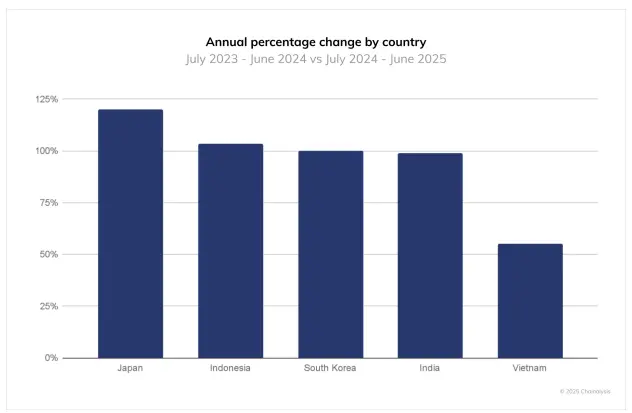
Japan has long been seen as the compliance ceiling in APAC, and this rebound indicates that excessive regulation is being moderately loosened.
Singapore and Hong Kong: A Tale of Two Institutional Safe Havens
Singapore and Hong Kong continue to serve as "institutional safe havens," with the former attracting institutions through the MAS licensing system, while the latter reshapes its role as an offshore financial center through the SFC's virtual asset service provider licensing system and the listing of spot ETFs.
Additionally, the Hong Kong Monetary Authority officially issued the first two stablecoin issuer licenses last month, with the licensed institutions being Anchor Financial Technology Limited and HSBC Hong Kong, marking an important step in Hong Kong's virtual asset regulation.
According to analysis from the Fudan Financial Review, the issuance of the first stablecoin licenses in Hong Kong aims to redefine the position of stablecoins within the Hong Kong financial system. It is transitioning from an auxiliary tool for crypto trading to the underlying infrastructure for cross-border payments, local payments, tokenized asset trading, and programmable finance.
"This signal can also be seen from the first licensed institutions. Anchor Financial Technology is backed by Standard Chartered Hong Kong, Hong Kong Telecom, and Animoca Brands, and HSBC is also among the first licensed institutions. This means that Hong Kong's stablecoin pilot is not just about the compliance of crypto-native projects but also an institutional integration of bank credit, payment gateways, and on-chain capabilities."
Conclusion: Compliance Premium is Being Redefined in APAC
Now, while the United States discusses the Clarity Act, what is the Asia-Pacific discussing?
The Asia-Pacific is discussing how to transform the "usage dividends" accumulated over the past decade into "institutional dividends." Vietnam is using its national team to secure territory, Taiwan is upgrading through specialized laws, South Korea is reshaping trading behavior with user protection laws, and Japan is easing entry for institutions through tax reforms. Each region has a different path, but the direction is consistent: to structure the gray areas, institutionalize retail activities, and make capital flows traceable.
For global exchanges, this means a previously non-existent competitive dimension is emerging: the value of regional compliance licenses may be more important than global brands. A compliance license transferred to Vietnam or Taiwan could be the only passport to enter a market with millions of users.
In other words, the next wave of excess premiums in the crypto industry will no longer be "extralegal dividends," but rather "compliance scarcity," and this scarcity is currently concentrated in the Asia-Pacific; the East is rising while the West is declining, which may not just be a relocation of market value, but likely an opportunity for the layout of compliance dividends.

 Risk warning