BTC $70,242.42 -4.70%
ETH $1,991.08 -3.10%
BNB $647.17 -4.75%
XRP $1.02 -2.91%
SOL $80.16 -3.84%
TRX $0.3149 -0.66%
DOGE $0.0654 -2.94%
ADA $0.1714 -1.30%
BCH $223.14 -2.79%
LINK $9.94 -1.91%
HYPE $72.23 +0.09%
AAVE $113.02 -4.89%
SUI $0.7913 -3.61%
XLM $0.1454 -1.23%
ZEC $950.47 -4.14%
AAPL $356.35 +0.13%
AMZN $268.49 +0.93%
GOOGL $301.24 +1.95%
MSFT $521.99 +0.12%
META $626.70 -0.71%
NVDA $166.19 +2.50%
TSLA $400.15 +3.19%
SNDK $944.84 -2.64%
INTC $61.72 +0.51%
SPCX $141.25 +0.68%
MU $806.27 +0.76%
AMD $582.44 +2.00%
BTC $70,242.42 -4.70%
ETH $1,991.08 -3.10%
BNB $647.17 -4.75%
XRP $1.02 -2.91%
SOL $80.16 -3.84%
TRX $0.3149 -0.66%
DOGE $0.0654 -2.94%
ADA $0.1714 -1.30%
BCH $223.14 -2.79%
LINK $9.94 -1.91%
HYPE $72.23 +0.09%
AAVE $113.02 -4.89%
SUI $0.7913 -3.61%
XLM $0.1454 -1.23%
ZEC $950.47 -4.14%
AAPL $356.35 +0.13%
AMZN $268.49 +0.93%
GOOGL $301.24 +1.95%
MSFT $521.99 +0.12%
META $626.70 -0.71%
NVDA $166.19 +2.50%
TSLA $400.15 +3.19%
SNDK $944.84 -2.64%
INTC $61.72 +0.51%
SPCX $141.25 +0.68%
MU $806.27 +0.76%
AMD $582.44 +2.00%

vix

All
Article
Flash

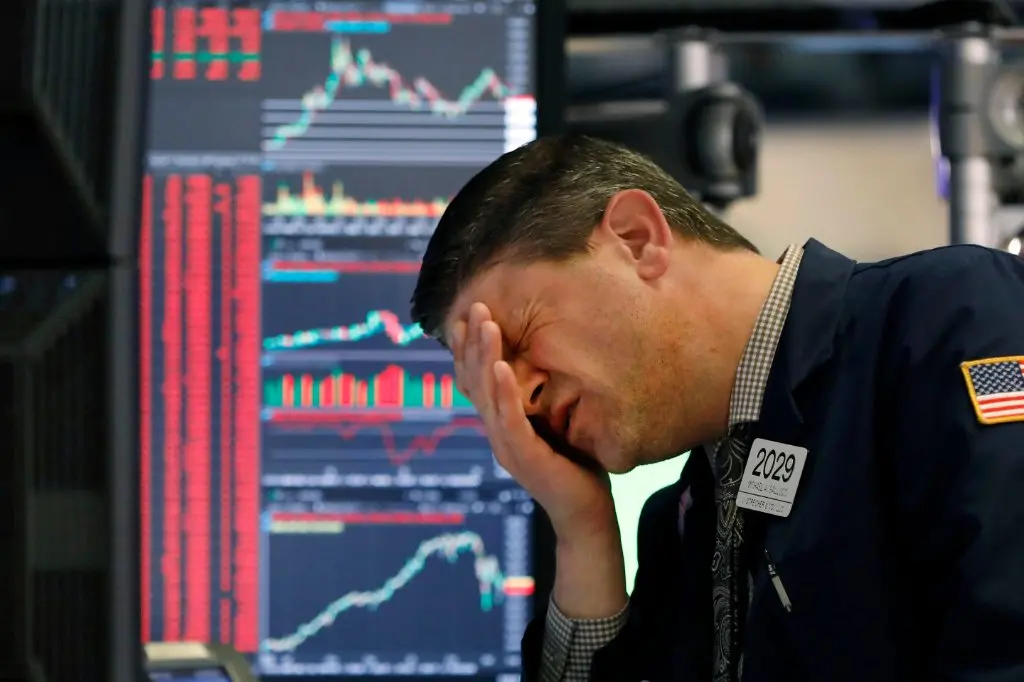
Bloomberg reviews the U.S. stock sell-off: retail investors sold first, followed by hedge funds and institutions, with mechanical reduction of positions intensifying the sell-off

According to Bloomberg, Wall Street's reaction to the U.S. midterm elections shifted from positive to negative in about 24 hours. The sell-off on Thursday spread from retail investors to hedge funds, long-only asset management firms, and quantitative strategies, causing a loss of approximately $3.7 trillion in market value for U.S. stocks in a single day, with the Nasdaq 100 index recording its largest drop since March 2020. Initially, the stock market rose after the elections due to the reduction of event risk and a decline in oil prices, but investors later reassessed the risks of Democratic scrutiny on data center expansion.In the first half hour after the market opened on Thursday, retail investors were the first to sell for profit, followed by hedge funds and long-only firms. Data from Vanda Research shows that the net selling scale of retail investors on that day was second only to two days during the pandemic shock in March 2020. Its strategist Viraj Patel pointed out that while retail and systematic investors were actively selling, institutional buyers chose to step back. The decline subsequently triggered mechanical selling, with Nomura strategist Charlie McElligott estimating that based on the negative gamma exposure during Thursday's trading, for every 1% drop in the market, options market makers would generate an additional selling pressure of about $7 billion.Volatility control funds estimated that they needed to reduce their holdings by about $61 billion in stocks based on market changes at the time, with about $25 billion in sales still being executed on Wednesday. The rebalancing of leveraged ETFs is expected to bring about an additional $47 billion in stock sales. Vanda estimated that commodity trading advisors sold about $13 billion in S&P 500 and Nasdaq futures. Goldman Sachs' prime brokerage trading desk estimated that fundamental long-short funds lost about 1.3% on Thursday, while technology-themed funds fell over 4%. The basket of stocks in storage, optical networks, data centers, and AI semiconductors dropped by 12% to 15% that day, and the VIX index rose from 16.6 points at the opening to nearly 28 points at the close.

first_img Cboe is exploring the launch of VIX perpetual futures, still in the early stages

According to CoinDesk, Cboe is exploring the launch of perpetual futures linked to the VIX index, which is still in the early stages, with no contract specifications yet and no filing documents submitted. This news comes from Bloomberg.The VIX index measures the expected volatility over the next 30 days as reflected by the pricing of S&P 500 options. As investors buy options to hedge against sharp market declines, the demand for options during downturns surges, thereby raising the index, which is why it is regarded as Wall Street's "fear gauge." Perpetual futures were first proposed by economist Robert Shiller in 1993 and were subsequently commercialized by the cryptocurrency industry.A mature derivatives ecosystem has already formed around the VIX, covering futures, options, and exchange-traded products tracking the index. However, futures come with expiration dates, and when contracts terminate, traders must roll over their positions or shift their bets to the next available contract. This rolling operation is costly and erodes returns, which was a major criticism faced by Bitcoin futures ETFs when they debuted at the end of 2021.In contrast, perpetual swaps never settle and instead anchor contract prices to the spot index through a funding rate mechanism, theoretically providing investors with the closest investment channel to the actual VIX spot price. Martin Lee, Head of Market Insights at DWF Labs, told CoinDesk that traders do not need to worry about expiration and value decay, as they can focus solely on assessing the direction of the underlying asset. He expects a strong trend of "perpetualization" to emerge in the coming months.

first_img Bitcoin VIX perpetual contracts launched on Hyperliquid, supporting direct long or short volatility

According to CoinDesk, the Bitcoin Volatility Index BVIV's perpetual contract was launched on Hyperliquid on Monday, allowing traders to bet on the magnitude of Bitcoin price fluctuations rather than the direction directly on the on-chain exchange. The BVIV index is often referred to as the "Bitcoin VIX," which tracks the expected implied volatility of the cryptocurrency over the next 30 days in real-time, similar to the Chicago Board Options Exchange VIX index that tracks the implied volatility of the S&P 500 index.The newly launched perpetual market allows traders to directly go long or short on the volatility index without needing to express their volatility views indirectly through costly options tools that require derivative expertise. The perpetual contract uses USDC as collateral and pricing asset, initially supporting up to 5x leverage. The Seda oracle infrastructure is responsible for connecting the Volmex index to the Markets exchange on-chain.Cole Kennelly, founder and CEO of Volmex Labs, stated that the launch of the BVIV index perpetual contract on Hyperliquid provides crypto traders with a convenient tool for volatility hedging and speculation. This launch is led by the on-chain perpetual contract platform Markets by Kinetiq based on Hyperliquid, in collaboration with Volmex and Perps.inc, marking the first joint deployment of the three parties and the first time the Volmex Bitcoin Volatility Index has gained access to an on-chain perpetual contract market. Hyperliquid is the world's largest decentralized perpetual contract exchange, with an average daily trading volume of several billion dollars and a fully diluted valuation of over $90 billion.
The on-chain perpetual contract protocol Travix has completed its seed round financing, with participation from Amber Group

Recently, the on-chain perpetual contract protocol Travix, which focuses on computing power asset trading, completed its seed round financing. The disclosed investor in this round is Amber Group, but the financing amount has not been disclosed. The funds will be used to accelerate the deep construction of perpetual contracts for computing power assets and exotic assets such as East Asian stocks, expand trading pairs for Compute-Led RWA like chips and storage, promote the development of the "Financial World Model," deepen the development and deployment of a trusted AI agent trading engine, and expand global markets and multilateral ecological construction as well as launch trading promotion incentive programs.It is reported that Travix is a new generation PerpDEX protocol built on a modular blockchain architecture, adopting a hybrid architecture of offline high-performance matching and on-chain settlement, achieving millisecond-level processing efficiency, and introducing a unified account management model. Its core directions include: perpetual contracts for computing power assets, supporting hardware asset trading such as H100 chips and storage; the Financial World Model, which transforms probabilistic events such as policy implementation and product launches into quantifiable event trading signals; and trusted AI agent trading, supporting users in deploying automated strategies through the Agent Engine.Travix claims that its goal is to achieve the integration of computing power assets, probabilistic trading, and trusted agents, creating a new generation of decentralized perpetual contract entry point where "trading is understanding the world."

Analysis: The VIX curve is rising, and anxiety in the stock market is increasing as the U.S. midterm elections approach

Although Nvidia's upcoming earnings report and Federal Reserve Chairman Waller's speech at the Jackson Hole annual meeting are the main events of interest for investors this week, traders in the stock derivatives market have already begun preparing for potential volatility increases around the November U.S. midterm elections.Traders focused on volatility in the futures market linked to the VIX index have noted signs indicating that demand for hedging S&P 500 index volatility has increased before and after the elections. VIX futures expiring in September are currently trading at around 17.4, but October contracts have risen to 19, and November contracts have further increased to 19.7.Matthew Thompson, co-portfolio manager at Little Harbor Advisors, stated, "The U.S. elections are approaching, and you are entering a time window where the elections will impact the VIX. You can already see this 'backwardation' in the term structure of VIX futures."A study by analysts at the Chicago Board Options Exchange Global Markets shows that since 1945, in 80% of midterm election years, actual volatility has been higher than the previous year, with an average increase of 3.5 volatility points. In years when both the White House and Congress are controlled by the same party, actual volatility increases by an average of 6 volatility points.
app_icon
ChainCatcher Building the Web3 world with innovations.