Scan to download
BTC $79,086.74 -2.81%
ETH $2,223.31 -3.29%
BNB $673.10 -1.15%
XRP $1.43 -7.00%
SOL $89.53 -4.12%
TRX $0.3519 -0.75%
DOGE $0.1130 -2.86%
ADA $0.2609 -5.28%
BCH $426.07 -2.77%
LINK $10.07 -5.68%
HYPE $44.82 +1.00%
AAVE $93.10 -6.87%
SUI $1.10 -9.07%
XLM $0.1545 -6.75%
ZEC $522.37 -1.97%
BTC $79,086.74 -2.81%
ETH $2,223.31 -3.29%
BNB $673.10 -1.15%
XRP $1.43 -7.00%
SOL $89.53 -4.12%
TRX $0.3519 -0.75%
DOGE $0.1130 -2.86%
ADA $0.2609 -5.28%
BCH $426.07 -2.77%
LINK $10.07 -5.68%
HYPE $44.82 +1.00%
AAVE $93.10 -6.87%
SUI $1.10 -9.07%
XLM $0.1545 -6.75%
ZEC $522.37 -1.97%

gho

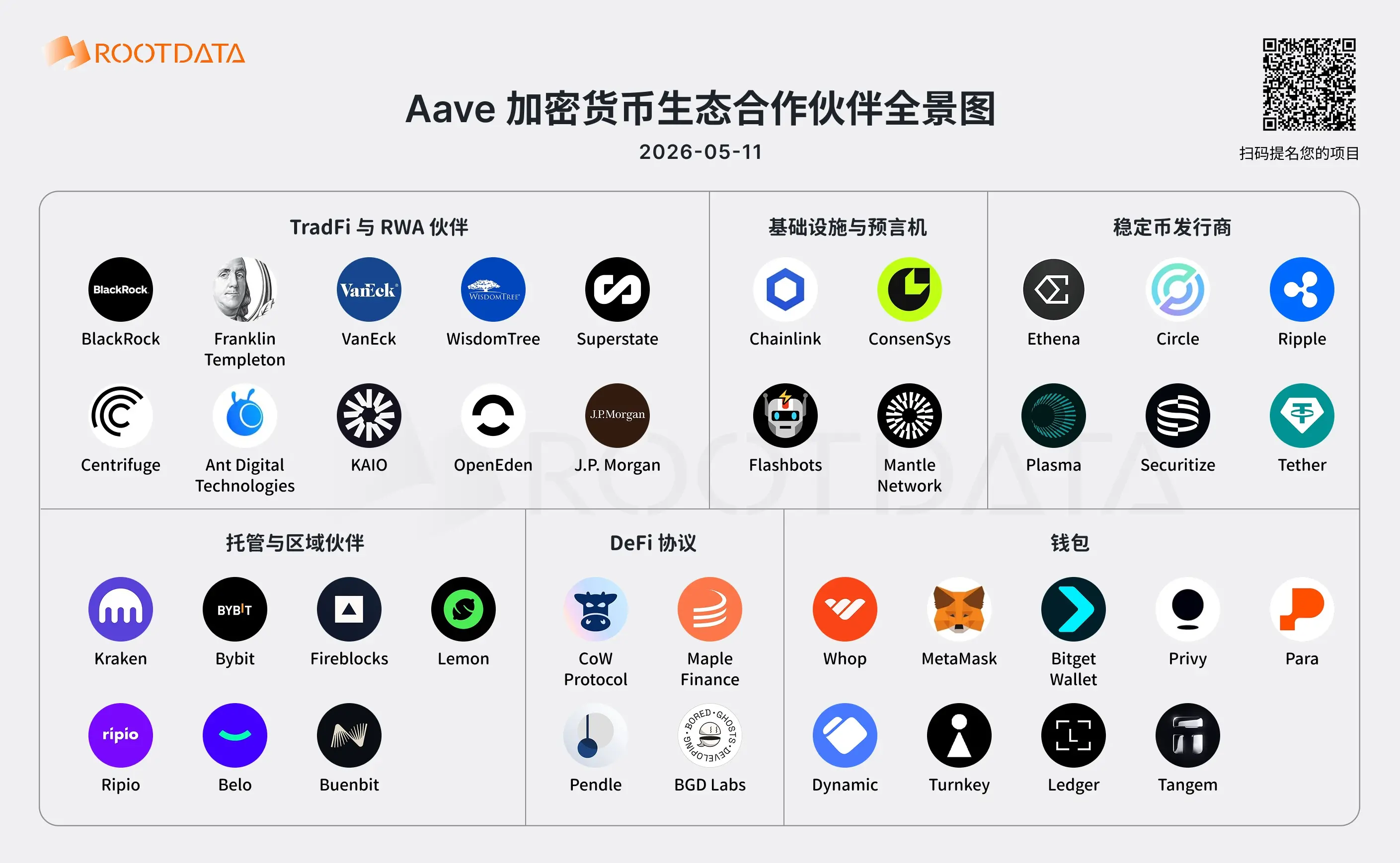
Illustration of Aave's 40 Web3 Business Partners: Defining the On-Chain Dollar Interest Rate Market

The Web3 asset data platform RootData has outlined 40 partners of Aave, covering multiple layers such as TradFi/RWA, stablecoins, infrastructure, wallets, DeFi protocols, exchanges, and custody. From its early focus on the lending efficiency of crypto assets to competing for on-chain dollar liquidity after the launch of GHO, Aave seems to be defining an interest rate system for on-chain dollars. At the TradFi and RWA layer, institutions like BlackRock, Franklin Templeton, VanEck, and JPMorgan are prominently featured, along with RWA platforms such as Centrifuge, OpenEden, and Securitize, indicating that Aave is no longer satisfied with lending native crypto assets but is attempting to meet the financing needs of real-world assets on-chain. At the stablecoin layer, partners like Circle, Tether, Ethena, Ripple, and Plasma suggest that Aave is competing for the on-chain "dollar liquidity" entry point. Whoever controls stablecoin deposits is closer to on-chain interest rate pricing power. At the infrastructure layer, partners like Chainlink, ConsenSys, Flashbots, and Mantle provide Aave with price oracles, MEV optimization, and multi-chain expansion capabilities. At the user distribution layer, wallet partners like MetaMask, Ledger, Bitget Wallet, Privy, and Turnkey are lowering the entry barriers for users; meanwhile, institutional channels like Kraken, Bybit, and Fireblocks further amplify the capital entry points. DeFi protocols such as Pendle, Maple Finance, and CoW Swap extend Aave's liquidity into fixed income, institutional lending, and trading scenarios. The recent rsETH/Kelp risk event caused Aave's TVL to drop from a peak of $44 billion to $15 billion, once again testing the risk management capabilities of this established DeFi protocol. Related collection: Aave Web3 Partner Network Collection (continuously updated) Cryptocurrency projects actively showcasing their partner networks have become a key way to enhance transparency and market trust. It is reported that RootData welcomes Web3 projects to claim their information and continues to track and open more project business relationship disclosure channels. The platform has released multiple editions of crypto project ecosystem maps, nominating Web3 ecosystem partners for upstream clients like Visa, Mastercard, and Coinbase. If you wish to nominate your project in future ecosystem maps, please fill out the [RootData 2026 Industry Ecosystem Mapping] form to supplement your important clients and partners.
Illustration of Aave's 40 Web3 Business Partners: Defining the On-Chain Dollar Interest Rate Market

Coinbase announces 2025 financial report: Q4 under pressure with a net loss of $667 million, strong performance throughout the year setting multiple new highs

Coinbase released its Q4 and full-year financial report for 2025. Despite the overall downturn in the crypto market, Coinbase achieved several historical highs, with trading volume and market share doubling, although Q4 revenue slightly missed expectations and recorded a net loss.In Q4, Coinbase reported a net loss of $667 million, with a loss per share of $2.49, far exceeding analyst expectations. Total revenue was $1.78 billion, a decrease of 5% quarter-over-quarter and approximately 22% year-over-year, falling short of market expectations of $1.83 billion to $1.85 billion. Adjusted earnings per share were $0.66, with adjusted net income of $178 million and adjusted EBITDA of $566 million.Q4 was challenging for Coinbase, but the full-year performance was strong, with total trading volume reaching $5.2 trillion, a year-over-year increase of 156%. The crypto trading market share doubled to approximately 6.4%, and subscription and service revenue grew by 23% to about $2.8 billion. The number of Coinbase One paid subscribers approached 1 million, and platform assets and USDC balances reached all-time highs.Coinbase stated that it is advancing its "Everything Exchange" strategy, which includes the expansion of derivatives and stablecoin payments. Despite short-term pressures from the bear market, Coinbase still views 2025 as a strong year and remains optimistic about product innovation and market recovery in 2026.

In 2025, the global gold demand exceeded 5,000 tons for the first time, with gold prices reaching new highs 53 times throughout the year

The World Gold Council today released the "Global Gold Demand Trends Q4 2025 and Full Year Report," indicating that global gold demand and gold prices have both set records. In 2025, total global gold demand (including over-the-counter transactions) surpassed 5,000 tons for the first time. Coupled with the strong trend of gold prices repeatedly breaking records throughout the year—53 new highs in total—the total value of global gold demand soared to an unprecedented $555 billion, a year-on-year increase of 45%.Overall gold demand in 2025 grew: global gold ETF holdings increased by 801 tons, marking the second-highest annual increase in history; purchases of gold bars and coins accelerated, reaching a 12-year peak. In 2025, global central bank gold purchases reached 863 tons, hitting the upper limit of the expected range; the scale of gold purchases remains at historical highs, with a wide distribution among purchasing central banks, although the pace of central bank gold purchases has slowed compared to the past three years.Against the backdrop of continuously breaking historical records in gold prices, gold jewelry demand declined in 2025, but the total value of global gold jewelry demand still grew by 18% year-on-year, reaching a record $172 billion, indicating that global consumer interest in gold jewelry has not waned. Benefiting from the sustained growth of applications related to artificial intelligence, demand for gold in technology remained stable in 2025.Looking ahead to 2026, as geopolitical tensions continue to escalate, the World Gold Council expects that gold ETFs will continue to see strong inflows, and demand for gold bars and coins will remain robust, supported by ongoing significant gold purchases by global central banks. In an environment where gold prices remain high for the long term, jewelry demand is expected to remain under pressure.
2026-01-29

Slow Fog Annual Security Report: Total losses from security incidents throughout the year amount to approximately $2.935 billion

According to incomplete statistics from Slow Fog Blockchain, there were a total of 200 security incidents throughout the year, resulting in losses of approximately $2.935 billion. Compared to 2024 (410 incidents, losses of about $2.013 billion), although the number of incidents has significantly decreased, the amount of losses has increased by about 46% year-on-year.From an ecological distribution perspective, Ethereum remains the most frequently attacked and severely impacted ecosystem, with losses of approximately $254 million for the year, significantly leading the proportion; BSC follows closely with related losses of about $21.93 million; Solana ranks third, with annual losses of about $17.45 million.By project track classification, DeFi projects are the most frequently attacked area: in 2025, there were a total of 126 security incidents, accounting for about 63% of the annual total, resulting in losses of approximately $649 million, a decrease of about 37% compared to 2024 (339 incidents, losses of $1.029 billion). There were only 12 incidents on trading platforms, yet they caused losses as high as $1.809 billion, with Bybit alone suffering a loss of about $1.46 billion, making it the most severe incident of the year.In terms of the reasons for the attacks, contract vulnerabilities were the main cause, with a total of 61 incidents; followed closely by hacked X accounts, with a total of 48 incidents.The report points out that with the accelerated popularization of generative AI over the past two years, attackers have also begun to incorporate it into their scams and attack chains. Compared to traditional tools, AI's capabilities in text, voice synthesis, image, and video generation have significantly reduced the cost of scams. Attacks no longer rely on crude scripts or obviously abnormal behaviors, but instead use highly realistic content, coherent interactions, and precise target selection, making it psychologically more difficult for victims to detect risks.
app_icon
ChainCatcher Building the Web3 world with innovations.