BTC $83,315.99 -1.68%
ETH $2,672.29 -0.67%
BNB $764.43 -1.76%
XRP $1.48 -3.39%
SOL $118.15 -4.04%
TRX $0.3361 +0.71%
DOGE $0.0932 -4.15%
ADA $0.2442 -4.51%
BCH $307.07 -8.28%
LINK $14.94 +5.99%
HYPE $87.71 -4.49%
AAVE $146.57 -5.53%
SUI $1.14 -9.13%
XLM $0.2277 +5.04%
ZEC $1,456.93 -9.51%
AAPL $338.31 -0.61%
AMZN $246.23 -1.60%
GOOGL $342.19 -0.62%
MSFT $509.48 -1.55%
META $717.13 -4.26%
NVDA $228.61 +1.40%
TSLA $358.45 -4.01%
SNDK $1,711.08 -4.09%
INTC $115.89 -7.85%
SPCX $146.52 -1.59%
MU $1,054.24 -3.93%
AMD $606.77 -4.37%
BTC $83,315.99 -1.68%
ETH $2,672.29 -0.67%
BNB $764.43 -1.76%
XRP $1.48 -3.39%
SOL $118.15 -4.04%
TRX $0.3361 +0.71%
DOGE $0.0932 -4.15%
ADA $0.2442 -4.51%
BCH $307.07 -8.28%
LINK $14.94 +5.99%
HYPE $87.71 -4.49%
AAVE $146.57 -5.53%
SUI $1.14 -9.13%
XLM $0.2277 +5.04%
ZEC $1,456.93 -9.51%
AAPL $338.31 -0.61%
AMZN $246.23 -1.60%
GOOGL $342.19 -0.62%
MSFT $509.48 -1.55%
META $717.13 -4.26%
NVDA $228.61 +1.40%
TSLA $358.45 -4.01%
SNDK $1,711.08 -4.09%
INTC $115.89 -7.85%
SPCX $146.52 -1.59%
MU $1,054.24 -3.93%
AMD $606.77 -4.37%

pricing

All
Article
Flash

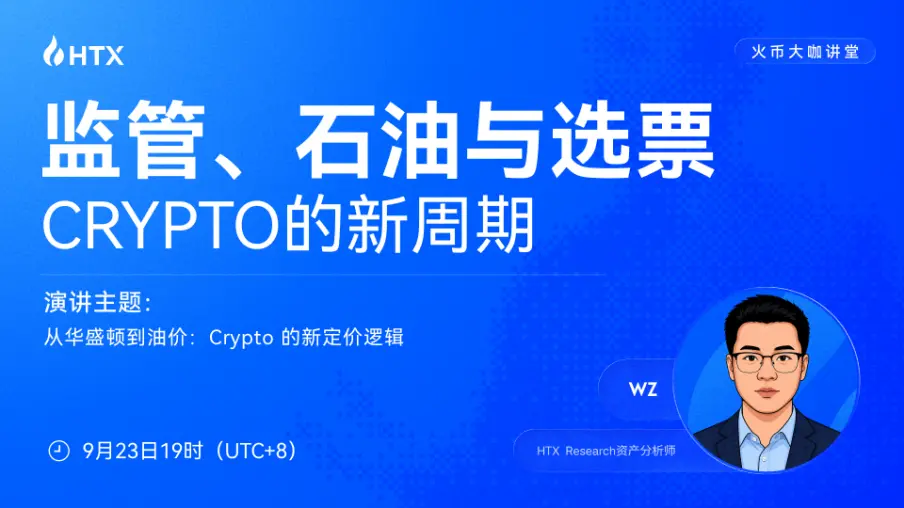
HTX Research Analyst WZ: The pricing of the cryptocurrency market is extending outward, with regulation and macro liquidity becoming key variables

In the seventh live broadcast of the Huobi Expert Lecture, HTX Research asset analyst WZ pointed out that in the past, people were accustomed to explaining Crypto with Crypto, but today, the variables that determine the next phase of Crypto are increasingly occurring outside of Crypto. This marks a new pricing cycle that Crypto is entering.On the policy level, WZ believes that although the Clarity Act, which has systematic characteristics, is hindered in the Senate due to the need to secure bipartisan votes and issues involving the Trump family's interests and stablecoin profit distribution, U.S. crypto regulation has not stalled. For instance, the SEC recently released an "innovation exemption" plan that allows compliant institutions meeting certain conditions to tokenize specific stocks, accelerating the integration of traditional finance and crypto.On the macro level, WZ stated that the situation in the Middle East and the blockage risk in the Strait of Hormuz have raised the "risk premium" of crude oil. Rising oil prices can trigger inflation expectations, which in turn affect U.S. Treasury yields and global liquidity. When energy prices remain high and interest rates stay elevated, the upward potential for risk assets like Bitcoin may be constrained.WZ also pointed out that in this cycle, the direct inflow and outflow of ETF funds have changed the traditional logic of capital overflow, making a "general rise" pattern for altcoins difficult to achieve. However, in the new cycle, assets with a "new narrative" and strong consensus will still experience independent upward trends.

The CFTC warns that event contract markets have an obligation to display clear and accurate derivative pricing information

The U.S. Commodity Futures Trading Commission (CFTC) issued a notice reminding regulated entities involved in the listing, promotion, or acceptance of event contracts to ensure that consumers are provided with clear and accurate product pricing information, avoiding misleading market participants, including the obligation to display clear and accurate derivative pricing information.The CFTC's Market Oversight and Market Participants divisions stated that registered entities and relevant personnel must comply with regulatory requirements, ensuring that users fully understand the product attributes in the CFTC-regulated market, and strengthen the supervision of information disclosure by intermediaries, related parties, and partners. It was also specifically pointed out that displaying event contract prices using the common "American odds format" may mislead traders' understanding of the product nature and prevent users from fully obtaining key trading information such as market depth and price impact.The CFTC requires that market participants clearly show consumers that the products are event contracts on CFTC-regulated exchanges, and any misleading pricing display behavior related to regulated products may violate relevant provisions of U.S. federal law regarding the prohibition of manipulative trading practices.

Trade.xyz announces full compensation for the abnormal liquidation event of the Hynix contract and accelerates the reform of the pricing mechanism

Trade.xyz issued a statement regarding the SK Hynix contract price spike incident: On July 27 at 23:01 UTC, the marked price of SK Hynix tokens plummeted from $1,127.9 to $917.25, triggering a large number of long position liquidations. This price originated from an actual transaction captured by multiple independent data providers, with the external venue being a major pre-market in South Korea. Its oracle system operates according to established specifications, synchronously tracking prices from external exchanges, functioning "as designed" on a technical level.However, the platform acknowledges that user dissatisfaction with the liquidations triggered by this event is understandable, emphasizing that "market integrity is the core value of Trade.xyz." To address this, Trade.xyz has decided to cover all liquidation losses caused by this price anomaly on a one-time discretionary basis. Specific eligibility requirements will be announced soon, with compensation expected to be completed within a few days, but it clearly states that this decision "does not constitute a guarantee for similar situations in the future." At the mechanism level, the platform will accelerate the review of pricing methods— including reassessing the assumptions of reliance on external venues and giving greater weight to its own order book price discovery (its order book depth and signal strength have significantly improved compared to external sources) to more effectively handle tail events.

RootData: The trading volume of perpetual contracts for exchange stocks dropped by nearly 90% over the weekend, but participation in stock expected pricing remains

According to data from RootData's stock perpetual contract exchange rankings, nearly 30 exchanges that have launched stock perpetual contracts still significantly adhere to the trading rhythm of traditional stock markets: trading volume drops sharply on weekends, and the morning session on Monday warms up as the traditional market approaches recovery, but has not yet returned to the intensity of a full trading day.Comparing trading days with non-trading days, the 24h trading volume of stock perpetual contracts dropped from approximately $39.078 billion to $4.896 billion, a decrease of about 87.5%. However, during the same period, the open interest slightly increased from $10.139 billion to $10.262 billion, indicating that positions have not been withdrawn on a large scale; what has truly decreased is active trading and turnover. A snapshot taken on the morning of Monday, July 27, shows that the 24h trading volume rebounded to $10.617 billion, an increase of about 116.8% compared to Sunday, indicating that market activity is recovering.In terms of liquidity, the weighted market depth (±2%) decreased from approximately $58.92 million to about $47.83 million, a decline of about 18.8%; it rebounded to around $55.68 million on Monday morning, nearing trading day levels. This indicates that the speed of order book recovery is faster than that of actual trading recovery, and market depth has not plummeted as sharply as trading volume.From the performance of exchanges, leading platforms such as Binance, OKX, and Bitget maintained relatively narrow spreads and strong depth on Monday morning; Hyperliquid performed well in rankings, but its trading volume was still below trading day levels; some long-tail platforms still face issues with excessively wide spreads, making it temporarily impossible to assess true liquidity.RootData Research believes that the most prominent value of these stock perpetual contract exchanges is to allow stock risks to be traded, priced, and hedged even on non-trading days of the traditional stock market. The traditional stock market is closed on weekends, with official prices remaining at the previous trading day's closing price, while stock perpetual contract exchanges still have trading, open interest, order books, and spreads on Sundays, indicating that crypto exchanges have broken through the "trading time" limitations of stocks.However, from the current data, they are participating in expected pricing rather than official pricing, making them more suitable for expressing events, emotions, macroeconomic changes, and risk preference shifts on non-trading days. Due to decreased trading volume over the weekend, widened spreads, and some platforms having abnormal data metrics, they currently resemble a "stock pre-opening price discovery layer," having participated in stock pricing but not yet obtaining the primary pricing power of the traditional stock market, nor have they surpassed the liquidity of the traditional stock market.

hot_img Academy of Social Sciences Expert: Changxin Technology's overseas on-chain transactions may weaken the domestic capital market's dominance in pricing technology assets

According to Caixin, Zhao Yao, a special researcher at the Payment and Clearing Research Center of the Financial Research Institute of the Chinese Academy of Social Sciences, stated that recent offshore digital asset platforms have launched on-chain trading products around Chinese technology companies such as Changxin Technology. This indicates that global digital financial platforms are creating trading exposure around high-quality Chinese technology assets, organizing price expectations, trading liquidity, and cross-border capital entry in advance. Although these products do not correspond to A-share equity, they are synthetic perpetual contracts or pre-market perpetual contracts settled in stablecoins such as USDC and USDT. However, if offshore platforms take the lead in forming a continuous trading market for technology assets, it may weaken the pricing dominance of domestic capital markets over technology assets.Zhao Yao suggested accelerating the construction of digital financial infrastructure for the renminbi, promoting the coordinated development of tokenized deposits by commercial banks, wholesale CBDC, and tokenization of technology assets, and exploring pilot projects for technology asset tokenization in Hong Kong to enhance the capital organization capability and international pricing power of the renminbi in global technology financial competition.
app_icon
ChainCatcher Building the Web3 world with innovations.