Crowded, Confused, Misstepped: Multiple Extreme Signals Emerge in the Global Market
 Core Viewpoint


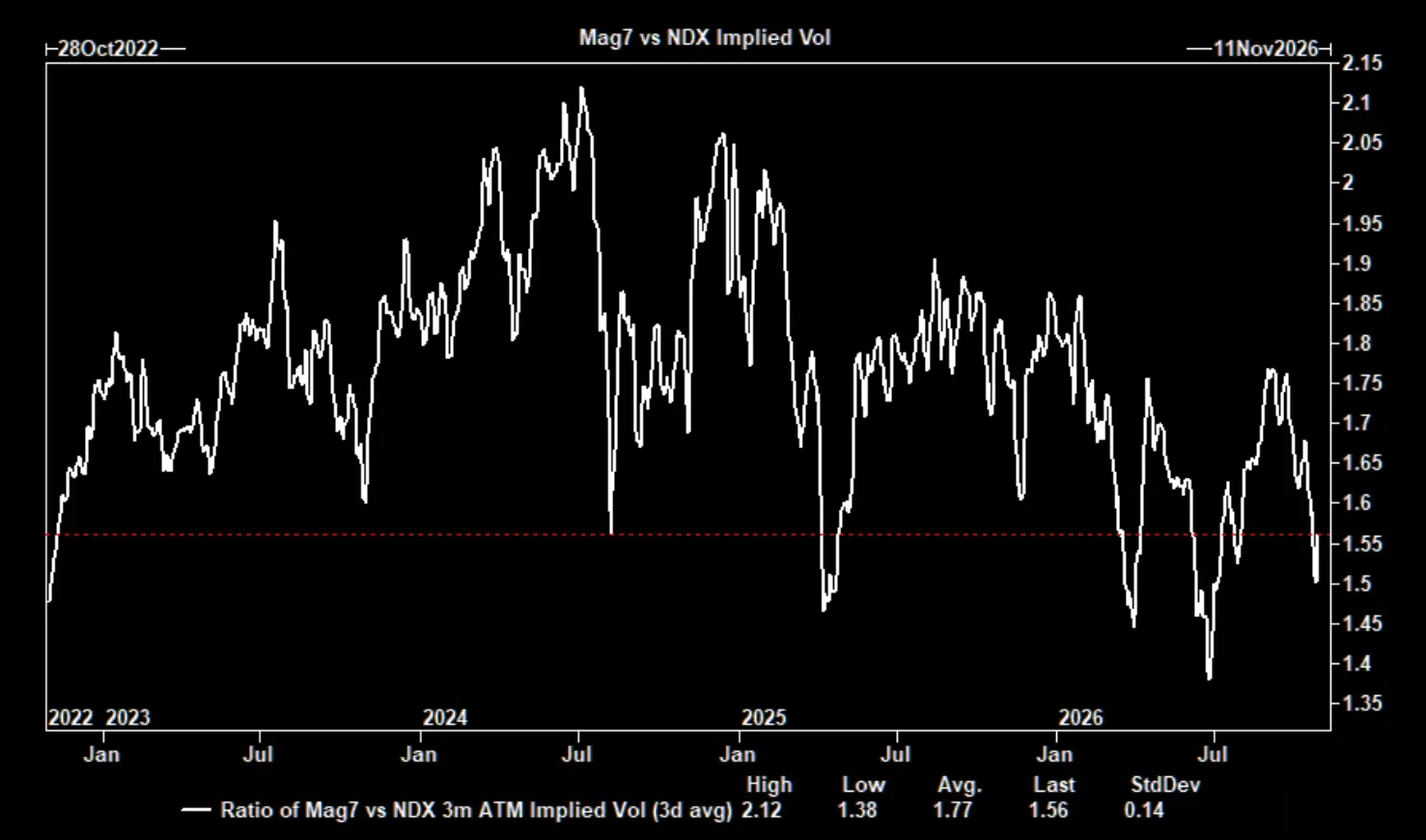
 The global market is simultaneously releasing multidimensional extreme signals: the implied volatility of Mag 7 has reached a four-year low, with hedge funds pushing their exposure to the historical 97th percentile; momentum strategies have dropped from extreme overcrowding to nearly zero within months; the South Korean stock market is experiencing a technical rebound after extreme overselling; the profit margin in the U.S. housing market has fallen below pre-pandemic levels; Brazil's debt trajectory may be subject to forced correction. This is not a singular risk, but a structural stress test across assets.
Current global markets are synchronously experiencing extreme signals across multiple dimensions, and Wall Street investors are facing not just a single risk, but a structural stress test across assets.
The implied volatility of the Magnificent 7 is exceptionally low relative to the overall technology sector, while hedge funds' exposure to these AI giants is nearing historical peaks; meanwhile, momentum strategy positions have been nearly completely dismantled, the South Korean stock market has rebounded from extreme undervaluation, and the fundamentals of the U.S. housing market continue to deteriorate. These signals are not isolated but have emerged simultaneously within the same time window.
What further unsettles the market is that the extreme phenomena reflect pricing chaos and position divergence—hedge funds and mutual funds have nearly opposite positions on the Magnificent 7, and the momentum strategy has gone from crowded to desolate in just a few months. Brazil's fiscal risks add another layer of concern to this already complex picture.
Magnificent 7 Volatility: Pricing Anomalies and Extreme Positions Coexist
The implied volatility of the Magnificent 7 is currently trading at a significant discount relative to the overall technology sector. According to Goldman Sachs data, this relative volatility ratio is only at the 15th percentile of the past four years, indicating that Magnificent 7 options are in an unusually cheap range compared to other tech stocks.
At the same time, although the implied volatility spread between the Nasdaq 100 index and the S&P 500 index compressed significantly last week—the largest three-day compression in four years—the one-month at-the-money option spread remains at the 94th percentile, indicating that technology sector volatility is still at historically high levels relative to the broader market.
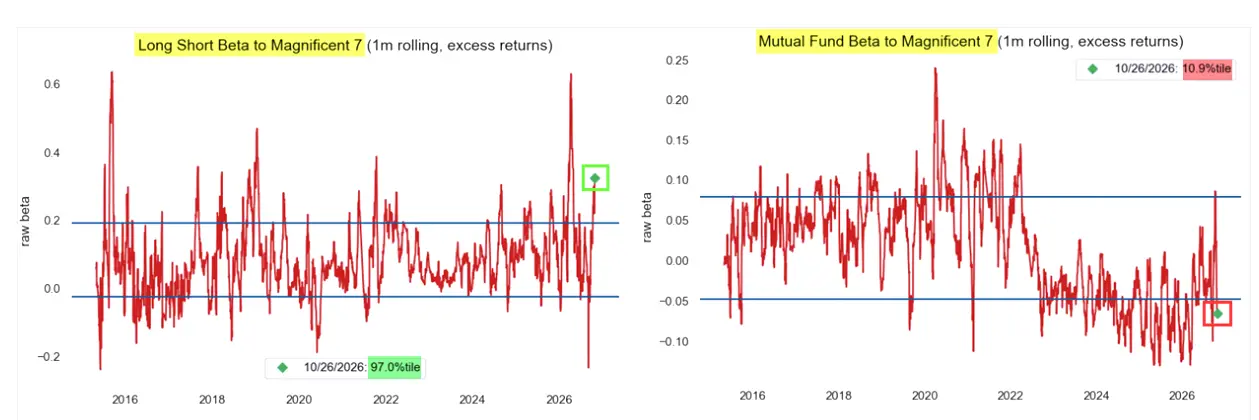
The divergence in positions is also extreme. Nomura strategist McElligott points out that the rolling beta of long-short hedge funds on the Magnificent 7 has risen to the 97th percentile historically, while mutual funds' beta exposure is only at the 11th percentile. Hedge funds are heavily invested in AI giants, while traditional long-term managers are structurally underweight—within the same group of stocks, there exist two completely different positioning realities.
Momentum Strategy: From Crowded to Desolate
The current dismantling of momentum strategies is not a typical position adjustment. Data from Goldman Sachs' prime brokerage shows that the momentum exposure of fundamental long-short strategies has plummeted from nearly 70% at its peak to about 15%, completing a transition from extreme crowding to near-empty in just a few months.
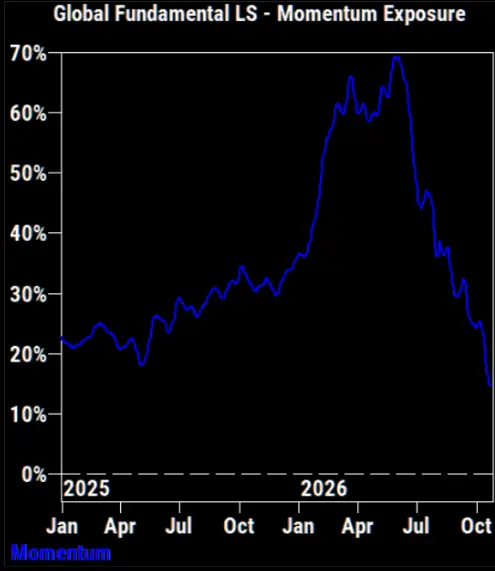
The speed and magnitude of this collapse are rare, indicating that the concentrated holdings in the momentum factor have undergone a systemic cleansing rather than a gradual risk rebalancing.
South Korean Stock Market: Technical Rebound After Extreme Undervaluation
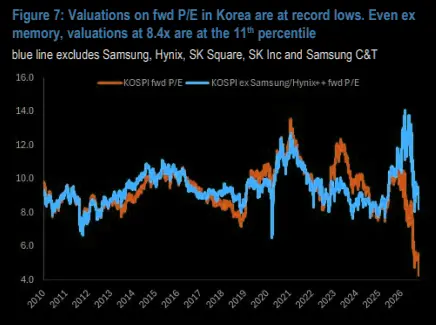
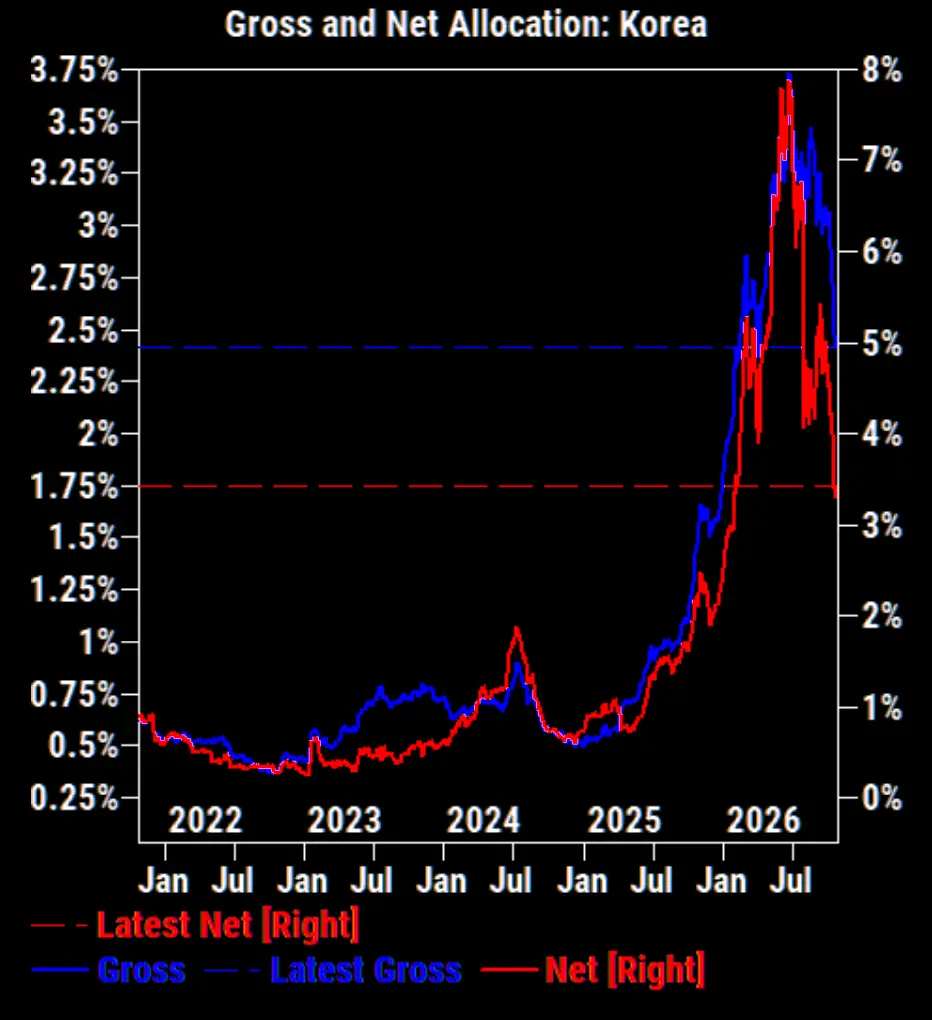
The South Korean stock market had previously fallen to an extreme valuation range. According to JPMorgan data, even excluding the leading memory chip manufacturers, the forward price-to-earnings ratio of the KOSPI is only 8.4 times, at the 11th percentile historically; the RSI indicator has dropped to its lowest level since "Liberation Day," with the number of oversold stocks reaching extreme levels.
Position data also corroborates this judgment. According to Goldman Sachs data, the net allocation ratio in the South Korean market has fallen to 3.4% (29th percentile over one year, 86th percentile over five years), and the total allocation ratio has dropped to 2.4% (30th percentile over one year, 86th percentile over five years). JPMorgan accurately captured this phase low in its report on October 20, suggesting that the combination of valuation and technical factors is becoming "increasingly attractive."
U.S. Housing: Dual Pressure from Demand and Profit Margins
The pressure in the U.S. housing market has spread from the demand side to the supply side. According to TS Lombard data, homebuilders' operating profit margins have fallen below pre-COVID levels, with weakening new home prices and rising costs for construction, labor, and financing creating a dual squeeze, leading builders to face profit erosion from both sides.
The demand side is also not optimistic. Mortgage rates have returned to around 7.3%, and U.S. housing affordability remains near historical lows. TS Lombard warns that if the Federal Reserve maintains a hawkish stance, interest rates may face further upward pressure, continuing to suppress homebuying demand. Their conclusion is quite straightforward: merely relying on falling home prices may not be enough to attract buyers back to the market.
Brazil: Debt Trajectory and Fiscal Cliff
Brazil's fiscal pressures are accumulating to a level that is unsettling the market. According to TS Lombard data, Brazil's debt-to-GDP ratio has risen from 71.7% when Lula took office in 2023 to 81.9%, and if the current policy path is maintained, this ratio could approach 118% by 2036. The elections are over, but the real test is just beginning: how to convince investors that Brazil has the capacity to stabilize its debt trajectory.
TS Lombard further warns that without substantial fiscal reform, Brazil may face the risk of partial government shutdowns by 2028. Mandatory spending is gradually crowding out discretionary fiscal space, and available funds may fall below the minimum threshold required for the government to operate normally. Their conclusion is quite severe: Brazil's next round of fiscal adjustment may not stem from political will but rather be compelled by mathematical logic.
 Risk warning
 Risk warning





Popular articles