Microsoft Conference Call: It is expected that Azure revenue will grow by up to 50% this fiscal quarter, while capital expenditures are constrained by "third-party delays."
 Core Viewpoint


 Microsoft's Q1 revenue for the fiscal year 2027 increased by 19% year-on-year to $92.28 billion, with Azure growth at 48% and guidance for the next quarter at 49%-50%; the CFO stated that delays in third-party capacity delivery have affected capital expenditures, with Q2 capital expenditures expected to exceed $50 billion and approximately $170 billion for the entire year.
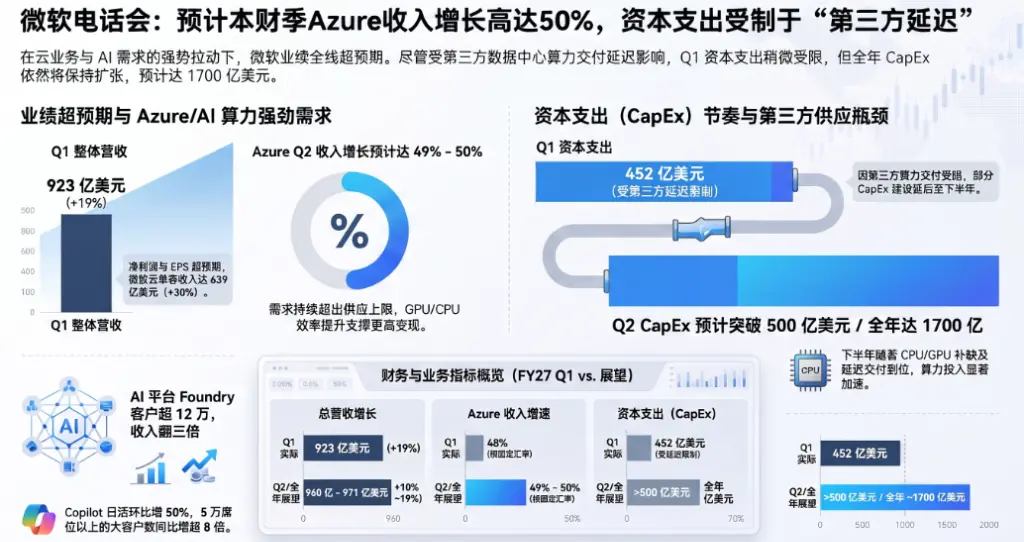
According to Wall Street News, after the U.S. stock market closed on Wednesday, the 28th, Microsoft announced its fiscal year 2027 first quarter earnings report, with revenue increasing by 19% year-over-year to $92.28 billion, exceeding analysts' expectations by 1.8%.
Microsoft's cloud service Azure saw a revenue growth rate of 48% this quarter, surpassing market expectations, and the guidance for the next quarter has been raised to a fixed exchange rate growth rate of 49% to 50%.
During the conference call, the company's management pointed out that efficiency improvements were the key variable behind Azure's strong performance this quarter. Chief Financial Officer Amy Hood explained that the engineering team has continuously explored efficiency gains at the GPU and CPU levels, allowing Microsoft to allocate more computing power, which was originally constrained by supply, to the Foundry platform.
Additionally, Amy Hood admitted that the token pricing this quarter was higher than expected, and high-quality models brought in higher revenue per token, contributing extra to the quarterly performance.
Microsoft CEO Satya Nadella emphasized that the Foundry platform has become the commercialization hub of Microsoft's AI strategy. Satya Nadella noted that enterprise customers' AI deployments are shifting from the experimental phase to production deployment, with the focus moving from "the next technological highlight" to "whether we can build stable systems, control model weights, manage costs, and ensure security."
He compared the current pace of enterprise AI workload implementation to the historical process of large-scale database application deployments in enterprises, stating:
This is a ten-year dimension, not just a phenomenon of a few quarters.
This quarter, capital expenditures reached $45.2 billion, lower than previously expected, due to delays in the delivery of some third-party computing power to the second half of the year. Amy Hood expects capital expenditures in the second quarter to exceed $50 billion, totaling about $170 billion for the year, with further acceleration in the second half, focusing on CPUs (including higher specifications for memory and storage) and GPUs, as well as delayed third-party computing power deliveries.
Amy Hood expressed confidence in the returns on every dollar of capital expenditure and expects to maintain positive free cash flow throughout fiscal year 2027. Executives also specifically mentioned that among all major cloud service providers, Microsoft is currently regarded as a "safe haven."
Regarding financing strategy, Amy Hood stated that the company will flexibly utilize various financing tools, including financing leases and the bond market, when the timing is right, but there is currently no urgent need. "We have many options."
Azure Growth Soars to 48%, Next Quarter Guidance "Even Stronger"
In this quarter, Microsoft's core cloud platform Azure saw revenue growth of up to 48% year-over-year, exceeding previous market expectations.
Microsoft CFO Amy Hood pointed out during the conference call that this outperformance is mainly attributed to the Foundry business and improvements in CPU monetization capabilities.
In response to Wall Street's concerns about next quarter's growth rate, Amy Hood provided a very confident guidance:
For Azure, we expect revenue growth at a fixed exchange rate to reach 49% to 50%.
She emphasized that despite delays in third-party GPU service contracts, Microsoft has compensated for this gap through comprehensive platform efficiency improvements.
The reason for such a strong guidance lies in the extreme scarcity of AI computing power combined with the benefits of underlying hardware optimization. Amy Hood candidly stated the current market situation:
Customer demand continues to exceed our available supply.
She further explained:
The engineering team has done an exceptionally good job in improving platform-level efficiency… We identified and monetized underutilized CPU capacity this quarter, helping us meet more of the growing demand with our existing capacity.
Satya Nadella's AI Ambition: "Copilot is the New Operating System for Work"
If the underlying infrastructure is the engine, then Copilot and its resulting Agentic ecosystem are Microsoft's ultimate weapon.
Microsoft CEO Satya Nadella made an ambitious assertion during the meeting:
We see Copilot as the new operating system for work.
Around this "new OS," Microsoft showcased extremely impressive commercialization data. Satya Nadella revealed:
Since July, the number of automated tasks has nearly doubled. Daily active users have increased by nearly 50% quarter-over-quarter and more than five times year-over-year.
Additionally, the number of customers with over 50,000 Copilot seats has increased more than eightfold year-over-year.
When asked about the pace of development for enterprise-level AI applications, Satya Nadella conveyed a signal about "long-termism" to Wall Street. He stated that enterprise-level AI is not merely a short-term phenomenon where a few large customers purchase significant computing power for a few quarters:
Enterprise-level business is not something you look at every quarter. This is a ten-year process, which is what I have always anticipated, rather than just having four customers buy a large amount of computing power from you and showing a few quarters of growth, which in my view does not constitute a real business.
Executives Boldly Respond to High Profit Margin Secret: "The Best Solution is Revenue Growth"
While maintaining rapid revenue growth, Microsoft's operating profit margin still slightly increased to 50% this quarter.
In response to analysts' questions about "how to maintain high levels of revenue and profit at 50% simultaneously," CFO Amy Hood boldly replied:
The best solution is revenue growth.
Amy Hood stated:
Even though many people seem to think I always start from the bottom of the income statement and work my way up, the correct answer is that you always start from the top of the income statement and then work your way down.
She pointed out that the essence of high profit lies not only in the expansion of revenue scale but also in real efficiency improvements, which are not just about cutting costs but are "stable, secure, and reliable, delivering the highest quality products at the lowest possible cost."
Capital Expenditures Constrained by "Third-Party Delays"
As a key indicator of the AI arms race among tech giants, Microsoft's capital expenditures this quarter amounted to $45.2 billion, with management stating that external factors have actually forced a slowdown in investment pace.
Amy Hood explained the reasons during the conference call:
Some third-party capacity that we expected to deliver in the first quarter has been delayed.
However, this does not mean that Microsoft's commitment to investment has weakened. Microsoft expects capital expenditures for this calendar year to reach about $170 billion. Amy Hood emphasized:
In the second half of the fiscal year, we currently expect capital expenditures to accelerate, mainly from CPUs (including higher memory and storage costs) and GPUs, as well as the delivery of third-party capacity that has been pushed to the second half.
Microsoft clearly stated that due to the strong performance of its core business, the company will continue to maintain positive free cash flow and is ready to supplement its resources through financing if necessary.
Full transcript of Microsoft's Q2 fiscal quarter conference call (AI-assisted translation):
Operator: Welcome to Microsoft's fiscal year 2027 first quarter earnings conference call. This conference is currently in listen-only mode, and a Q&A session will follow the formal presentation. Please note that this conference is being recorded. Now, I am honored to introduce Vice President of Investor Relations Jonathan Neilson.
Jonathan Neilson, Vice President of Investor Relations: Good afternoon, and thank you all for joining today.
Joining me on the call today are: Chairman and CEO Satya Nadella, Chief Financial Officer Amy Hood, Chief Accounting Officer Alice Jolla, and Deputy General Counsel and Corporate Secretary Brian DeFoe.
You can find our earnings press release and financial summary slides on Microsoft's Investor Relations website. These slides are intended to supplement our formal remarks today and provide reconciliation between GAAP and non-GAAP financial metrics. More detailed outlook slides will also be released on the Microsoft Investor Relations website during today's earnings outlook segment of the conference call.
This conference call will discuss several non-GAAP items. The non-GAAP financial metrics provided should not be viewed as a substitute for or superior to GAAP financial performance metrics; they are provided solely as supplemental information to help investors further understand the company's performance in the first quarter and the impact of related items and events on financial results. Unless otherwise noted, all year-over-year comparisons made during today's conference call correspond to the same period of the previous fiscal year. Where fixed exchange rate data is available, we will also provide fixed exchange rate growth rates as a framework for assessing the company's underlying business performance, excluding the effects of foreign exchange rate fluctuations. If the fixed exchange rate growth rate is the same as the reported growth rate, only the reported growth rate will be cited.
After the conference call, we will immediately post the formal remarks on the website before the complete transcript is released. Today's conference call is being streamed live and recorded. If you have a question, your question will be included in the live broadcast, transcript, and recording for future use. You can replay this conference call and view the transcript on Microsoft's Investor Relations website.
This conference call will contain forward-looking statements, which are predictions, projections, or other statements about future events. These statements are based on current expectations and assumptions and are subject to risks and uncertainties. Actual results may differ materially due to factors discussed in today's earnings press release, comments made during this conference call, and the "Risk Factors" section of our filings with the Securities and Exchange Commission, including Forms 10-K, 10-Q, and other reports and documents. We do not undertake any obligation to update any forward-looking statements.
Now, I will turn the floor over to Satya.
Satya Nadella, Chairman and CEO: Thank you very much, Jonathan. The fiscal year has started strong. Microsoft Cloud revenue surpassed $63 billion, with year-over-year growth accelerating to 30%. We are currently focused on three things: designing AI as an empowering tool, ensuring that every organization has sovereignty over its own learning data, and building trust through mechanisms that ensure the safety and security of agents.
Next, I will introduce our progress on these goals and how we are building a new technology stack—starting with Copilot.
This quarter, we released the largest update to Copilot to date, integrating chat, collaboration, automation, and code into a unified experience. This is a unified product experience that spans both commercial and consumer segments and is built into the full suite of Office applications. We position Copilot as the next-generation operating system for work.
Customers are increasingly using Copilot to accomplish real work. Since July, the number of automated tasks has nearly doubled. Daily active users have increased by nearly 50% quarter-over-quarter and more than five times year-over-year. User satisfaction has increased by nearly 20% quarter-over-quarter, reaching a new historical high. 90% of Copilot queries are conducted in automatic mode, which dynamically routes tasks across models to achieve an optimal balance between quality, speed, and cost.
These improvements are translating into larger-scale purchases. The number of customers with over 50,000 Copilot seats has increased more than eightfold year-over-year, including Capgemini, HCL Tech, Hitachi Group, Truist Financial, and HM Revenue and Customs. Just last week, Volkswagen announced plans to deploy Copilot to over 330,000 employees, making it one of the largest deployments in Europe to date.
We are also seeing strong momentum with the E7 suite. This suite integrates Copilot E5, Entra, and Agent 365. To date, thousands of customers across various industries have purchased this suite, including Amadeus, BlackRock, Fiserv, and the New South Wales Department of Health.
Our business model is expanding from seat-based subscriptions to include usage-based billing, thereby broadening our Total Addressable Market (TAM) and Average Revenue Per User (ARPU). The subscription model brings increasingly powerful daily intelligent features to every user, typically funded by IT departments, unifying cutting-edge advancements across the entire organization. As intelligent agents take on higher-value work, the usage-based billing model opens up demand driven by business units, linking spending directly to the value created by the intelligent agents.
The number of Copilot customers actively consuming points through the usage-based billing model grew by over 75% this quarter.
In the software development field, all major programming intelligent agents have settled on GitHub. Over the past six months, the number of pull requests (PRs) generated by intelligent agents has increased sixfold, with agent-initiated PRs now accounting for more than one-third of all PRs on the platform. As intelligent agent activity on GitHub continues to grow, we are making ongoing investments in reliability.
This morning at the GitHub Universe conference, we shared how to scale capacity and rearchitect the core Git architecture for the era of intelligent agents. We also announced that Copilot Fusion is now officially widely available—this is a significant initiative to introduce multi-model orchestration into software development. It can achieve cutting-edge quality with speed improvements of up to 40% and cost reductions of up to 77%. Since the launch of usage-based billing, the point consumption of GitHub intelligent agent features has more than doubled. We are also helping developers secure their code and transform AI-generated code into high-quality software. GitHub Advanced Security revenue has grown by over 50% year-over-year, with customers leveraging its AI capabilities to scan entire code repositories and fix vulnerabilities in real time.
In the enterprise application space, we are extending the vision of "Copilot as the new work operating system" by directly integrating the business logic and capabilities of Dynamics 365 into Copilot, helping each organization build its own infinite SaaS factory. This quarter, we launched 30 new Copilot skills in Dynamics 365, enabling customers to directly invoke CRM and ERP capabilities within their workflows.
In the recruitment field, over 10 million LinkedIn members use our AI-driven job search feature daily, and 25,000 customers are utilizing our intelligent recruiting solutions. Recruiters using the recruiting assistant can find interview-quality candidates 33% faster while reducing the volume of resumes screened by 83%.
In the healthcare sector, we automated the processing of 30 million patient visit records this quarter, a 70% year-over-year increase, helping clinicians reduce administrative work and spend more time on patient care. Ten healthcare institutions, including Advocate Health, Mass General Brigham, Mercy, and Intermountain Health, have each recorded over 1 million visits through our solutions since the beginning of this calendar year.
In the scientific field, our FDE team is collaborating with customers to leverage Discovery to accelerate scientific progress. Saint-Gobain is a typical case—the company used Discovery to accelerate the development of low-carbon building materials.
At the core of our intelligent agent experience is a universal platform. Its foundation is Foundry, which is becoming an increasingly important engine driving our growth. Foundry helps organizations build learning loops rooted in business context and securely deploy intelligent agents at scale. Currently, the number of Foundry customers has exceeded 120,000, with revenue growing more than threefold year-over-year. Foundry's model selection capabilities and feature set, combined with its deep integration with our entire tech stack, are forming a differentiated competitive advantage.
Azure OpenAI directly benefited from significant advancements in OpenAI models last quarter. With Foundry's built-in model selection capabilities, customers can optimize builds between quality, cost, and performance. In fact, the number of customers building intelligent agent solutions using multiple models has increased fivefold year-over-year, and revenue from open-source models on Foundry has grown tenfold.
We are also making rapid progress in developing our own models. Our goal is to push the optimal boundary of cost and effectiveness—that is, to provide capabilities comparable to cutting-edge models at extremely low training costs within three to six months of their release, thereby transferring cost savings to customers. This goal is already reflected in our products today:
- MAI-Cyber currently supports over 40% of scans in our MDASH code scanner, with a cost reduction of 18% per scan;
- MAI-Transcribe is the most accurate and cost-effective speech transcription model globally, supporting multilingual workflows for Dragon Copilot;
- MAI-Code-Flash had 3 million active users on GitHub last month, helping developers make better use of AI points;
- Microsoft-Decision-1 is our new model for structured decision-making, outperforming LLMs and other decision models in both latency and quality. In its first month, over 4,000 customers have used it, including Atos Group, Equinor, and Raiffeisen Bank International (RBI);
- MAI-Base-2 has recently completed pre-training, achieving training computational efficiency 4 to 12 times higher than other open-weight models we tested. This foundational model will be used in the upcoming MAI series models covering reasoning, code, and cybersecurity.
In addition to models, we are opening up the capability framework that supports our own Copilot experience within Foundry. This provides customers with a Microsoft-managed way to build intelligent agents that can reason, use tools, and complete complex long-cycle tasks while retaining autonomy over their model selection.
Another key layer is the data layer. Currently, the number of paid Fabric customers has reached 44,000, a year-over-year increase of over 50%. We are driving deep integration between Foundry and Fabric, enabling customers to build their own intelligent agents directly alongside their data. Currently, over 19,000 customers are using both Foundry and Fabric, allowing businesses to connect and operate intelligent agents on real-time operational data, analytical data, and unstructured data. Customers are also rapidly deploying our AI-optimized databases, including PostgreSQL, SQL DB, Hyperscale, and Cosmos DB, providing intelligent agents with fast, secure data access capabilities and the necessary context.
The growth of PostgreSQL has accelerated for the fourth consecutive quarter, while the number of customers using both PostgreSQL and Foundry has increased by 90% year-over-year.
We also have one of the most critical databases for any enterprise, the knowledge base underlying Microsoft 365, which encompasses people, relationships, documents, emails, meetings, chats, projects, and other work products. Work IQ opens this context to every intelligent agent workload. Through Microsoft IQ, we integrate Work IQ, Fabric IQ, and Foundry IQ into a unified context for intelligent agent systems. Currently, nearly 60,000 customers are accessing context across Microsoft IQ, a quarter-over-quarter increase of 25%.
As the number of intelligent agents deployed by enterprises increases, the demand for large-scale governance is becoming increasingly urgent. Through Agent 365, we provide an AI observability platform that enables customers to manage, protect, and optimize the performance and costs of intelligent agents. Currently, there are over 50 million intelligent agents in the registry, a quarter-over-quarter increase of over 30%.
Finally, as intelligent agents gain broader access to enterprise data and systems, security becomes increasingly critical. Our approach is to separate intelligence from permissions, enforcing authentication, permission management, monitoring, and isolation measures externally to the model. Last week, we expanded Purview's capabilities, launching new features to help customers protect and isolate internal threats from intelligent agents, including: expanded intelligent agent discovery across on-premises and cloud environments, dynamic permission management enforcing least privilege access for each task, and continuous risk assessment. We also launched the Guardian intelligent agent team to continuously monitor intelligent agent activity, helping to prevent unsafe behavior before it occurs. Preview customers, including KPMG, Nationwide Building Society, Northern Trust, and Salentis, have provided positive feedback on Purview overall.
On a broader level, we are helping customers comprehensively protect and govern the use of AI within enterprises. To date, customers have used Microsoft Purview to audit over 7.6 billion intelligent agent activities, a fivefold quarter-over-quarter increase.
Supporting all of the above is our infrastructure. We are building on an expanding business order with a flexible, unified resource pool that dynamically allocates capacity between compute, data, Foundry, and Copilot, seizing the highest-value opportunities.
The growing demand has driven us to add 24 new data centers across five continents this quarter, and we are also accelerating the speed of capacity rollout—in our largest region (which accounts for the majority of GPU deployments), the startup cycle for the new GB300 has shortened by about 20% quarter-over-quarter. Meanwhile, we continue to enhance the efficiency of our existing infrastructure through comprehensive optimizations at the data center design, chip system, software, and model levels. For example, we have increased the throughput of Copilot workloads by over 50% quarter-over-quarter.
We continue to expand our fleet with the latest innovations from NVIDIA and AMD, as well as our self-developed Maia system. We are very excited to have received the first batch of NVIDIA Vera Rubin GPUs. Maia 200 has achieved up to 1.7 times the performance per watt in Copilot's AI experience and Teams, while Maia 300 will bring further enhancements, achieving a 40% performance per watt improvement compared to leading GPU systems.
Our growth is not limited to GPUs. Our self-developed cloud-native Cobalt CPU continues to see widespread adoption, providing better cost-effectiveness for general cloud workloads. Azure's overall growth is broad-based across both enterprise and SMB segments, spanning core cloud services and AI infrastructure.
Finally, let's talk about devices and consumer business. In terms of Windows, we are advancing the vision of bringing mixed intelligence to every desk and every home, making every PC a secure intelligent agent terminal. As more powerful models run locally, we see opportunities to equip PCs with more intelligent capabilities—effectively approaching infinity. We are collaborating with a broader hardware ecosystem to bring these capabilities into the next generation of PCs, covering AMD Ryzen AI 400 series, Intel Core Ultra Series 3, and Qualcomm Snapdragon X2 series. Earlier this month, we also launched new PCs featuring NVIDIA RTX Spark and DGX workstations for Windows. With these new devices, you can run last year's cutting-edge models on laptops and last quarter's models on desktops.
We are integrating Windows with Agent 365, enabling agents to operate within the secure boundaries of devices. We launched the Microsoft Execution Container (MXC) — a policy-driven execution layer for governing and isolating agents on Windows and other platforms, integrated with Agent 365 for governance and observability. Agents like OpenAI Codex, Anthropic Claude Code, and Meta Muse are adopting MXC, and clients such as Meta have begun large-scale deployments in their enterprise environments.
In the search and advertising sector, Bing and Edge have once again achieved share growth. On LinkedIn, the engagement of our over 1.4 billion members continues to deepen, with content viewing time increasing by 15% year-over-year.
In the gaming sector, we remain focused on creating high-quality games, covering various gaming scenarios for players on consoles, PCs, mobile devices, and the cloud. Minecraft set a historical record this quarter, achieving the highest levels of engagement and revenue, while World of Warcraft welcomed the largest Beta test in the series' history. We enter the holiday shopping season with the strongest lineup of first-party and third-party games in recent years, including last week's release of Modern Warfare IV — which received the best reviews for the Call of Duty series in over a decade — and Grand Theft Auto VI, launching next month on Xbox.
In summary, based on the demand we observe, product strength, and the efficiency improvements we are driving across our technology stack, I have never been more confident in the long-term returns of our investments.
Next, I will hand over the floor to Amy.
Amy E. Hood, Executive Vice President and Chief Financial Officer: Thank you, Satya, and good afternoon, everyone.
This quarter, our performance exceeded expectations in revenue, operating income, and earnings per share, thanks to strong demand for Microsoft Cloud.
This quarter, revenue was $92.3 billion, a 19% increase. Gross profit grew by 17%, with a gross margin of 68%. Operating income increased by 21%, or 22% at constant currency. Earnings per share were $4.89, an 18% increase after excluding the impact of our investment in OpenAI, and a 19% increase at constant currency. The foreign exchange impact was generally consistent with guidance.
Operating expenses grew by 6%, primarily driven by ongoing investments in R&D computing capabilities and talent. Operating margin slightly improved to 50% year-over-year, benefiting from strong revenue growth, platform efficiency improvements, and targeted investments, although partially offset by a shift in the sales structure towards Azure.
After excluding the impact of our investment in OpenAI, other income and expenses were negative $234 million, slightly below expectations.
Capital expenditures were $45.2 billion, due to delays in the delivery of some expected third-party capacity in the first quarter. About three-quarters of capital expenditures were for short-term assets, primarily CPUs and GPUs, including higher memory and storage costs to support customers in building and scaling AI applications. The remaining expenditures were for long-term assets. This quarter, financing leases amounted to $7.4 billion. Please note that we recognize the full principal value of financing leases at the start of the lease term, included in capital expenditures. Actual cash payments for property, plant, and equipment were $39.4 billion.
Cash flow from operating activities was $58 billion, a 29% increase, driven by strong cloud service invoicing and collections. Free cash flow was $18.6 billion, reflecting higher capital expenditures.
Finally, we returned $10.2 billion to shareholders through dividends and share repurchases.
Now, I will report the performance of each segment based on the updated segment structure announced in September.
The Agents and Infrastructure segment had revenue of $76.8 billion, a 25% increase, reflecting the overall strength of our platform's various connection layers. Commercial bookings decreased by 12%, down 11% at constant currency, primarily due to the base effect of large-scale Azure commitments from the same period last year, partially offset by healthy commercial sales growth this quarter (including a large-scale Azure commitment this quarter).
Commercial remaining performance obligations grew by 73% to $677 billion, due to large-scale Azure commitments this quarter, with a smaller sequential decline than historical seasonal patterns. Our remaining performance obligations have a weighted average remaining term of 2.3 years, with about 30% expected to be recognized as revenue in the next 12 months, a 29% year-over-year increase. The portion expected to be recognized after the next 12 months grew by 98%.
Next, let's discuss Microsoft Cloud business.
Revenue was $63.9 billion, with growth accelerating to 30%, or 31% at constant currency, with the sequential increase nearly doubling year-over-year, reflecting strong demand for Azure and M365 commercial cloud.
Azure revenue exceeded expectations, growing by 48%, although the aforementioned delays in third-party capacity had some impact on performance, with growth primarily driven by Foundry and improved CPU monetization. Foundry revenue grew more than threefold year-over-year, with the unexpected momentum coming from the efficiency improvements of our GPU clusters — allowing us to allocate additional capacity to customers — and benefiting from higher revenue per token this quarter.
In terms of the CPU cluster, engineering efforts enabled us to identify and utilize underutilized capacity this quarter, helping us meet more growth demand with existing capacity. The timing of such engineering efficiencies, along with the delivery of third-party GPU leases, our own capacity builds, and ARPU adjustments from changes in model mix, may cause quarter-to-quarter fluctuations in year-over-year growth rates.
M365 commercial cloud revenue grew by 18%, or 19% at constant currency (after excluding the impact of a 1 percentage point revenue recognition benefit from the year-ago base). On a reported basis, revenue grew by 17%, or 18% at constant currency. The results exceeded expectations, primarily driven by stronger adoption and usage of GitHub Copilot, partially offset by weaker sales execution of M365 E3 and standalone SKUs.
We are continuously optimizing our sales strategy to balance the rhythm of traditional seat-based SKUs with new high-end E7, M365 Copilot, and usage-based productivity products.
Year-over-year growth was driven by both ARPU and seat growth. ARPU growth primarily came from high-end seat products, including M365 Copilot, E5, and E7 (which have reached millions of paid seats), as well as additional contributions from usage-based billing products led by GitHub Copilot. Copilot revenue growth accelerated sequentially, continuing to gain traction across M365, GitHub, and security products.
Paid M365 commercial seats grew by 5%, slightly impacted by the aforementioned weaker sales execution. Growth was driven by the expansion of the installed base across various customer segments, primarily focused on our small and medium-sized businesses and frontline worker products.
M365 consumer cloud revenue grew by 17%, or 16% at constant currency, with a sequential decline as we began entering a high base period from last year's price increase.
Revenue from productivity and server licenses decreased by 3%, or 2% at constant currency, primarily due to a one-time purchasing peak from last year's product releases, with a reduction in transactional purchases, partially offset by a higher proportion of current revenue recognition in the contract structure.
Industry solutions cloud revenue grew by 10%, with Dynamics 365 and LinkedIn Talent Solutions both achieving growth, but booking trends continued to slow. Frontline and support services revenue grew by 4%, or 5% at constant currency, driven by support services.
Microsoft Cloud gross margin decreased year-over-year to 66%, primarily driven by the shift in sales structure towards Azure, partially offset by improvements in product-level gross margins focused on Azure. This segment's gross profit grew by 20%, or 21% at constant currency. Operating expenses grew by 10%, driven by the aforementioned R&D investments. Operating profit grew by 24%, or 25% at constant currency. Operating margin slightly declined year-over-year to 53%, as strong revenue growth, platform efficiency improvements, and targeted investments were more significantly offset by the shift in sales structure towards Azure.
Next, let's discuss Devices and Consumer business.
Revenue was $15.5 billion, a 3% decrease. Search and advertising revenue (excluding traffic acquisition costs) grew by 12%, exceeding expectations, driven by increases in both volume and price from LinkedIn, Edge, and Bing. Xbox revenue decreased by 2%, with Xbox content and services revenue down by 2%, or down 1% at constant currency, driven by declines in third-party content and Xbox Game Pass, partially offset by growth in first-party content. Windows OEM and device revenue decreased by 22%, below expectations, down 27%, or down 28% at constant currency, primarily driven by demand pull from the end of support for Windows 10 in the same period last year, inventory depletion by OEM and channel partners, and weakened demand in the PC market, with current inventory levels remaining high.
This segment's gross profit was roughly flat year-over-year, with operating expenses decreasing by 3%, primarily driven by Xbox, partially offset by ongoing R&D investments. Operating profit grew by 2%, or 3% at constant currency. Operating margin improved year-over-year to 35%, benefiting from reduced amortization of intangible assets from the Activision acquisition, partially offset by the impact of a declining share of Windows OEM revenue.
Now turning to the outlook for the second quarter, unless otherwise noted, all figures are in U.S. dollars.
Based on current exchange rates, we expect foreign exchange to have no material impact on total revenue, operating cost and expense growth, or revenue growth in the two segments.
The following is guidance:
Revenue for the Agents and Infrastructure segment is expected to be between $80.1 billion and $80.7 billion, representing growth of 24% to 25%. In terms of commercial bookings, we expect healthy growth in commercial sales, but results will be impacted by large-scale Azure commitments signed in the same period last year. The timing of such large-scale Azure commitments will reduce the indicative significance of quarterly growth rates on the underlying sales execution.
Azure revenue is expected to grow by 49% to 50% at constant currency, with ongoing efficiency improvements in the CPU and GPU clusters partially offsetting the impact of delays in third-party GPU-as-a-service contracts into the second half of the year. Customer demand continues to exceed available supply. Looking beyond the second quarter, year-over-year growth will continue to reflect the timing and scale of engineering efficiency improvements within the quarter, new capacity, and strong year-over-year comparisons, including accelerated growth in the second half of the year.
M365 commercial cloud is expected to grow by approximately 19% at constant currency, with foreign exchange expected to reduce reported growth by less than 1 percentage point. We expect continued momentum in high-end seat-based products and usage-based billing products, with improved sales execution for E3 and standalone SKUs. Growth will primarily be driven by ARPU, with seats also contributing, and we continue to expect revenue growth to gradually accelerate throughout the year.
M365 consumer cloud revenue is expected to achieve low double-digit growth, with a sequential decline as we enter the aforementioned price adjustment comparison period.
Revenue from productivity and server licenses is expected to decline in the mid-to-high single digits year-over-year, with a sequential decline, due to an anticipated reduction in the proportion of current revenue recognition in the contract structure. Quarterly growth rates may fluctuate significantly due to contract structure, product release timing, and other transactional purchasing trends.
Industry solutions cloud is expected to grow in the mid-to-high single digits, with the aforementioned booking trend continuing to manifest.
Frontline and support services are expected to grow in the low to mid-single digits.
Microsoft Cloud gross margin is expected to be around 65%, a year-over-year decline, as ongoing improvements in product-level gross margins will be more significantly offset by the shift in sales structure towards Azure.
The Devices and Consumer segment is expected to have revenue between $15.9 billion and $16.4 billion. Search and advertising revenue (excluding traffic acquisition costs) is expected to achieve low double-digit growth, driven by stable trends in both rate and volume, with overall search and advertising revenue expected to achieve similar growth rates.
Xbox content and services are expected to see revenue growth in the mid-to-high single digits, with a quarter-on-quarter increase driven by the release timing of third-party and first-party content. As the content release pace unfolds throughout the year, the growth rate is anticipated to be strongest in the second quarter, slow down in the third quarter, and further decelerate in the fourth quarter.
Hardware revenue is expected to decline year-on-year in the second quarter.
Windows OEM and device revenue is expected to decline by about 30% year-on-year. The growth rate will continue to be affected by high inventory levels, demand in the PC market, and the high base from the same period last year due to the end of support for Windows 10. As in previous quarters, the range of potential outcomes remains wider than normal. We expect these trends to continue for the remainder of the fiscal year.
At the company level, revenue is expected to be between $96 billion and $97.1 billion, representing an 18% to 19% growth. Operating costs are expected to be between $32.7 billion and $32.9 billion, an increase of 26% to 27%; operating expenses are expected to be between $18.5 billion and $18.6 billion, an increase of 9%, driven by ongoing investments in research and development capabilities and talent. The guidance for operating costs and operating expenses includes estimates for the costs of the recently announced voluntary employee departure program. Operating profit margins are expected to decline slightly year-on-year.
Excluding the impact of our investment in OpenAI, other income and expenses are expected to be approximately negative $300 million, with interest income being outweighed by interest expenses (including interest payments related to data center financing leases).
The effective tax rate for the second quarter is expected to be around 20%.
In terms of capital expenditures, the second quarter is expected to exceed $50 billion. Therefore, considering the aforementioned three capacity delays, total calendar year expenditures are expected to be around $170 billion. In the second half of the fiscal year, we currently expect capital expenditures to be primarily driven by CPU (including higher memory and storage costs), GPU, and third-party capacity deliveries delayed to the second half, achieving acceleration. As we continue to enhance infrastructure efficiency, every dollar of capital expenditure is expected to support more revenue and higher returns in the long term.
Based on strong business performance, we expect to maintain positive free cash flow for the entire fiscal year 2027. To supplement the cash generated by the business and maintain financial flexibility, we will seek additional sources of financing when we believe the timing is attractive.
In summary, we have started fiscal year 2027 with strong momentum, and Microsoft Cloud is accelerating in growth. Product improvements and the efficiency of data center infrastructure, along with first-party applications and agents, are continuously enhancing the value we create and the outcomes we deliver for our customers. Continuously delivering value to customers will enable us to achieve sustainable long-term growth.
Now, let's move into the Q&A session, handing it back to Jonathan.
Q&A Session
Jonathan Neilson, Vice President of Investor Relations: Thank you, Amy. Now we will move into the Q&A session. To respect other participants, please limit your questions to one per person. Operator, please repeat the instructions.
Operator: The first question comes from Adam Wood of Morgan Stanley. Please go ahead.
Adam Wood, Analyst (Morgan Stanley): With capital expenditures below expectations and cloud gross margins improving quarter-on-quarter, I would like to ask: as more AI capacity comes online, what will be the more important factors driving returns in the coming years—improving utilization and lowering unit costs, or monetizing more workloads across Fabric, Foundry, and Copilot?
Satya Nadella, Chairman and CEO: Thank you for your question, Adam. Both are important. But I think our mindset is to maintain a unified resource pool and maximize its efficiency and flexibility. That is, from the physical construction of data centers to the rigor of operational management, to how optimized workloads run on the infrastructure, that is our starting point.
Once we achieve that, it’s about how to allocate resources by observing demand signals. You can even see this from our new divisional structure: the underlying stateful database for Copilot is Work IQ, which is called in Foundry—Foundry is where customers build multi-agent supply chain systems that span both unstructured and structured data, and of course, utilize PostgreSQL databases in Azure. All agent work is registered in Agent 365, with Purview managing its security. We view all of this as part of the same infrastructure. Of course, we will report to you in various product forms.
But back to your core question—where does profit come from, where does leverage come from? It won’t come from a single point, but from every layer, and when we collaborate across layers, the benefits will compound.
Amy E. Hood, Executive Vice President and CFO: Adam, sorry we may not have caught the first half of your question, but we at least received the latter half.
Adam Wood, Analyst (Morgan Stanley): Very helpful, thank you.
Operator: The next question comes from Karl Keirstead of UBS. Please go ahead.
Karl Keirstead, Analyst (UBS): Thank you. Amy and Satya, I would like you to further interpret what I believe is one of the key metrics from this call—the guidance for Azure fixed currency growth of 49% to 50% in December. I can think of several variables involved: the capacity coming online, allocation to third-party customers, and possibly strong demand from OpenAI. Could you elaborate on the main drivers among these? Thank you.
Amy E. Hood, Executive Vice President and CFO: Thank you for your question, Karl. Perhaps I will start with the first quarter, which helps to understand the situation in the second quarter and even longer-term, and it relates to Adam’s question as well.
In the first quarter, the engineering team did an outstanding job in improving efficiency at the platform level. This is not just about GPU efficiency, but efficiency improvements at every level—how applications utilize the platform, how Foundry utilizes the platform, and the efficiency of the Azure platform itself. These efficiency improvements are continuously advancing week by week, with good ideas, a lot of practice, some successes, and some failures, but we are persistently pushing forward. Therefore, it may not be easy to predict how much impact they can bring each quarter. In the first quarter, the team performed exceptionally well, which is reflected in our ability to allocate more capacity to Foundry this quarter.
This is a good thing because, as I mentioned in the call, our demand still exceeds supply. Therefore, whenever the engineering team can achieve efficiency improvements, we prioritize allocating them to Foundry because, as Satya described, Foundry is crucial for customers building new technology stacks.
Secondly, the pricing per token you mentioned will also bring some volatility. This quarter, our token pricing was above expectations. Being able to leverage high-quality models and achieve good margins indeed had a positive contribution this quarter, and it was certainly the case in the first quarter. Additionally, the figures from the first quarter also reflect efficiency improvements that apply not only to GPUs but also to CPU memory storage—this is a workload that encompasses all components and requires all parts to work together.
Therefore, our ability to create additional capacity within the existing clusters also allowed us to convert demand quite rapidly in the first quarter. For the second quarter, these efficiency improvements will continue, which is a good thing. We also need to further explore efficiency opportunities, which is what we rely on to achieve the guidance provided—my confidence in the team’s work in the first quarter extends into the second quarter, but we also need this work to help us bridge some supply gaps, as some supply that was originally expected in the second quarter has been pushed to the second half.
Moreover, there is also some uncertainty in token pricing within the quarter, and these factors can change at any time. Overall, based on the efficiency improvements we have observed, and the guidance I provided when I could foresee these improvements, I feel optimistic. However, the predictability of other factors is lower, and I hope this helps you understand the various driving factors, Karl.
Karl Keirstead, Analyst (UBS): Very helpful, thank you, Amy.
Operator: The next question comes from Mark Moerdler of Bernstein Research. Please go ahead.
Mark Moerdler, Analyst (Bernstein Research): Thank you very much. Congratulations on the impressive quarterly results and guidance. I would like to understand the driving factors behind the strong growth of Azure AI—are they coming from traditional enterprise customers or digital-native or AI-native customers? As inference demand begins to ramp up, and Microsoft is the preferred platform for enterprises, Amy, how should we understand the current share of enterprise customer workloads in the overall workload? Satya, what specifically drives the strong growth of the Azure AI platform—is it enterprises or digital-native customers? Clearly, both are involved, but any details that reflect the increase in enterprise demand would be valuable.
Satya Nadella, Chairman and CEO: Thank you for your question, Mark. I just returned from Europe last week, and it was exciting to see a large number of high-quality agent systems being widely deployed.
Deutsche Bank has deployed a fully agent-based system for handling automated trading and coupon dispute management. Rolls-Royce has deployed a system to manage all maintenance work for its jet engines—each engine has 30,000 parts, and the supply chain is quite complex, covering planning, execution, and inventory management, all built on the Foundry agent system.
Raiffeisen Bank International (RBI) showed me over 20 end-to-end business processes, whether in credit or other areas, that they can handle in a more optimized way. The breadth of workloads is impressive, and the multi-model characteristics are also very prominent—they started with cutting-edge models, and Unilever even directly trained a MAI model using our tracking data, which showcases the complexity of optimization, workload optimization, and token optimization.
Overall, enterprise workloads are truly rolling out. It reminds me of the past when enterprises built database applications; now, all of this is being replayed in the AI space. Meanwhile, some of the demand for "novelty" is waning—enterprises are increasingly focused on: Can I build a robust system? Can I control model weights? Can I manage costs and reliability? What about security? In this sense, the broad rollout of enterprise workloads is beginning.
But like all enterprise businesses, this is not something that can be accomplished in a single quarter; it is a journey that spans a decade. This is exactly what I have been looking forward to seeing—not relying on a few customers who purchase large amounts of capacity to sustain growth for a few quarters, as that is not a truly sustainable business.
What I hope to see is breadth. We are well-positioned in terms of breadth, and we have large customers willing to purchase from us, and we welcome these collaborations. As long as the pricing is reasonable, we will win them; if not, we will patiently build breadth in our business.
Operator: The next question comes from Gabriela Borges of Goldman Sachs. Please go ahead.
Gabriela Borges, Analyst (Goldman Sachs): Good evening, thank you. Satya, I would like to continue exploring the topic of breadth. You mentioned in your remarks that MAI can now achieve performance comparable to cutting-edge models within three to six months of their release, while OpenAI accounted for 11% of revenue this quarter. Could you share your latest thoughts on how the token mix and token value are evolving between cutting-edge models, MAI, and more complex enterprise customer self-AI strategies from a broader perspective? Thank you.
Satya Nadella, Chairman and CEO: I believe that for any workload, you can consider the following three points as a toolbox:
First, when a new model is released and it performs excellently on a metric that is important to you, you should use it. Some of OpenAI's models from last quarter are just like that; they are excellent models. We are very excited about the progress OpenAI has made on Astra and the breakthroughs to come, and we have seen good demand.
Second, people are starting to think: Can I use multiple cutting-edge models at the same time? These models vary greatly in price. In fact, this morning "Artificial Analysis" released what I believe to be truly valuable benchmarking—using our Fusion programming agent, we ranked second or third, which is very exciting. This means you can now achieve cutting-edge performance at a speed 45% faster and at a cost 75% lower. Who wouldn't want this solution? As a user of programming agents, you want Anthropic and OpenAI to compete for your workload, not just once a quarter, but for every task. This is precisely the value that our routers and automatic Fusion orchestration provide, and we are looking forward to it.
Third, there is another important way. Many customers are saying: Take Unilever, for example; that is their own system, and they will eventually leverage the data tracking accumulated on cutting-edge models to train their own models, which could be open-weight models or MAI models.
All three of these approaches should be available as options. Depending on pricing and customer needs, they will choose flexibly. And there is a timing aspect to it—not that once a choice is made, it is fixed there. It may start with cutting-edge models, then shift to open weights, then to MAI models, and then switch back to the next cutting-edge model when it is released for a few months, and so on. This is the dynamic nature of these workloads, in my opinion. That is why, whether in Foundry, Fabric, or the builds of Copilot and GitHub Copilot, what we truly want to create is a model system that continuously creates value for customers, rather than locking them into a single choice.
Operator: The next question comes from Brent Thill of Jefferies. Please go ahead.
Brent Thill, Analyst (Jefferies): Thank you, Amy. It’s great to see Azure approaching 50% growth, and there’s another metric also nearing 50%—your operating margin. Many people will ask how you can maintain around 50% levels on both the top and bottom lines. Can you talk about the operational improvements you are continuously pushing forward and how you maintain the high level of the bottom line?
Amy E. Hood, Executive Vice President and Chief Financial Officer: Thank you, Brent. First, I want to say that the best solution is always revenue growth. Many people seem to think I start looking from the bottom of the income statement, but the correct approach is to start from the top down.
Our focus, I would say, runs through almost all comments: We have adjusted our divisional structure because we are changing the way we deliver products and services to customers—we are delivering new, different, and more valuable products, and the integration between these products is far greater than before. When top-line revenue accelerates, there is no doubt that it will contribute positively to profits in a quite healthy way, and I think everyone should also pay attention to the absolute amount of profit.
The second point is that efficiency improvement is our real focus. When we talk about efficiency, many people think it is cost-related. The results do reflect in costs, but the real value of efficiency lies in stability, security, and reliability—it delivers the highest quality output at the lowest possible cost, which is the essence of operational excellence.
In terms of product excellence, I believe all teams did an outstanding job last quarter. On top of that is a continuous operational focus on improvements and ensuring that operational expenses are truly used to build new things or ensure safety and quality. I think we have proactively adhered to these two directions in this environment, which is crucial. When you do these things and happen to be in a good market where customer breadth and global business are improving, you will see good results. This quarter is especially so—we achieved significant efficiency improvements during the quarter, realizing revenue growth without incurring additional costs, naturally benefiting from this. But what reassures me is what lies behind this number—I believe it is a focus on the right leverage.
Operator: The next question comes from Brad Reback of Stifel. Please go ahead.
Brad Reback, Analyst (Stifel): Sorry, I didn’t hear my name called earlier. Regarding M365 usage-based billing: When you transitioned GitHub from a seat-based model to a usage-based billing model, it unlocked a lot of revenue growth for you. Now, on the usage-based billing side for your core M365 customer base, as the tools become ready, do you think this release will come as quickly as it did for GitHub without a lot of sales investment, or will it require significant effort to get these metrics truly moving? Thank you.
Satya Nadella, Chairman and Chief Executive Officer: Thank you for your question. I believe the release will be faster in the programming space because the market is already accustomed to this payment method. Moreover, I hope that what we released today at GitHub Universe regarding Fusion also provides a more attractive solution—you purchase a batch of credits and hope to use those credits as efficiently as possible, which is the value of GitHub Copilot Fusion. We are very optimistic about our progress in this area.
Regarding Copilot itself, we are committed to continuously injecting more value into subscriptions with each model update, fundamentally integrating cutting-edge advancements for everyone and driving widespread deployment across the organization. In many cases, as I mentioned, this part is funded by the IT department—this is something you want to standardize across the organization. At the same time, you can also enable pay-as-you-go or usage-based billing models for the scenarios you need. Both options remain open.
Therefore, the challenge is to help customers understand these two options and utilize them in the best way. We don’t want them to over-purchase in one way and then feel like they’ve run out of credits—this is not beneficial for anyone. We want them to understand the value of subscriptions—it is continuously improving, not static; at the same time, they can flexibly use usage-based billing. The maturity of this dual understanding is gradually forming in our sales strategy and customer awareness, and we are optimistic about the progress, but there is still much work to be done.
Amy E. Hood, Executive Vice President and Chief Financial Officer: I would like to add that this is also why we are continuously investing in and adjusting our sales strategy with cutting-edge partners. We need both aspects to work together to ensure customers fully utilize Copilot licenses and choose usage-based billing at the right time. Whether it’s the investment in the FDE organization (Frontier Collaborative Work) or the new sales strategies within our modern workplace and Microsoft 365 sales teams, they all point to this goal.
As Satya mentioned, outside of the programming space, this will be a relatively slower process, but we are still seeing encouraging signals, and I remain optimistic about it.
Operator: The last question comes from Tal Liani of Bank of America. Please go ahead.
Tal Liani, Analyst (Bank of America): I want to confirm what you just said—did you disclose Copilot-related data this quarter? Additionally, my question is more about capital commitments or capital strategy. You mentioned in your remarks that you would seek financing in the future if needed. Can you talk about the strategy between debt and equity and other financing methods, and how you plan to finance if needed? Thank you.
Amy E. Hood, Executive Vice President and Chief Financial Officer: I will answer this question. What I mean is that if it is attractive and reasonable, we have ample financing flexibility. I have talked about this issue before: financing leases are a method we have been using; additionally, we are fortunate to have access to the bond market, which is an option we have not fully utilized given our credit rating; of course, there are also other options.
Overall, we are optimistic about maintaining positive free cash flow, and we are confident in the returns on every dollar of capital expenditure. Therefore, we believe that when the timing is right and attractive, we have plenty of options to enter the financing market.
Regarding your direct question—this quarter we did not disclose specific numerical updates for Copilot, only discussing the momentum of revenue and usage growth.
Jonathan Neilson, Vice President of Investor Relations: Thank you, Tal. The Q&A session of today’s earnings call concludes here. Thank you all for participating, and we look forward to speaking with you again soon.
Satya Nadella: Thank you, everyone.
Amy E. Hood: Thank you.
Operator: Thank you for participating. The meeting is now concluded. Please disconnect. Thank you for your participation.
Risk Warning and Disclaimer
The market has risks, and investment requires caution. This article does not constitute personal investment advice and does not take into account the specific investment goals, financial situation, or needs of individual users. Users should consider whether any opinions, views, or conclusions in this article align with their specific circumstances. Investing based on this is at your own risk.
 Risk warning Risk warning





Popular articles