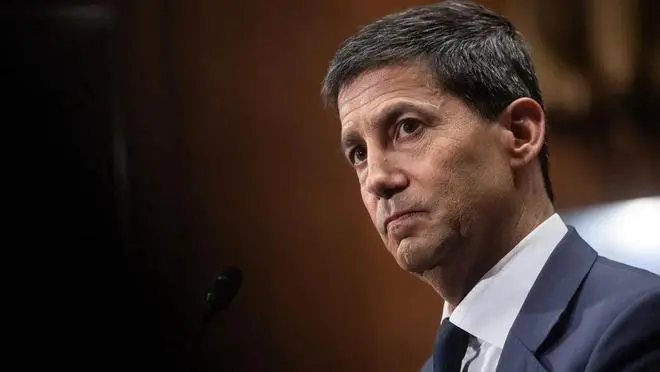
The "three words" and "one answer" from yesterday's press conference: the entire Wall Street is pondering "Wosh's approach."
 Core Viewpoint

 Within the framework of Waller, after the target range rises to 3.75%-4%, the policy stance remains stimulative—raising interest rates has only withdrawn "one dose" of it. The neutral interest rate—the core anchor for the Federal Reserve's assessment of policy tightness over the past decade—has been set aside at the operational level. Some analysts point out that Waller is steering the Federal Reserve's decision-making logic towards monetarism, calling it a "seismic shift."
Author: Wall Street Journal
At the press conference following the interest rate hike yesterday, Federal Reserve Chairman Waller redefined the nature of this rate increase with the phrase "dose of accommodation," and when pressed about the position of interest rates relative to the neutral rate, his response was equally thought-provoking: this concept is "academically useful," but has "no operational effect on our decisions today."
These three words and one statement are forcing Wall Street to rethink the interest rate path and policy framework of this Federal Reserve.
In Waller's framework, after the target range rises to 3.75%-4%, the policy stance remains stimulative—this rate hike merely removed "one dose" of accommodation. The neutral rate—the core anchor for the Federal Reserve's judgment on policy tightness over the past decade—has been set aside from an operational perspective.
CME FedWatch data shows that the probability of another rate hike in October has jumped from 42% a week ago to about 58%. Goldman Sachs and Bank of America have both raised their rate hike expectations, with Bank of America also predicting another hike in December. The implied rate for the end of 2027 is 4.635%, indicating there may be three to four more rate hikes.
"Dose of Accommodation": The Rate Hike Only Removed One Dose of Accommodation
Waller repeatedly emphasized this statement at the press conference, noting that the basis for the rate hike decision is that the U.S. economy appears to have "strengthened," and financial conditions have become less tight.
Krishna Guha, head of economics and central bank strategy at Evercore ISI, stated in a client report that this was the "most prominent hawkish element" of the press conference. "This is not a slip of the tongue. He repeated it multiple times, clearly after careful consideration," Guha wrote, "This framework has a substantive distinction from the language used by the Federal Reserve in recent years, suggesting that the number of rate hikes may be open-ended."
James Egelhof, chief U.S. economist at BNP Paribas Securities, interpreted it as follows: in the Federal Reserve's dictionary, accommodation means stimulus. "This means that the current monetary policy stance is significantly stimulative. Under conditions of a stimulative starting point, strong cyclical momentum, and persistent inflation, substantial rate hikes—perhaps more than the three we expect—may be needed to stabilize unemployment and prevent the economy from overheating next year."
If Waller's framework is understood literally—Guha further pointed out—"interest rates may need to continue rising until the financial conditions faced by the private sector are no longer 'accommodative'—however that is defined. This is quite an open-ended outlook."
Neutral Rate Excluded, Monetarism Emerges
At the press conference, CNBC reporter Steve Liesman pressed on how far current interest rates are from the neutral rate (r*).
Waller said that as a student of economics, he has studied the neutral rate, specifically the "Wicksellian real rate" named after Swedish economist Knut Wicksell. This concept is "academically useful and helps us think about policy discussions," but has "no operational effect on the decisions we make today."
This statement needs to be understood in context. Since the Bernanke era, the neutral rate has been the core reference point for the Federal Reserve's policy-making—rates above the neutral level are considered tight, while those below are considered accommodative, with policy discussions revolving around this invisible benchmark. Waller has characterized it as purely an academic discussion, effectively dismantling this positioning system that has been in place for over a decade.
Some analysts point out that Waller is steering the Federal Reserve's decision-making logic toward monetarism, calling it a "seismic shift." His predecessor Powell—who remains on the FOMC as a board member—has repeatedly rejected the basic principles of monetarism. Waller had already hinted at this direction during the Jackson Hole meeting in August, suggesting a connection between changes in the money supply and economic activity and inflation.
This press conference further confirmed this orientation. Waller clarified several positions that are highly consistent with monetarism: individual price changes in food, energy, etc., do not "cause" inflation, and the Federal Reserve must ensure that these relative price changes do not produce second- or third-order effects; individual data points are "full of noise," and what matters is the trend; the Federal Reserve deals with aggregate issues—labor market, GDP, total spending, and overall inflation—but he also acknowledged that the lowest income groups living on wages would benefit the most from price stability.
Data on the money supply has already provided clues. Waller stated at the press conference at least twice that in recent months, he has found it difficult to describe financial conditions as "tight." Analysts point out that over the past 6 to 9 months, the growth rate of the broad money supply in the U.S. has remained in the range of 6%-8%, which is clearly too high—this growth rate needs to drop to around 6% to achieve the 2% inflation target. Compared to the abstract and unobservable neutral rate, the growth rate of the money supply provides a more direct basis for policy judgment.
What Is Wall Street Pricing In?
Jack Janasiewicz, chief portfolio strategist at Natixis Investment Managers, believes that the phrase "dose of accommodation" "reinforces the hawkish tone, suggesting that the committee no longer views policy as moderately tight," but he "does not believe this is the beginning of an aggressive new tightening cycle," and is more inclined to understand it as "withdrawing the Federal Reserve's insurance rate cuts implemented in the fall of 2025."
If the futures pricing comes to fruition, Waller's Federal Reserve will at least reverse most of the rate cuts approved during Powell's tenure. However, the current focus of disagreement has gone beyond the number of rate hikes themselves—when the neutral rate is excluded from operational considerations and the money supply takes center stage, the market needs to adapt to a whole new set of policy coordinates. After three press conferences, Waller has outlined his framework, but he has not provided an answer to where the endpoint of rate hikes lies.

 Risk warning

Popular articles