Bitget UEX Daily Report | US Treasury options shift to betting on interest rate cuts in 2027; expectations for a rate hike in September have significantly cooled; the AI industry chain is collectively under pressure (August 19, 2026)

 Bitget UEX Daily Report
# 1. Hot News
Federal Reserve Dynamics
U.S. Treasury options shift to bet on interest rate cuts in 2027, September rate hike expectations significantly cool down
- U.S. inflation, retail sales, and consumer confidence weakened in July, coupled with an unexpected decrease of 23,000 in non-farm employment, leading to trades in the interest rate options market hedging against a reversal of Federal Reserve policy.
- Investors are buying September expiry options betting on maintaining interest rates, while also positioning in March and June 2027 SOFR call options.
- The probability of a September rate hike has dropped from about 68% two weeks ago to around half; interest rate swaps indicate only about a 9 basis point hike is implied for the September meeting. Market Impact: The repricing of the policy path alleviates some tightening concerns, but long-term yields remain high, with expectations diverging between the short and long ends, creating differentiated pressure on growth stocks.
International Commodities
Trump suspends engagement with Iran, geopolitical deadlock continues
- U.S. officials say Trump has asked his negotiation team (including Vice President Pence, Special Envoy Hook, and Kushner) to suspend contact with Iran.
- The White House's strategy has shifted from "striking quickly" to a long-term "choking off," following active discussions. Market Impact: The suspension of negotiations related to Hormuz exacerbates supply uncertainty, providing geopolitical support for oil prices, and inflationary concerns persist.
Macroeconomic Policy
Multiple U.S. states tighten regulations on data center electricity use, AI infrastructure becomes a midterm election issue
- Pennsylvania requires data centers to self-generate power and increase the proportion of clean energy; Texas initiates audits for grid access; New York State halts the construction of new large data centers.
- Bank of America strategists list this as a variable for the midterm elections, suggesting that tightening regulations may affect the pace of AI capital expenditures. Market Impact: Increased constraints on electricity and communities raise the costs and uncertainties of AI infrastructure deployment, drawing attention to related equipment and power suppliers, while technology hardware valuations come under pressure.
# 2. Market Review
Commodity & Forex Performance
- Spot Gold: Approximately $4,343/ounce, +0.2%
- Spot Silver: Approximately $63/ounce, -0.52%
- WTI Crude Oil: Approximately $85/barrel, +0.87%
- Brent Crude Oil: Approximately $89/barrel, +0.56%
- U.S. Dollar Index (DXY): Approximately 99.645, slight fluctuations
Driving Factors Analysis: Trump's suspension of engagement with Iran continues the uncertainty in Hormuz, providing geopolitical support for oil prices. Gold fluctuates between rising interest rate expectations and high long-term bond yields, while silver shows a mixed performance influenced by both industrial and safe-haven factors. U.S. Treasury options indicate a significant cooling of September rate hike probabilities, but the 30-year yield remains high, limiting the upside potential for precious metals. Institutions believe that short-term commodities are jointly dominated by geopolitical and interest rate path repricing, with high oil prices potentially reinforcing the narrative of sticky inflation, and asset linkage reflecting geopolitical deadlock → oil price support → inflation expectations → policy path reassessment.
Cryptocurrency Performance
- BTC: Approximately $64,600, +0.31%
- ETH: $1,915, +0.32%
- Total Cryptocurrency Market Cap: $2.29 trillion, +0.2%
- Market Liquidation Situation: $205 million liquidated in the last 24 hours, with $119 million in long positions liquidated.
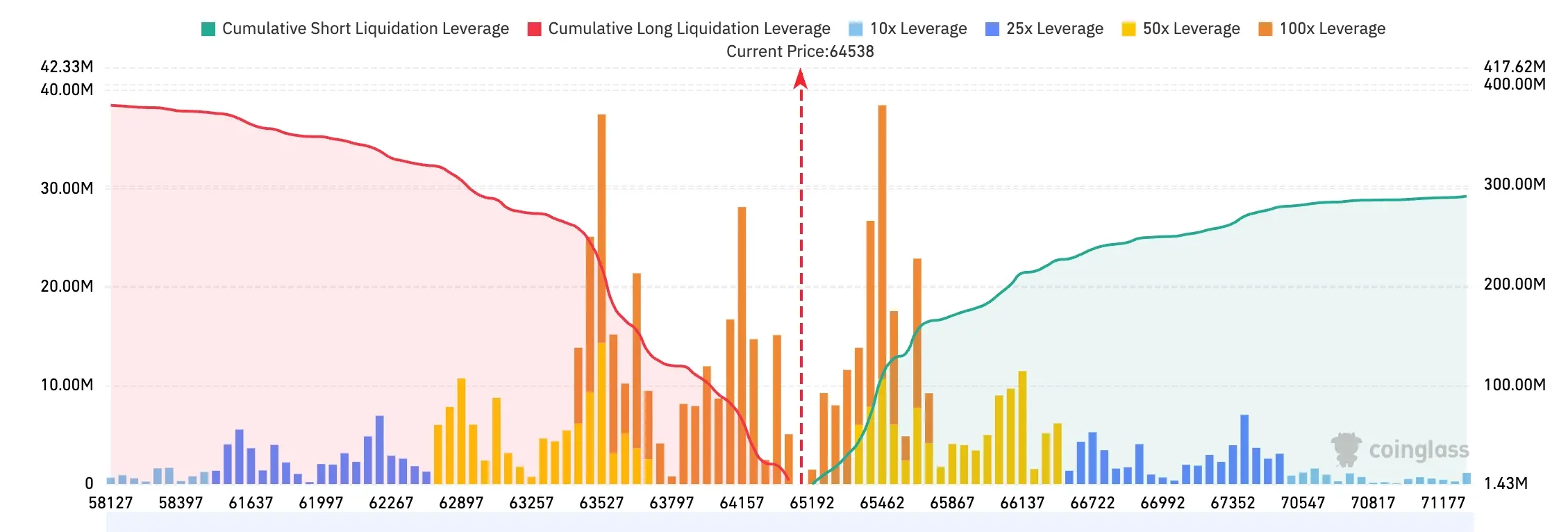
- Bitget BTC/USDT Liquidation Map: Current BTC price is approximately $64,538, with a large number of high-leverage (50x/100x) short liquidations clustered in the $65,000--$66,000 range; if broken, it could trigger a chain liquidation of shorts and amplify upward momentum; the liquidation pressure for longs in the $63,000--$64,000 area has been partially released, with short-term leverage clearly skewed upward.
- Spot ETF Net Inflow/Outflow: Yesterday's net inflow was $298 million, current dynamic net inflow is $46 million.
Driving Factors Analysis: The pullback in the U.S. stock AI sector and high long-term bond yields suppress risk appetite, causing the cryptocurrency market to follow suit. Whales have net accumulated about 43,000 bitcoins over the past 60 days, indicating that medium- to long-term funds are still positioning on dips. ETF fund flow volatility coexists with leveraged liquidations, with institutional consensus pointing to range-bound fluctuations, focusing on interest rate path repricing and geopolitical developments affecting risk assets.
U.S. Stock Index Performance

- Dow Jones: Closed at 53,343.40 points, down 0.22%
- S&P 500: Closed at 7,691.76 points, down 0.69%
- NASDAQ: Closed at 26,289.71 points, down 1.33%, with significant drag from technology and semiconductors
Tech Giants Dynamics
- NVDA: Approximately $219.74, down 2.34%
- AAPL: Approximately $310.03, up 1.45%
- MSFT: Approximately $481.63, up 0.27%
- GOOGL: Approximately $344.20, up 0.06%
- AMZN: Approximately $259.45, down 0.71%
- META: Approximately $543.67, down 4.45%
- TSLA: Approximately $336.87, down 0.72%
Performance Summary and Driving Analysis: The seven tech giants show significant differentiation. Apple, Microsoft, and Google are relatively resilient or up, while Nvidia and Meta lead in declines. The AI hardware and semiconductor sectors have significantly corrected under dual pressures of valuation and regulation, with funds partially rotating into software and defensive sectors. U.S. Treasury options indicate a shift in rate cut expectations, but high long-end yields and tightening data center regulations jointly suppress high capital expenditure growth stocks, highlighting differences in individual stock drivers.
Sector Movement Observation
Semiconductors/Storage Significantly Corrected
- Representative Stocks: SK Hynix down about 9.2%, SanDisk down about 9.01%, Broadcom down about 3.17%.
- Driving Factors: Cooling AI enthusiasm, valuation digestion, and the drag from the Korean market, with funds withdrawing from the hardware segment.
Optical Communication Concept Significantly Declined
- Representative Stocks: Coherent down about 12.75%, Lumentum down about 9.87%.
- Driving Factors: Stage cooling of demand expectations for AI optical modules, with high elasticity amplifying declines in the sector.
Pharmaceuticals and Dividend Sectors Relatively Strong
- Representative Stocks: Johnson & Johnson reached a new closing high, Eli Lilly and others are close to historical highs.
- Driving Factors: Funds rotating from high-valuation AI themes into defensive and stable growth sectors.
# 3. In-depth Analysis of U.S. Stocks
1. Coherent (COHR) - Leading Optical Communication Stock Significantly Corrected
Event Overview: Coherent's stock price fell about 12.75% in a single day, becoming one of the biggest decliners in the AI optical communication sector. The company previously reported better-than-expected Q4 fiscal year results (revenue of about $2.05 billion, up about 34% year-over-year, non-GAAP EPS of $1.74), and provided higher-than-expected guidance for the next quarter, with the stock price surging over 7% in the previous trading day. However, on August 18, there was a clear profit-taking, and the listing of the Tradr 2X Short COHR Daily ETF (COHQ) that day provided a leveraged tool for bearish funds, further amplifying the decline. Market Interpretation: Institutions believe this correction mainly reflects a technical adjustment of high-elasticity stocks after performance realization, combined with a decline in overall risk appetite in the AI hardware sector and revenue expectations for Anthropic falling short of some market rumors. The fundamentals are still recognized, but short-term valuation digestion and the introduction of leveraged products exacerbate volatility. Investment Insight: The logic of optical communication demand remains unchanged, but high volatility requires stricter position and timing management, with attention to subsequent orders and capacity realization.
2. Lumentum (LITE) - Optical Module Sector Under Pressure
Event Overview: Lumentum's stock price fell about 9.87%, weakening alongside Coherent, Credo, and other optical communication stocks. The market attributes the pressure to the digestion of high valuations in AI optical interconnects, profit-taking after the previous day's gains, and broader sell-offs in semiconductors and AI hardware. Market Interpretation: Analysts point out that the optical communication sector had previously seen significant gains, with static valuations being relatively high; once macro or sentiment turns, rapid pullbacks occur. Institutions like William O'Neil maintain buy ratings, but short-term funds are flowing into defensive and software sectors. Investment Insight: As a core stock for AI data center optical modules, the mid-term logic remains intact, but caution is warranted regarding valuation volatility and sector rotation risks.
3. Credo Technology (CRDO) - High-Speed Connectivity Chips Lead Declines
Event Overview: Credo Technology's stock price fell about 13%, leading declines among AI optical and high-speed connectivity-related stocks. The company benefits from demand for high-speed SerDes and optical interconnects in data centers, but on August 18, it followed the significant correction of the entire AI hardware and optical sector. Market Interpretation: Institutions view this decline more as a result of sector-wide risk appetite decline and digestion of previous gains, rather than a sudden deterioration in the company's fundamentals. Its high beta attributes amplify elasticity when sentiment shifts. Investment Insight: Suitable as a high-elasticity allocation for AI infrastructure, but close monitoring of data center capital expenditure rhythms and competitive landscape changes is necessary.
4. SanDisk (SNDK) - Storage Sector Significantly Retreats
Event Overview: SanDisk's stock price fell about 9%, under pressure alongside Micron, Seagate, and other storage-related stocks. The market is concerned about the impact of a high interest rate environment on growth stock valuations and the stage cooling of AI storage demand expectations. Market Interpretation: Analysts believe that the storage cycle and AI demand still have medium- to long-term support, but short-term impacts from high long-term bond yields and funds rotating from hardware to other sectors are significant. Some storage stocks had surged due to policy and demand narratives in the previous trading day, followed by profit-taking. Investment Insight: The logic of supply-demand gaps in storage remains, but short-term volatility has increased; attention should be paid to subsequent earnings reports and capital expenditure guidance.
5. Apple (AAPL) - Rising Against the Trend in Tech Pullback
Event Overview: Apple's stock price rose about 1.45%, showing relative strength in an environment where the NASDAQ fell sharply and AI hardware collectively corrected, becoming one of the few stocks among the seven giants to close higher. Market Interpretation: Institutions view Apple as a relatively defensive tech allocation, with hardware cycles and service businesses providing some buffer, as funds partially rotate into more certain consumer electronics leaders during the sell-off of high-valuation AI hardware. Investment Insight: Suitable as a stable exposure within the tech sector, with attention to new product cycles and the contribution of AI functionalities to long-term growth.
# 4. Market & Project Dynamics
The U.S. Treasury options market has significantly shifted to betting on interest rate cuts in 2027, with September rate hike probabilities retreating from high levels to about half.
The VanEck research team points out that among the 12 market capitulation indicators it tracks, 8 have lit up, indicating that Bitcoin's nearly 11-month correction may be nearing its end. Bitcoin has fluctuated between $58,000 and $66,500 since June, currently around $64,700, still about 48% lower than the historical high of October 2025. The U.S. spot Bitcoin ETF recorded nearly $300 million in net inflows on Monday, the strongest single-day performance since May 5. VanEck notes that the previous three Bitcoin bear market cycles took an average of 12.7 months from peak to maximum drawdown, and the current cycle has entered its 11th month; based on historical cycle patterns, the market may enter an accumulation phase from September to November. However, the team warns that historically, after concentrated triggers of capitulation indicators, short-term returns are not necessarily ideal—average returns over 90 and 180 days in similar situations have been lower than market benchmarks. Meanwhile, long-term holders have reduced their holdings by about 356,000 BTC over the past 30 days, bringing their holdings down to 11.84 million BTC, marking the first time in months that the proportion of total circulation has fallen below 60%.
The U.S. Securities and Exchange Commission (SEC) has proposed new regulations "Regulation Crypto Assets," aimed at providing a compliance path for investments involving digital assets, allowing certain issuers to be exempt from securities law compliance. The new regulations are described as a "tailored issuance system," designed to help raise funds while protecting investors, differing from innovation exemptions. The new regulations include a "startup exemption," allowing issuances of up to $5 million to be exempt from registration requirements under the Securities Act of 1933 for four years; and a "financing exemption," allowing issuances of up to $75 million to be exempt for one year. The proposal also includes a safe harbor provision, allowing digital assets to no longer be considered securities after meeting specific conditions and "ceasing all management activities." The public comment period for the proposal is 60 days.
Bitcoin whales have net accumulated about 43,000 BTC over the past 60 days, with medium and large holders accelerating their purchases.
Anthropic plans to expand its credit line and advance a potential IPO in the fall, with revenue exceeding OpenAI. OpenAI's revenue for the second quarter was $6.7 billion, up from $5.7 billion in the first quarter, a quarter-over-quarter increase of 18%. Meanwhile, the company's operating profit margin further declined, and losses widened. Some investors are disappointed with this performance, as OpenAI's revenue growth rate lags behind that of competitor Anthropic.
Bank of America analyst Vivek Arya estimates through a free cash flow split valuation model that Nvidia's current stock price is about 34% to 50% undervalued compared to its value, even accounting for the risks associated with providing financing for the ecosystem. He points out that the market may have overestimated the risks of Nvidia's AI investments, presenting "an attractive buying opportunity." The report shows that Nvidia has committed approximately $300 billion to projects such as the OpenAI Ohio data center campus and ecosystem partners, with about $70 billion in equity investments and about $230 billion in remaining value guarantees or buyback commitments. BofA maintains a "buy" rating on Nvidia with a target price of $350.
# 5. Today's Market Calendar
Data Release Schedule
|-----|----|----------------|-----| | Focused | U.S. | Relevant economic data and Federal Reserve officials' speeches | ⭐⭐⭐ |
Important Event Forecast
- U.S.-Iran Engagement Dynamics: Continuously track the follow-up progress after Trump's suspension of negotiations.
- Data Center Regulation: Monitor the impact of state policies on AI capital expenditures.
- AI Company Dynamics: Anthropic financing and potential IPO progress.
August 19 (Wednesday)
- ★★★★★ The Federal Reserve will release the minutes of the July FOMC meeting (evening UTC+8), following last week's CPI, becoming the most important macro event of the week. Key observations include details of the three dissenting votes against maintaining interest rates at the July meeting, discussions on sticky inflation, the labor market, and the September policy path;
- Target (TGT), Lowe's (LOW), TJX, and Analog Devices (ADI) will release earnings reports before the market opens, testing retail consumption health and semiconductor/AI-related demand (ADI focuses on industrial, data center power, and communication ends);
- EIA crude oil inventory data.
August 20 (Thursday)
- The U.S. will release the Philadelphia Fed Manufacturing Index for August, weekly initial jobless claims, and July leading indicators;
- ★★★★ Walmart (WMT) will release earnings before the market opens, core testing low-end consumer resilience, grocery, and general merchandise demand; Alibaba (BABA), NetEase (NTES), Deere (DE), etc. will also report;
- Ross Stores and others will report after the market closes.
August 21 (Friday)
- ★★★★ The U.S. will release the preliminary value of the August S&P Global Manufacturing/Services PMI, verifying economic expansion momentum and soft landing continuity;
- Other significant events are relatively few.
*After last week's CPI/PPI slowdown, rate hike expectations have significantly cooled; if the minutes show limited dissent and retail/housing data is robust, soft landing trades and growth stocks are likely to continue; conversely, if the minutes lean hawkish or consumer guidance is weak, it may raise tightening pricing again and test high-valuation sectors. Market volatility is expected to be moderately high, with a focus on the wording of the minutes and pricing reactions to retail earnings reports exceeding or falling short of expectations.
Institutional Views:
Investment bank analysts believe that U.S. Treasury options indicate a significant cooling of September rate hike expectations, with the repricing of the policy path providing some buffer for risk assets, but high long-end yields and the digestion of AI hardware valuations still suppress growth stocks. Trump's suspension of engagement with Iran continues geopolitical uncertainty, providing support for oil prices. Tightening data center regulations increase constraints on AI infrastructure deployment, with funds rotating from semiconductors and optical communications to pharmaceuticals, software, and other sectors. The cryptocurrency market maintains fluctuations amid whale accumulation and ETF volatility. Overall strategy suggests focusing on interest rate path reassessment and regulatory progress, maintaining caution on high-valuation AI hardware while observing the sustainability of defensive sectors.
Disclaimer: The above content is compiled by AI search, with human verification for publication, and does not constitute any investment advice. The data in the text may inevitably contain deviations; please refer to real-time market data.
 Risk warning




Popular articles