Galaxy Research: Can the SEC's new regulations usher in a new era of token financing?
 Core Viewpoint

 In the past decade, token issuance has been trapped in a regulatory dilemma of "difficult registration, overseas issuance, and unclear exit." Reg Crypto aims to change this situation by establishing a new set of lifecycle rules for tokens from issuance, construction to exit through financing exemptions, exclusive disclosure requirements, and safe harbor mechanisms.
Author: Alex Thorn, Head of Research at Galaxy Research
Compiled by: Jiahua, ChainCatcher
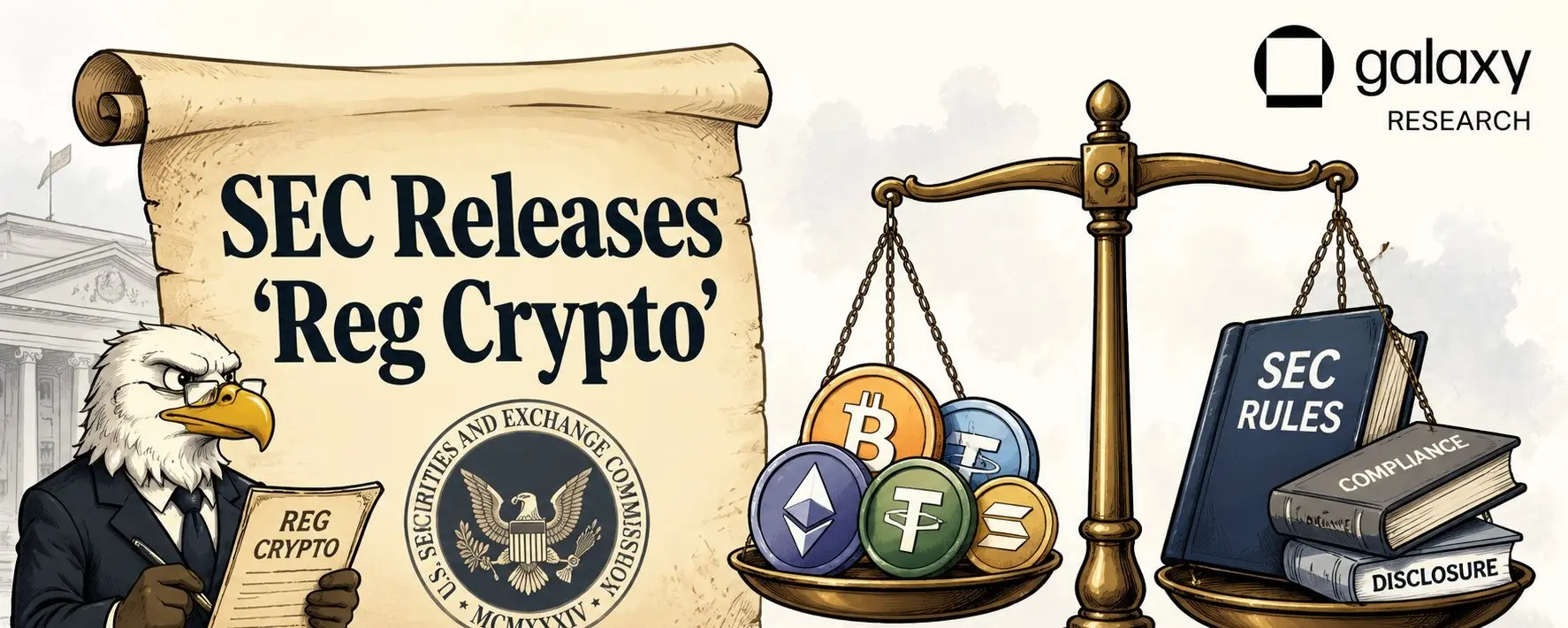
On August 18, the U.S. Securities and Exchange Commission (SEC) proposed the Regulation on Crypto Asset Regulation (hereinafter referred to as "Reg Crypto"). This is the first set of securities rules in the U.S. specifically designed for the issuance and sale of crypto assets, rather than simply applying previously established rules for corporate stocks to crypto assets.
The proposal will first provide a legal pathway for certain tokens to be sold to the U.S. public, including allowing non-accredited investors to participate without the need for a registered offering. Secondly, it will establish a formal mechanism with clear timelines for terminating investment contracts related to tokens.
For the past decade, U.S. token issuers have effectively faced two choices: either conduct a registered offering (which very few projects can realistically complete) or choose to issue overseas. Reg Crypto offers a third option while also providing an exit path for thousands of tokens that are already traded but whose legal status remains unclear.
This rule applies only to crypto assets that are not themselves securities but whose issuance or sale constitutes part of an investment contract, and where the issuer has committed through that contract to build a certain product, network, or ecosystem.
Tokenized stocks and bonds, as well as arrangements that bind tokens to equity or other securities, are explicitly excluded from this framework. Within this scope, the proposal is divided into four phases: Raise, Disclose, Build, and Exit.
Four Phases: Raise, Disclose, Build, and Exit
Raise: A one-time financing exemption for startups will allow issuers to raise up to $5 million over a period of up to four years, with public filings submitted at the start and end of that period. A larger exemption designed based on Regulation A (a public offering exemption under U.S. securities law that allows companies to raise funds from the public after meeting disclosure requirements) will allow issuers to raise up to $20 million or $75 million within 12 months, depending on their tier.
To qualify for this financing exemption, SEC qualification approval is required, along with ongoing reporting and financial statements. Larger tier issuances will also require audited financial statements, and the issuer must maintain a substantial connection to the U.S. in terms of organizational structure, management, and assets.
Disclose: Issuers need to provide information specifically designed for tokens, including token supply and release plans, minting and burning mechanisms, governance mechanisms and smart contract permissions, source code, and most importantly: what the issuer commits to building and the current progress of that construction.
Build: The startup exemption will provide a window of up to four years for issuers to complete their promised core construction work.
Exit: Once the issuer completes or permanently ceases the above work, makes no new commitments to undertake such work, and submits a transition report, the relevant investment contracts will be deemed terminated. Thereafter, the SEC will no longer consider the crypto asset as being bound by that investment contract under the Securities Act and the Securities Exchange Act.
It is noteworthy that this safe harbor mechanism also applies to issuers that do not use the above financing exemption mechanisms. This means it not only affects future token issuances but also provides a potential exit path for tokens that were issued years ago but whose securities attributes remain unclear.
From the SEC's estimates of applicable scale, the impact of this rule will be more intuitive. To estimate the related paperwork workload, the SEC assumes that approximately 475 issuers will use the investment contract safe harbor mechanism each year, while about 130 projects will conduct issuances through the two new exemptions each year. This suggests that in the short term, Reg Crypto is more likely to address the legal status issues of existing assets under securities law rather than immediately triggering a new wave of token issuances.
Investment contracts sold under any of the above exemptions will not be considered restricted securities; if not otherwise restricted by contract, they can be resold immediately. The proposal will also prioritize certain state-level registration and qualification requirements, covering eligible initial offerings and some secondary transactions, provided that the issuer continues to fulfill relevant obligations.
However, this rule does not involve exchanges, brokers, dealers, or custodial businesses, nor is it the same as another innovative exemption previously discussed by the SEC regarding tokenized securities and on-chain transactions. The public comment period will last for 60 days after the proposal is published in the Federal Register.
The SEC canceled a public meeting originally scheduled for August 14 and released the proposal four days later. Three current commissioners—Chairman Paul Atkins, and commissioners Hester Peirce and Mark Uyeda—have all issued statements of support. Although the comment period is 60 days, the timeline remains tight for formal passage before 2027.
Our View
As we wrote last week here, despite the Senate being stalled on the CLARITY Act, the SEC under Atkins is still advancing measures that can enhance regulatory clarity in the crypto industry.
Reg Crypto is a constructive step and one of the clearest signals to date: the SEC is not prepared to wait for Congress to modernize its own regulatory framework. This disclosure system is the most obvious manifestation of the SEC beginning to understand the uniqueness of crypto assets. It requires issuers to disclose token supply and release plans, minting and burning mechanisms, smart contract permissions, source code links, ecosystem structure, and continuously record what the issuer commits to building and the current progress.
These are the real concerns of token purchasers, and this information differs from what equity investors in companies focus on. The SEC is acknowledging something it refused to recognize during the tenure of Atkins' predecessor, Gary Gensler: that there are distinctions between token issuance and equity issuance in both form and function, and therefore the information disclosure needed by investors should also differ.
The proposal's understanding of "time" is equally important. After a stock issuance, its securities attributes persist for a long time. Under the Reg Crypto framework, investment contracts associated with tokens can bind the issuer's obligations from the time of issuance during the project's construction period and terminate on a publicly recorded date, even if the tokens themselves still exist and continue to trade.
This is not just a new exemption but a regulatory framework built around the token lifecycle, transformed into enforceable rules. Whether issuers will adopt these financing exemption mechanisms remains an open question.
Rule 506 under Regulation D (which is a private placement exemption rule in U.S. securities offerings allowing companies to raise funds from accredited investors without public registration) remains in effect, with no financing cap, no SEC qualification approval required, and no ongoing public reporting obligations. In contrast, Reg Crypto's advantage is that it allows for legal public offerings to non-accredited investors, with the relevant securities being immediately transferable and able to take precedence over certain state-level registration requirements.
For projects that wish for tokens to circulate genuinely rather than remain in the portfolios of venture capital firms for an extended period, the absence of a federal holding period may be the most underrated provision in the entire proposal. Of course, the trade-off is that issuers must bear real information disclosure and reporting obligations; if adopting larger financing exemptions, they must also maintain a substantial connection to the U.S.
This requirement brings another challenge. In the past, many token projects chose to establish offshore foundations, not only to evade U.S. securities laws but also for governance, fund management, and tax treatment considerations.
The larger financing exemptions in Reg Crypto require many projects to substantively relocate their issuance entities, management, business operations, and most assets back to the U.S. Before the U.S. tax treatment of token sale revenues and treasury allocations becomes clearer, this requirement may be sufficient to keep many projects maintaining their existing structures.
The startup exemption does not have similar U.S. registration requirements, so despite its financing cap of only $5 million, it may achieve higher adoption rates in the early stages. If these issues can be positively resolved, the most noteworthy scenario would be a truly legitimate token financing 2.0.
One of the early significant applications in the crypto industry is capital formation: project parties can raise funds directly from future users rather than relying entirely on venture capital firms and traditional private financing systems. The token financing cycle of 2017 demonstrated both the market's demand for the initial coin offering model and the consequences of adopting this model in the absence of credible disclosures, investor protections, and enforceable rules.
Reg Crypto fills in many of the key factors that were missing back then: exemption mechanisms designed for different financing scales; information disclosure requirements tailored to the characteristics of tokens; allowing public investors to participate under limit constraints; and clearly defining the timeline for terminating the issuer's obligations under securities law.
This system may also give rise to a new service ecosystem. Securities lawyers, auditing firms, technical disclosure service providers, issuance platforms, and compliance service agencies will benefit by helping projects prepare issuance materials and transition reports, just as Regulation A+ spawned its own supporting service industry.
The teams most likely to adopt this framework first are those that already have U.S. entities, clearer organizational structures, and can bear the costs of ongoing disclosures. The SEC estimates that preparing a transition report under the independent safe harbor mechanism will require an average of about 30 hours of work, including external professional service costs. This means that even completing the "exit" process is rarely something that can be fully accomplished by the project parties alone.
However, in the short term, "exit" is more important than "raise."
The most immediate impact of Reg Crypto is likely to be the cleanup of historically problematic tokens rather than reigniting U.S. token issuance. This in itself is significant: for many years, the market has been trying to infer when investment contracts actually terminate through regulatory speeches, settlement agreements, and litigation cases.
Previously, the industry had hoped for the standard of "sufficient decentralization," which suggested that when a blockchain network is no longer controlled by a single entity and the token's value no longer primarily relies on the issuer's efforts, it might fall outside the scope of securities regulation. However, this standard has always lacked clear definition and has become a long-term uncertainty in past U.S. crypto regulation.
Reg Crypto will replace this ambiguity with formal filing documents and clear dates. However, it is important to note that the rule is still in the proposal stage and not a formal rule. Even if ultimately passed, the system itself may still face changes. The SEC's proposal currently still needs to undergo a 60-day public comment process.
Atkins stated in his own remarks that legislation remains indispensable, and only through congressional action can future regulatory agencies prevent overturning the framework currently established by the SEC. Given that this system may indeed be adjusted in the future, this judgment is reasonable.
Additionally, state regulatory agencies may also challenge the broadly applicable federal priority provisions in the proposal. Reg Crypto may bring significant regulatory clarity to the crypto industry, but only Congress can ensure that this clarity truly lasts in the long term.
 Risk warning



Popular articles