Goldman Sachs: In July, crowded trades were smashed, the bull market in US stocks hasn't ended but it's harder to navigate
 Core Viewpoint

 In July, the US stock indices appeared stable on the surface, but underneath, they experienced a shocking bloodbath of positions. The most crowded AI and momentum trades suffered a heavy blow from deleveraging, and the market logic is shifting from "frenzied narratives" back to "real returns." The bull market has not exited, but the era of "buy and win effortlessly" has come to an end. The road ahead is bumpy, and the market no longer tolerates leverage.
Author: Pan Lingfei, Wallstreet News
In July, the U.S. stock market did not experience a collapse at the index level, but rather a liquidation at the position level. The S&P 500 held its ground this week, with a volatility range of only 3.5% throughout July, less than 2% away from its peak. More counterintuitively, the equal-weighted S&P, low-volatility S&P, and the S&P 500 excluding AI all reached historical highs this week.
Tony Pasquariello, head of Goldman Sachs' hedge fund business, wrote in the latest market observation: "After experiencing a truly parabolic rise in high-speed trading, a heavy hammer has smashed through consensus positions over the past month; I tend to believe that this frenzy has cooled down." The focus is not on the disappearance of risk, but rather that the most crowded, most convenient, and easiest trades to leverage have been forced to cool down.
Surface calm and underlying volatility coexist. The S&P 500 had an average daily volatility of less than 1% this week, but Goldman Sachs' flagship momentum basket had an average daily volatility close to 10%. On June 22, Goldman Sachs' TMT momentum basket had a year-to-date increase of up to 145%, followed by the most severe recorded drawdown, and then a single-day rebound of 17%. Asian fundamental long-short funds achieved record performance in the first half of the year, only to face the largest single-month drawdown in the past decade, while South Korea's KOSPI surged 18% overnight.
This framework ultimately leads to an uncomfortable conclusion: The outlook for the U.S. stock market remains favorable, but the risk-reward is no longer cheap, and the upside elasticity of global stocks is weaker than before. The bull market has not been declared out, but the next phase is not one of "buy and lie back to win."
The Index Didn't Collapse, But Crowded Trades Did
The most easily misjudged aspect of July is focusing solely on the S&P 500.
The index did not signal panic. The S&P 500 is less than 2% away from its peak, with a volatility range of only 3.5% in July, appearing to be just normal fluctuations. However, active managers underneath have experienced a different market: popular momentum, AI chains, Korean stocks, and Asian long-short strategies have all been squeezed out of leverage.
The issue is not how much it fell on a particular day, but that the previously most profitable trades suddenly lost liquidity. Betting on the S&P 500 itself sees stability; betting on high-momentum tech stocks sees volatility approaching chaos.
The key split in July lies here: There is not much turbulence at the index level, but at the position level, the boat has already capsized for some.
Deleveraging Is Not a Minor Adjustment, But a Real Cleansing
Several data points indicate that this round of deleveraging has exceeded ordinary portfolio adjustments.
Global tech exposure has experienced the largest sell-off in over five years. The asset management scale of Korean stock leveraged ETFs was $53 billion at the peak in June, now reduced to $15 billion. The total exposure reduction seen by Goldman Sachs' prime brokerage is the largest since the end of 2022.
More detailed position changes point in the same direction: fundamental long-short clients' leverage exposure to momentum factors has dropped to the 28th percentile of the past year. Crowded trades have shifted from "everyone is on the bus" to a significant portion of people having gotten off, or even being forced off.
This does not mean that painful trades will not return. It simply means that compared to early July, the impulse to chase has noticeably decreased, while cash and discipline have increased.
The Contradiction of AI Trading, From Narrative to Return Rate
In the latter half of July, AI trading faced not just simple profit-taking, but a more fundamental question: Can the massive capital expenditures by ultra-large cloud providers on AI generate sufficiently clear and sustainable returns?
Last week, market skepticism about this question intensified. The answers provided this week were inconsistent, but better than the most pessimistic versions.
Meta has not demonstrated significant AI returns have been realized; Microsoft provided clearer signals that capital expenditures are translating into revenue and AI products, and that this is scaling; Amazon subsequently reported a re-acceleration in AWS growth and an expansion in cloud business profit margins. The credit spreads of ultra-large cloud provider bonds have also narrowed.
These changes are significant. If AI trading is left with "huge investments, distant returns," valuations will be under pressure; but if some companies can prove that investments are beginning to turn into revenue, the market will not treat the entire AI chain with a one-size-fits-all approach.
However, differentiation has already emerged. The previous phase where simply attaching the AI label could boost valuations is no longer as easy after this round of cleansing.
Fed Communication Becomes Murky, Long-Term Rates Re-emerge as a Market Concern
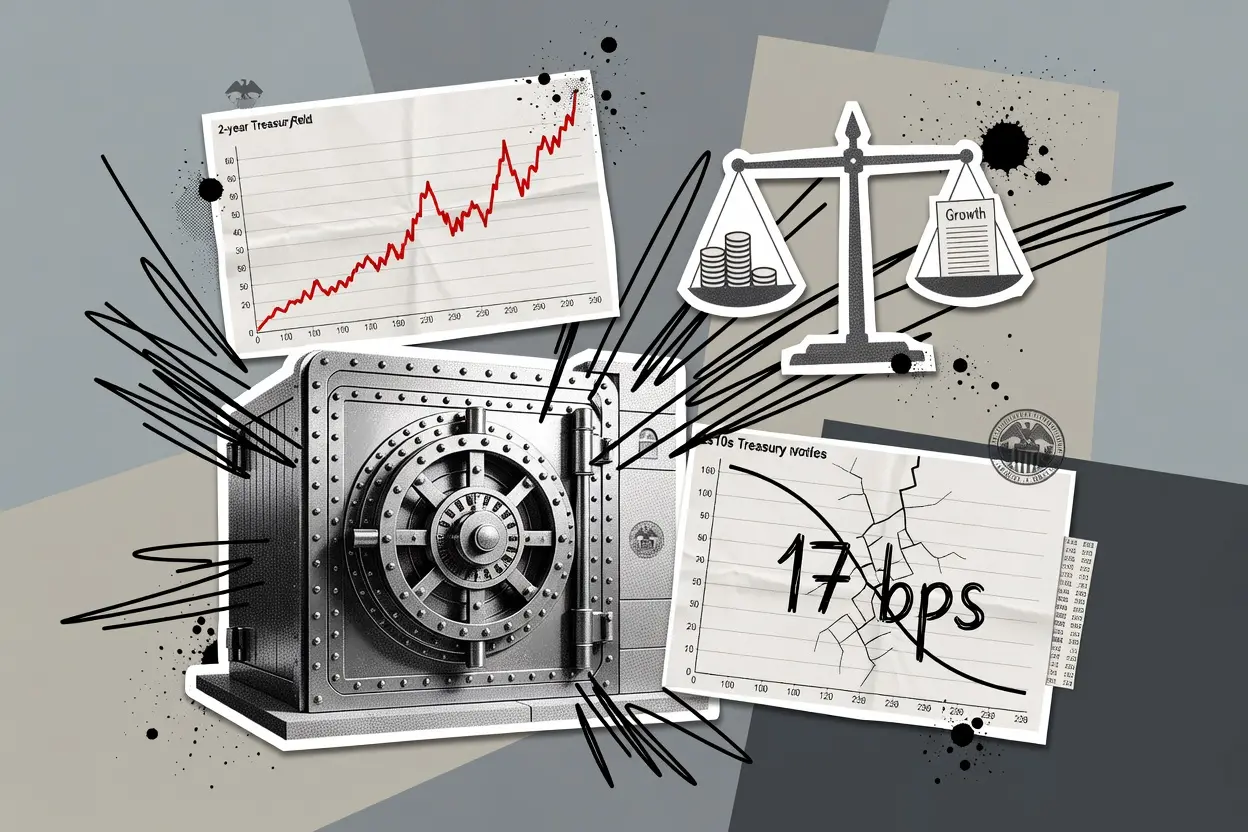
After the FOMC meeting, stock market traders did not feel much relief. The volatility at the long end of the U.S. Treasury curve briefly spilled over into the stock market.
The more troubling aspect is the change in communication style. The market was accustomed to higher transparency, but now it seems to have entered a more restrained and less explicit phase. Traders must judge policy direction with fewer clues, which inherently brings friction.
What truly needs to be monitored is the policy direction, not every single word. However, for stocks, changes in long-term rates cannot be ignored, especially for long-duration stocks. The valuations of AI, tech, and growth stocks are more sensitive to distant discount rates; once the long end of the global bond market continues to exert pressure, "stability at the base" does not mean comfort every day.
The U.S. Stock Market Remains Favorable, But Upside Elasticity Has Thinned
From a broader framework, the U.S. stock market has not lost support. Economic performance is good, earnings growth is strong, and capital flows are expected to turn more positive, with nearly $1 trillion in AI capital expenditures still flowing through the system.
This explains why the S&P 500 can hold its ground amid significant deleveraging at the underlying level. The index is not without risk, but there are enough support factors to hold it up.
However, this is not a signal for aggressive bullishness. The direction of U.S. stocks remains favorable, but the risk-reward is at a mid-level, and the upside elasticity of global stocks is not as strong as in the previous phase.
Short-term volatility will continue. Summer liquidity is not conducive to risk transfer; once a certain type of position becomes crowded, illiquid, and structurally complex, volatility will be amplified. At the portfolio level, it is more suitable to increase liquidity and reduce complexity, rather than continue chasing the steepest trades.
The Answer Given by the Nasdaq: The Bull Market Is Still On, But the Path Will Be Difficult
The Nasdaq 100 index has currently fallen 8% from its June peak, but is still up 12% year-to-date. Over the past nine months, it has declined in six of those months, but point-to-point is still up 9%. The price-to-earnings ratio has fallen back to the lower end of the range seen in recent years.
These numbers clearly describe the market state: the trend is not bad, but the process is tough.
For trading, the endpoint and the path are not the same thing. The main bull market of the Nasdaq is still ongoing, but if the future continues to follow the rhythm of "rising for a while, smashing positions, then recovering," making money will be harder than just being right about the direction. July has already given a reminder: the market does not reward crowded trades, nor does it forgive leverage.

 Risk warning