The "Roller Compactor Effect" of AI and the "Workshopization" of software are precursors to the Internet of Intelligent Agents
 Core Viewpoint

 Future products should be written for Agents, not for people.
Recently, some very interesting things have happened over the past month.
On August 11, SpaceX released the AI agent application Grok Bot. This is an "AI colleague" that works around the clock on its own cloud computer.
On September 8, Meta launched the personal agent application Muse. It can open browsers, fill out forms, and negotiate on behalf of users. Within ten days of its launch, it topped the U.S. App Store charts and triggered a sell-off of traditional online intermediary platform companies, such as Expedia, Airbnb, and Booking, which saw their stocks plummet for several consecutive days.
On September 22, Anthropic, the creator of Claude, released the new model Opus 5.5. Not long ago, OpenAI, the creator of ChatGPT, launched two new versions of GPT-6, both priced at half of the previous generation.
In mid-September, Salesforce, one of the world's largest SaaS software companies, held its annual conference. Patrick Stokes, the president responsible for application business, stated that AI would dismantle software interfaces and then replace them.
These events came from different companies and industries, concentrated within two months. It may seem like random cuts, but underneath is the same thing: AI agents that can handle tasks for people are starting to interact with software and the internet. The shape of the new generation of the internet is emerging.
1. The Roller Coaster Effect
A head of an AI incubator told me that the biggest awakening for AI entrepreneurs over the past year is realizing that AI is fundamentally different from the internet and blockchain; it is an extremely centralized and rapidly centralizing arena where the lifespan of startups is very short. They must seek speed and sales, unhesitatingly finding buyers before being crushed by giants, cashing out and exiting. As for dreams of growing larger, they shouldn't even think about it.
This is the mindset of the small grass in front of the roller coaster.
The "roller coaster effect" is a source of anxiety for many AI entrepreneurs. With every step forward in cutting-edge models, a batch of startups is unknowingly crushed. Public companies can at least lament their stock price plummeting, while hundreds or thousands of small teams face instant oblivion without anyone noticing.
First, let's look at the money. According to U.S. venture capital data firm PitchBook, global AI venture capital reached a record in the first half of 2026, with more than half flowing to OpenAI and Anthropic. It’s like a banquet with thousands of tables, where half the dishes are served at the main table, which only has two people sitting at it.
Now, let's look at specific companies. Google has an AI note-taking product called NotebookLM, where users input documents and web pages, and it turns the content into podcast-style audio explanations, gaining popularity online in 2024. Its head, Raiza Martin, left Google with two colleagues to create an AI podcast application called Huxe, which generates daily audio briefings based on users' emails and calendars, with funding from Google’s chief scientist Jeff Dean.
On May 21 of this year, the world's largest music streaming platform, Spotify, made an update that included similar features. On May 22, Huxe announced its shutdown.
Public companies are no different. In February, Anthropic released a set of industry plugins for Claude, covering legal, financial, and other sectors. Thomson Reuters, the parent company of Reuters, relies on selling legal, tax, and accounting information, and its stock price fell by more than 15% that day.
After Claude released the Opus 5.5 model, a large number of users posted beautifully crafted videos on Twitter using simple prompts, cheering with joy, while teams that had spent countless sleepless nights in the video AI production field could only face their screens and silently weep.
Heaven and earth are indifferent, treating all things as straw dogs. Giants like OpenAI and Anthropic are not out to get you; they have no hostility towards you and no intention to compete with you, and they may not even know you exist. They simply move forward with the trend, and you vanish into thin air.
What did that cliché say? To eliminate you is none of your business.
2. The Workshopization of the Software Economy
In February of this year, Claude Opus 4.6 was released. With the support of this model, Claude Code became so powerful that even those who couldn't write code suddenly felt their tech dreams could be salvaged.
More and more people are getting into software development. There is an AI platform called Lovable that allows non-programmers to create websites and applications through chat. It claims to add one million new projects weekly, with users primarily being complete coding novices.
On the other hand, selling software is becoming increasingly difficult. The main index fund tracking U.S. software stocks fell by over 24% in the first quarter of this year, marking the worst quarter since the 2008 financial crisis. Stock prices reflect expectations, and while high interest rates are a factor, it does not mean demand has shrunk. In September, the ones getting hit were internet intermediaries, as the market revalued software sold to people.
I call this the "workshopization" of the software economy. The industrial revolution moved spinning and weaving from homes to factories; AI is moving software development back from factories to homes. Every individual and small company can open their own software workshop.
In the past, opening a small store required a complete inventory system, which meant negotiating with outsourcing companies, signing contracts, and waiting for production times. Now, you can say a few words in front of a computer, and if you're quick, you can build a prototype in an afternoon. Internal tools like customer management and scheduling are the same.
Can the next big company grow out of these workshops? It's difficult. The problem with workshops is isolation, which becomes more apparent as the number of workshops increases. In a small country with few people, the sounds of chickens and dogs can be heard, but the people live and die without interacting. Laozi regarded this as an ideal, but in software, it becomes a dilemma: I can't use your product, and you can't touch my data; the things made in workshops can only be used by themselves.
There have never been so many people making software, and selling software has never been this hard.
3. The Internet of Agents
On the AI side, there is extreme centralization, while on the software side, it is moving towards decentralization. It’s a tale of two extremes, but in fact, they are two sides of the same coin. It is precisely because your AI capabilities are continuously strengthening that the space for software is being squeezed.
Right now, it’s just the beginning. People are still using AI to develop software and then using that software. A few steps further, software may no longer be needed; users will interact directly with AI agents to solve all problems.
Muse is currently the clearest prototype.
Meta allocates a virtual computer to each user in the cloud, and Muse works on that computer. When users close the app, it continues to work, notifying them only when it has finished or needs approval; if the other party has an interface, it directly calls it through a connector; if there is no interface, it opens a browser and operates page by page like a human.
Filling out forms, comparing prices, negotiating—tasks that used to require user input are now handled by it.
It still doesn't do well. The U.S. payment media PYMNTS asked it to do three things: restock toilet paper on Amazon, order a pizza from Domino's, and book a table at a restaurant. It failed to accomplish all three, with the evaluator stating that it added an extra layer of management to tasks that a person could complete in 30 seconds.
But what we need to look at is the direction. How is this different from using apps in the past? In the past, to book a flight, you had to open several travel websites, compare prices one by one, and fill in names and ID numbers in boxes. In the future, you can simply tell Muse, "I want to go to Tokyo next month, find the cheapest direct flight," and let it handle the rest.
For the first time, users are only speaking to one agent, which then interacts with the entire internet. Apps and websites retreat to the background.
This is not just a change in how people interact with the internet; it is another upgrade of the internet itself.
Looking at it in the context of internet history: Web 1.0 connected documents; it was the internet of documents, where people read. Web 2.0 connected applications and services; it was the internet of applications, where people used. What does Web 3.0 connect?
The term Web 3.0 has had several interpretations over the past twenty years. The inventor of the World Wide Web, Tim Berners-Lee, systematically articulated the "Semantic Web" in 2001, aiming to label web pages with tags that machines can understand. The blockchain community proposed the "Value Internet," intending to allow money and assets to flow online like information. Both descriptions capture characteristics but fail to articulate the form.
Now it is clear that the form of Web 3.0 is the internet of agents. Agents read, use, and negotiate on behalf of people, with one agent interacting with hundreds of apps and thousands of APIs. Human experience is no longer important; what matters is whether the agent finds it good. If it’s good for the agent, it’s good for me too. For the past twenty years, product managers and designers have focused on human experience, competing on interfaces and operations. Moving forward, products must be written for agents, competing on clear interfaces, clean data, and readable terms.
Salesforce launched a toolkit without interfaces, opening the entire platform to agents through MCP and APIs, and even integrated its own functions directly into Claude. A company that relied on interfaces to sell software has dismantled its own interface.
The CEO of online travel platform Expedia summarized the company's new strategy as needing to "appear wherever agents are." In the past, travel platforms needed to pull people to their websites; now they need to go to the agents.
Who is this bad news for? Wall Street is re-evaluating "consumer inertia." Many businesses rely on customers being too lazy to compare prices, switch apps, or negotiate over the phone. Agents don’t mind the hassle; they can handle all these tasks. Thus, the market is selling off such businesses.
Even Meta itself needs to transform. This company started by selling user attention, with revenue primarily coming from advertising. Agents do not view ads or scroll through information feeds; the revenue source that Mark Zuckerberg is finding for Muse is a small fee taken from transactions.
Thirty years ago, websites began optimizing for search engines, which later became a business. This time, the object that needs to adapt has shifted from a sorting machine to an agent that makes decisions for its owner. Products that agents cannot understand are equivalent to non-existence; only products that agents can comprehend and use smoothly can secure business. The capabilities produced in workshops are the same; if agents cannot understand them, they cannot be sold.
U.S. tech analyst Ben Thompson stated that agents will become the "ultimate gatekeepers." Whoever controls the agents controls user demand.
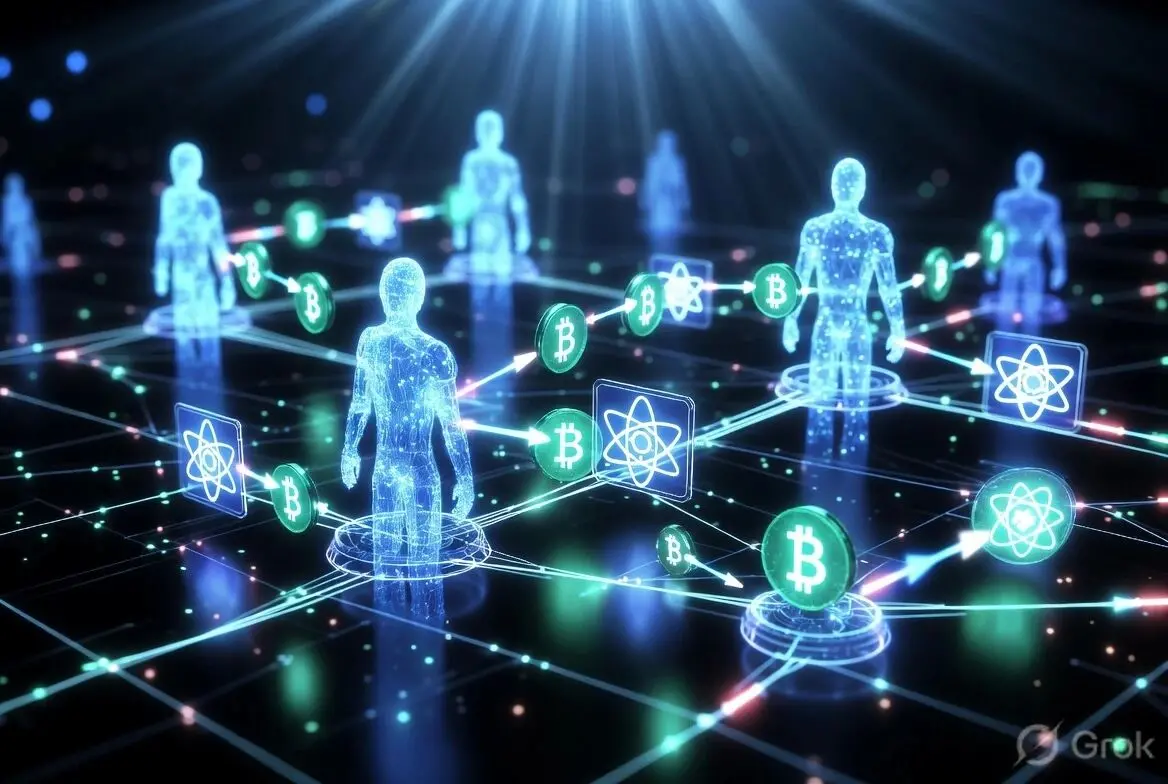
Another thing that will definitely happen is blockchain payments and token economies. Agents exchange value among themselves, with small amounts and frequent transactions, often with unfamiliar counterparts. Whether to pay and how much is decided by programs on the spot, with no human oversight. Credit cards charge 2.9% plus 30 cents per transaction, making it costly to pay one cent, as the fee would be 30 times higher; card networks cannot handle such transactions.
Visa's own research also acknowledges that cards cannot handle this segment, assigning micro-payments between machines to stablecoins. Stablecoins are a type of digital currency typically pegged to the U.S. dollar on a one-to-one basis, circulating on the blockchain, with a total supply exceeding $300 billion.
My judgment is that blockchain-based digital payments and token economies, which involve using on-chain credentials for pricing, settlement, and profit distribution, are essential basic elements of the internet of agents.
I always remember a meeting at the Digital Asset Research Institute in 2018, where Professor Zhu Jiaming said that in the long run, blockchain is not for people; it is for AI. At that time, I felt this statement was very accurate, but I couldn't understand how AI would use it. Now it is clear.
4. "AI Agent Friendly" Work
The impact of AI on job positions has always been a hot topic. In the AI era, what kind of people can survive and develop sustainably in the long term? Or to put it more bluntly, what jobs can avoid being crushed by a steamroller?
It must be jobs that collaborate friendly with AI entities.
Top AI scientists in large model companies certainly fit this description, but such individuals are extremely rare, and the barriers to entry are very high, making it inaccessible for most people.
Recently popular front-end deployment engineers (FDE) seem to have quickly fizzled out. People soon realized that this was just a trendy term for on-site outsourcing, and the key issue is that it often turns out to be a one-time deal. Various imagined AI enterprise solutions were rushed into implementation, only to find that the data quality was too poor, and the deployed enterprise AI was like the village fool, forcing a reorganization starting from the underlying data. But isn’t this the job of data engineering? As a result, FDE became Fooled Data Engineer, a data engineer who was fooled. Who would want to do this lousy job?
Currently, the trend is AI engineers who create products based on AI models and AI-Assistant Developers who use AI to assist in developing traditional software. However, if the judgments that AI Agents are squeezing software and the internet towards intelligence are correct, then these two job positions will also transform. In the past, products were made for people, but increasingly, they will be made for Agents. In the past, optimization was for search engines; in the future, it will be for Agents.
Another more common type of job is the management of AI entities.
When entities become strong enough, there’s no need to develop software; you just need to manage them well, set requirements, and make judgments and decisions at critical points to accomplish the vast majority of work. But this is still far from enough. In the future, you will need to design and organize several, dozens, hundreds, or even thousands of entities, organizing them into an efficient and powerful legion, designing efficient processes, ensuring safety, controlling expenses and Token budgets, effectively evaluating performance, and continuously improving, then competing and battling against equally sized legions of entities from your competitors.
For example, a company's procurement Agent needs to negotiate prices with sales Agents from a thousand suppliers, and the Agents on the other side are equally smart. The outcome depends on how this side divides labor, authorizes, and holds accountable. Management needs to become engineering; authority, boundaries, incentives, and audits must be trainable and measurable. This is a new management science and a new systems engineering.
Conway's Law states that the organization that designs a system will ultimately produce a system that replicates its own communication structure. In the Agent era, the members of the organization are Agents, and the system and organization become one. Whatever the organization looks like, that’s what the Agent system will look like; designing an Agent system is designing an organization.
This is not just someone’s fantasy. Microsoft stated in its annual workplace trends report that everyone will become the boss of an Agent; NVIDIA CEO Jensen Huang said that IT departments will become the HR departments for AI Agents.
Therefore, the most valuable jobs in the agent internet are, first, AI engineers who can create products and services for Agents, and second, commanders who can lead a thousand Agents to defeat another thousand Agents.
 Risk warning