Real gold and silver express confidence, NVIDIA adds $150 billion to its buyback, setting a record in U.S. corporate history
 Core Viewpoint

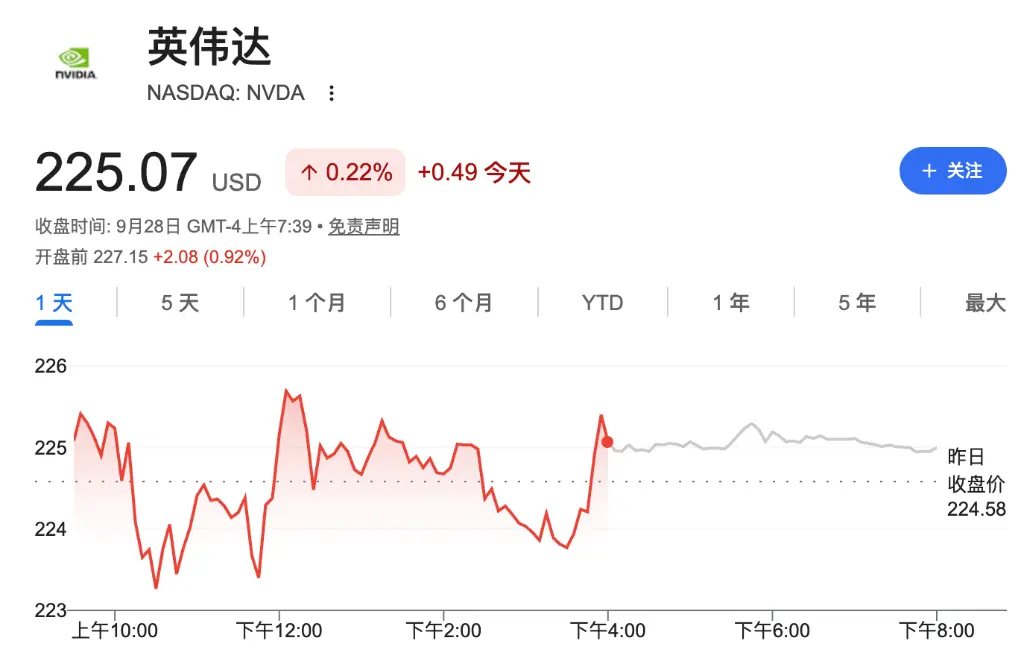
 NVIDIA announced an additional $150 billion stock buyback plan, setting a new record for the largest buyback in U.S. corporate history, surpassing Apple's previous record of $110 billion. CEO Jensen Huang stated that this move demonstrates confidence in the long-term opportunities of AI. Boosted by this news, NVIDIA's stock price rose by 1.3% in pre-market trading on Monday, after previously falling nearly 1%.
Author: Li Jia, Wall Street Journal
With continuous massive profits from its top position in the AI supply chain, Nvidia announced a stock buyback plan with an additional scale of $150 billion, setting the record for the largest buyback in U.S. corporate history.
The world's most valuable company stated on Monday that its board has approved an increase of $150 billion to the buyback plan. Combined with the existing plan, Nvidia is now authorized to spend up to $235 billion on stock buybacks before January 2028. Following this news, Nvidia's stock price rose by 1.4% in pre-market trading on Monday, although the gains later narrowed.
Nvidia co-founder and CEO Jensen Huang stated on Monday that this new plan reflects the company's "confidence in the long-term opportunities in the AI field." He emphasized that the platform transformation driven by AI and accelerated computing has brought business growth, and the company's strong cash flow generation ability allows it to return capital to shareholders while investing in advancing technological transformation.
This massive buyback initiative comes at a time when Nvidia's stock price has shown signs of slowing down its strong upward momentum. As more investors begin to question the sustainability of the AI boom, this record capital return not only directly addresses market concerns but also highlights management's high confidence in its core business monetization capabilities.
Refreshing the Record for Corporate Capital Returns in the U.S.
Nvidia's $150 billion authorization breaks the previous record of $110 billion set by Apple in 2024 for the largest corporate buyback in the U.S. According to Bloomberg, when Apple announced this buyback, the iPhone manufacturer held the top five largest buyback authorizations among U.S. companies.
Typically, large-scale buyback authorizations indicate that company management believes its stock is undervalued, but this is often also related to large mature companies facing slowing growth. For example, when Apple set its buyback record, its iPhone business was experiencing slowing growth, primarily relying on its dominance in the smartphone market to generate profits.
However, Nvidia's trajectory contrasts sharply with this. The chip manufacturer's sales continue to rise rapidly, with an expected revenue growth of about 90% this year. This indicates that while Nvidia implements substantial shareholder returns, its fundamentals remain in a phase of rapid expansion.
Strong Demand for AI Infrastructure Investment
The surge in Nvidia's profits is fundamentally due to the entire tech industry continuing to inject massive funds into AI infrastructure. According to Goldman Sachs, global investment in the AI sector is expected to exceed $1 trillion this year.
As the core computing power supporting large language models like ChatGPT, Claude, and Gemini, Nvidia's chip products remain in high demand in the market. In the fierce AI competition, many companies, including OpenAI, Anthropic, and SpaceX, are major customers. Even Google, which has its own series of AI chips, is a significant buyer of Nvidia products in its cloud computing division.
Abundant Cash Flow Supports Long-Term Valuation
The better-than-expected financial data provides solid support for Nvidia's massive buyback. According to consensus forecast data from Visible Alpha, a subsidiary of S&P Global, Nvidia generated nearly $100 billion in free cash flow in the most recent fiscal year ending in January this year. This figure is expected to more than double to $329 billion by the 2028 fiscal year.
In terms of net profit, Visible Alpha predicts that Nvidia's net profit for this fiscal year will double to $245 billion and further rise to $387 billion in the next fiscal year ending in January 2028.
In secondary market performance, since OpenAI launched ChatGPT at the end of 2022, Nvidia's stock price has increased by over 1200%. However, in 2026, the stock's remarkable growth has slowed, with a year-to-date increase of about 20%. Against the backdrop of market divergence regarding the sustainability of the AI boom, strong earnings expectations and abundant cash flow have become the core support for stabilizing investor confidence in Nvidia.

 Risk warning