Morning Report | SK Hynix's Q2 profits may hit a record high, with the combined profits of South Korea's storage giants expected to exceed 150 trillion won; Zhao Changpeng: Acquiring small and medium exchanges carries high security risks, acquisition is still possible but more complex
 July 26 Market Important Events Overview
Compiled by: ChainCatcher
What important events have occurred in the past 24 hours?
Analysis: Bitcoin's rebound faces quadruple pressure, rising U.S. Treasury yields intensify market risks
According to ChainCatcher, CryptoQuant analyst Axel Adler released a weekly analysis indicating that the U.S. 10-year Treasury yield has recently risen to about 4.7%, approaching the upper limit of the past five years. The high-interest-rate environment is tightening financial conditions, increasing financing costs and asset discount rates, and intensifying pressure on risk assets. Currently, the futures market estimates that the probability of the Federal Reserve raising interest rates at its next meeting is about 38%, but a Reuters survey of 104 economists generally expects rates to remain unchanged. In the Bitcoin market, Axel Adler pointed out that BTC rebounded about 11% from a low of around $59,000 in June to nearly $66,000, but has now fallen back to about $64,300. The market is simultaneously facing four potential risks: first, a significant compression of volatility, with actual volatility in July dropping by 31%, falling to the 8th percentile of historical ranges, indicating that more severe market movements may follow; second, persistent weakness in demand in the U.S. spot market, which has maintained a discount trading for about two and a half months, with no sustained capital inflow; third, insufficient buying liquidity in the market, with stablecoins continuously flowing out of exchanges, and new capital activity close to annual lows; fourth, investors are still realizing losses, with some positions choosing to exit during the profit recovery phase, putting pressure on prices. Additionally, Adler mentioned that MicroStrategy founder Michael Saylor has not continued to make large-scale Bitcoin purchases recently but has published a lengthy article recommending 38 books on civilization, currency, energy, and technological development, attempting to construct a theoretical framework for Bitcoin as a result of long-term financial evolution. Adler believes that the market is currently still in a critical observation phase, requiring attention to changes in liquidity, recovery in U.S. demand, and whether investor behavior improves.
Aave founder: CLARITY Act enters "final mile," if passed will bring benefits to DeFi
According to ChainCatcher, Aave founder Stani posted on the X platform stating that there is a greater need than ever for consensus among industry stakeholders to make every effort to promote the smooth passage of the U.S. CLARITY Act. Although the bill is not perfect and many details still need to be formulated by regulators, it will become the first regulatory legislation involving DeFi, providing a clear legal framework and regulatory certainty for institutions, fintech companies, and banks to participate in on-chain finance. Once officially passed, its impact on the on-chain financial ecosystem is expected to be similar to the development opportunities brought to the stablecoin industry by the previous GENIUS Act, attracting more investment and institutional funds into the on-chain space. Over the past year, especially in recent weeks and days, the Aave team has been in close communication with relevant policymakers in Washington, D.C., and is now in the "final mile" of promoting the bill's implementation, which is a crucial stage.
MiCA implementation, European crypto industry faces "major reshuffle": high regulatory thresholds may trigger a new wave of mergers and acquisitions
According to ChainCatcher, the EU's Markets in Crypto-Assets Regulation (MiCA) competitive phase is coming to an end, but the real challenges for companies are just beginning. The high costs of maintaining operational compliance may change the landscape of the European crypto industry. In the future, the focus of industry competition may shift from "who can obtain a license" to "who can bear the regulatory costs," driving companies to achieve scalable development through mergers, joint ventures, or partnerships with banks. As MiCA gradually takes effect and the UK's crypto regulatory framework is about to take shape, the European crypto industry is entering a new consolidation phase. Industry insiders believe that high regulatory standards may drive a new wave of mergers and acquisitions, and cooperation between crypto-native companies and traditional financial institutions will deepen further. This trend may be more pronounced in the UK market. The UK's Financial Conduct Authority (FCA) is developing a new regulatory framework for crypto assets, which is expected to incorporate crypto businesses into the existing financial services regulatory system, subjecting them to capital, operational, and customer asset protection requirements similar to those faced by traditional investment institutions. Steven Lightstone, a partner at Morgan Lewis's London office and co-head of the global fintech team, stated that while the FCA aims to promote market competition and support new entrants, its regulatory standards will be very strict when it comes to consumer protection. Unlike the MiCA framework, which operates independently in the EU, the UK plan will directly utilize the existing financial regulatory system to manage crypto businesses. Meanwhile, the enhancement of regulatory certainty is driving European banks to accelerate their entry into the digital asset space. Sygnum Europe CEO Simon Schneider stated that currently, less than 20% of banks in Europe offer crypto-related services, indicating a significant market gap. The greatest value of MiCA is not just in creating a new licensing system but in providing legal certainty for financial institutions entering the digital asset market. He pointed out that after the introduction of regulations on distributed ledger technology, most large Swiss banks have begun to offer digital asset services, and other regions in Europe may replicate this path in the future. In the future, banks may not necessarily replace crypto-native companies but are more likely to rely on specialized infrastructure service providers for cooperation in custody, brokerage, staking, and asset tokenization. As companies that fail to obtain MiCA licenses gradually exit the European market, assets may further concentrate among regulated entities. However, Schneider believes that self-custody and institutional custody models will coexist for a long time. Industry insiders believe that the European crypto industry is entering a "regulation-driven consolidation cycle." For crypto startups that have relied on rapid innovation and light asset models in the past, future core competitiveness may no longer be just technological speed but compliance capability, capital scale, and the ability to integrate financial infrastructure.
Data: 10 listed companies hold over 1 million BTC, Strategy's holdings valued at approximately $58 billion
According to ChainCatcher, Bitcoin.com reports that as of July 25, 2026, 10 listed companies collectively hold over 1 million BTC. Strategy holds 843,775 BTC, valued at approximately $58 billion at current prices, making it the largest corporate holder of Bitcoin globally. On the list, Twenty One Capital holds 43,514 BTC, Metaplanet holds 43,000 BTC, Mara Holdings holds 36,303 BTC, Bullish holds 24,300 BTC, and Strive holds 19,921 BTC. SpaceX holds 18,712 BTC, Coinbase Global holds 16,492 BTC, Riot Platforms holds 15,680 BTC, and Cleanspark holds 13,924 BTC. SpaceX went public on Nasdaq on June 12, 2026, raising approximately $85.7 billion in its IPO. Since 2026, Riot Platforms' stock price has risen by 73%, Cleanspark by 39%, and Mara Holdings by 31%. During the same period, Strategy has fallen by 40%, Metaplanet by 49%, Twenty One Capital by 48%, and Coinbase Global by 31%.
Zhao Changpeng: Acquiring small exchanges poses high security risks, acquisition still possible but more complex
According to ChainCatcher, Binance founder CZ responded to the question of "why not acquire small CEXs" by stating that acquiring centralized exchanges is different from other businesses. Once a hack occurs after the acquisition, it is difficult to determine whether it is a leftover backdoor from the previous team or a new issue, thus increasing security and compliance risks. He emphasized that acquiring CEXs is still possible, but due diligence and risk control processes are more complex.
U.S. government has implicitly established a corporate equity investment portfolio of about $27 billion
According to ChainCatcher, Fortune reports that the Trump administration has invested about $26.7 billion in approximately 30 equity or quasi-equity transactions. The largest investment is a 9.9% stake in chip manufacturer Intel, currently valued at about $42 billion. Other investments include $400 million in rare earth miner MP Materials, "golden shares" retained during the acquisition of U.S. Steel by Japan's Nippon Steel, and multiple equity stakes in several quantum computing companies. The report states that these holdings are spread across at least four agencies: the Department of Commerce (17 transactions), the Department of Defense (7 transactions), the U.S. International Development Finance Corporation (DFC, 6 transactions), and the Department of Energy (2 transactions). Only the DFC has explicit statutory authority for equity investments (established by Congress in 2018 for overseas development projects). Currently, there is no unified public ledger of government holdings, with the most complete public tracking maintained by the Council on Foreign Relations. Some transactions are only in the state of signing agreements or nearing term sheets, especially the 9 quantum computing-related transactions announced by the Department of Commerce within a week.
SK Telecom to invest 750 billion KRW to establish AI data center subsidiary SK Hyper
According to ChainCatcher, South Korean SK Telecom (SKT) announced the establishment of a new company specializing in artificial intelligence data centers (AIDC) called SK Hyper and plans to invest a total of 750 billion KRW to promote the expansion of large-scale AI data center operations. It is expected to initially invest 330 billion KRW and plans to cumulatively invest 750 billion KRW by December 2030, ultimately holding 100% equity in the company. The newly established SK Hyper will be responsible for the development and commercialization of future large AI data center projects, including site selection, power infrastructure, and customer business cooperation, and will later introduce financial investors (FI) for equity investment and project financing (PF) as external funding.
North Korean hacker group BlueNoroff uses fake Zoom and Teams meetings to scan crypto wallets and deploy malware
According to ChainCatcher, Crypto.news reports that the North Korean-linked hacker group BlueNoroff uses fake Zoom and Microsoft Teams meetings to analyze cryptocurrency users before deploying malware. The hackers first take control of the accounts of trusted contacts in the crypto industry and then send seemingly normal meeting links through Calendly, pointing to spoofed Zoom/Teams domain names. Once users enter the fake meeting page, the page quietly scans the wallets in their browsers, determining whether to continue the attack based on the wallet's value. The fake meetings will prompt users to "update Zoom/Teams" or run commands, which actually download malware (supporting Windows and macOS). The malware steals browser keys, system data, and Telegram sessions.
Cascade announces CLS incident progress: funds have been recovered, users can receive 100% full compensation
According to ChainCatcher, Cascade announced on the X platform that the incident involving the withdrawal of CLS funds has been resolved, and the parties involved have cooperated to return all stolen funds. All users holding funds in CLS will be able to receive 100% full compensation based on the value as of July 15, 2025, at 21:08:00 UTC. The claims function will be opened in the coming days. ChainCatcher previously reported that MAX, the Discord administrator of the multi-asset perpetual contract platform Cascade, stated in the channel that the Cascade CLS treasury had allegedly encountered a security vulnerability, resulting in a loss of approximately $1.3 million. The platform has currently suspended all trading and withdrawals and invited SEAL 911 and other third-party security teams to investigate and handle the matter.
Musk's net worth plummets, jokingly refers to himself as a "former trillionaire"
According to ChainCatcher, Jinshi reports that Tesla (TSLA.O) stock price has fallen nearly 20% this week, closing at $313.03 per share, marking the largest weekly decline since 2022; SpaceX (SPCX.O) closed at $115.07 per share, the lowest level since the company's IPO last month. Bloomberg's Billionaires Index shows that Musk's personal wealth evaporated by about $130 billion (approximately 880 billion RMB) in just five trading days, just weeks after he became the first billionaire in human history to surpass $1 trillion in wealth. Musk himself jokingly referred to himself as a "(former) trillionaire" on social media.
Mango Labs founder: Longxin Technology is a rare 1:5 betting opportunity
According to ChainCatcher, Mango Labs founder @dovwo expressed his market views, stating, "I have gone long on Longxin Technology; in my view, Longxin is a rare 1:5 betting opportunity with a downside of 20% and an upside of 100%, a one-to-five risk." @dovwo listed the reasons for his bullish outlook as follows: low circulation ratio, regulatory intervention, and institutions optimistic about its investment opportunities below a market cap of 30 trillion. The suggested strategy is "if it opens high tomorrow, directly close the position to take profit; if it opens low and rises, patiently wait, and resolve the battle within three days."
Crypto KOL: The migration of Binance Alpha and signal traders may be the main reason for the closure of BitMart, BitMex, and other CEXs
According to ChainCatcher, crypto KOL Phyrex posted on the X platform stating, "BitMart and BitMex did not close due to a blowout; it is very different from the sacrifices of FTX, these two mainly have business issues." He revealed that in 2023, BitMart had approached his acquaintances for acquisition discussions, and although a lot of data was done, it ultimately came to nothing. The decline of many third-tier exchanges is partly due to the impact of Binance Alpha. Small exchanges are essentially the base for various altcoins, pump-and-dump coins, and community coins, but the emergence of Alpha has provided better sources for these coins, leading to a significant reduction in listing fees for third-tier exchanges and a decrease in joint market-making profits. Another reason is the signal teachers; although the total number of signal teachers is not large, their followers come in waves, and these teachers generally move between various exchanges. Once a new exchange offers better profits, these teachers quickly lead their followers to migrate. The recent closures of several well-known exchanges generally follow this pattern.
WOO X ambassador: Bitmart's withdrawal restrictions due to security reasons may constitute an encroachment on user funds
According to ChainCatcher, regarding the details of the withdrawal announcement released by Bitmart, WOO X ambassador Baki posted on the X platform stating, "BitMart is restricting user withdrawals under the pretext of security, and its operation to close the automatic withdrawal function may lead to a large number of users being unable to complete fund withdrawals. The platform has changed the withdrawal process to manual review, requiring users to submit account identity and KYC information verification, login device and IP address and account security status verification, withdrawal address and blockchain transaction risk review, source of funds and transaction history review, and Travel Rule compliance and sanctions screening, among other regulatory checks. Additional documents such as proof of identity, proof of address, proof of source of funds, or proof of ownership of the withdrawal address may also be required." Baki suggested that users with P2P options could withdraw to their bank accounts through that channel; he also emphasized that the crypto market is not decentralized but controlled by a few large groups, exchanges, and funders.
Data: AFX Trade hacker has exchanged 12,467 ETH for BTC
According to ChainCatcher, on-chain analyst Yu Jin monitored that the AFX Trade hacker has exchanged 12,467.4 ETH for BTC. On July 23, the AFX Trade Arbitrum cross-chain bridge was hacked, resulting in a loss of approximately 24 million USDC. Subsequently, the attacker gradually transferred the stolen funds from Arbitrum to Ethereum.
Data: Robinhood ecosystem token PONS market cap briefly surpassed $56 million, setting a new historical high
According to ChainCatcher, GMGN market data shows that the market cap of the Robinhood ecosystem token PONS briefly surpassed $56 million, setting a new historical high, currently reported at $49.8 million, with a daily increase of over 24%. The token's price is highly volatile, driven by market sentiment and hot events, lacking actual value support, and investors should be aware of the risks.
U.S. Secret Service recovers over $25 million in cryptocurrency through five investigations
According to ChainCatcher, Bitcoin.com reports that the U.S. Attorney's Office for the District of Columbia and the U.S. Secret Service's Washington field office announced that multiple investigations by the cyber fraud task force have seized over $25 million in cryptocurrency, related to international fraud schemes targeting residents of the U.S. and Canada. The U.S. Attorney for the District of Columbia has submitted five civil forfeiture complaints seeking to seize the recovered cryptocurrency. Investigators confirmed multiple money laundering networks and thousands of global victims, with the largest complaint involving a romance scam affecting over 200 victims, amounting to approximately $12.1 million. Another complaint involves a network of suspicious cryptocurrency wallets reported to the U.S. Secret Service by Canadian authorities, amounting to approximately $10.4 million. Agents tracked over 270 suspected victim transactions related to a fraudulent investment platform, with these two cases accounting for about 85% of the assets involved in the five forfeiture complaints. The remaining cases involve blocked withdrawals, fake investment accounts, and recovery scams. Investigators stated that most suspected money launderers are located in Southeast Asia and identified internet protocol addresses associated with China, Malaysia, and Cambodia, with the five investigations still ongoing.
Lido responds to stETH yield calculation anomaly: issue has been fixed and oracle upgraded, user funds unaffected
According to ChainCatcher, Ethereum staking protocol Lido stated on the X platform that the stETH Rebase has been completed as expected, and ETH yields that were missed due to insufficient calculations have been compensated, corresponding to an annual percentage rate (APR) of about 2.29%. The protocol's oracle has also been updated and audited, with the new version improving reporting processing speed and helping to quickly locate the cause of similar issues in the future. Regarding the yield calculation anomaly, Lido stated that contributors are still conducting root cause analysis, and more investigation details will be published on the official forum and social media. Throughout the entire incident, user funds have never faced risk. Preliminary assessments suggest that the issue may stem from a special edge case: a validator in a pending deposit state was omitted from the yield report, resulting in some staking yields not being included in the calculations. Lido stated that a complete post-mortem report will be released in the coming days to further explain the cause of the issue, corrective measures, and future improvement plans.
TRUMP team address unlocked yesterday, 13.8 million tokens transferred to CEX
According to ChainCatcher, on-chain analyst Yu Jin monitored that the tokens transferred from the TRUMP team address yesterday have entered CEX, with 13.8 million TRUMP (valued at $21.94 million) transferred to Binance, OKX, and Kucoin 15 minutes ago.
Tom Lee: Ethereum will not be eroded by L2, expected to become the most widely used settlement layer for finance and AI agents
According to ChainCatcher, Bitmine chairman Tom Lee posted on the X platform stating that Ethereum is expected to become the most widely used settlement layer for finance and AI agents, "ETH is the on-chain currency." Additionally, in an interview he shared, Tom Lee responded to market concerns that Ethereum is being eroded by Layer 2, stating that he does not agree and pointed out that while Layer 2 networks have attracted tens of millions of real-world users into the on-chain ecosystem, Ethereum's mainnet is still further solidifying its position as the primary economic settlement center, with the fast confirmation mechanism reducing transfer friction by about 98%.
Three iOS users lost $1.8 million in Bitcoin due to downloading a fake Sparrow Wallet, suing Apple for inaction
According to ChainCatcher, MacRumors reports that three iOS users have sued Apple in federal court in California, alleging that after downloading a fake Sparrow Wallet app from the App Store between May and August 2025, they collectively lost about $1.8 million in Bitcoin. The lawsuit claims that even when victims reported the fraudulent activity, Apple rarely or never took any action, and other fake Sparrow apps remain in the App Store. Craig Raw, the developer of Sparrow Wallet, publicly criticized Apple for its slow response to the appearance of multiple counterfeit versions of its app in the App Store, failing to promptly remove the fake apps, and even allowing other fake versions to still exist.
SK Hynix Q2 profits may set records, combined profits of South Korea's storage giants expected to exceed 150 trillion KRW
According to ChainCatcher, Jinshi reports that SK Hynix will announce its second-quarter results on the 29th, and following Samsung Electronics, SK Hynix is expected to also set a new high in profits for the second quarter of this year. According to reports from 14 brokerages compiled by South Korea's financial information agency Yonhap Infomax over the past month, SK Hynix's second-quarter revenue and operating profit are expected to be 84.0597 trillion KRW and 64.0899 trillion KRW, respectively. The expected operating profit for the second quarter is about 17 trillion KRW higher than the total operating profit of 47.2 trillion KRW for last year. Adding the operating profit of 37.6103 trillion KRW from the first quarter of this year, SK Hynix's operating profit for the first half of the year will exceed 100 trillion KRW. Earlier this month, Samsung Electronics also released preliminary performance reports, with its DS division performing strongly, achieving an operating profit of 89.4 trillion KRW. If SK Hynix's performance meets market expectations, the combined operating profits of the two companies in the second quarter will exceed 150 trillion KRW.
Meme Popularity Rankings
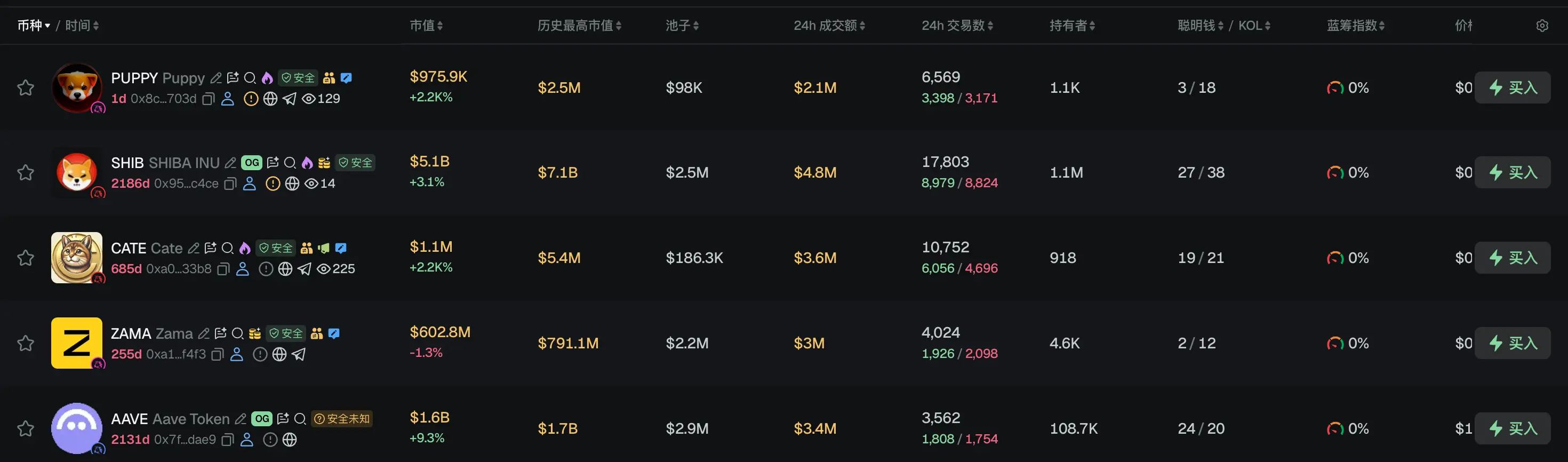
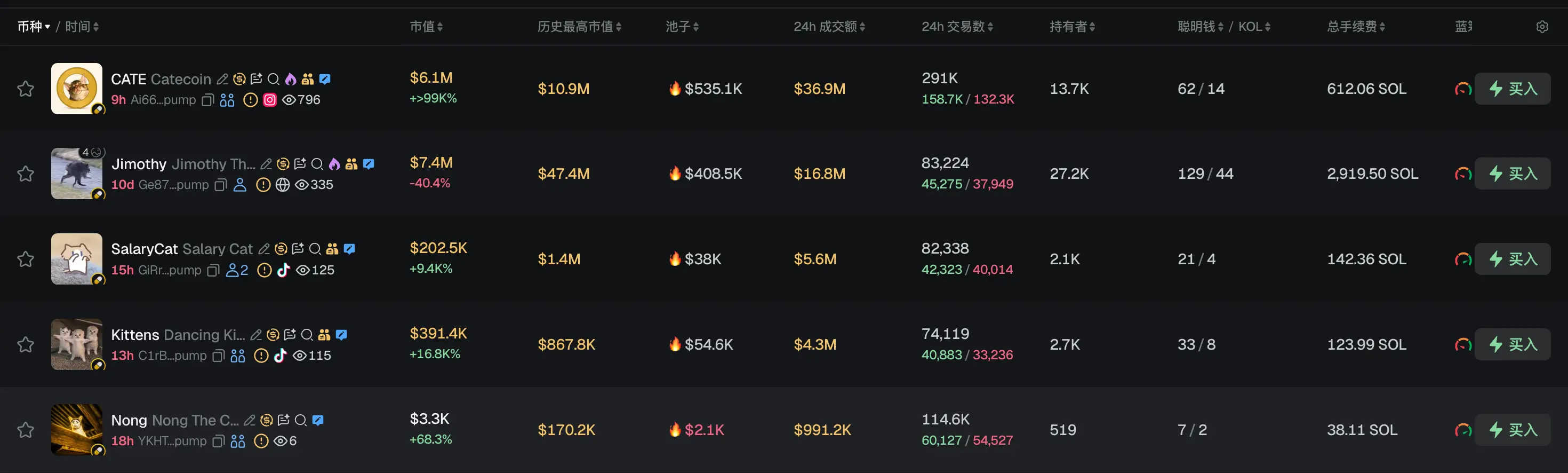
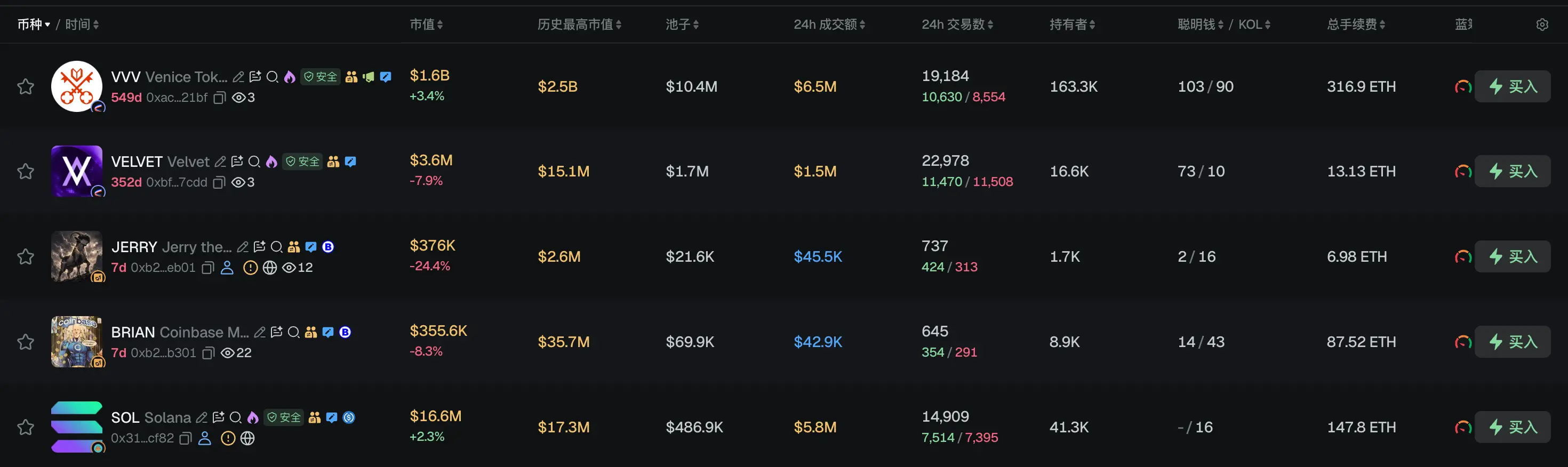
According to the meme token tracking and analysis platform GMGN market data, as of July 27, 09:30,
The top five popular ETH tokens in the past 24 hours are: PUPPY, SHIB, CATE, ZAMA, AAVE
The top five popular Solana tokens in the past 24 hours are: CATE, Jimothy, SalaryCat, Kittens, Nong
The top five popular Base tokens in the past 24 hours are: JERRY, BRIAN, SOSO, CATE, AiFi
What are some noteworthy articles to read in the past 24 hours?
Given the current situation, although cases of exchanges collapsing have emerged, it is still difficult to conclude that the bear market has truly bottomed. After all, the crypto industry has not reached a point of complete exhaustion, nor have there been historical blowout events like Mt. Gox or FTX. Regardless, the industry continues, as stated in Bitmart's last tweet: "The future still belongs to blockchain."
The "difficult summer" for stock market bulls: $100 oil prices, AI backlash, tariff reboots
Bank of America European strategy chief Sebastian Raedler's judgment is straightforward: profit margin expectations, five-year forward earnings growth, and the global market cap/GDP ratio are all at historical highs, while risk premiums are at a 20-year low. "The market is pricing in a scenario where everything goes smoothly and without risk," he said. He expects global stock markets to have another 7% to 8% downside.
The report also states in its disclaimer that on-chain attribution is directional estimation and cannot be fully adjusted to total supply. For USDC, the core takeaway from this report can be summarized as follows: the most important insight regarding USDC is that although it has become the core asset for on-chain dollar liquidity, the current demand structure remains highly dependent on DeFi. When DeFi expands, USDC grows rapidly as collateral, margin, and liquidity assets; when DeFi cools down, this portion of operating capital also contracts rapidly. For Circle, the key to determining profit stability and valuation ceilings in the future lies in whether it can upgrade USDC from DeFi operating capital to a foundational dollar asset in payments, corporate finance, RWA settlements, and institutional financial systems.
Abraxas Capital, an institution that makes on-chain analysts uneasy
Beyond ETH, Abraxas's holdings in tokenized gold are also dominant. Abraxas holds approximately 86,947 XAUT across wallets, accounting for 12.3% of the supply, valued at about $400 million. At one point in June 2025, one Abraxas address contributed 99.26% of the liquidity pool for Uniswap V3 XAUT/WBTC. The mystery surrounding Abraxas has not diminished. We still do not know why it establishes each position, nor can we deduce the entire fund's strategy and performance from on-chain labels. But clearly, they do not need to operate social media. The scale of capital flow itself is the most expensive advertisement.
Why are more and more Indian executives emerging in the global payments circle?
The truly scarce individuals in the future payment industry may not be those who understand a particular product the best. Instead, they are those who can connect: banks, regulators, technology, business, capital, teams from different countries, and keep complex systems running smoothly. Many changes among Chinese payment professionals, from "discontent" to "acceptance," are actually a re-recognition of a kind of globalization capability. This is not about Indian talent replacing Chinese talent, but rather the global payment industry entering a new competitive stage. Chinese payment talent already possesses world-class business capabilities. The next stage requires bridging how these capabilities can be seen, connected, and amplified within global organizations. Because the future truly belongs to the era of global talent, where the competition is not just about the ability to get things done, but the ability to make things happen globally. Appendix: A map of Indian executives and entrepreneurs in the global fintech and payments ecosystem (60 individuals), with data sourced from the internet.
Wintermute: Three new directions for AI x crypto that we are optimistic about
R[3]sidency × Construct accelerator: The infrastructure needed for the machine economy does not yet exist. This is where the work lies, and it is what Wintermute is looking for. They want to support founders who see new problems emerging between financial rails, autonomy, and trust—those who can deliver products on existing rails while adapting to the evolution of standards. This is the purpose of R[3]sidency × Construct: 8 teams, each with $300,000, 12 weeks in London, 30+ mentors, and a Demo Day in London and New York. Operated in collaboration with top partners: Fabric Ventures, Solana, and Coinbase. If you are building for a world where machines and humans trade and operate in parallel—they want to support you.
 Risk warning



Popular articles