Which of the nine major cryptocurrency derivatives exchanges is attracting real liquidity?
 Core Viewpoint

 The competitive landscape of exchanges from the perspective of open interest contracts.
Author: momo, ChainCatcher
Introduction:
As perpetual contracts gradually become the core trading scenario in the crypto market, the competition among exchanges is no longer just about "who has higher trading volume," but rather who can accommodate more leveraged funds, retain more long-term positions, and ultimately become the true liquidity center of the market.
Among all derivative indicators, Open Interest (OI) is one of the data points that best reflects this competitive landscape.
OI represents the total value of contracts that are currently open in the market; essentially, it is the total amount of leveraged positions that traders still hold and have not closed. Compared to trading volume, which can be easily influenced by wash trading, activity incentives, and high-frequency trading, OI is closer to the true "stock fund pool" of the exchange. Each OI indicates that users have genuinely occupied margin, the platform has genuinely borne the risk of liquidation, and the market has genuinely formed risk exposure.
Especially at this stage, with the rise of on-chain perpetual contracts and the global redistribution of trading liquidity, changes in OI are not just fluctuations in data from a single platform, but a microcosm of the evolution of the entire exchange competitive landscape.
This article will analyze the OI performance of leading Chinese exchanges and major competing platforms in April from multiple data dimensions to dissect the current competitive situation in the derivatives market (data source: Coinglass). The core findings of this article are as follows:
Binance leads with a significant OI share of 29%, while Bybit and MEXC rank second and third with market shares of 12.78% and 12.13%, respectively.
Hyperliquid has the highest OI/trading volume ratio at 1.44, indicating a more pronounced position retention characteristic and relatively lower short-term turnover; OKX and HTX rank lower, with a higher proportion of short-term trading.
Binance and OKX have relatively sufficient reserve asset scales compared to OI; MEXC has the highest OI/PoR ratio, indicating a higher leverage-bearing intensity.
Only MEXC and KuCoin saw their OI reach new highs for the year in April, while most other platforms have not yet recovered their January peaks.
The OI growth of MEXC and KuCoin is accompanied by higher funding rates and volatility, with bullish sentiment relatively more concentrated; Binance's OI growth is relatively stable, and its rate structure is more balanced.
1. OI Market Size and Market Share
First, let's look at the overall market level. According to Coinglass data, the daily average open interest in the global derivatives market in April 2026 was $123.083 billion, with the monthly peak occurring on April 18, reaching $133.255 billion.
Focusing on nine mainstream exchanges, namely Binance, Bybit, MEXC, Gate, OKX, Bitget, Hyperliquid, KuCoin, and HTX, we calculated their daily average OI for April and their market share among the nine exchanges.
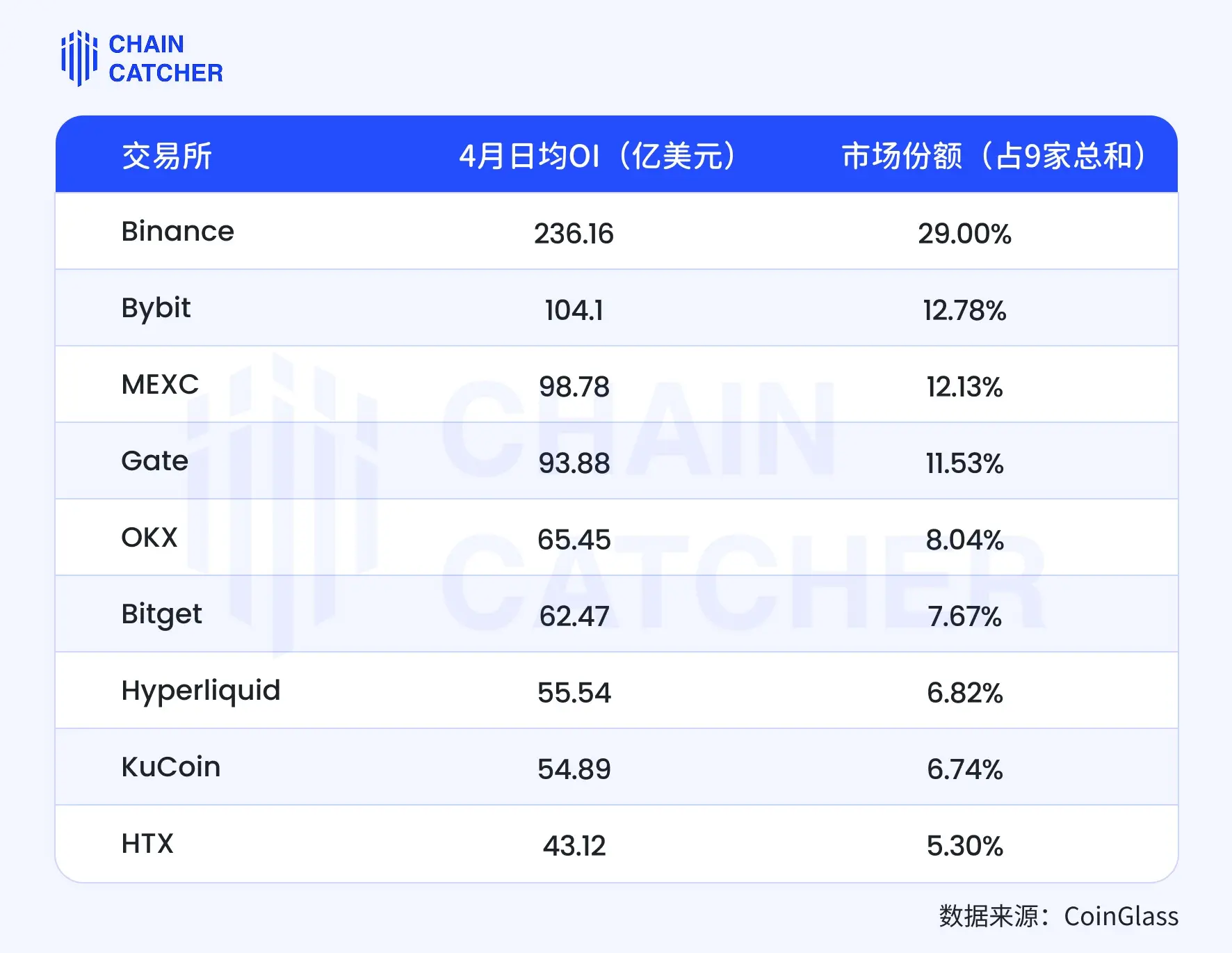
Binance's daily average OI in April exceeded $23.6 billion, firmly holding the first place with a 29% share, which is higher than the combined total of the second and third places, demonstrating a clear advantage. The second tier consists of Bybit, MEXC, and Gate, with shares ranging between 11.5% and 13%, with the three closely competing.
The third tier includes OKX, Bitget, Hyperliquid, and KuCoin, with shares falling in the range of 6.7% to 8.0%.
Notably, Hyperliquid, as the only decentralized derivatives platform, ranks seventh, surpassing mainstream CEXs like KuCoin and Bitget, while HTX ranks last with 5.3%, showing a significant gap from the leaders.
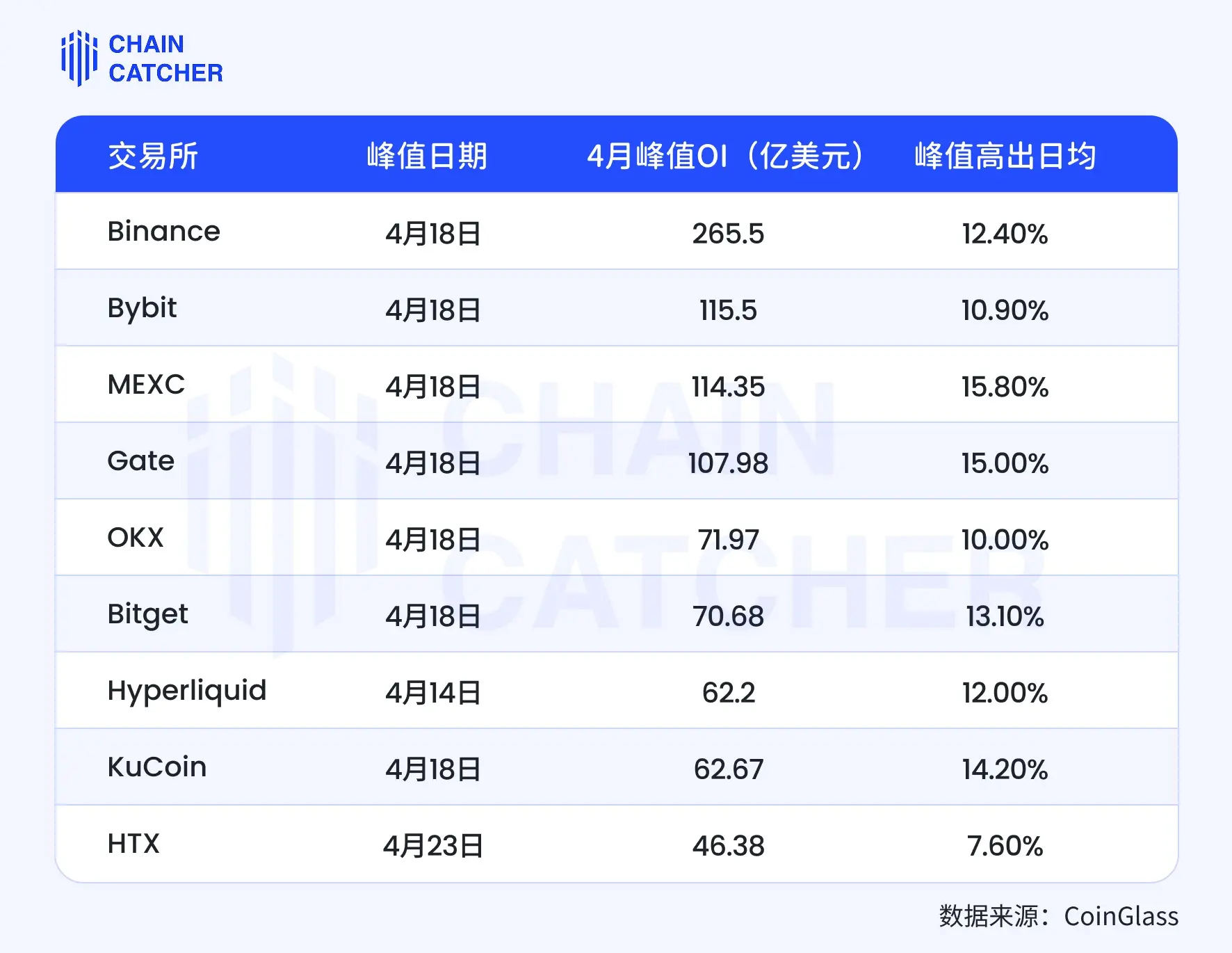
Next, looking at the peak values of each exchange in April and the differences from their daily averages, we can gauge the sensitivity of their OI to market sentiment and liquidity depth.
The vast majority of exchanges saw their peaks on April 18, consistent with the overall market peak.
In terms of absolute peak values, Binance reached $26.55 billion on April 18, which is 2.3 times the $11.55 billion of the second-place Bybit, demonstrating Binance's ability to absorb more positions during market fluctuations.
MEXC and Gate's peak values fluctuated more than 15%, significantly higher than Binance's 12.4% and Bybit's 10.9%, indicating that the OI of these two platforms is more affected by short-term sentiment, possibly reflecting more active short-term capital speculation. Although Binance had the largest absolute increase, its relative volatility was at a moderate level, showing that its liquidity pool is deep enough to better absorb sudden capital shocks.
Hyperliquid's peak occurred on April 14, four days earlier than the mainstream market peak, with its peak exceeding the daily average by 12.0%, roughly on par with Binance, but its pulse rhythm is independent of CEXs, indicating that on-chain derivatives sometimes reflect changes in high-risk preference capital sentiment earlier.
2. OI Growth Trend
From January to April, all exchanges saw a significant decline in OI in February, which is related to the overall market correction. Starting in March, the trends began to diverge.
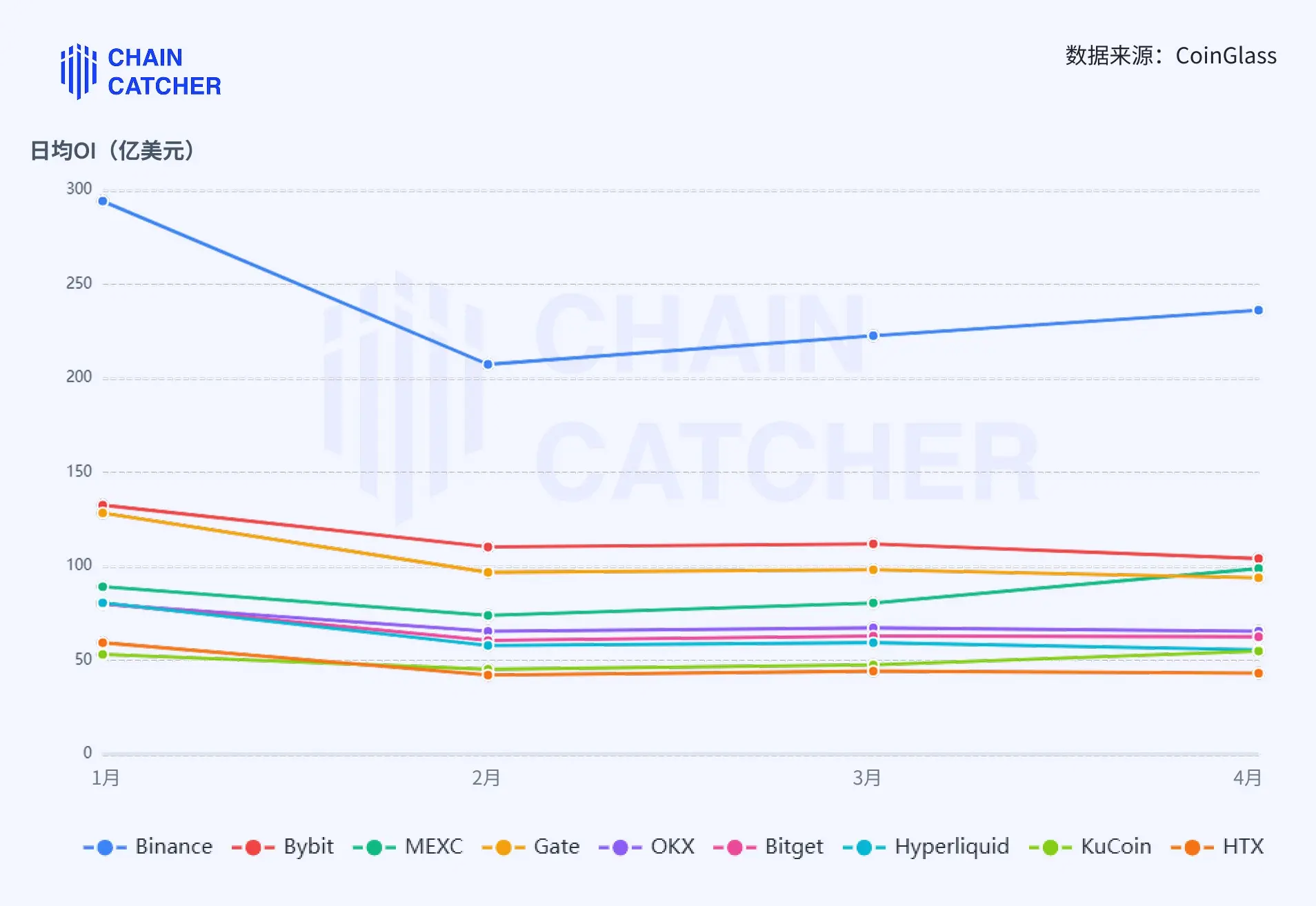
Binance opened high in January with $29.416 billion, then plummeted to $20.733 billion in February, a decrease of 29.5%. It then gradually rebounded over the next two months, reaching $23.616 billion in April. Although the absolute volume is still far ahead, the OI has not returned to the January peak, showing an overall pattern of "high opening, low going down, then rebounding, but not reaching new highs."
MEXC and KuCoin are the only two exchanges with OI in April significantly higher than in February and March. MEXC rebounded from $7.388 billion in February to $9.878 billion in April, surpassing January's $8.912 billion, achieving a V-shaped reversal and setting a new high for the year. KuCoin rose from $4.522 billion in February to $5.489 billion in April, also exceeding January's $5.311 billion, with a rebound stronger than most CEXs. This counter-trend growth may indicate a surge in specific high-volatility coins or differentiated contract products, showing that some high-risk preference capital is migrating to platforms focused on small to mid-cap coins.
The OI of Bybit, Gate, OKX, Bitget, Hyperliquid, and HTX has fluctuated slightly or continued to decline after the drop in February, failing to recover lost ground. Among them, Hyperliquid, Gate, and Bybit saw relatively more significant declines, with April OI down approximately 31%, 27%, and 21% from January, respectively. This data performance indicates that the existing capital, primarily composed of institutions or experienced traders, is currently maintaining a wait-and-see strategy; although asset efficiency is high, activity has not yet returned.
3. Position Stickiness (OI / Trading Volume)
OI measures the "existing leveraged scale" in the market, while the OI/trading volume ratio essentially measures the "position retention characteristics behind the trading volume." When trading volume grows rapidly but OI increases only slightly, it indicates that more transactions come from short-term turnover rather than the continuous accumulation of new risk exposure. At this point, market prosperity may reflect more liquidity circulation rather than genuine capital expansion.
We calculated the daily average OI of the nine exchanges in April divided by their daily average trading volume to obtain their respective OI/trading volume ratios.
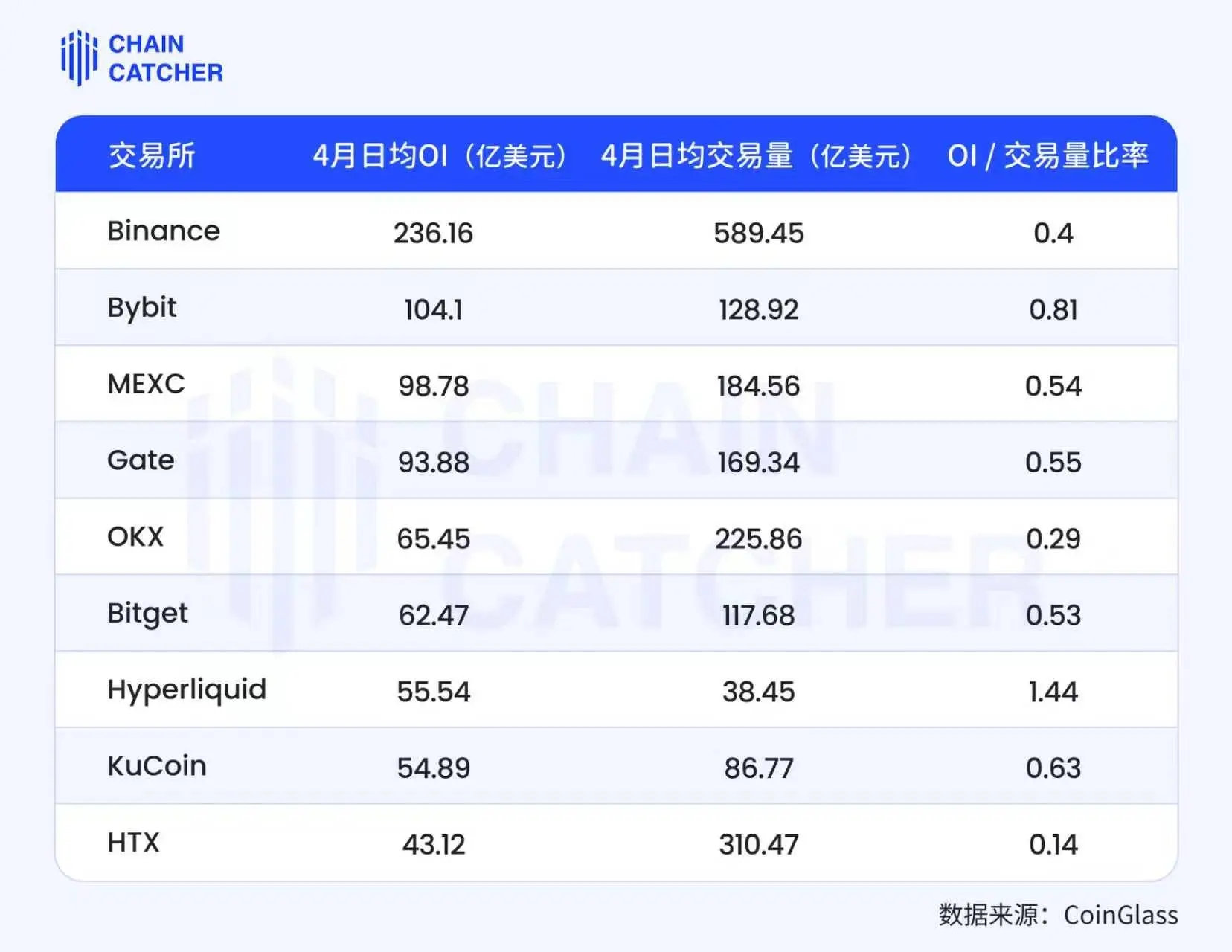
From the ratio distribution, the exchanges exhibit significantly different user position characteristics.
Hyperliquid ranks first with a ratio of 1.44, also being the only platform where OI exceeds daily average trading volume, indicating a higher position retention efficiency and relatively lower short-term turnover. This year, crypto researcher Prathik Desai also indicated in a blog that the OI/trading volume ratio of on-chain perpetual contract platforms is generally higher than that of centralized exchanges, reflecting that DEX users are more inclined towards holding positions rather than high-frequency turnover.
Bybit performs best among CEXs with a ratio of 0.81, indicating that its users have a relatively strong willingness to hold positions. KuCoin, Gate, MEXC, and Bitget are in the middle range, with similar ratios and not much difference in retention efficiency.
Binance's ratio is 0.40, ranking seventh among the nine. This does not indicate weak retention capability but rather that its trading volume base is too large. With a daily average of $58.9 billion, it is nearly five times that of the second-place Bybit. Under such a massive flow, it still retains $23.6 billion in OI, making its absolute stock the largest in the market.
OKX and HTX have ratios of 0.29 and 0.14, respectively, ranking last. Both have relatively high daily average trading volumes, but OI is significantly low, indicating a higher proportion of short-term turnover in trading volume and relatively low capital retention efficiency. This structure may face faster liquidity contraction pressure during increased market volatility.
4. Leverage Pressure (OI / Asset Reserves)
The OI/PoR (Asset Reserves) ratio measures how much open interest each dollar of reserves needs to support.
A lower ratio means that the platform's reserve scale is relatively more sufficient; a higher ratio indicates that the platform is bearing a larger open leveraged position under relatively limited reserves.
Since Hyperliquid adopts an on-chain transparent liquidation mechanism, its asset structure is relatively simple, and its reserves are almost entirely composed of stablecoins, this article uses it as a reference anchor for a "high transparency leverage structure" to observe the relative relationship between each CEX's reserve scale and OI, rather than an absolute safety standard.
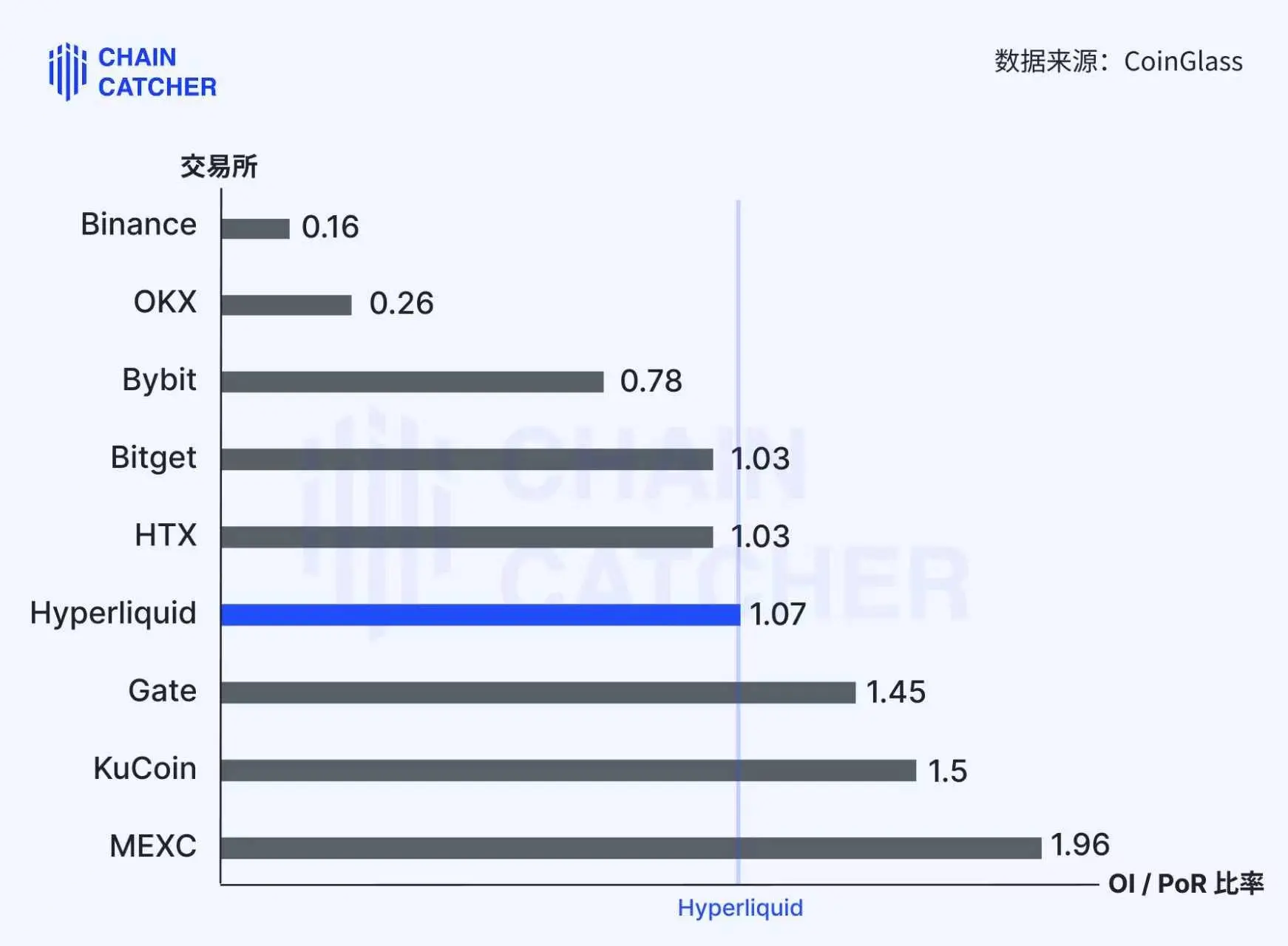
Using Hyperliquid's 1.07 as a reference anchor, the CEXs show clear differentiation between their reserve scales and OI.
Binance and OKX have significantly lower ratios, indicating that their reserve asset scales are more sufficient relative to OI. Among them, Binance's daily average reserve assets are more than six times OI, presenting a relatively conservative leverage-bearing structure among leading exchanges; OKX also has a large reserve coverage space.
Bybit's ratio is 0.78, in the middle range. Compared to January, its reserve asset scale has grown faster than OI, indicating an overall improvement in structure.
Bitget and HTX both have ratios around 1.03, close to Hyperliquid's reference structure, indicating a relatively balanced relationship between their OI and reserve scales.
Gate and KuCoin have ratios above the reference level, meaning they are bearing larger open leveraged positions under relatively limited reserve scales. Among them, Gate.io's daily average reserve is about $6.46 billion, corresponding to about $9.39 billion in OI; KuCoin's reserves and OI also show similar characteristics.
MEXC's ratio reaches 1.96, the highest among the sample. Its daily average reserve is about $5.03 billion, corresponding to about $9.88 billion in open contracts, showing a high leverage-bearing intensity. According to CoinMarketCap data, MEXC has a high proportion of stablecoins in its reserves, which helps enhance liquidity allocation capability; however, at the same time, a higher OI/reserve structure also means that the platform has higher requirements for liquidity management, risk control, and liquidation mechanisms.
From another perspective, a higher OI/PoR ratio also means that the platform supports a larger scale of contract trading activities per unit of reserve assets, reflecting a higher capital utilization intensity. However, this high-efficiency structure is often accompanied by higher volatility sensitivity, which significantly raises the demands on the platform's risk control system during extreme market conditions.
5. Stability of Funding Structure (Funding Rate)
Let's take a look at the funding rates, which reveal the "distribution quality" of leverage structures across different exchanges: some platforms are expanding healthily, some are crowded on one side, and others are engaged in existing speculation amid liquidity withdrawal.
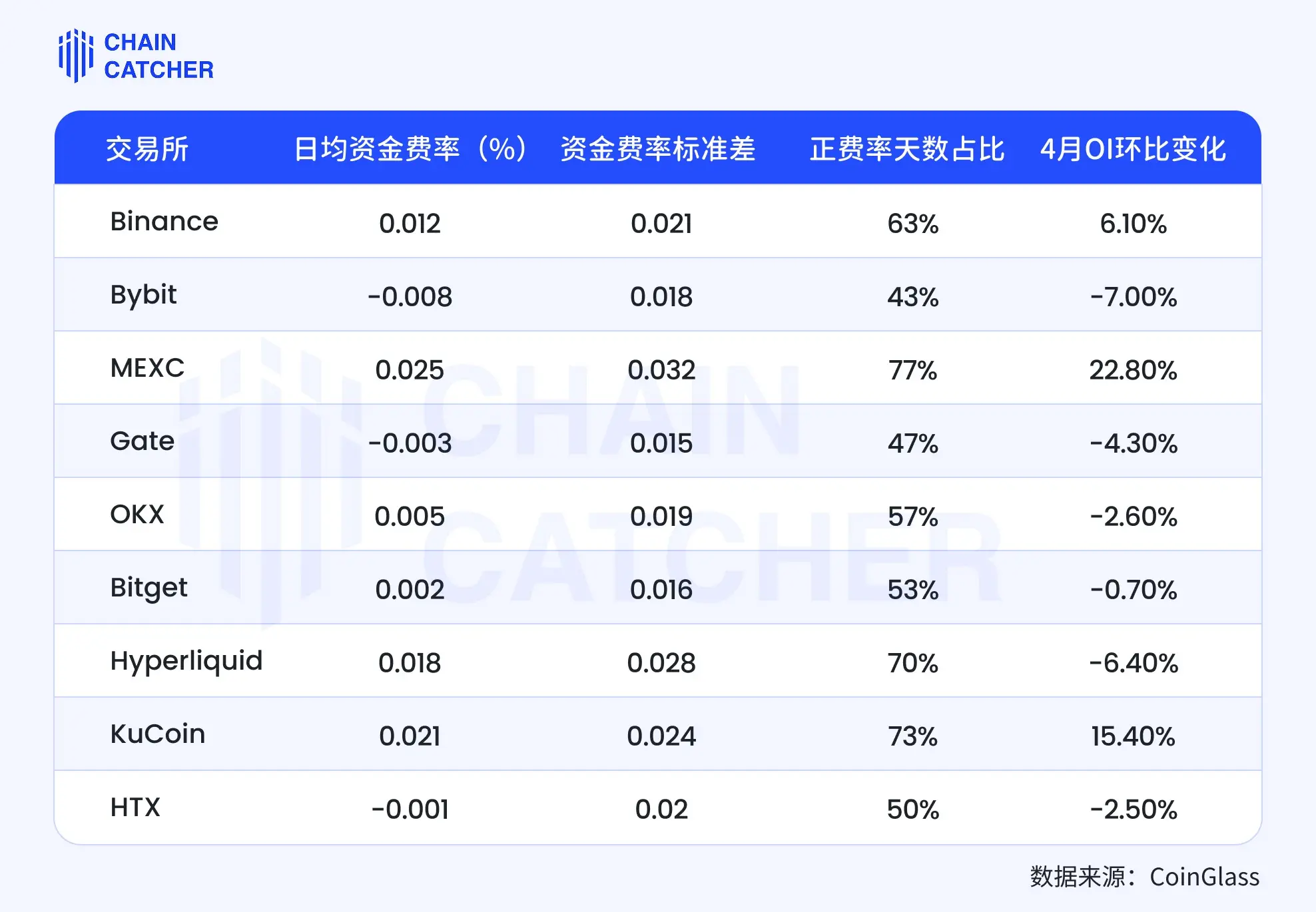
In April, MEXC and KuCoin's OI grew by 22.8% and 15.4%, respectively, but their daily average funding rates reached 0.025% and 0.021%, with the proportion of positive rate days reaching 77% and 70%, respectively, indicating that new positions are highly concentrated on the bullish side. At the same time, their funding rate standard deviations of 0.032 and 0.024 are also the highest among the nine.
Although a high standard deviation does not directly equate to frequent sentiment switches, it may also reflect sustained bullish premiums, short-term short squeezes, or overall market volatility magnification under one-sided trending conditions. Regardless, this "high leverage, strong one-sidedness, high volatility" funding rate structure may easily trigger a series of liquidations on the bullish side during sudden market pullbacks, leading to a sharp contraction in OI.
Binance's performance reflects the risk control stability of leading platforms. In April, OI steadily grew by 6.1%, but its funding rate of 0.012% and volatility remained in a moderate range. The proportion of positive rate days was 63%, indicating that although bulls have the advantage, they have not formed absolute crowding. This funding rate structure, combined with significant depth, gives Binance's leverage structure stronger resilience, effectively absorbing medium-sized price shocks, representing a relatively healthy leverage expansion.
Bybit and Gate, while experiencing a decline in OI, saw their funding rate center shift towards negative values, reflecting weakened market interest and the proactive exit of bulls.
Notably, Hyperliquid maintained a relatively high positive funding rate of 0.018%, yet its OI shrank by 6.4%. This contrast of "strong funding rate, capital outflow" suggests that while the bulls on this platform remain stubborn, overall liquidity is being lost due to external competition or strategic reallocation, and its leverage attractiveness is gradually weakening.
OKX, Bitget, and HTX have average funding rates close to zero and extremely low volatility, indicating a long-term equilibrium state between bullish and bearish forces. This is corroborated by their slight OI fluctuations, reflecting that their user structure is primarily composed of existing arbitrage or low-frequency trading. Although there is a lack of explosive growth momentum in the short term, such balanced leverage structures often exhibit stronger risk resistance during extreme market conditions.
6. Comprehensive Analysis and Outlook
Based on the five dimensions of open interest scale, growth trends, position retention characteristics, reserve safety cushions, and funding rates, the following core judgments can be made:
Binance's leading position is more solid than what trading volume data suggests. Binance's daily average OI in April reached $23.6 billion, accounting for nearly 30% of the market. Its reserves are six times OI, providing the thickest safety cushion; the funding rate is moderate, and growth is healthy. It is not only the largest leveraged capital pool but also the most conservatively managed core infrastructure.
The competitive landscape of the second tier of derivatives is still in dynamic differentiation. Bybit, MEXC, and Gate have OI shares between 11.5% and 13%. MEXC is the most aggressive in leverage, with OI close to twice its reserves, experiencing a counter-trend growth of nearly 23%. Bybit has good reserve coverage and a strong willingness to hold positions. OKX has substantial reserves but a high proportion of short-term turnover. Hyperliquid, as a representative DEX, has reached $5.5 billion in OI, with the highest position stickiness, but its recent high funding rates and OI contraction indicate that existing bulls are becoming crowded. Traditional CEXs are simultaneously facing pressure from compliance platforms and on-chain protocols.
The market is in a cautious recovery phase. In February, all platforms saw a decline in OI, and from March to April, most have not recovered their January peaks, with only MEXC and KuCoin setting new highs for the year. Existing capital is generally on the sidelines. Future attention should be paid to Federal Reserve policies, Bitcoin spot ETF capital flows, and regulatory developments in major regions, as these variables will determine whether OI continues to recover or shifts towards expansion or contraction.
References:
 Risk warning