Scan to download
BTC $59,541.53 -0.41%
ETH $1,587.37 +0.60%
BNB $553.44 +0.36%
XRP $1.04 +0.19%
SOL $73.95 +2.70%
TRX $0.3195 -0.71%
DOGE $0.0724 -0.39%
ADA $0.1445 +0.15%
BCH $199.43 +2.85%
LINK $7.30 +0.10%
HYPE $66.34 +6.56%
AAVE $90.02 -3.86%
SUI $0.6942 +1.16%
XLM $0.1857 +7.69%
ZEC $399.41 +5.54%
BTC $59,541.53 -0.41%
ETH $1,587.37 +0.60%
BNB $553.44 +0.36%
XRP $1.04 +0.19%
SOL $73.95 +2.70%
TRX $0.3195 -0.71%
DOGE $0.0724 -0.39%
ADA $0.1445 +0.15%
BCH $199.43 +2.85%
LINK $7.30 +0.10%
HYPE $66.34 +6.56%
AAVE $90.02 -3.86%
SUI $0.6942 +1.16%
XLM $0.1857 +7.69%
ZEC $399.41 +5.54%

sena

All
Article
Flash

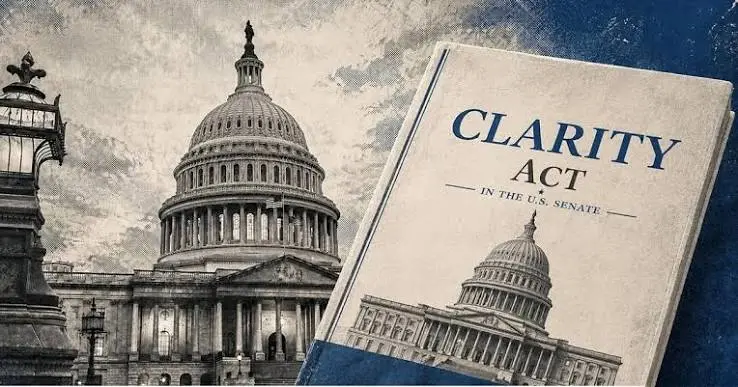
The U.S. CLARITY Act is entering a critical two weeks, with multiple parties intensifying discussions during the Senate recess

According to Crypto in America, the U.S. Senate will recess until July 13, and the advancement of the CLARITY Act depends on the progress of behind-the-scenes coordination over the next two weeks. Staff from both parties, government officials, and industry stakeholders are working to resolve remaining differences, including reconciling text discrepancies between the Banking Committee and the Agriculture Committee, as well as reaching consensus on ethical standards and provisions to combat illegal financial activities.The bill requires the support of at least 60 senators to pass. Even if all 53 Republican votes are in favor, at least 7 Democratic senators will need to join; the support of the majority of Democrats may depend on whether the White House can agree to establish a strong ethical framework regarding issues related to Trump's cryptocurrency business. According to Reuters, since Trump's return to the White House, his cryptocurrency business has generated over $2 billion in new wealth for him.Additionally, major law enforcement groups still oppose the inclusion of provisions from the Blockchain Regulatory Certainty Act in the bill, arguing that it would increase the difficulty of investigating and prosecuting on-chain crimes. Remaining discrepancies in the Agriculture Committee's text include issues such as the prioritization of federal law over state law, management of conflicts of interest in exchanges, and restrictions on related-party transactions. Sources indicate that the parties have not yet reached a final agreement, and there remains uncertainty about whether the Senate vote can be completed before the August recess.

SBI Holdings acquires Bitbank for $289 million, creating Japan's largest cryptocurrency exchange; bipartisan U.S. senators urge CFTC to investigate Polymarket's "deceptive marketing."

According to BBX data, last weekend Japan's largest financial group completed the most important cryptocurrency acquisition, and U.S. bipartisan senators launched a new regulatory offensive against prediction market platforms. The core developments are as follows:SBI Holdings, Inc. (Tokyo Stock Exchange: 8473) announced the acquisition of the Japanese cryptocurrency exchange Bitbank (privately held) for approximately $289 million. After the transaction is completed, SBI's cryptocurrency business will surpass all competitors, creating Japan's largest cryptocurrency exchange. SBI Holdings is one of Japan's largest independent financial services groups, already owning cryptocurrency-friendly network bank SBI Shinsei Bank, cryptocurrency asset custodian SBI Digital Asset Holdings, and multiple Bitcoin mining and cryptocurrency venture capital investments. Bitbank is one of Japan's largest spot BTC exchanges and holds an official cryptocurrency exchange license from the Financial Services Agency (FSA) of Japan. This acquisition marks a shift for traditional Japanese financial institutions from "strategic trial" in the cryptocurrency sector to "scale acquisition dominance," alongside the joint stablecoin plan of the three major banks: Mitsubishi UFJ ($MUFG), Sumitomo Mitsui ($SMFG), and Mizuho ($MFG) (targeting March 2027), forming the most intensive wave of cryptocurrency layout in Japan's financial industry by 2026.U.S. Senators John Curtis (Republican, Utah) and Adam Schiff (Democrat, California) reported on June 28 that they jointly sent a letter to the CFTC, urging it to conduct a formal investigation into the prediction market platform Polymarket (privately held), citing a "concerning" investigative report regarding Polymarket's "deceptive marketing" practices, which accused it of systematic misleading in user acquisition and risk disclosure. This is the third regulatory offensive against prediction market platforms initiated by Congress this year (previously, the House Oversight Committee launched an insider trading investigation on May 22); the two senators come from different parties, which is significant. For Robinhood Markets, Inc. (NASDAQ: $HOOD), this investigation poses indirect pressure—Robinhood's prediction market/event contract business (which achieved a record daily trading volume in June) faces the same regulatory qualitative disputes as Polymarket; however, Robinhood's defensive advantage lies in its ongoing application for a CFTC Designated Contract Market (DCM) license, providing a clearer compliance path compared to Polymarket.

The U.S. Senate is striving to advance the cryptocurrency bill in July, but agendas such as the housing bill may squeeze the time window

The U.S. Senate is trying to advance the cryptocurrency market structure bill, the "Clarity Act," in July, but the time window for the bill's passage is narrowing due to a backlog of priority agendas such as the defense authorization bill, the agriculture bill extension, and housing legislation. The Senate's schedule is tight in the coming weeks. In addition to the annual defense and agriculture bills, Trump stated on Wednesday that he would not support a major housing bill unless Congress first passes a bill requiring federal election voters to provide proof of citizenship. This housing bill also includes provisions to prohibit central bank digital currencies.As members of Congress will leave Washington before the August recess, if the relevant bills do not advance before then, the political focus will shift to the November elections when they return, further reducing the available floor time for cryptocurrency legislation. Republican Senator Cynthia Lummis indicated that a new version of the text is expected to be released around July 4 for final review by lawmakers, with a vote planned for July. A Senate aide also mentioned that the "Clarity Act" will become one of the bipartisan priorities when the Senate reconvenes in July. However, the bill still faces multiple uncertainties, including the level of Democratic support, controversies over Trump's related cryptocurrency conflicts of interest, the priority of other significant bills, and the Senate's limited scheduling.

Democratic senators in the U.S. are calling for a hearing on the UAE's $500 million investment in Trump's cryptocurrency project, accusing it of policy favoritism

On June 23, five Democratic senators from the U.S. Senate, including Elizabeth Warren and Richard Blumenthal, jointly sent a letter requesting multiple Senate committees to hold hearings immediately regarding the $500 million investment by UAE officials in the Trump family's cryptocurrency project WLFI, to investigate whether this investment influenced the Trump administration's subsequent policy decisions towards the UAE.According to the letter, an agent for a member of the Abu Dhabi royal family signed an agreement with the Trump family to acquire a 49% stake in WLFI for $500 million, with the agreement completed four days before Trump's inauguration. The foreign buyer prepaid $218 million to entities associated with the Trump family and Middle East chief diplomat Steve Witkoff. The deal was reportedly endorsed by UAE National Security Advisor Sheikh Tahnoon bin Zayed Al Nahyan, and the senators described this move as "unprecedented in U.S. political history."More concerning is the policy direction following the completion of the deal. The letter lists a series of decisions made by the Trump administration within months of the agreement that were clearly favorable to the UAE: approval of $1.4 billion in arms sales to the UAE; the Treasury Department establishing a "known investor pilot" program, which opened the green light for a fast-track approval process for the UAE that had long been lobbied for by CFIUS; and the Commerce Department lifting chip export restrictions from the Biden era, authorizing UAE AI company G42 to acquire 35,000 Nvidia Blackwell chips, with a transaction amount exceeding $1 billion. However, U.S. intelligence officials reportedly found that G42 had provided U.S. technology that could enhance missile capabilities to China.The senators demanded that Trump administration officials "explain under oath when they became aware of the payments to the president and his chief regional diplomat's family," and provide clarification on how to restore public trust. Currently, neither WLFI nor the UAE government has responded to this matter.

Bipartisan senators urge the U.S. Treasury to maintain state-level stablecoin regulatory authority under the GENIUS Act

A bipartisan group of senators led by Cynthia Lummis has written to U.S. Treasury Secretary Scott Bessent, requesting that the Treasury maintain states' regulatory authority over certain stablecoin issuers when formulating implementation rules for the GENIUS stablecoin bill. The GENIUS Act was signed into law last year, establishing a federal regulatory framework for stablecoins in the United States, requiring that stablecoins be fully backed by U.S. dollars or similar high-liquidity assets, and mandating that issuers with a market capitalization exceeding $50 billion undergo annual audits, while also setting rules for offshore issuance.The bill allows stablecoin issuers with a market capitalization of no more than $10 billion to be regulated at the state level, as long as the relevant state regulatory systems are "substantially similar" to federal requirements. The senators believe that the rules previously proposed by the Treasury do not clearly outline the timeline and standards for state regulatory system applications, reviews, and certifications, creating uncertainty for the states. The letter points out that there are significant differences in legislative cycles across states, with some states even adopting a biennial legislative cycle, thus requiring a flexible and continuously open certification mechanism to ensure that states can apply for certification when demand arises, rather than being constrained by timing mismatches that limit innovation and competition.

Over 200 cryptocurrency institutions, including Coinbase and Ripple, jointly urge the U.S. Senate to advance the vote on the CLARITY Act

According to The Block, a joint letter initiated by Stand With Crypto, the Blockchain Association, the Crypto Council for Innovation, and The Digital Chamber has been submitted to U.S. Senate Majority Leader John Thune and Minority Leader Chuck Schumer, urging a prompt full Senate vote on the Digital Asset Market Clarity Act (referred to as the CLARITY Act). More than 200 crypto companies, industry associations, and community organizations, including Coinbase, Ripple, Kraken, a16z, Circle, and Binance.US, participated in signing.The joint letter points out that the CLARITY Act will establish a comprehensive federal regulatory framework for the digital asset market, clarify the division of responsibilities among regulatory agencies, provide feasible registration pathways, and protect software developers' innovation while encouraging more digital asset businesses to return to the U.S. market. The signatories stated that the act would help keep innovation, jobs, investment, and market activities in the U.S., further solidifying the country's leading position in global digital asset innovation.It is understood that the CLARITY Act received bipartisan support from the Senate Banking Committee last month and passed the committee's review. Senator Cynthia Lummis subsequently stated that the next step for the act will be to enter the full Senate review stage.Additionally, 160 former national security and law enforcement officials had previously signed in support of the act, and U.S. Treasury Secretary Scott Bessent and White House crypto advisor Patrick Witt have also publicly called for advancing the legislative process. However, the issue of the Trump family's interests in relation to the crypto industry is still seen as one of the main obstacles facing the advancement of the act.
app_icon
ChainCatcher Building the Web3 world with innovations.