BTC $71,530.87 -4.17%
ETH $2,018.56 -2.90%
BNB $656.02 -4.45%
XRP $1.04 -2.28%
SOL $81.50 -4.03%
TRX $0.3154 -0.64%
DOGE $0.0662 -3.37%
ADA $0.1736 -2.16%
BCH $225.75 -2.40%
LINK $10.08 -3.84%
HYPE $72.20 -1.26%
AAVE $114.07 -7.13%
SUI $0.8043 -3.88%
XLM $0.1499 +0.09%
ZEC $957.00 -3.96%
AAPL $355.02 -0.12%
AMZN $267.58 +0.58%
GOOGL $299.73 +2.17%
MSFT $522.98 +0.47%
META $625.66 -0.79%
NVDA $167.85 -3.72%
TSLA $398.00 +1.81%
SNDK $944.64 -3.91%
INTC $61.61 -1.38%
SPCX $140.31 -0.04%
MU $804.79 -1.14%
AMD $585.73 +5.86%

gpt-6

All
Article
Flash

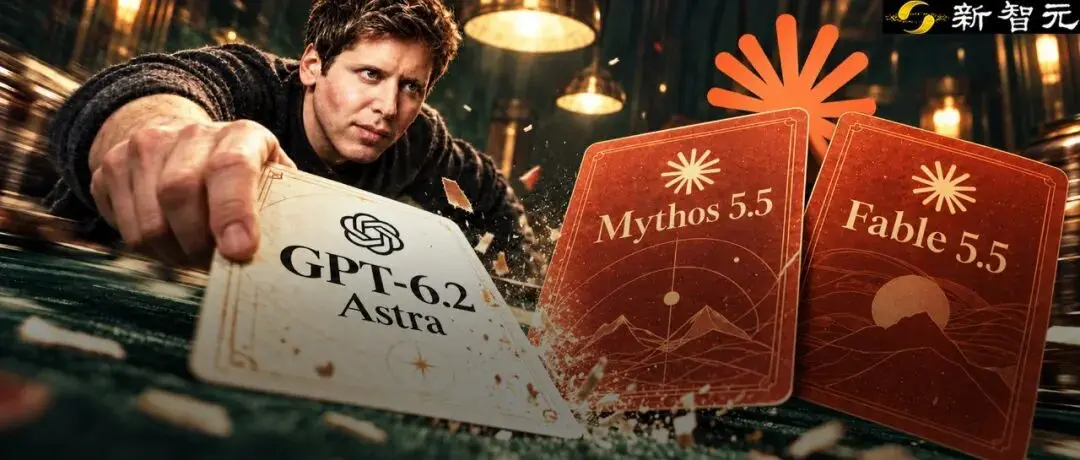
first_img GPT-6.2 Astra appears in Codex, Anthropic official website code appears Mythos 5.5

On November 1, 2026, multiple users posted on X stating that OpenAI's Codex usage data included a model label named GPT-6.2 Astra, while the model selector still displayed GPT-6 Astra. A usage chart covering October 26 to November 1 showed that gpt-6-astra accounted for 80%, and gpt-6.2-astra accounted for 19.8%. Another account posted a suspected JSON snippet of an API response, with the response.model field being gpt-6.2-astra. According to Quantum Bit, GPT-6.2 Astra has been undergoing a limited gray testing among some users, with access primarily restricted to Pro plan users at $500 per month. Some users reported that about 20% of requests were routed to 6.2, while others claimed all requests pointed to 6.2.On the same day, an account posted a screenshot claiming that hidden code on the Anthropic official website's Mythos page included Claude Mythos 5.5. The visible page displayed Claude Mythos 5.1, while the hidden header and logo alt text indicated 5.5. According to Quantum Bit, this text briefly appeared in the front-end code of the official website and was removed a few hours later. Anthropic has not confirmed this, and currently, apart from the screenshot, there are no archived copies to verify this change.Additionally, there were previous reports that Fable 5.5 had appeared in the Microsoft Azure and MLflow directories, with a context window of 1 million tokens and an output limit of 128K tokens. Verification showed that on October 13, 2026, a bot added the entry azure_ai/claude-fable-5-5 to the price list of the open-source tool LiteLLM, which was deleted the next day, with the deletion note stating "Azure did not list this model." These parameters are identical to those of Fable 5.1. As of now, neither OpenAI nor Anthropic has officially released the aforementioned models.

first_img Grok 4.7 recommends the Republican Party 90% of the time, while GPT-6.1 nearly fully supports the Democratic Party

TechCrunch reported that the conversational AI research and design studio Convovo, led by Cornell University professor Tapan Parikh, released a study stating that when asked to recommend only one candidate for the upcoming U.S. midterm elections, SpaceXAI's Grok 4.7 chose Republican candidates 92% of the time, while OpenAI's GPT-6.1 Sol chose Democratic candidates 97% of the time. The study covered nearly 500 campaigns, with the two models agreeing on recommendations less than 10% of the time.Researchers posed the same question to both models via API, asking for a specific candidate without allowing for avoidance or a tie. The report noted that consumer applications refused to answer. An OpenAI spokesperson stated that ChatGPT is designed to be objective by default, and political conversations should not carry any directional bias; the study tested the developer API, and the prompt explicitly requested a candidate recommendation, which cannot represent the user experience when asking questions through the chat application. SpaceXAI did not respond to requests for comment in time.The report indicated that Grok's responses often cited conservative sources as well as Ballotpedia, OpenSecrets, and VoteSmart, with 39% including Christian conservative voter guides, 23% including Turning Point Action, and 41% including X; GPT's results heavily relied on Wikipedia, the Associated Press, Axios, and Reddit. The study also mentioned that each time Grok was called via the xAI API, it included approximately 1,240 additional input tokens that the researchers did not write, could not view, or remove. Parikh subsequently disabled online search and sampled 30 campaigns, with GPT choosing Democrats in 24 cases, while Grok refused to choose in 27 cases.

first_img After the release of GPT-6 Astra, users complained that it became less intelligent, and OpenAI has not yet responded

According to a report by Decrypt, OpenAI's latest flagship model GPT-6 Astra has seen a surge of user complaints on the X platform about its performance "getting dumber" just a week after its release. An anonymous developer, synthwavedd, posted that "Astra feels noticeably dumber today," joking that it was a "post-release lobotomy." Previously praising the model, developer Pranjal Paliwal stated after reviewing the code Astra wrote for him: "We don't have AGI; what we're encountering is a performance regression."Developer Pankaj Kumar listed the symptoms: faster responses with poorer quality, and he suspects OpenAI has lowered the "juice value" (the computational power invested by the model before answering). Salio and researcher Md Ismail Sojal compared Astra on the release day with the current version using the same prompts, both yielding worse results. T3Chat founder Theo believes Astra is simply less stable than Claude Fable, with users beginning to showcase poor results after the honeymoon period ended. There are also opinions pointing out that OpenAI's previous flagship GPT-5.6 Sol experienced a similar cycle in July, when OpenAI executive Tibo Sottiaux denied intentionally weakening the model but admitted the company had been experimenting with "reasoning effort" settings.OpenAI has not released a statement regarding Astra similar to that of Sol.
app_icon
ChainCatcher Building the Web3 world with innovations.