Scan to download
BTC $79,086.74 -2.81%
ETH $2,223.31 -3.29%
BNB $673.10 -1.15%
XRP $1.43 -7.00%
SOL $89.53 -4.12%
TRX $0.3519 -0.75%
DOGE $0.1130 -2.86%
ADA $0.2609 -5.28%
BCH $426.07 -2.77%
LINK $10.07 -5.68%
HYPE $44.82 +1.00%
AAVE $93.10 -6.87%
SUI $1.10 -9.07%
XLM $0.1545 -6.75%
ZEC $522.37 -1.97%
BTC $79,086.74 -2.81%
ETH $2,223.31 -3.29%
BNB $673.10 -1.15%
XRP $1.43 -7.00%
SOL $89.53 -4.12%
TRX $0.3519 -0.75%
DOGE $0.1130 -2.86%
ADA $0.2609 -5.28%
BCH $426.07 -2.77%
LINK $10.07 -5.68%
HYPE $44.82 +1.00%
AAVE $93.10 -6.87%
SUI $1.10 -9.07%
XLM $0.1545 -6.75%
ZEC $522.37 -1.97%
Web3 Business Partner Collection

Web3 Business Partner Collection

A total of 20 articles Last updated on 05.11

Special topic introduction

Illustration of Industry Giants' Web3 Business Partners

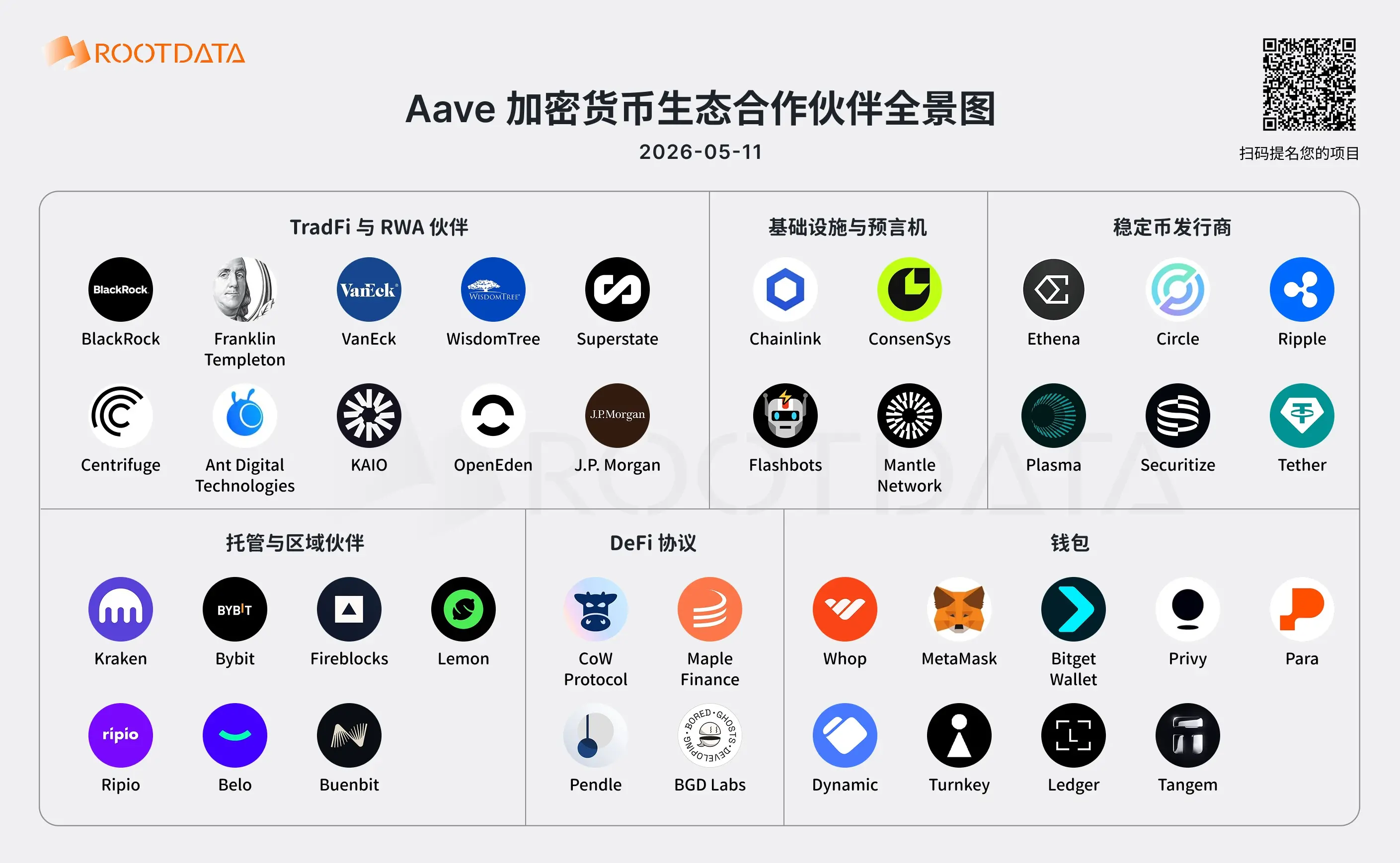
Illustration of Aave's 40 Web3 Business Partners: Defining the On-Chain Dollar Interest Rate Market

The Web3 asset data platform RootData has outlined 40 partners of Aave, covering multiple layers such as TradFi/RWA, stablecoins, infrastructure, wallets, DeFi protocols, exchanges, and custody. From its early focus on the lending efficiency of crypto assets to competing for on-chain dollar liquidity after the launch of GHO, Aave seems to be defining an interest rate system for on-chain dollars. At the TradFi and RWA layer, institutions like BlackRock, Franklin Templeton, VanEck, and JPMorgan are prominently featured, along with RWA platforms such as Centrifuge, OpenEden, and Securitize, indicating that Aave is no longer satisfied with lending native crypto assets but is attempting to meet the financing needs of real-world assets on-chain. At the stablecoin layer, partners like Circle, Tether, Ethena, Ripple, and Plasma suggest that Aave is competing for the on-chain "dollar liquidity" entry point. Whoever controls stablecoin deposits is closer to on-chain interest rate pricing power. At the infrastructure layer, partners like Chainlink, ConsenSys, Flashbots, and Mantle provide Aave with price oracles, MEV optimization, and multi-chain expansion capabilities. At the user distribution layer, wallet partners like MetaMask, Ledger, Bitget Wallet, Privy, and Turnkey are lowering the entry barriers for users; meanwhile, institutional channels like Kraken, Bybit, and Fireblocks further amplify the capital entry points. DeFi protocols such as Pendle, Maple Finance, and CoW Swap extend Aave's liquidity into fixed income, institutional lending, and trading scenarios. The recent rsETH/Kelp risk event caused Aave's TVL to drop from a peak of $44 billion to $15 billion, once again testing the risk management capabilities of this established DeFi protocol. Related collection: Aave Web3 Partner Network Collection (continuously updated) Cryptocurrency projects actively showcasing their partner networks have become a key way to enhance transparency and market trust. It is reported that RootData welcomes Web3 projects to claim their information and continues to track and open more project business relationship disclosure channels. The platform has released multiple editions of crypto project ecosystem maps, nominating Web3 ecosystem partners for upstream clients like Visa, Mastercard, and Coinbase. If you wish to nominate your project in future ecosystem maps, please fill out the [RootData 2026 Industry Ecosystem Mapping] form to supplement your important clients and partners.
Illustration of Aave's 40 Web3 Business Partners: Defining the On-Chain Dollar Interest Rate Market

Illustration of Ondo Finance's 153 Web3 business partners: Tokenized stocks and RWA contractors on Wall Street

The Web3 asset data platform RootData has organized the 153 partners and ecosystem participants of Ondo Finance, covering multiple key areas such as TradFi, public chains, custody, DeFi, exchanges, wallets, cross-chain bridges, payments, and service providers. This list fully demonstrates how Ondo has completed the transition from a single government bond yield product to an RWA infrastructure platform within three years, with its TVL growing from approximately $534 million in 2024 to over $3 billion in 2026, capturing about 58%-80% of the tokenized stock market. In the traditional finance layer, institutions such as BlackRock, Franklin Templeton, Fidelity Investments, Goldman Sachs, JPMorgan Chase, Mastercard, and PayPal are prominently featured, indicating that Ondo is no longer just serving traditional finance clients but is also undertaking the complex compliance packaging, on-chain issuance, and settlement capabilities involved in the tokenization process, effectively becoming Wall Street's on-chain asset "outsourcer." In the custody and institutional funding layer, the inclusion of leading custodians like Anchorage Digital, BitGo, Fireblocks, and Cobo signifies that Ondo has obtained the most critical entry permissions for institutional funds. In the on-chain liquidity layer, 15 public chains including Ethereum, Solana, Sui, and Aptos, along with DeFi protocols such as Pendle, Morpho, Curve, 1inch, and Euler, collectively form its liquidity network. Essentially, Ondo is transforming traditional finance's "static assets" into on-chain tradable, collateralizable, and composable assets. In the trading and payment distribution layer, the large-scale integration of Ripple, exchanges, wallets, and payment service providers indicates that Ondo has expanded from merely "selling yield products" to further extending into trading, clearing, and payment processes, attempting to master the complete circulation path of RWA. Related compilation: 【Ondo Finance Web3 Partner Network Compilation (Continuously Updated)】 Cryptocurrency projects actively showcasing their partner networks have become a key way to enhance transparency and market trust. It is reported that RootData welcomes Web3 projects to claim their information and continues to track and open more project business relationship disclosure channels. The platform has continuously released multiple editions of cryptocurrency project ecosystem maps, nominating Web3 ecosystem partners serving upstream clients like Visa, Mastercard, and Coinbase. If you wish to nominate your project in future ecosystem maps, please fill out the 【RootData 2026 Industry Ecosystem Mapping】 form to supplement your important clients and partners.

Illustration of Bybit's 30 Web3 business partners: from contract exchanges to on-chain financial networks

Web3 asset data platform RootData has outlined 30 Web3 business partners of Bybit, covering multiple key layers such as institutional custody, stablecoins, blockchain infrastructure, DeFi protocols, and real-world payments. From the funding perspective, partners like Circle, Tether, and Ethena indicate that Bybit has begun to deeply engage in liquidity structures related to stablecoins and RWA. In particular, RWA protocols like Ondo and Backed are essentially helping on-chain funds gradually access U.S. Treasuries, real yield assets, and traditional financial markets. In terms of blockchain infrastructure, its layout covers mainstream networks such as Mantle, Solana, Sui, and TON, while also extending to restaking systems like EigenLayer and Solayer. This means Bybit has started to expand towards on-chain yield and asset issuance layers. In the on-chain liquidity layer, Bybit collaborates with protocols like Aave, Kamino, Raydium, Orca, and Sanctum, using bbSOL to further strengthen its DeFi yield and asset circulation capabilities. What is particularly noteworthy is its infrastructure layout on the institutional side. Bybit has integrated with custody systems such as Fireblocks, Anchorage, Copper, Sygnum Bank, and Cactus Custody, and connected with banks and payment networks like QNB Group, Pave Bank, and Thredd. With institutional funds entering, the biggest competitive point for crypto exchanges has shifted from "matching ability" to "asset security and settlement capability." Especially after the North Korean hacker attack incident, the custody system has become the most critical part of exchange infrastructure. At the same time, Bybit's global branding strategy is also changing. In the past few years, it has made high-profile collaborations with top sports IPs like Oracle Red Bull Racing. In recent years, it has gradually shifted towards high-growth regions like the Middle East, establishing connections with institutions like Dubai DMCC. Its branding logic is transitioning from "traffic exposure" to "regional financial resource binding." Related collection: Bybit Web3 Partner Network Collection (continuously updated) Crypto projects actively showcasing their partner networks have become a key way to enhance transparency and market trust. It is reported that RootData welcomes Web3 projects to claim their information and continues to track and open more project business relationship disclosure channels. The platform has continuously released multiple editions of crypto project ecological maps, nominating Web3 ecological partners for upstream clients like Visa, Mastercard, and Coinbase. If you wish to nominate your project in future ecological maps, please fill out the [RootData 2026 Industry Ecosystem Mapping] form to supplement your important clients and partners.

Illustration of Hyperliquid's 30 Web3 Business Partners: Building an Operating System for On-Chain Liquidity

The Web3 asset data platform RootData has outlined 30 Web3 business partners of Hyperliquid, covering multiple key aspects such as stablecoins, cross-chain infrastructure, wallet entry, DeFi protocols, institutional custody, and trading ecosystems, gradually forming a complete on-chain financial system. At the funding level, Hyperliquid has connected with stablecoin issuers such as Circle, Tether, and Ethena. In terms of underlying infrastructure, it connects with cross-chain and oracle services like Chainlink, Axelar, deBridge, and Ripple. The user entry layer includes wallets and front-end tools like Phantom, Rabby Wallet, and DeBank, lowering the entry barrier for users. At the same time, more native DeFi protocols have begun to emerge within its ecosystem, such as Pendle, Felix, HypurrFi, and HyperBeat. According to RootData, the Hyperliquid ecosystem has included 145 quality projects, indicating that Hyperliquid is attracting more financial applications to build businesses around its liquidity. Additionally, the inclusion of custodians like Anchorage Digital, BitGo, and Fireblocks has begun to connect it with larger institutional funds. Trading platforms and market-making institutions like Bybit, trade.xyz, and IMC Trading further enhance market liquidity. Overall, Hyperliquid is continuously expanding around "on-chain liquidity," attempting to replicate the ecosystem model of centralized exchanges on-chain, but the core is no longer an account system. Related compilation: Hyperliquid Web3 Partner Network Compilation (continuously updated) Cryptocurrency projects actively showcasing their partner networks has become a key way to enhance transparency and market trust. It is reported that RootData welcomes Web3 projects to claim their information and continues to track and open more project business relationship disclosure channels. The platform has continuously released multiple issues of cryptocurrency project ecosystem maps, nominating Web3 ecosystem partners for upstream clients like Visa, Mastercard, and Coinbase. If you wish to nominate your project in future ecosystem maps, please fill out the [RootData 2026 Industry Ecosystem Mapping] form to supplement your important clients and partners.

Illustration of Kalshi's 20 Web3 business partners: A prediction market centered on compliance

Web3 asset data platform RootData has compiled a list of 20 business partners for Kalshi, covering key aspects such as blockchain infrastructure, oracle data, market-making liquidity, compliance and regulation, and transaction distribution. On-chain, Kalshi supports network assets such as Solana, Base, Bitcoin, and BNB Chain, and provides data support through oracles like Pyth Network and RedStone. At the liquidity layer, it brings in traditional market makers like Jump Trading and SIG to participate in price discovery. Simultaneously, Kalshi expands its trading and distribution capabilities through platforms like Coinbase and Robinhood. However, compared to its Web3 partner network, Kalshi's more substantial off-chain capabilities lie in its core competencies built upon compliance, risk control, and financial infrastructure. For example, it facilitates fund access and payment compliance through Plaid and Aeropay, receives market monitoring and risk control support from Solidus Labs, and collaborates with Birches Health to establish a responsible trading mechanism. Overall, Kalshi's structure is not typical of a crypto application, but rather resembles an "event exchange" operating within a regulatory framework: first building financial infrastructure, then selectively integrating Web3 capabilities. This gives it a stronger "traditional financial attribute" compared to other prediction market projects. Related compilation: [Kalshi Web3 Partner Network Compilation (Continuously Updated)] Crypto projects proactively showcasing their partner networks has become a key way to improve transparency and market trust. RootData welcomes Web3 projects to submit their information and continuously tracks and opens more channels for disclosing project business relationships. The platform has already released multiple editions of crypto project ecosystem maps, nominating Web3 ecosystem partners serving upstream clients such as Visa, Mastercard, and Coinbase. If you wish to nominate your project in future ecosystem maps, please fill out the [RootData 2026 Industry Ecosystem Mapping] form to add your key clients and partners.

Illustration of Polymarket's 38 Web3 business partners: Who is providing the infrastructure for "information pricing"?

The Web3 asset data platform RootData has outlined 38 business partners of Polymarket, covering multiple key areas such as oracle, cross-chain assets, exchanges, wallets, and application layers. From a structural perspective, Polymarket primarily relies on Polygon to process transactions and supports assets from multi-chain networks such as Ethereum and Solana. It also provides key data inputs through oracles like UMA and Chainlink to ensure the credibility of event outcomes and price discovery mechanisms. In terms of asset liquidity, it collaborates with stablecoins and cross-chain services like Circle and Bridge, and connects with mainstream wallet systems including MetaMask, Phantom, and Privy, facilitating the flow of funds across different networks and lowering the barriers to participating in prediction markets. Regarding user entry points, Polymarket integrates centralized exchanges like Gate and Phemex, and combines applications and data tools such as Jupiter, MoonPay, Polysights, and Kaito to form potential ecological traffic expansion. Overall, the Polymarket ecosystem can be broken down into three layers: the upstream relies on oracles to settle "tradeable information," the middle layer completes matching and settlement through multi-chain and stablecoins, and the downstream reaches users through wallets and applications. The platform is building a financial system that converts information into prices and completes pricing through on-chain markets. Related collection: [Polymarket Web3 Partner Network Collection (continuously updated)](https://cn.rootdata.com/Archives/detail/Polymarket%20Crypto%20Business%20Partner?k=NDc2OTgz) Cryptocurrency projects actively showcasing their partner networks have become a key way to enhance transparency and market trust. It is reported that RootData welcomes Web3 project parties to [claim data](https://www.rootdata.com/Projects/submit?ft=claimApply) and continues to track and open more project business relationship disclosure channels. The platform has continuously released multiple editions of cryptocurrency project ecological maps, nominating Web3 ecosystem partners for upstream clients such as Visa, Mastercard, and Coinbase. **If you wish to nominate your project in future ecological maps, please fill out the [RootData 2026 Industry Ecosystem Mapping](https://forms.gle/tWArmXcpSfZJkh1r8) form to supplement your important clients and partners.**

Illustration: Fireblocks' 30 Web3 business partners: Who is driving the $200 billion stablecoin flow?

The Web3 asset data platform RootData has outlined 30 business partners of Fireblocks, spanning multiple key areas such as DeFi protocols, payment settlement, compliance analysis, trading institutions, and multi-chain infrastructure: * Settlement Layer: Represented by Circle, TripleA, and Lynq, responsible for stablecoin issuance and payment clearing. * Liquidity and Trading Layer: Includes market makers and trading institutions such as Wintermute, Amber Group, GSR, and Wootton, responsible for fund distribution and market depth. * On-chain Application Layer: Covers DeFi and application tools like Aave, Morpho, and MetaMask, which support the actual operation scenarios of funds. * Compliance and Risk Control Layer: Service providers like Chainalysis, Elliptic, and Coincover form an important supplement to its regulatory adaptation capabilities. By 2025, Fireblocks is expected to handle over $200 billion in stablecoin transactions per month, a year-on-year increase of 300%. Fireblocks' positioning is evolving from a "custody and security service provider" to a central hub for on-chain fund flows and institutional asset circulation. Currently, Fireblocks supports over 150 public blockchain networks, and its partnership network has expanded to over 2,500 global institutional participants, including banks, asset management firms, exchanges, market makers, and fintech companies. Related compilation: [Fireblocks Web3 Partner Network Compilation (Continuously Updated)](https://cn.rootdata.com/Archives/detail/Fireblocks%20Crypto%20Business%20Partner?k=NDc2MTU1) Cryptocurrency projects actively showcasing their partner networks have become a key way to enhance transparency and market trust. It is reported that RootData welcomes Web3 project parties to [claim information](https://www.rootdata.com/Projects/submit?ft=claimApply) and continues to track and open more project business relationship disclosure channels. The platform has continuously released multiple issues of the cryptocurrency project ecosystem map, nominating Web3 ecosystem partners for upstream clients such as Visa, Mastercard, and Coinbase. **If you wish to nominate your project in future ecosystem maps, please fill out the [RootData 2026 Industry Ecosystem Mapping](https://forms.gle/tWArmXcpSfZJkh1r8) form to supplement your important clients and partners.**

Illustration of Zero Hash's 28 Web3 business partners: Connecting cryptocurrency and fiat currency settlement with compliant licenses

The Web3 asset data platform RootData has outlined the Web3 business partners of Zero Hash, whose partners cover key areas such as asset management institutions, payment channels, public chain infrastructure, and stablecoin systems, and are building a cooperative network centered on **compliance clearing** and **asset access**. Structurally, Zero Hash is committed to becoming a B-end crypto financial infrastructure provider, offering institutions a one-stop capability of "**fiat currency → crypto assets → multi-chain circulation → stablecoin settlement**": Upstream, it connects asset management and financial platforms such as Morgan Stanley, Franklin Templeton, and Republic; on the funding entry side, it interfaces with payment and fiat channels like Stripe, Ramp, and Transak; at the infrastructure level, it covers multi-chain infrastructures such as Ethereum, Solana, Polygon, Avalanche, and Aptos; at the same time, it connects with stablecoin systems like Circle, Tether, Paxos, as well as PYUSD and RLUSD, completing clearing and settlement support. In addition, Zero Hash, as one of the few infrastructure providers holding money transmission licenses (MTL) in multiple U.S. states and possessing complete regulatory framework adaptation capabilities, has a very clear common characteristic among its partners: funding entry (banks/payments), asset carriers (stablecoins/public chains), or distribution platforms (financial products/applications). Related collection 【[Zero Hash Web3 Partner Network Collection (Continuously Updated)](https://cn.rootdata.com/Archives/detail/zerohash%20Crypto%20Business%20Partner?k=NDc1NzIy)】 Crypto projects actively showcasing their partner networks has become a key way to enhance transparency and market trust. It is reported that RootData welcomes Web3 project parties to [claim data](https://www.rootdata.com/Projects/submit?ft=claimApply) and continues to track and open more project business relationship disclosure channels. The platform has continuously released multiple versions of the crypto project ecosystem map, nominating Web3 ecological partners for upstream clients such as Visa, Mastercard, and Coinbase. **If you wish to nominate your project in future ecosystem maps, please fill out the 【[RootData 2026 Industry Ecosystem Mapping](https://forms.gle/tWArmXcpSfZJkh1r8)】 form to supplement your important clients and partners.**

Illustration of 78 Web3 Business Partners in Anchorage: A Financial Bridge Connecting Wall Street and the On-Chain World

The Web3 asset data platform RootData has outlined 78 business partners of Anchorage, including over 30 DeFi protocols, more than 20 blockchain infrastructure projects, as well as various stablecoins and payment settlement networks, covering the complete path from asset issuance to on-chain operations. Represented by institutions like BlackRock, products such as ETFs bring funds into the crypto market, after which Anchorage assumes custody and compliance responsibilities. These assets are then deployed on-chain, participating in liquidity operations and yield generation through DeFi protocols, stablecoin systems, and infrastructure networks. Ultimately, they flow back into the traditional financial system through OTC, trading, and clearing paths. In this process, Anchorage's role is not just "custody," but a key node throughout the entire lifecycle of funds, with its upstream and downstream including crypto-native institutions such as A16z, Blockchain Capital, Electric Capital, and Defiance, as well as DeFi protocols, L1/L2 networks, stablecoins, and clearing and settlement systems, along with fintech companies like AngelList and Series Financial, as well as payment companies and core banking systems. Anchorage's partner strategy emphasizes "key path coverage," ensuring that funds have corresponding infrastructure at every stage. As compliant entry points like ETFs gradually open up, the crypto market shifts towards asset allocation-driven strategies, and bridge-type institutions like Anchorage are moving from the background to the core. Related compilation: [Anchorage Web3 Partner Network Compilation (continuously updated)](https://cn.rootdata.com/Archives/detail/Anchorage%20Crypto%20Business%20Partner?k=NDc1MTgz) Crypto projects actively showcasing their partner networks have become a key way to enhance transparency and market trust. It is reported that RootData welcomes Web3 project parties to [claim data](https://www.rootdata.com/Projects/submit?ft=claimApply) and continues to track and open more project business relationship disclosure channels. The platform has continuously released multiple editions of crypto project ecological maps, nominating Web3 ecological partners for upstream clients such as Visa, Mastercard, and Coinbase. **If you wish to nominate your project in future ecological maps, please fill out the [RootData 2026 Industry Ecosystem Mapping](https://forms.gle/tWArmXcpSfZJkh1r8) form to supplement your important clients and partners.**

Illustration of Upbit's 10 Web3 Business Partners: Exchange Model Shaped by Korean Regulations

The Web3 asset data platform RootData has outlined Upbit's business partners, which are relatively limited and mainly focused on areas such as blockchain infrastructure and compliance services. This is closely related to South Korea's unique and strict regulatory framework: under a system environment centered on real-name systems, VASP regulation, and anti-money laundering, exchanges are required to take greater responsibility for the flow of funds and user identities, making Upbit more inclined to develop its own systems and build localized capabilities rather than extensively introducing external partners. From the disclosed structure, on the technical side, infrastructure capabilities are strengthened through Lambda256, Aptos, and others; on the compliance level, service providers such as VerifyVASP, Chainalysis, and Crystal Intelligence are introduced; and supplementary funding and liquidity are provided through Circle and Naver Pay. Additionally, Upbit quickly built trading capabilities relying on its cooperation with Bittrex since its launch in 2017. On the branding side, Upbit has explored NFT entertainment collaborations with Hybe and has laid out plans in esports (LCK) and signed top players like Faker, while also becoming a primary partner of the Korean Sports Council. However, as the popularity of NFTs and the metaverse has declined, the influence of related entertainment collaborations has weakened. Related compilation: [Upbit Web3 Partner Network Compilation (continuously updated)]
app_icon
ChainCatcher Building the Web3 world with innovations.