Written in the Eye of the Storm: Why I Don't Think the Current Decline is a Short-Term Risk
 Core Viewpoint


 Grasping the overall trend is sometimes far more valuable than focusing on short-term signals.
Author: WhosCalvin
The poem says: "When the time comes, the world works together; when the opportunity goes, heroes are not free." Especially in the stock market, grasping the overall trend is sometimes far more valuable than focusing on short-term signals. Every time I see many people emotionally fluctuating over things with predetermined outcomes due to one or two news items, I can't help but feel regret. Among them are even finance influencers with hundreds of thousands of followers.
I previously promised to write a long article clarifying the current market's main line. This article will string together a series of viewpoints from after the INTC earnings report at the end of October, warning about AI hardware risks, to the Democratic election victory, announcing the explanation for the AI hardware market, and then to Jensen Huang stepping down, bluntly stating that the market underestimates the impact. Perhaps a month or even six months later, you will find that everything that has happened is merely an extension of this main line. Many research reports or influencers may only realize and reiterate my viewpoints a month or even half a month later.
Without further ado, let’s get straight to the point. The only main line in the current market is:
The United States, unable to afford the accelerated AI capital expenditure, is deliberately slowing down the pace of AI. Slowing down AI construction is a good thing for cloud companies, hardware manufacturers, model companies, and even the United States (except for shareholders).
1. The Dilemma of Mid and Downstream
The first sign that there might be signs of a bubble bursting was after the INTC earnings report, which saw a post-market drop of 25% that day. Upon closer examination of the earnings report and the conference call, I discovered several issues:
In simple terms, the earnings report showed that INTC was aggressively ramping up production: the firm purchase orders (Firm POs) issued to semiconductor equipment suppliers in Q3 surged nearly 40% quarter-over-quarter, while also expanding capacity across multiple lines. This directly leads to a high probability of negative free cash flow (FCF) by 2027.
However, if we only look at this earnings report, it only indicates that INTC is currently encountering some issues in its capital cycle, and that the expansion due to strong demand seems reasonable. But if we look at the earnings reports of leading cloud companies (Hyperscalers + representative small and medium AI clouds Neoclouds) together, we find that the AI bubble has already shown cracks: four out of the five largest cloud companies (AMZN, GOOGL, META, ORCL) have officially seen their quarterly free cash flow turn negative due to capital expenditures, and the industry is transitioning from "tech giants relying on their own cash flow for internal growth" to a new phase of "external equity and debt financing":
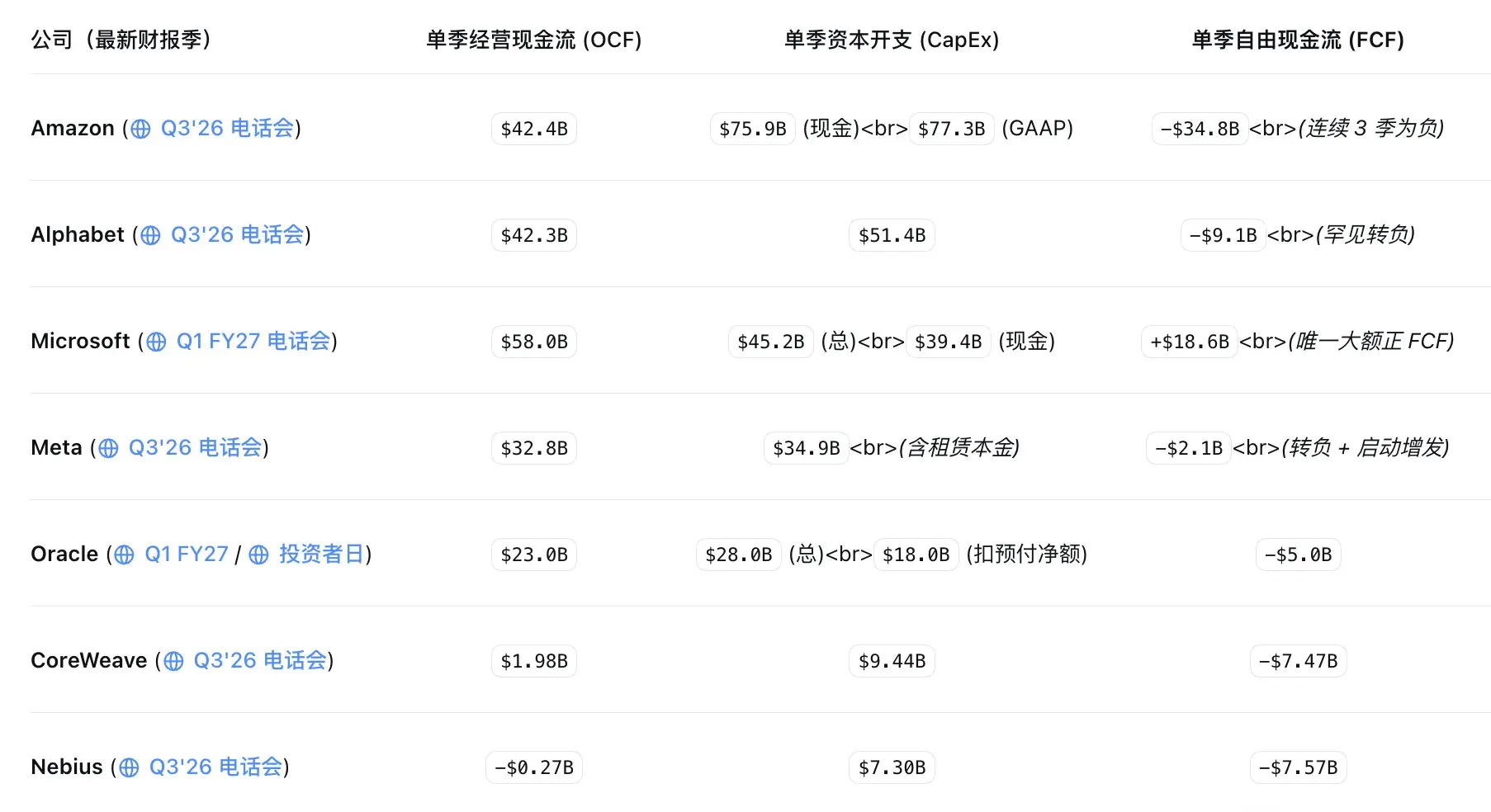
Summary of the FCF situation of leading cloud companies in AI
Before this quarter, everyone believed that the driving force behind the sustainable development of AI came from the fact that most of the industry-leading computing power providers were cash cow giants with super cash printing machines (search advertising, e-commerce, enterprise software), which is fundamentally different from the tech bubble of 2000. Now, this annualized $800B of self-generated cash flow has been completely drained.
As the five major cloud companies continue to accelerate towards $820B+ or even nearly $1 trillion in capital expenditures by 2027, while Neoclouds and large model unicorns are also investing hundreds of billions to compete for chips, all excess incremental funds can only be filled by leveraging. Meanwhile, according to the latest report from the Federal Reserve, the off-balance sheet "uncommitted lease commitments" of the seven giants have exceeded $1 trillion, with guarantees and other contractual commitments exceeding $2 trillion.
Of course, while downstream companies are forced to leverage due to the capital expenditure race, is the midstream doing well? Not really. The midstream heavy asset segment has also become a "negative FCF disaster area," where hardware manufacturers that build factories, purchase wafer equipment, expand production lines, and finance assembly are burning their FCF into negative numbers to compete for AI capacity:
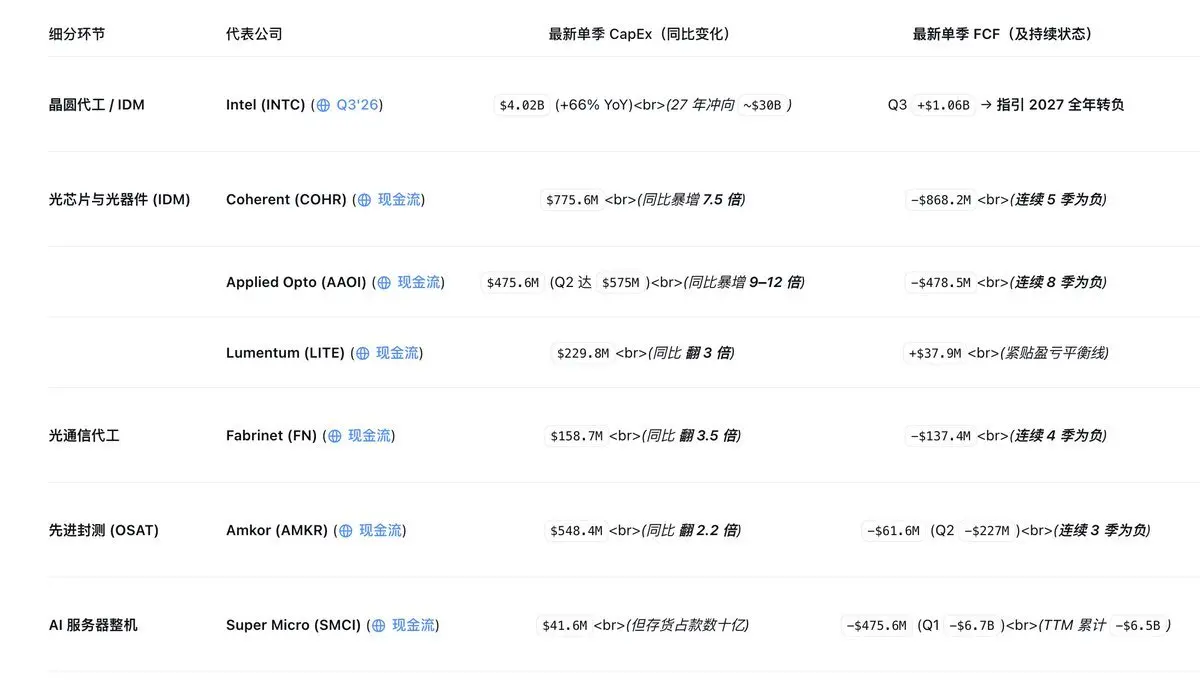
Summary of the FCF situation of leading hardware manufacturers in AI
The vast majority of these companies are aggressively expanding capacity to take on massive orders, and most of their operating cash flow has been consumed by this expansion; some smaller companies are even undergoing extreme expansions far beyond their own capacity.
Of course, looking at this data alone indicates strong short-term demand, the industry is in a high boom, and they have irrevocable prepayments and guaranteed long-term contracts from downstream. However, when these new optical chip wafer fabs, advanced packaging lines, Intel's new production lines, and storage clean rooms, which take 1.5 to 2.5 years to build, are concentrated in production and supply in the second half of 2027 to 2028, if they happen to coincide with downstream cloud companies slowing their CapEx growth due to financing costs and depreciation pressures in 2028, these midstream heavy asset manufacturers with thin margins, relying on burning FCF for expansion, will be the first to bear the dual squeeze of "capacity coming online and prices dropping + high depreciation backlash."
These are all things that smart capital in the market has quietly priced in after the earnings season. Meanwhile, the upstream monopolistic hardware manufacturers (NVDA, MU, TSMC, AVGO) appear to have mountains of net cash and almost no debt from their earnings reports; even if AI cools down tomorrow, they will at most earn slightly less profit and will not face a debt crisis.
However, combining our analysis above, you will find that these very few monopolistic rent-seekers at the top of the upstream pyramid rely on sucking blood from the mid and downstream to maintain their positions. But you cannot have a building with only the fifth floor; when the first and second floors and the foundation start to shake, it is likely that the fifth floor will be the first to collapse.
Currently, Micron's 81.1% gross margin, SK Hynix's nearly 80% operating profit margin, and NVIDIA's 74.8% gross margin are essentially scarcity premiums under extreme shortages, rather than the norm in manufacturing. Once the top five cloud giants, which account for 60% of your revenue, can no longer absorb the goods, no upstream supplier will dare to take their clients to court to force them to take delivery; almost 100% will compromise—allowing for delayed deliveries or renegotiating prices.
Therefore, assuming that next year the top five cloud companies do not collapse but decide to reduce their total annual CapEx by 20% (for example, from $820B to $650B) just to bring their negative free cash flow back to positive, the already built data centers will continue to generate revenue, and the cloud revenues of AWS, GCP, and Azure may still grow by +20%; but for upstream hardware manufacturers, it would be a disaster: once downstream realizes that chips are no longer in short supply, they will immediately stop panic ordering and duplicate orders, prioritizing the consumption of their accumulated inventory (for example, the large inventory that Google currently has for external TPU sales). A 20% reduction in downstream terminal CapEx, transmitted to upstream chip, storage, and optical module manufacturers, often results in a 40%-60% drop in new orders. This is the "bullwhip effect."
So the current AI chain can be summarized in one sentence: the "strong AI demand," which has been magnified layer by layer, is forcing downstream cloud companies and midstream manufacturers to burn through cash flow or even take on debt to unidirectionally support the very few upstream monopolistic oligarchs.
Theoretically, as long as this demand continues, this story can keep going. But in reality, the most critical link in this entire chain is also the most precarious one.
2. Building Towers on Sand: AI Demand
Currently, there is only one true and tangible AI hardware demand in the entire industry: AI Coding. There is ample evidence that companies are very willing to pay to replace or enhance high-salaried programmers. Personally, I also spend thousands each month on various AI subscriptions.
However, even so, relying solely on "helping programmers write code" and "helping giants sell more ads" is far from filling the $800B+ capital expenditure pit of cloud companies.
What’s worse is that even the strongest current demand is entirely subsidized and cannot form a positive cycle. Computing power consumption has indeed surged tenfold, but why do we not see an equivalent increase in revenue? Because the giants are simply too afraid to charge ordinary users at real costs. Currently, all coding plans from model companies are losing money while gaining attention. Meta borrowing money to issue shares and heavily investing in Muse AI is the same—computing power is indeed being burned at an exponential rate, but fundamentally, the giants are borrowing to subsidize global users to use AI for free, which is a "survival tax" rather than a proven business return.
The buyers at the very bottom of the chain are these continuously loss-making model companies, not real demand entities. Their money comes from VC, sovereign funds, bond issuance, and even from investments by MSFT, AMZN, GOOGL, NVDA, TSMC themselves. Essentially, it is: large companies and the capital market invest money in model companies → model companies use this money to sign five-year large computing power contracts with cloud companies → cloud companies take these contracts to borrow money to buy upstream chips.
Additionally, in a detail that went unnoticed, this quarter's earnings report had an extremely surreal detail: CRWV proudly announced in its conference call that over 75% of its $133B backlog orders came from "investment-grade large enterprises"—and these major clients are precisely the large cloud companies themselves, such as Microsoft, Google, and Meta! GOOGL also admitted that due to insufficient data center capacity, it began renting computing power from third parties starting at the end of Q3.
Thus, a cycle that deceives the entire capital market has begun: even if there is only $100 worth of model invocation demand at the terminal → model companies sign a $100 contract with large cloud companies (counted in large cloud companies' earnings reports) → large cloud companies, unable to build data centers in time, turn around and sign an $80 long-term lease with Neoclouds (also counted in the new cloud earnings report) → both sides simultaneously take their respective surging orders to midstream optical module and upstream chip manufacturers to compete for goods. The same demand has been repeatedly magnified several times in the industry chain's ledger.
To be honest, you can understand the above part as a collection of AI ghost stories, or you can say it is just a summary of the negative news over the past two months. But this has already laid the groundwork for a slowdown: for downstream and midstream, a slowdown is definitely a good thing.
If downstream reduces CapEx, their free cash flow will instantly revive. If midstream demand slows down, although short-term performance will be affected, they will no longer have to spend money to expand capacity, avoiding the situation where new production lines encounter order cuts right after being put into production; and if demand continues to surge, facing the triple blow of "sudden order drop + margin decline + valuation cuts" is just a matter of time.
Meanwhile, outside the upstream and downstream of computing power, the training costs required by these AI chain's root, leading model companies, are decreasing exponentially:
Of course, in Anthropic's own FWP, their computing power expenditure has increased about 11 times over six quarters, from $900 million to $9.9 billion. They need to spend more money on training to maintain their leading position. So as long as frontier competition continues and inference demand continues to grow, total demand will keep rising.
But outside the industry chain, can this illusory frontier competition continue?
3. The Lightness of an Empire
Now we come to the main topic: why I say the United States can no longer afford the accelerated AI capital expenditure, and thus is deliberately slowing down the pace of AI.
I will elaborate on my viewpoint from two aspects: why the United States wants to slow down, and how it is specifically doing so.
First, why? This is actually quite obvious: AI has transformed from the "debt relief remedy" that Washington and Wall Street hoped for into the "biggest source of vulnerability" in the U.S. economy and financial system. The Financial Stability Report released by the Federal Reserve on November 13 has saved me a lot of words; if you're interested, you can take a look yourself, and I won’t elaborate further.
The rapid construction of AI data centers is continuously driving U.S. inflation through multiple price transmission chains, such as "channels of electricity, grid capacity, and municipal water," "price increases due to the 'capacity squeeze' of storage chips and IT hardware," and "physical extrusion channels for engineering materials, grid equipment, and technical blue-collar workers." It has become a threat on par with the energy price increases caused by the war in Iran.
In fact, in the second half of the year, several roles within the Federal Reserve have been vocal about how AI is driving U.S. inflation, supporting this argument. Federal Reserve Vice Chair for Supervision Bowman disclosed on November 10 that, within the year ending September 2026, AI-related price pressures alone contributed about a quarter of the excess above the 2% target for U.S. core PCE, comparable to energy.
Last year and even in the first half of this year, the theory that "the productivity gains brought by AI will ultimately lower costs and increase total supply, thereby reducing inflation" has shown no signs of materializing. Instead, the development of AI currently seems to be replacing an increasing number of jobs.
If the above is merely theoretical, a series of events that occurred this month serves as evidence for the theory.
Assuming the U.S. discovers that accelerating AI will lead to a number of corporate failures and continued inflation affecting the U.S. economy, thus needing to slow down the pace of AI, this initiative cannot be started by the former president himself or his faction, as he is one of the biggest promoters of the AI bubble. Therefore, a group of people must step forward to take the blame—namely, the Democratic Party.
This is also why the former president has hardly made any effort in this midterm election, even allowing oil prices to soar to 120. If he wanted to lower oil prices, he could achieve that in the short term by signaling a few words, but he even stated before the election that he would strike hard against Iran. His complete inaction has led to a significant victory for the Democratic Party, giving them enough voice to apply brakes to the nationwide AI frenzy. Meanwhile, the former president, who was constantly rallying support in the first half of the year, has found that he hasn't cheered for AI companies for at least a quarter.
Of course, the Democratic Party does not genuinely want to kill AI; they just do not want the aforementioned mid- to downstream failures to occur during their term. So all they will do is slow down the pace.
The U.S. hegemonic status has begun to shift from military strength and dollar hegemony to technological hegemony—specifically, global top-tier AI capabilities. This has basically become a consensus. The core of current U.S. debt is that the U.S. must maintain a leading position in the AI field. And now, to actually start slowing down the pace of AI, does that mean they are not taking the only competitor in the AI field, China, seriously?
When the first place does not want the second place to surpass them, aside from working hard themselves, the best method is actually to prevent the second place from learning.
Thus, you can see the two-pronged approach the U.S. has taken this month: impeaching Huang Renxun, the top chip dealer to China and the biggest promoter of the AI bubble, and the BIS introducing new regulations on remote computing power access, closing the arbitrage window for China's remote computing power. Before this month, the U.S. had been turning a blind eye to all of this.
The above is a deduction based on the combination of theory and actual events. My theory was conceived earlier, and the subsequent events have been confirming my viewpoint. This includes the Nvidia conference call early this morning, where the interim CEO stated, "The internal view on 'revolving financing' has changed over the past quarter; guarantees to customers will tighten, and support for neocloud will be 'selective.'"
Many people think this is short-sighted from the CFO, but I dare say that even if a real CEO is elected or even if there is a very small chance of Huang Renxun returning, this strategy will not change.
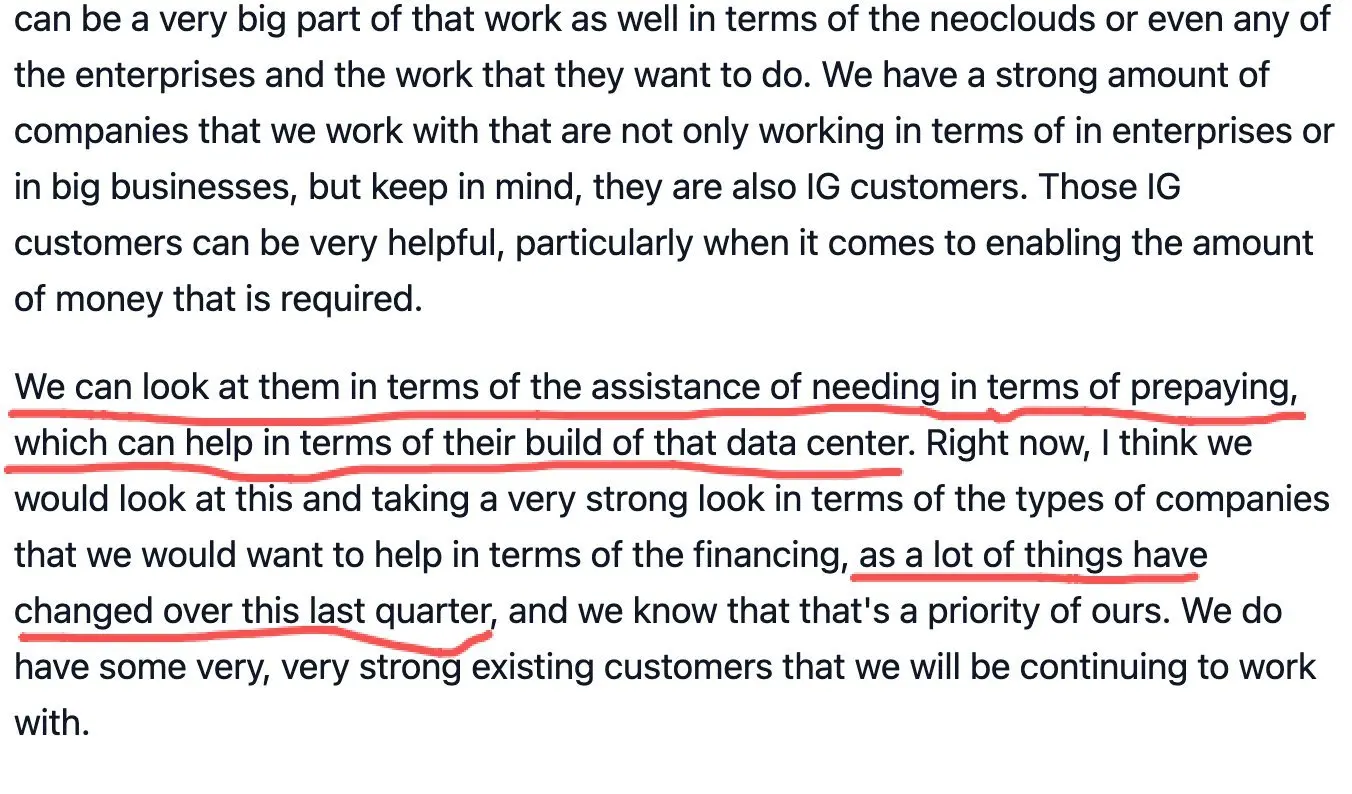
The interim CEO stated that guarantees will be tightened
IV. Postscript: What happens next?
The above is merely my deduction based on the industrial chain and macro background, combined with actual events that have occurred, which cannot be stopped from being validated. If this theory is true, then the following events are highly probable:
Huang Renxun is unlikely to return; because no one can guarantee that he won't export advanced chips to China again. The conference call early this morning confirmed this once again.
Chip policies towards China will continue to tighten. Previously, it seemed there were ways to simply not take it seriously while also making some premium. Now it concerns the very foundation of the United States, so they will naturally not loosen their grip.
They will try every means to obstruct China's AI development and data center construction, possibly starting with public opinion. For example, promoting the idea that AI leads to unemployment and that data centers affect residents' lives.
U.S. public opinion will decrease or no longer promote favorable news for the AI industry, but rather focus on negative news (this is also why there has been so much bad news recently).
Public figures who previously praised AI will go silent or shift their rhetoric.
In the next phase:
The Democratic Party will substantively execute legislation to pause or slow down data center construction.
The mid- to downstream sectors of the AI industry will slow down capital expenditures for financial safety reasons.
At this stage, it will already be quite clear. It may even evolve into a situation where all bad news has been fully priced in.
Currently, my position is light on stocks + investing in companies that can still benefit from the current level of AI or companies that will benefit from slowing CapEx. Of course, this is just my personal operation and does not constitute investment advice; I will not analyze buy or sell points.
I wrote this long article mainly because every time I see bloggers shouting "short-term risks," "all bad news priced in," or "Huang Renxun is coming back," I find it amusing; at the same time, I feel a bit annoyed. So I simply organized my views completely; if they are validated again in the future, I won’t have to type a lot of words. Of course, I also welcome being proven wrong, so that my friends in hardware can make money.
Everyone needs to take responsibility for their own views and trades. I also do not wish for anyone to cut losses after reading my article, only to come back two days later and blame me for causing them to miss out. Although I don’t have many fans, I will definitely block them.
Trading is solely about self-reliance.

ChainCatcher reminds readers to view blockchain rationally, enhance risk awareness, and be cautious of various virtual token issuances and speculations. All content on this site is solely market information or related party opinions, and does not constitute any form of investment advice. If you find sensitive information in the content, please click , and we will handle it promptly.





Popular articles