The generational buying point for BTC is approaching, and the AI crisis may create the final bottom
 Core Viewpoint


 100y believes that BTC is approaching a bottom buying point, with the range of $45,000 to $55,000 being attractive. The baseline scenario is that a crisis in the AI industry triggers the final bottom within the next year, followed by a reversal driven by credit expansion and monetary easing in the United States. The breakdown of moving averages, MVRV nearing 1, mining costs, and extremely pessimistic sentiment support this judgment, but risks such as the failure of the four-year cycle still exist.
Author: 100y, Head of Research at Four Pillars
Compiled by: Gu Yu, ChainCatcher
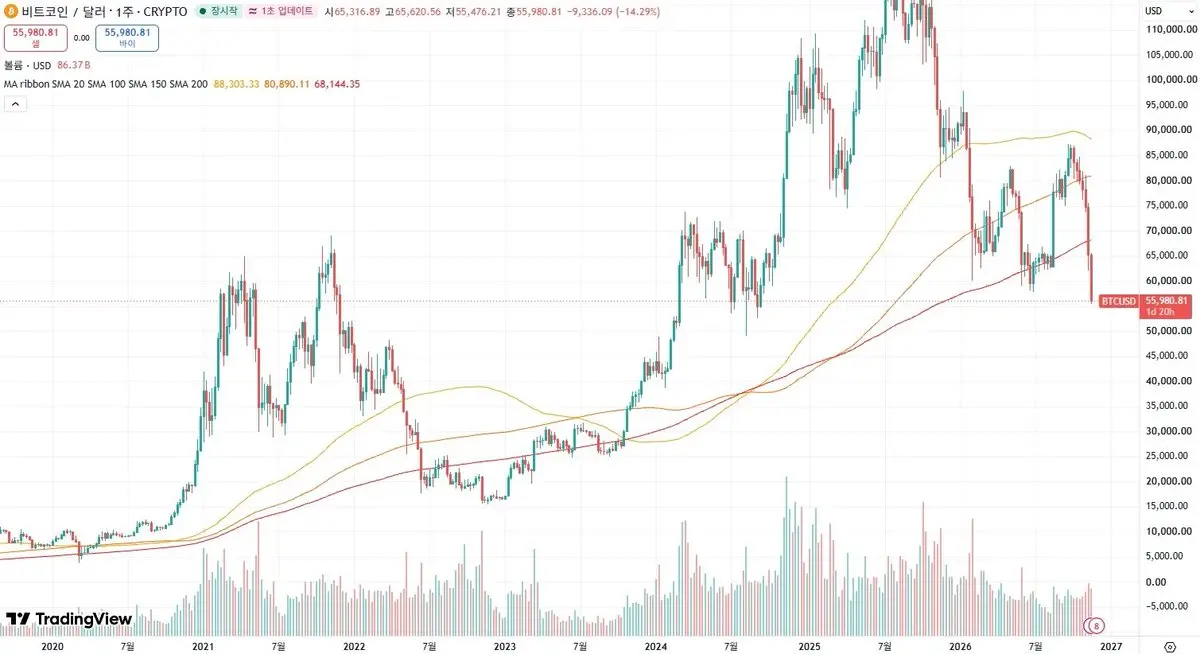
I woke up late on Saturday morning, made myself pasta and salmon, and then sat down at my computer. I could hardly believe my eyes. The trading price of BTC was $55,000 at that time.
Is the crypto market officially dead? Or is this a generational buying opportunity?
Here are my thoughts:
We are very close to a bottom buying opportunity for BTC. Assuming BTC will eventually enter another bull market, the range of $45,000 to $55,000 looks like an attractive entry point.
There is still a significant possibility that we have not yet seen the bottom of this cycle. Technical indicators like moving averages and MVRV, along with on-chain metrics, suggest that there may be more downside ahead. Given the situation in the AI industry, macro factors could also push BTC prices lower.
My baseline scenario is that a crisis in the AI industry will trigger the final bottom for BTC at some point within the next year, followed by a trend reversal driven by credit expansion and monetary easing in the U.S.
Let me briefly explain why I believe this is the most likely scenario.
1. The crypto industry is stronger than ever
Before diving into technical analysis, market cycles, and on-chain data, let’s take a step back and look at the broader crypto industry to which BTC belongs.
As I will discuss later, I have seen an increasing number of posts on X claiming that crypto has achieved nothing compared to AI, and that the entire industry is essentially useless. I completely disagree.
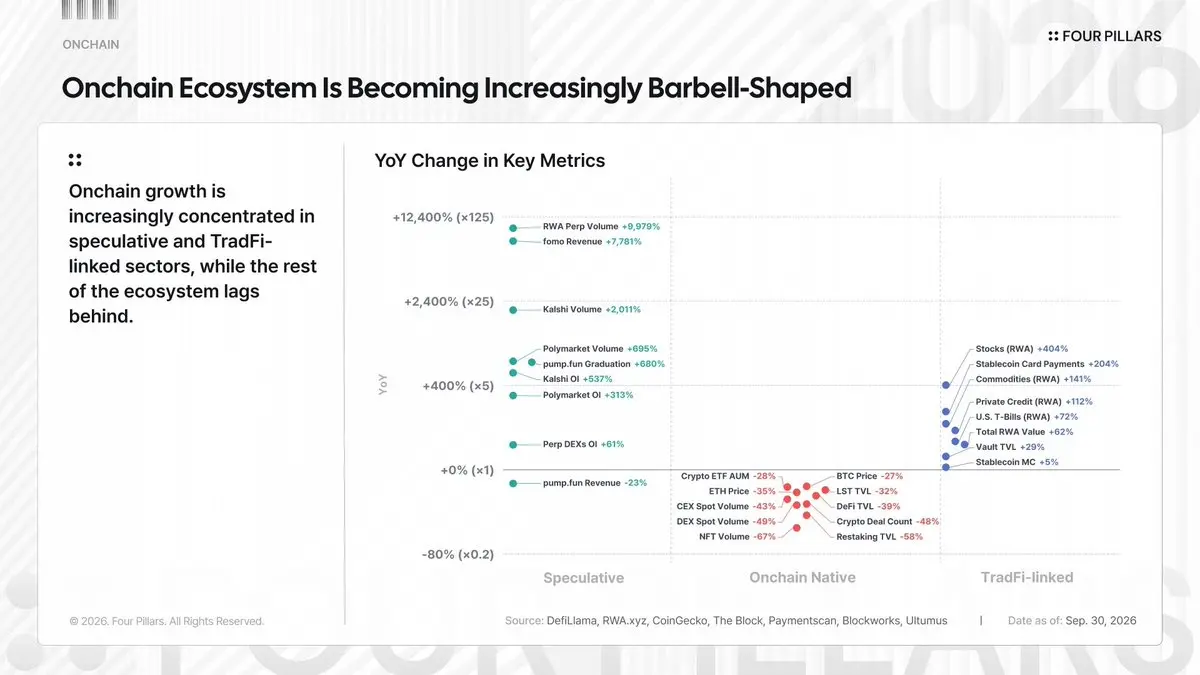
The above image comes from the upcoming year-end report from Four Pillars. My current assessment of the crypto industry is that several sectors have clearly found product-market fit (PMF). However, the issue is that adoption is extremely concentrated in a few areas.
The first is the more speculative side of crypto, including memecoins, perpetual futures, and prediction markets. Regardless of the broader crypto market conditions, these sectors continue to attract stable user activity. Especially perpetual contracts and prediction markets represent a new way to trade financial markets, with significant growth potential. There is a reason why Robinhood, Coinbase, and various traditional financial institutions are so focused on these markets.
The second is the rise of crypto as the next generation of financial infrastructure, primarily through stablecoins and real-world assets (RWA). Traditional financial infrastructure is extremely fragmented. Different asset classes and use cases rely on completely independent backend systems. Blockchain is increasingly seen as one of the few technologies capable of integrating these fragmented systems. Just look at the tokenization initiatives from DTCC, ICE, and NYSE, as well as the stablecoin initiatives being explored by large banks like Bank of America. There is a reason why so many financial institutions, large and small, are investing resources into stablecoins, RWAs, and blockchain infrastructure.
While BTC's current trading price may be between $55,000 and $56,000, the crypto industry can be said to have found more genuine PMF than ever before and is increasingly integrating into the existing financial system.
Regardless of market prices or sentiment, the crypto industry is thriving. If you think about the future of financial infrastructure, it is hard to imagine this industry will not see significant growth from here.
2. The 300WMA has been broken
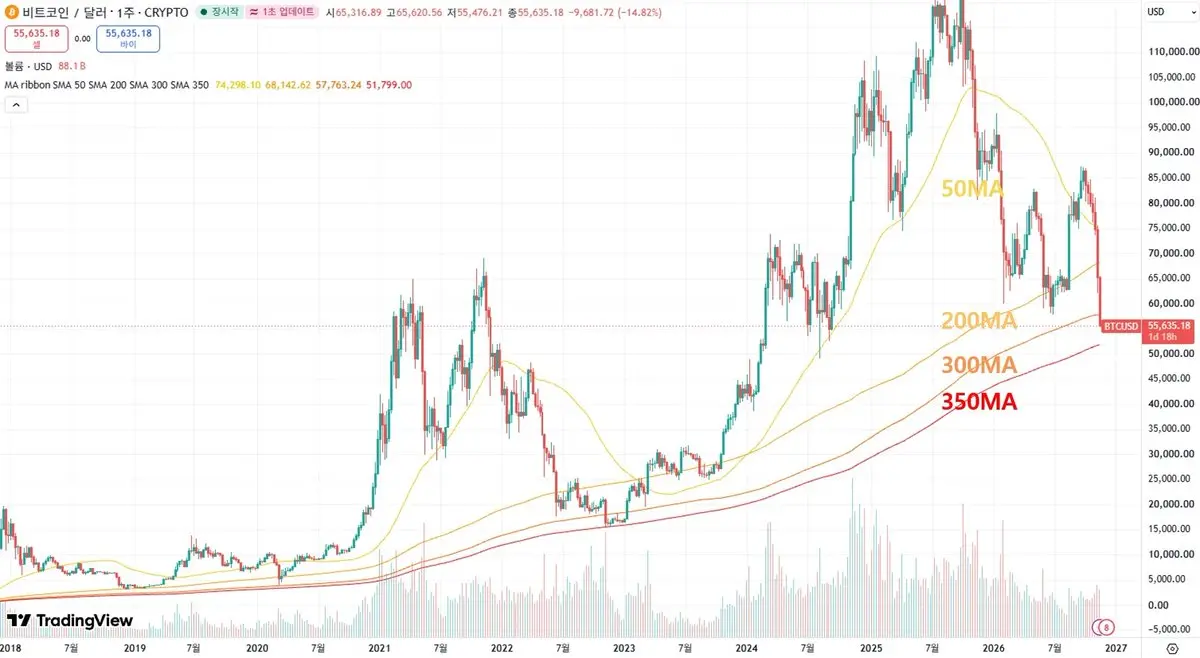
There is an old saying in the crypto circle: "The 200WMA is the bottom."
In major market crashes, including the 2018 bear market, the COVID crash, the Terra collapse, and the FTX bankruptcy, the 200-week moving average has been an extremely useful psychological reference point for identifying BTC bottoms.
But this time, things are different. The recent sell-off has not only broken the 200WMA but also the 300WMA. BTC is currently approaching the 350WMA, which has historically acted as a perfect floor price.
If BTC touches the 350WMA in the short term, the corresponding price would be around $52,000.
In any case, BTC has already broken below the 200WMA, one of its strongest historical psychological support levels. This fact suggests that, assuming another bull market will eventually come, we may be very close to the bottom.
We have seen similar situations before. In June 2022, after the Terra collapse and the subsequent bankruptcies of Celsius and 3AC, BTC briefly traded about 20% below its 200WMA.
It took BTC about 9 months to regain its position above the 200WMA, and about 14 months to clearly break away from that level and start the next major uptrend.
Today, BTC's trading price is about 18% below its 200WMA, placing us in a very similar position.
If history repeats itself, we could certainly see another wave of decline. But we may also be entering a period where BTC will trade sideways for the next year before the next major breakout, gradually moving up with its 200WMA.
3. The beginning of a new four-year cycle
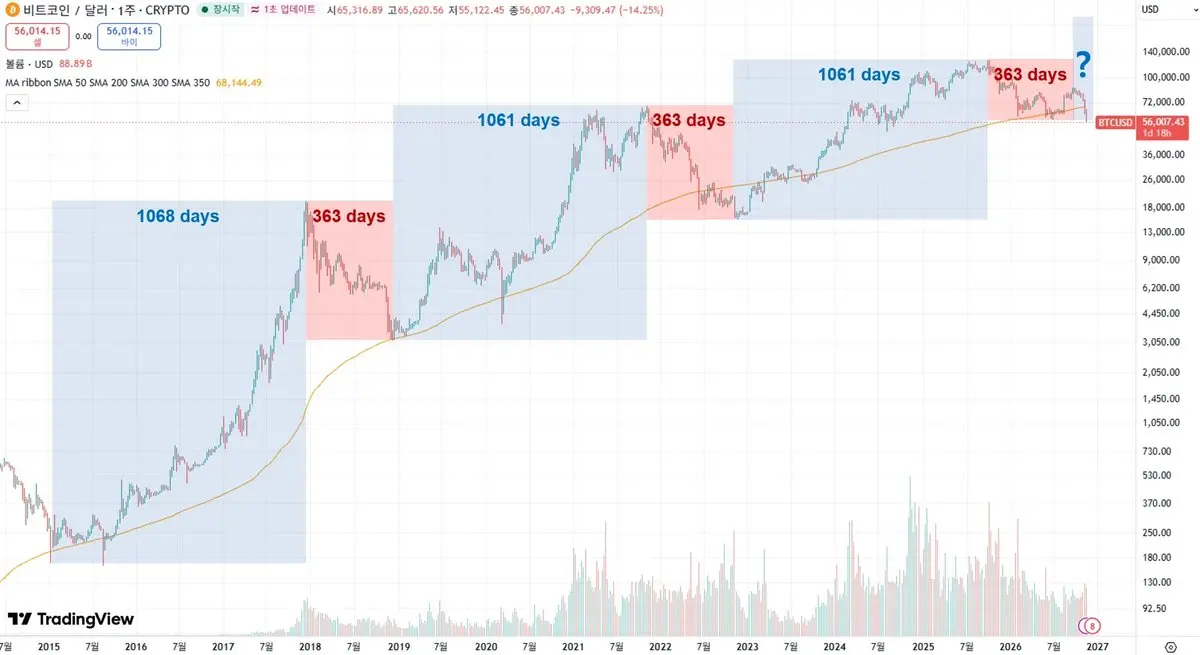
I believe one of the least convincing yet most powerful narratives is the four-year cycle theory of Bitcoin. I do not believe there are any fundamental reasons to believe it will continue to work so consistently.
However, the time intervals between bottoms and tops are strikingly similar, sometimes almost making it feel like a secret society is controlling BTC prices.
Since the bottom in 2015, BTC has repeatedly experienced an increase of about 1,061 to 1,068 days, followed by a decline of about 363 days. Combined with Bitcoin's halving cycle, this pattern has become an extremely powerful narrative shaping investor psychology.
This is particularly important for assets like BTC that do not generate cash flow and are heavily influenced by macro conditions and market sentiment. For such assets, narrative is extremely important.
If historical patterns continue, we should be nearing the end of the bear market and about to enter a new bullish phase.
However, there is an important risk here. It has been over 363 days since the last peak, and BTC's decline has exceeded the historical timeframe. I do not think this alone is enough to declare the four-year cycle invalid. But if BTC continues to deviate from this pattern, we will need to seriously reassess whether this theory still holds.
4. MVRV is approaching a drop below 1
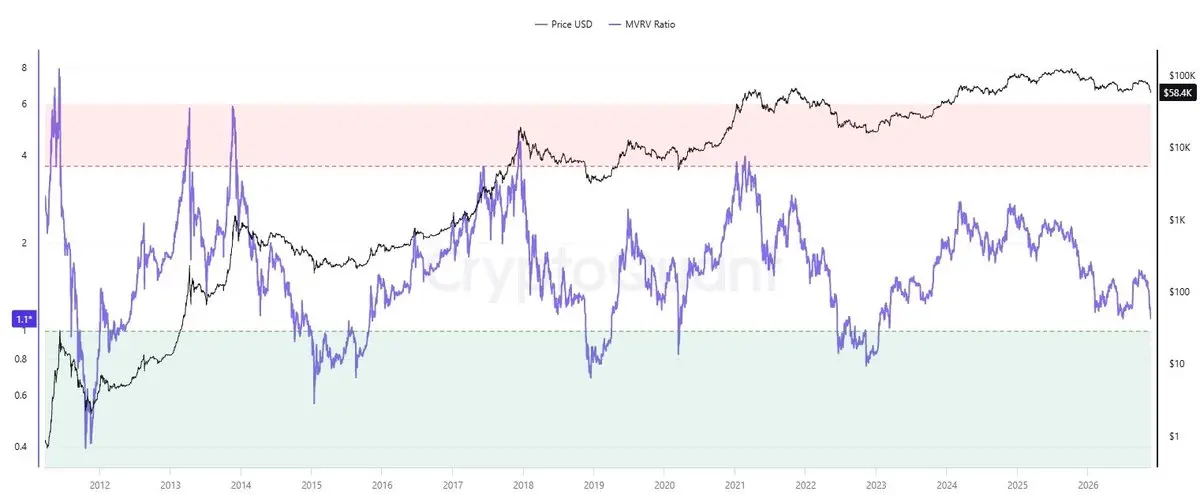
Source: CryptoQuant
MVRV stands for Market Value to Realized Value, which is the ratio of market value to realized value. It is calculated by dividing BTC's current market value by its realized market value; the realized market value is valued at the price of each BTC when it last moved on-chain.
In simple terms, a lower MVRV means that BTC's current market value is relatively low compared to the overall cost basis estimated by investors.
Historically, periods when MVRV drops below 1 often provide attractive long-term buying opportunities.
In previous cycles, BTC typically reached its final bottom about 1 to 6 months after MVRV dropped below 1. Subsequently, it often consolidated around the range where MVRV was below 1 for about 6 to 12 months before resuming an upward trend.
MVRV has not yet dropped below 1, but we are very close. This increasingly makes me optimistic that a strong long-term buying opportunity may be approaching.
There is also an encouraging detail here. The MVRV bottoms of each cycle have been gradually rising. Since 2011, the historical MVRV lows have been approximately 0.395 → 0.564 → 0.691 → 0.760.
If this trend continues, there is a significant possibility that the MVRV bottom of the current cycle will not be as deep as in earlier cycles.
Assuming the realized market value remains unchanged, and the next MVRV bottom falls around 0.8 according to historical trends, we can estimate that the BTC bottom is around $43,000.
5. BTC is approaching its mining cost trading
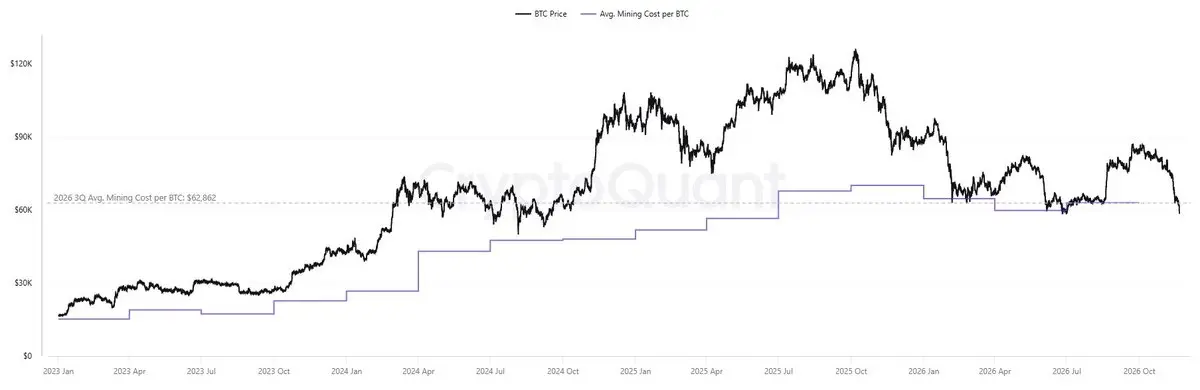
Source: CryptoQuant
CryptoQuant estimates the cost of mining 1 BTC by analyzing the financial disclosures of Marathon Holdings, one of the major publicly listed Bitcoin mining companies. As of the third quarter of 2026, this cost is approximately $62,900 per BTC.
Historically, the production cost for Bitcoin miners has been a useful signal for identifying potential market bottoms. When the trading price of BTC is below the production cost, miners' incentive to sell newly mined tokens at a loss decreases.
Of course, the situation has changed. Halving has reduced BTC's output, and many Bitcoin mining companies are now diversifying into AI data center businesses.
Therefore, I would not consider mining costs as an absolute bottom for BTC prices. However, I still think it is a useful indicator to keep an eye on when assessing where the market bottom might be.
6. BTC has decoupled from M2 liquidity
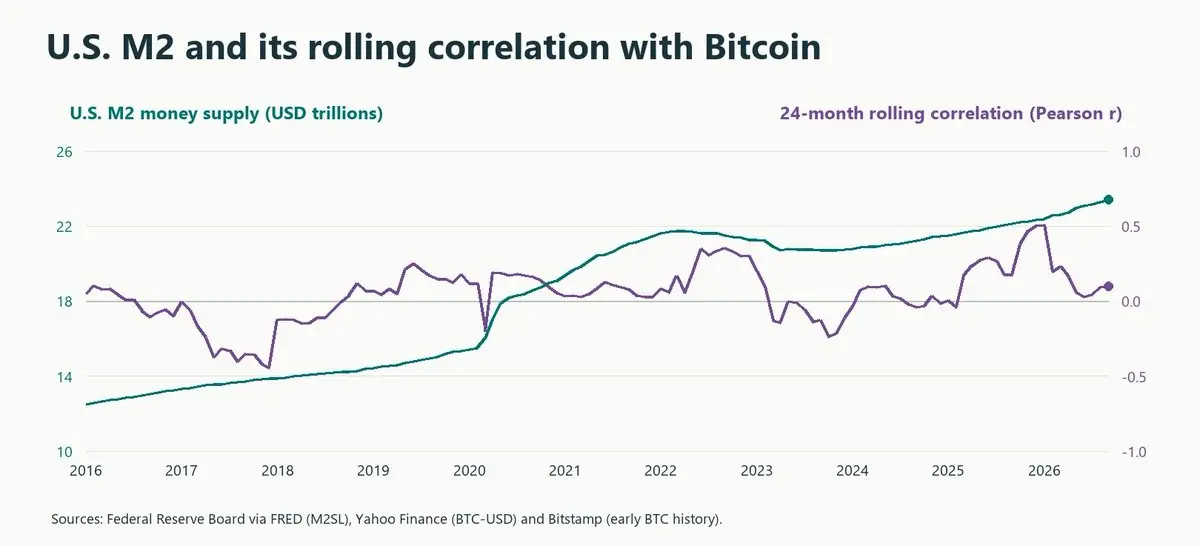
Many investors view BTC as digital gold with a fixed supply. In this framework, when liquidity expands in the financial system, the price of BTC, priced in dollars, should typically benefit. Historically, we have also seen BTC rise significantly during periods of expansion in the U.S. M2 money supply.
However, an interesting phenomenon has emerged recently. Throughout 2026, U.S. M2 liquidity has expanded again, yet BTC has continued to decline significantly. The correlation between BTC prices and M2 liquidity has dropped to nearly zero. In my view, this suggests that BTC may be significantly undervalued relative to the current scale of liquidity available in the financial system.
7. Market Sentiment is Extremely Poor

Thanks to posts from Jeff Dorman, iruletrenches, Beanie, and Austin Campbell.
Extreme bearish sentiment has historically been a useful signal for markets nearing a bottom. Right now, crypto sentiment is almost at an all-time low.
In the past few weeks, X has been filled with posts claiming that crypto is worthless, the entire industry is meaningless, and that basically every crypto token is garbage. More interestingly, these posts have garnered significant attention and agreement from investors.
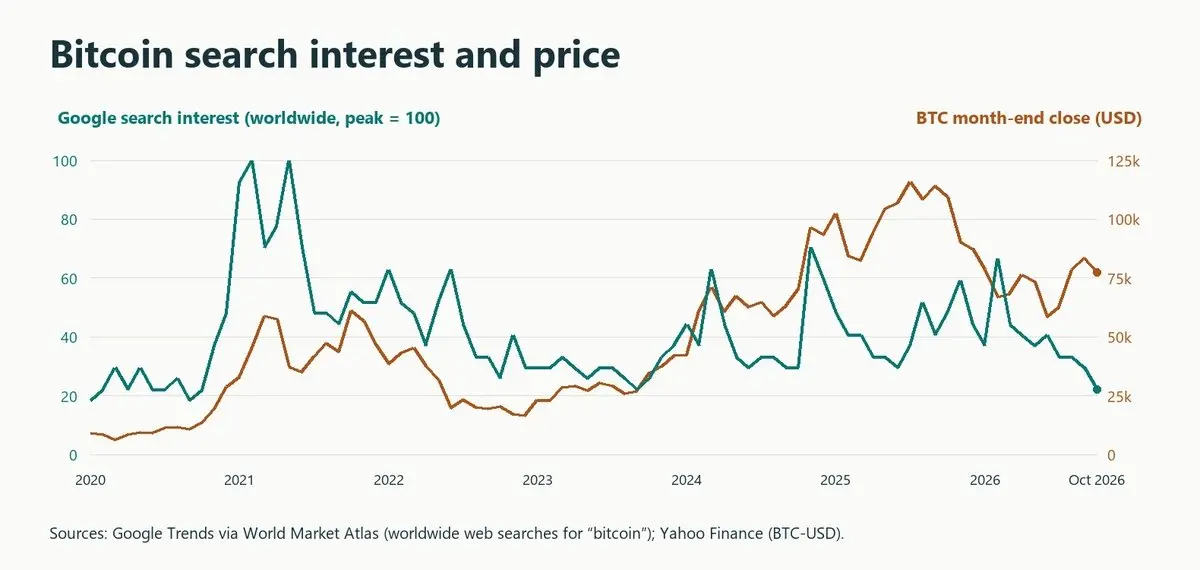
Google Trends tells a similar story. Interest in searching for Bitcoin has fallen back to levels last seen around 2020, close to the lowest point since then.
Historically, moments when everyone gives up on crypto often end up being some of the best buying opportunities.
8. Monetary Expansion is Inevitable
When thinking about market liquidity over the next three years, there is one thing I am particularly confident about. AI will ultimately lead to a massive expansion of dollar liquidity.
This aligns broadly with the argument made by Arthur Hayes in his article Situationship.
The logic is simple.
If the AI bubble does not burst and the industry continues to grow, the creation of private credit, including bank loans, will continue to expand.
If the AI bubble bursts, the U.S. government will inevitably respond with credit expansion and monetary easing, just like during the 2008 financial crisis.
From recent developments, I am increasingly leaning towards the second scenario.
Following a series of controversies surrounding Jensen Huang and his resignation as NVIDIA CEO, coupled with the Democratic Party's significant victories in the midterm elections and the resulting pressure on AI data center construction and development, investors have gradually begun to question the financing structure supporting the AI industry.
Whether these developments will ultimately trigger a significant correction in the AI bubble remains to be seen. However, if the AI bubble does indeed burst, I find it hard to imagine the U.S. government sitting idly by and doing nothing. AI is no longer just another market-driven industry. It is becoming a strategic national asset.
In a world where it is increasingly believed that whichever country first achieves AGI or ASI may dominate the next global power era, the U.S. cannot afford to fall behind China. In this context, I believe the U.S. has little choice but to support the AI industry through aggressive credit creation and monetary expansion.
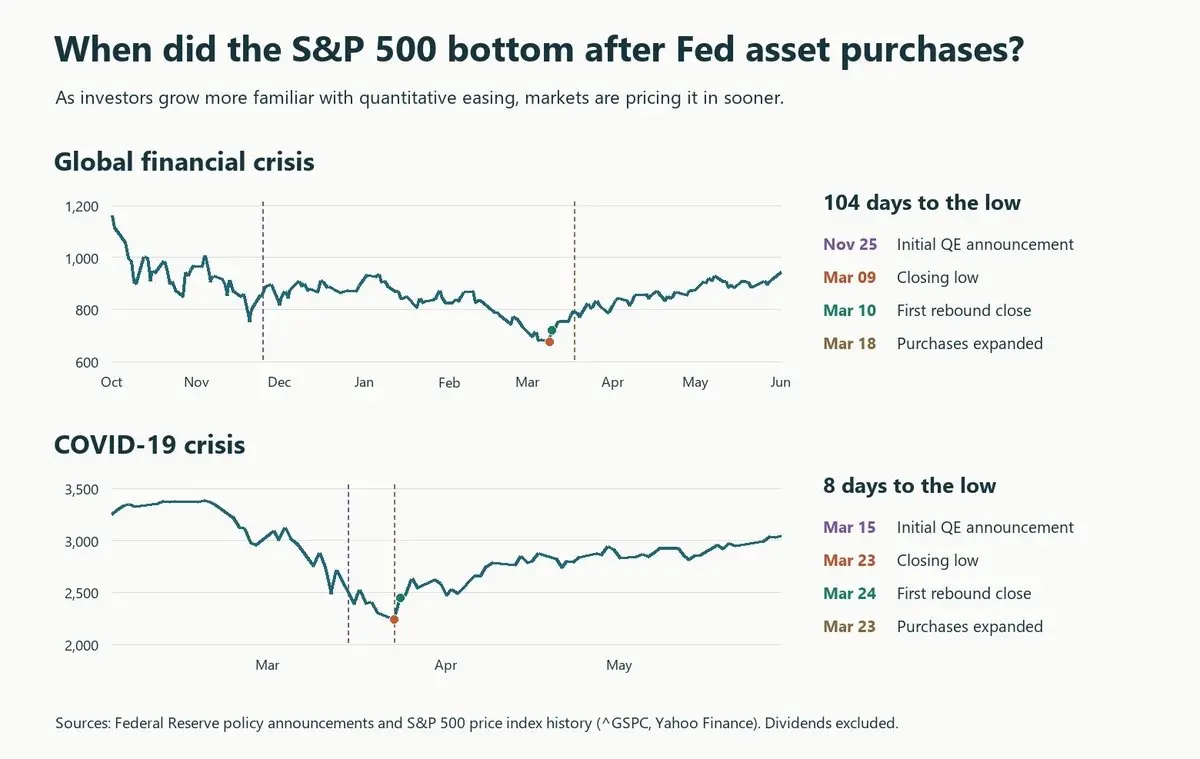
Looking back at the 2008 financial crisis and the COVID crash in 2020. The time from the announcement of quantitative easing to the market bottom has significantly shortened. My interpretation is that investors have learned how the market reacts to monetary easing and are increasingly pricing it in more quickly. If the AI bubble collapses and the government announces aggressive credit and monetary expansion again, I expect BTC to rebound strongly.
9. Worst Case Scenario
So far, I have explained why I believe the next 6 to 12 months may provide an attractive entry point for BTC, assuming we eventually welcome the next bull market.
But let's flip the argument. Almost every point I have made so far can also be interpreted as a bearish signal.
A healthy crypto industry does not necessarily mean higher BTC prices. Even if stablecoins, RWA, and blockchain technology replace a significant portion of the global financial backend infrastructure in the next five to ten years, it does not guarantee that BTC will capture that value.
The loss of the 200WMA and 300WMA could mean BTC has lost momentum. Price levels that previously served as reliable bottoms may no longer be relevant.
The four-year cycle may have been broken. Historically, bear markets should last about 363 days. Yet we are currently on day 411 of the decline.
An MVRV below 1, along with BTC trading below the cost of production for miners, does not guarantee that a bottom has been reached. Especially now that many Bitcoin mining companies are also operating AI data centers, this may be changing historical dynamics.
Despite M2 liquidity expanding, BTC continues to decline, which could be a structural warning signal. Funds that might have flowed into BTC could instead be absorbed by the AI industry.
And that's not all. Potential capitulation sell-offs from DAT companies, threats posed by quantum computing, and the continued selling pressure from stolen funds related to events involving Binance and other platforms could pose significant risks to BTC's future performance. BTC may not recover as historical cycles suggest, for many reasons.
10. Buy BTC, Thank Me Later
Ultimately, buying BTC is a bet that its future price will be higher. To have faith in this bet, you need to answer a fundamental question for yourself: Where does Bitcoin's value actually come from?
Some view BTC as the asset that best represents the growth and scale of the broader digital asset industry. Others see it as digital gold, a tool to hedge against the long-term devaluation of fiat currencies. Still, others value it as a decentralized currency that anyone in the world can freely hold and transfer without relying on governments or centralized institutions.
Personally, one of the most ironic reasons I am bullish on BTC in the long term is the advancement of AI. AI will significantly increase the supply of things we once thought were scarce. Software, content, knowledge work, and countless other things that historically required human time and labor will become cheaper and more abundant.
I believe that in a world where almost everything becomes abundant, those things that cannot be artificially created or inflated, as well as systems that do not require trust in centralized authorities, will become relatively more valuable.
For this reason, I believe the technological value of blockchain, especially decentralization and verifiability, will become even more important in the AI era. And BTC is the asset that has upheld these principles for the longest time.
It does not rely on the profits of any one company, nor on the policies of any one government. No single entity can unilaterally increase its supply, and participants around the world can independently verify and enforce the same set of rules.
I believe the next six to twelve months will be a critical period for testing this belief, while also potentially providing one of the most interesting opportunities to bet on this belief.
Buy BTC, thank me later.
ChainCatcher reminds readers to view blockchain rationally, enhance risk awareness, and be cautious of various virtual token issuances and speculations. All content on this site is solely market information or related party opinions, and does not constitute any form of investment advice. If you find sensitive information in the content, please click , and we will handle it promptly.




Popular articles