Tron Industry Weekly Report: Crypto ETFs continue to reduce holdings, BTC returns to $60,000, detailed explanation of communication and digital asset trading infrastructure centered on privacy protection, Beldex

 The cryptocurrency market is undergoing a phase adjustment driven by tightening macro liquidity, institutional fund withdrawals, and deleveraging, with short-term market sentiment clearly leaning towards pessimism. Beldex is a comprehensive privacy ecosystem based on BDX staking main nodes as infrastructure, with privacy trading as its underlying capability, and extends to anonymous messaging, decentralized VPN, private browsing, and cross-chain assets.
I. Outlook
1. Macroeconomic Summary and Future Predictions
Macroeconomic Review (November 9, 2026 - November 15, 2026)
This week, the core contradiction in the global macro market focused on the unexpected resilience of U.S. inflation, rising expectations for Federal Reserve interest rate hikes, and pressure on global risk asset valuations. The U.S. October CPI rose 0.4% month-on-month, higher than the market expectation of 0.3%, while the core CPI increased by 0.3% month-on-month; during the same period, the PPI rose 0.3% month-on-month and 6.5% year-on-year, reflecting persistent upstream price pressures. The previously released U.S. October non-farm payrolls added 165,000 jobs, significantly above the expected 70,000, combined with a 3.4% annualized GDP growth in the third quarter, further reinforcing the judgment that U.S. economic growth is robust but inflation is declining slowly. As a result, the market has revised up the expectations for the Federal Reserve's December interest rate hike, with the U.S. two-year Treasury yield rising rapidly, and the ten-year Treasury yield reaching about 5.15% over the weekend, leading to a stronger dollar and pressure on U.S. stocks, especially in the overvalued technology sector. Overall, the current macro environment is shifting from previous easing expectations to a pattern of "strong economic resilience, persistently high inflation, and a tightening monetary policy," with tightening global liquidity expectations becoming a major factor affecting the pricing of stocks, bonds, and crypto assets.
Macroeconomic Outlook for the Coming Week (November 16, 2026 - November 22, 2026)
Looking ahead to next week, global markets will focus on U.S. consumer resilience, the Federal Reserve's policy stance, and growth momentum in major economies. The U.S. will release October retail sales and industrial production data on November 17, with the market generally expecting retail sales to grow about 0.2% month-on-month, a significant slowdown from the previous value of 0.8%; the minutes from the Federal Reserve's October meeting, to be released on November 18, will serve as an important basis for judging the magnitude of the December rate hike and internal policy disagreements. Additionally, the initial jobless claims on November 19, the University of Michigan consumer confidence index on November 20, as well as China's October economic activity data, U.K. inflation data, and China's central bank LPR quotes, will also impact global growth and monetary policy expectations. It is expected that the short-term market will maintain a high volatility pattern: if U.S. consumption and employment continue to be strong and the meeting minutes signal a hawkish stance, the dollar and U.S. Treasury yields may remain strong, putting pressure on U.S. tech stocks, gold, and crypto assets in terms of valuation and liquidity; conversely, if consumption significantly cools and the Federal Reserve signals a cautious rate hike, market risk appetite may see a temporary recovery.
2. Cryptocurrency Industry Market Changes and Warnings
Cryptocurrency Market Changes (November 9, 2026 - November 15, 2026):
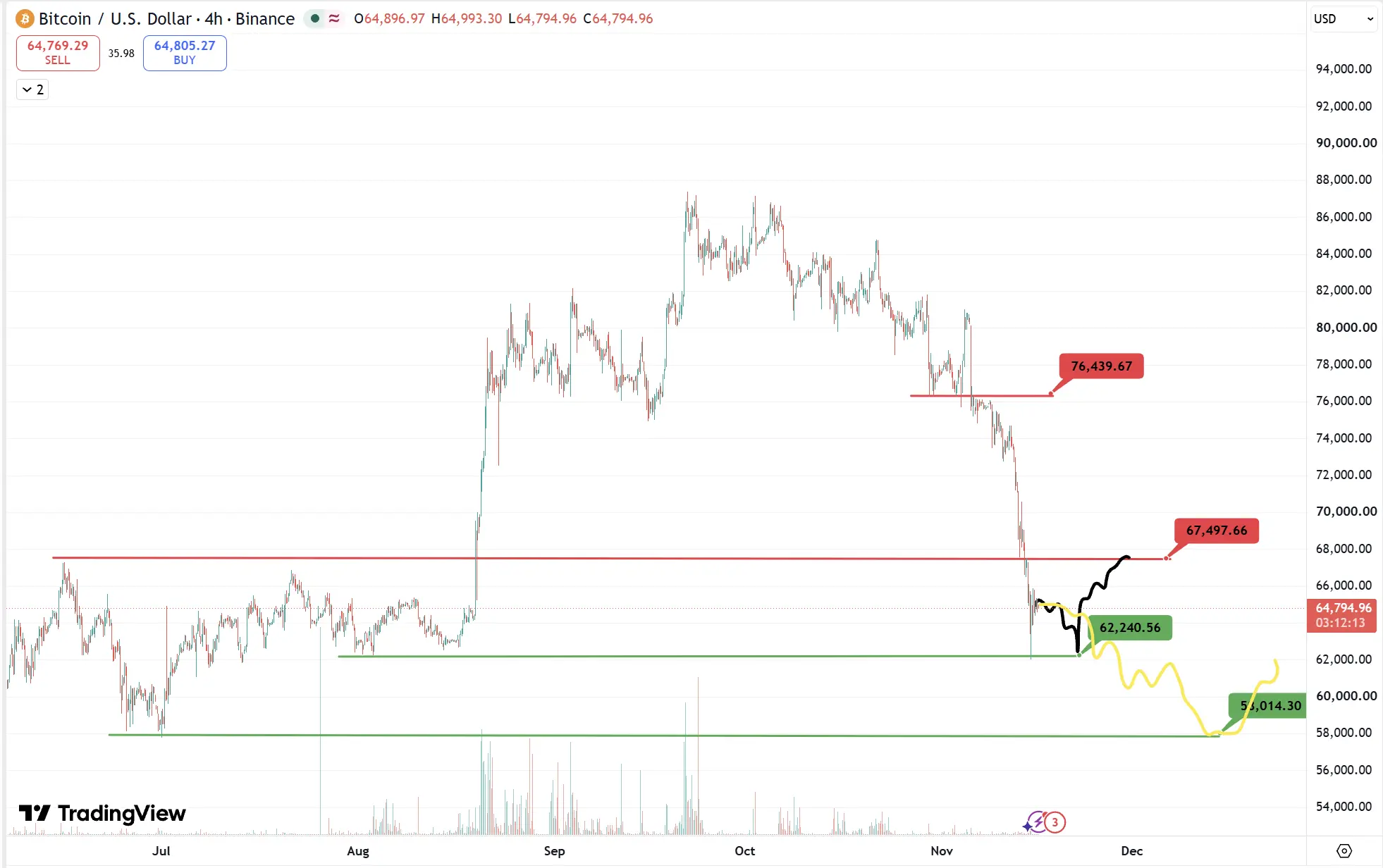
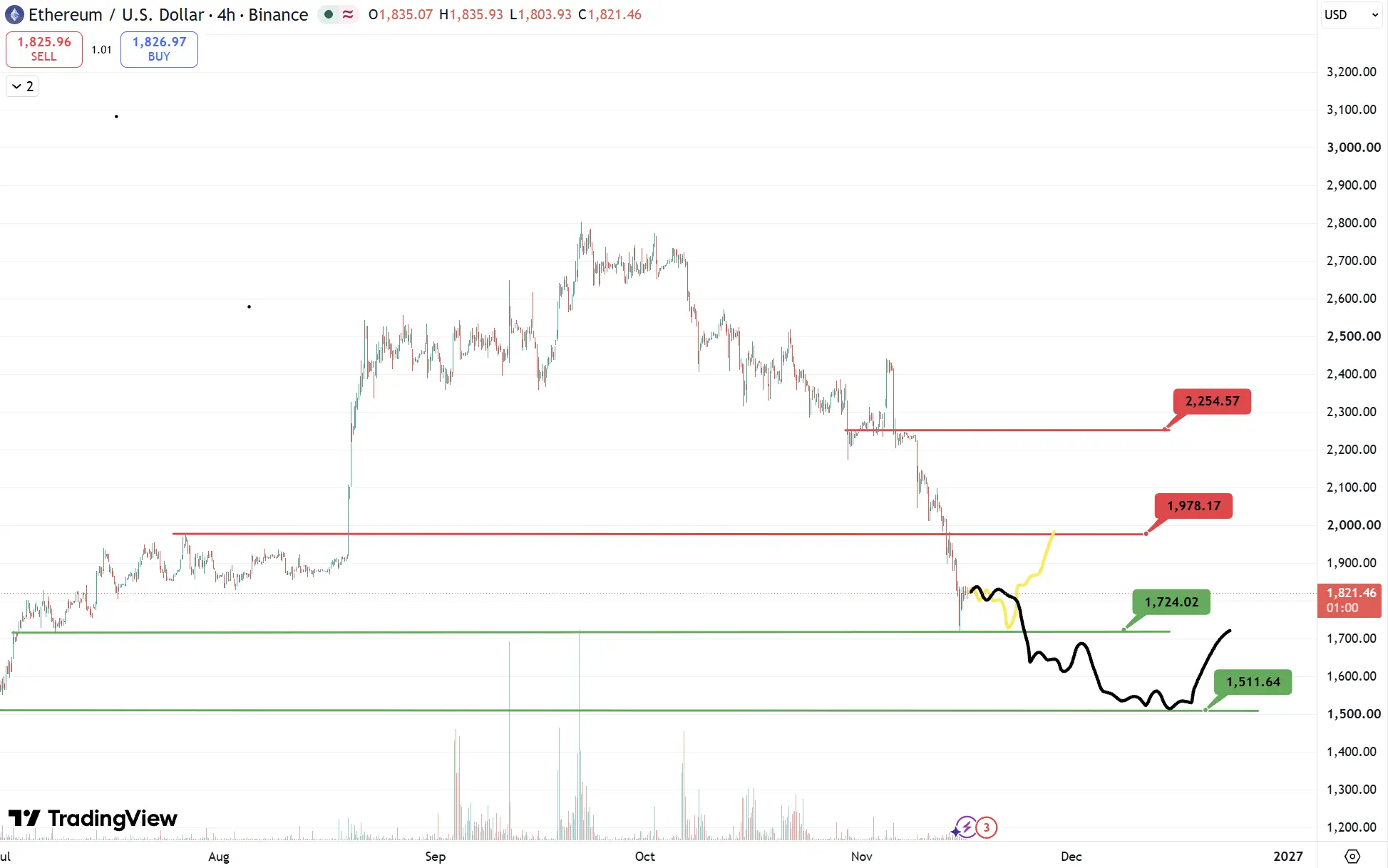
This week, the cryptocurrency market continued its downward trend, characterized by a decline in risk appetite, ongoing withdrawals of institutional funds, and liquidity contraction. Bitcoin (BTC) fell from about $75,000 at the beginning of the week to below $66,000 over the weekend, with a decline of over 10% during the week; Ethereum (ETH) and most mainstream altcoins also faced pressure, resulting in a general downward trend in the market. This round of adjustment was mainly influenced by rising expectations of hawkish monetary policy from the Federal Reserve, weakening tech stocks, and ongoing institutional de-risking. In terms of funds, the U.S. spot Bitcoin ETF saw a cumulative net outflow of about $1.065 billion from November 9 to 13, marking the second consecutive week of over $1 billion in fund withdrawals; the Ethereum spot ETF experienced a net outflow of about $399 million during the same period, recording net outflows for the seventh consecutive week, with related ETFs like Solana and XRP also facing redemption pressure. Meanwhile, as of November 14, the circulating supply of U.S. dollar stablecoins decreased by about $4.441 billion within a week, reflecting insufficient incremental funds in the market. Overall, the crypto market is undergoing a phase of adjustment driven by tightening macro liquidity, institutional fund withdrawals, and deleveraging, with short-term market sentiment clearly leaning towards pessimism.
Market Forecast for the Coming Week (November 16, 2026 - November 22, 2026):
It is expected that the cryptocurrency market will continue to operate in a weak oscillation pattern with high volatility next week, with market trends primarily dependent on Federal Reserve monetary policy expectations, the performance of U.S. tech stocks, and the flow of funds in spot ETFs. After consecutive declines, Bitcoin may have a technical rebound demand due to overselling, but current institutional funds have not shown sustained inflows, and the contraction of stablecoin supply also indicates a lack of sufficient new liquidity support in the market, so the sustainability of short-term rebounds remains to be verified. From a technical perspective, it is essential to pay attention to BTC's support performance around $65,000 to $66,000; if it falls below this range and ETF outflows continue, it may further test the $62,000 to $64,000 range; if macro risk sentiment improves and ETF redemptions slow down, a rebound testing the $69,000 to $72,000 range is possible. ETH and high-volatility altcoins are expected to remain influenced by Bitcoin's movements, with funds likely concentrating further on more liquid mainstream assets. Overall, the market is likely to be in a phase of bottom exploration and technical repair next week, with a focus on preventing further downside risks in the short term.
3. Industry and Sector Hotspots
This week, investment and financing in the cryptocurrency industry showed a trend of funds concentrating on RWA (Real World Asset Tokenization), institutional-level blockchain infrastructure, stablecoin payments, and AI applications, with large financing primarily driven by traditional finance and leading crypto venture capital firms. According to public disclosures, the RWA infrastructure project Index Industries completed a $50 million seed round financing, led by Lightspeed, with participation from Polychain Capital, Galaxy Ventures, and others, focusing on the tokenization of U.S. real estate assets; the institutional-level blockchain project Alta completed a $47.5 million Series A financing, led by Index Ventures, aiming to build a financial infrastructure that combines privacy protection, compliance, and cross-border payment capabilities; the AI and blockchain integration project DECA Labs secured $12 million in financing, with participation from Polychain Capital, Pantera Capital, and others; the institutional trading platform Marble completed a $11 million seed round financing.
II. Market Hotspot Sectors and Potential Projects of the Week
1. Overview of Potential Projects
1.1. Detailed Explanation of Total Financing of $36 million, led by DWF, enflux, and sigma capital, with participation from Nxgen, Newtribe, and Eak Ventures - Building a decentralized communication and digital asset trading infrastructure centered on privacy protection: Beldex
Introduction
Beldex is a comprehensive privacy ecosystem based on BDX staking main nodes, with privacy trading as its underlying capability, extending to anonymous messaging, decentralized VPN, privacy browsing, and cross-chain asset transactions.

Key Observations
• The technology stack is not entirely original: one-time addresses, ring signatures, RingCT, and Bulletproofs all originate from mature research contexts, with the project's innovation focus leaning more towards integration, network governance, and productization.
• The main node serves as a single point of aggregation for the system: it simultaneously undertakes consensus, security checks, instant transactions, and service routing, enhancing resource reuse but also expanding the impact range of main node layer failures or centralization.
• The white paper's claims need secondary verification: the same document mentions fixed block rewards of 6.5 BDX, 10 BDX after hard forks, and producer rewards of 6.25 BDX, indicating that parts of the economic model are not fully unified.
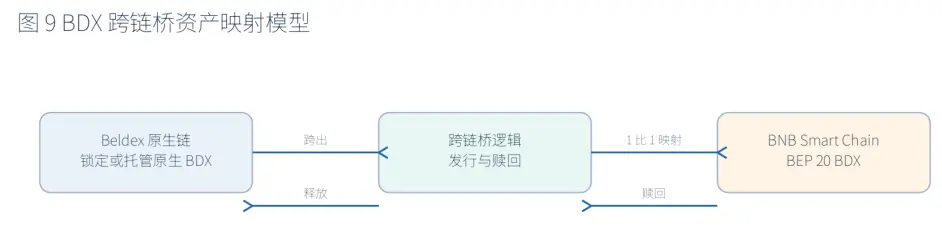
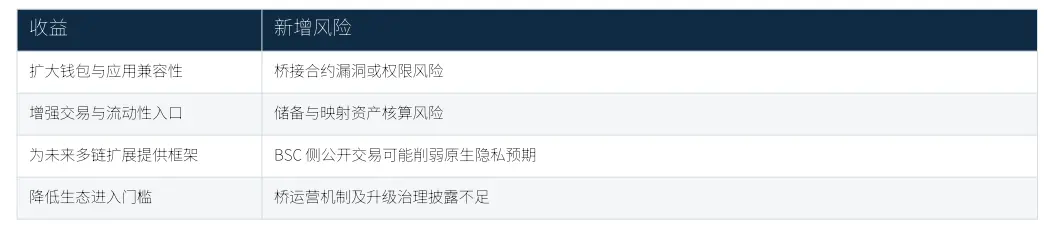
• Cross-chain bridges expand composability while introducing privacy and custody boundaries: assets on the BEP 20 side can connect to the EVM ecosystem, but their privacy attributes should not automatically equate to those of the native chain.
Project Analysis
1 Project Positioning and Problem Space
Beldex defines the problem as the traceability of digital activities: public ledgers expose addresses, amounts, and balances, while centralized communication and VPN services may retain metadata, server logs, or data that can be forcibly disclosed. The project thus attempts to build a privacy computing ecosystem covering transactions, communication, and network access, rather than just an anonymous payment asset.
1.1 Target Users and Needs
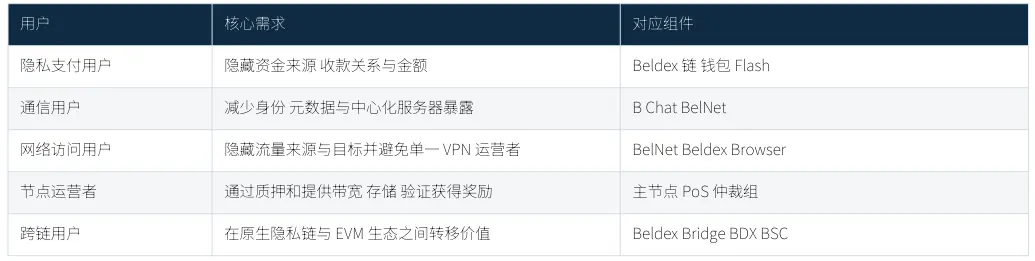
1.2 Design Mainline
The project's design mainline can be summarized in three layers: the first layer uses cryptography to reduce the traceability of on-chain transactions; the second layer forms a service network with economic constraints using PoS main nodes; the third layer deploys applications such as instant transactions, messaging, anonymous routing, and browsers on the same network. This structure allows BDX to serve as a payment asset, collateral asset, and service settlement medium simultaneously.
2 Privacy Trading Technology Breakdown
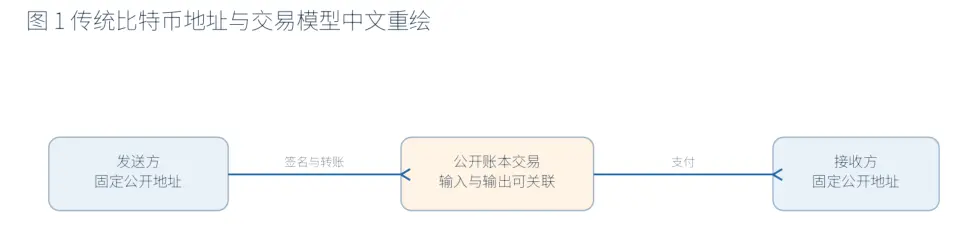
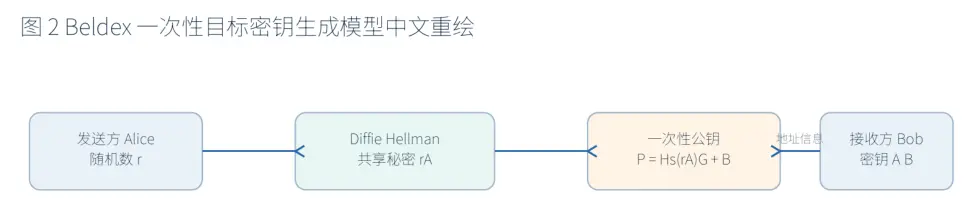
2.1 One-Time Addresses and Unlinkable Payments
Traditional fixed addresses aggregate multiple incoming transactions to the same identity clue. Beldex adopts the CryptoNote model: the sender uses a random number and the receiver's dual public keys for Diffie Hellman calculations, generating a unique one-time target public key for each output. External observers, even if they know the receiver's public address, find it difficult to directly attribute multiple outputs to the same entity.
2.2 Standard Transactions and Incoming Transaction Identification
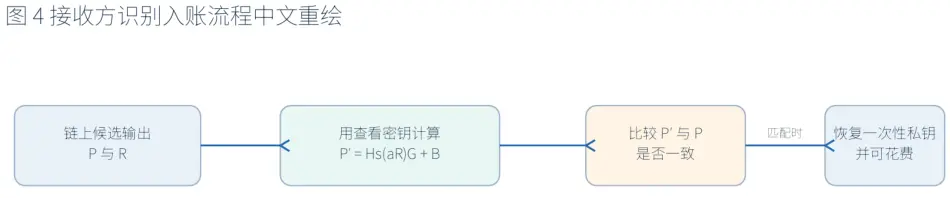
The sender writes a random point R into the transaction, and the receiver uses the view key to scan on-chain outputs, calculating candidate target public keys and comparing them with the on-chain P. If they match, the receiver can further recover the corresponding one-time private key and spend that output. The view key can be used for delegated scanning or auditing, but its permission design must avoid evolving into a leakage of spending permissions.
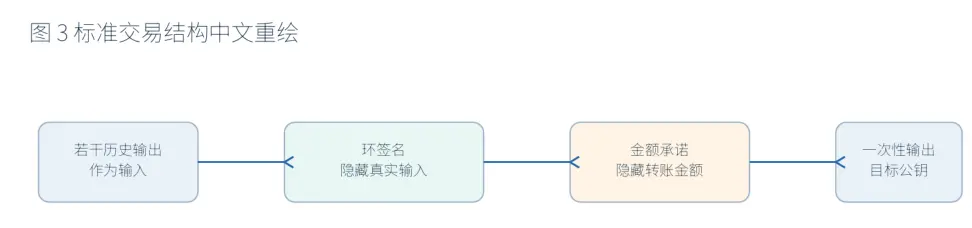
2.3 Ring Signatures and Key Images
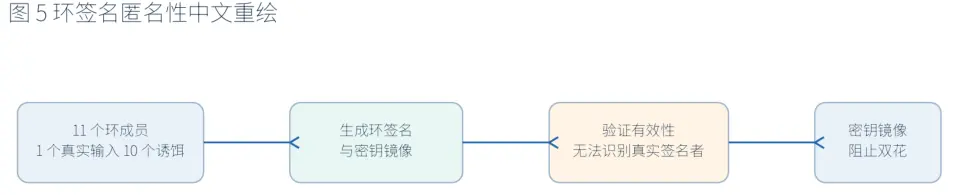
Ring signatures place real inputs alongside several unrelated public keys in the same anonymous set. Verifiers can confirm that the signature comes from a member of the set but cannot directly determine the real signer. The white paper states that the fixed ring size is 11, meaning 1 real input is paired with 10 decoys. Key images generate comparable identifiers from the use of the same private key, allowing for the identification of double spending without exposing real members.
2.4 RingCT and Amount Hiding
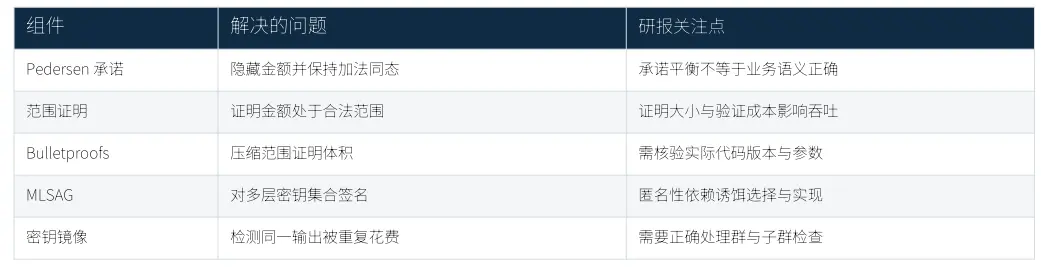
RingCT uses Pedersen commitments to hide transaction amounts while allowing validators to confirm that inputs and outputs remain balanced at the commitment level. Range proofs are used to demonstrate that amounts fall within a legitimate range, avoiding the issuance of new tokens through negatives or overflows.
The white paper further describes Borromean range proofs, Bulletproofs, MLSAG, and two types of transaction organization: RCTTypeFull and RCTTypeSimple.
2.5 Technical Evaluation

3 Consensus and Masternode Network
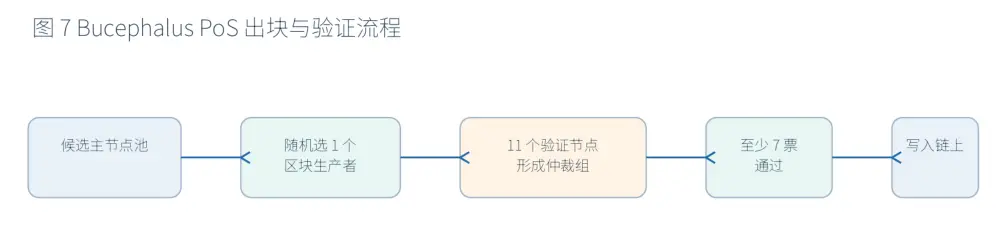
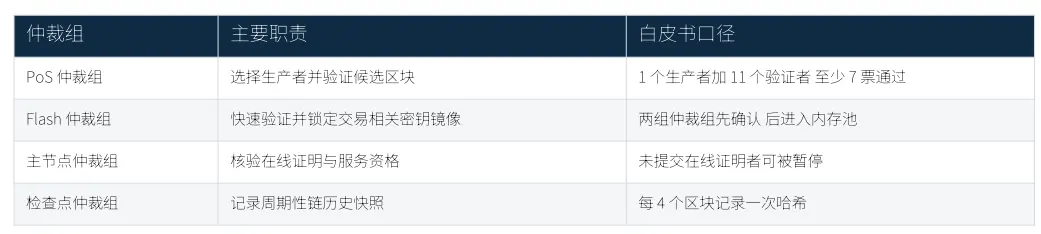
Beldex transitions to PoS through the Bucephalus hard fork. Masternodes need to lock 10,000 BDX and provide bandwidth, storage, and online services. Masternodes serve as both block producers and validators, as well as the infrastructure for Flash, checkpoints, B Chat, and BelNet, thus the staking constraints also bear the responsibility for consensus security and service quality assurance.
3.1 Four Types of Arbitration Groups
3.2 Fault Tolerance and Penalties
The white paper lists faults such as producers not producing blocks, validators not revealing commitment values, validators providing different random values, and double signing. The system handles these through downgrading scores, switching blocks, pausing nodes, and canceling transaction processing. If the arbitration group cannot reach the required majority before timing out, the next group takes over block production.
Key Risks
The more responsibilities the masternode layer undertakes, the more important the network's centralization, node operation thresholds, and software homogeneity risks become. The white paper does not provide the distribution of masternode numbers, staking concentration, or geographic or cloud service provider concentration, making it impossible to judge the actual degree of decentralization based solely on protocol rules.
4 Flash Instant Transactions and Token Mechanism
4.1 Flash Working Logic
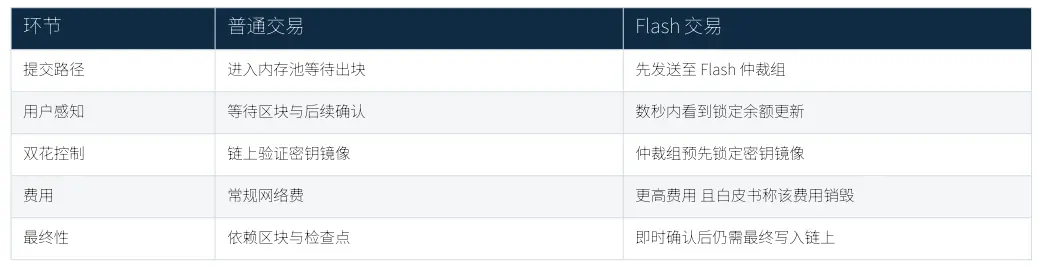
Regular transactions need to wait to enter blocks and receive confirmations. Flash allows selected masternodes to verify transaction authenticity in advance and temporarily store the key images corresponding to UTXOs; if the same key image appears again, conflicting transactions are rejected. The transaction still enters the memory pool and is eventually written to the chain. This mechanism places the risk assessment before final on-chain entry in the hands of the masternode arbitration group.
4.2 The Functional Closed Loop of BDX
• Transaction and network fees;
• 10,000 BDX masternode collateral and shared staking;
• Node and masternode rewards;
• Payment medium in ecological services;
• 1:1 asset mapping between the native chain and BSC;
• Deflationary mechanism formed by the destruction of Flash transaction fees.
5 Product Ecosystem
5.1 Wallet
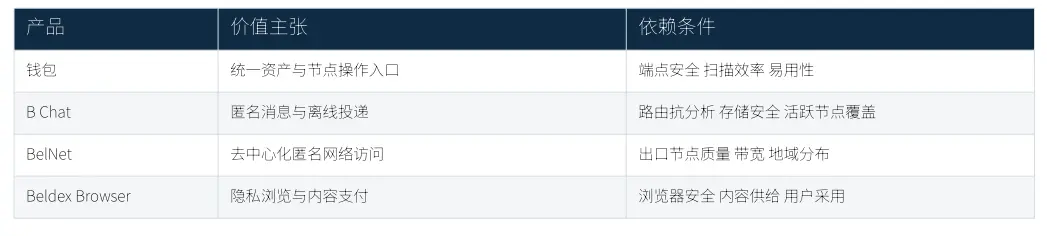
The white paper lists Android, iOS, and Electron desktop wallets. The mobile version is used for holding and sending/receiving BDX and mentions staking features; the desktop version also provides a graphical interface for deploying and managing masternodes. Wallets are key endpoints in privacy chains, and their scanning performance, key backup, and malware protection directly affect user experience and asset security.
5.2 B Chat
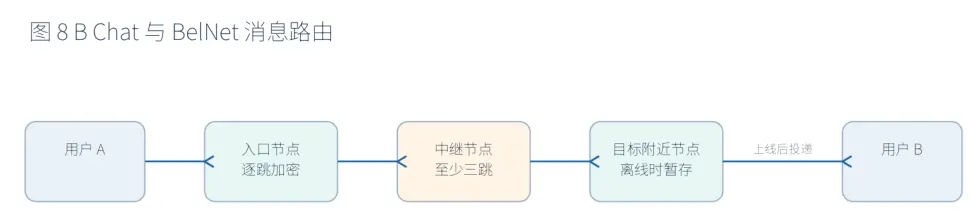
B Chat routes messages through BelNet and requires at least three relay hops. Each hop only processes encrypted message packets; if the recipient is offline, nearby nodes can temporarily store messages and deliver them once the recipient is online. The white paper emphasizes the anti-censorship value of decentralized storage and routing compared to centralized servers.
5.3 BelNet and Browser
BelNet is a decentralized VPN based on the Beldex Routing Protocol, using packet switching and maintained by masternodes that manage a distributed node directory. Nodes must meet staking and bandwidth requirements, and governance nodes regularly check service capabilities. The Beldex Browser then routes browsing traffic into BelNet and proposes a payment model supporting content creators with BDX.
6 Cross-Chain Bridge
Beldex Bridge connects the native Beldex chain with the BNB Smart Chain. The white paper states that native BDX and BDX BSC maintain a 1:1 ratio, with smart contracts responsible for issuance and redemption, allowing assets to access BEP 20 wallets, trading, and liquidity applications. The document provides the BSC contract address as 0x9d10a1ec41Fe7878429BB457e31F9b050D38c633.
Tron Commentary
Beldex's advantage lies in its relatively complete Web3 ecosystem built around privacy protection, using the Beldex Network as the foundation, through PoS consensus, masternodes, and privacy transaction mechanisms, further covering applications like BChat for private communication, BelNet for decentralized VPN, and Beldex Browser, extending privacy capabilities from mere anonymous payments to communication, network access, and Web3 usage scenarios, while also having certain cross-chain and ecological expansion space.
The disadvantage is that its core competitiveness is highly concentrated in the privacy track, and compared to mainstream general-purpose public chains, there is still a gap in developer scale, DeFi liquidity, application richness, and overall network effects. Additionally, privacy transactions and anonymous communication inherently face higher global regulatory and trading platform compliance pressures, and restrictions on privacy coins in some jurisdictions may affect BDX's trading accessibility and institutional adoption. Therefore, its long-term growth is more reliant on whether privacy demand can continue to expand and whether the ecosystem can form a truly large-scale user and application network.
II. Industry Data Analysis
1. Overall Market Performance
1.1. Spot BTC vs ETH Price Trends
BTC
ETH
III. Macroeconomic Data Review and Key Data Release Nodes for Next Week
This Week's Macroeconomic Data Review (November 9 - 15)
This week, the core focus of the global macro market is on the U.S. October CPI and PPI inflation data, the U.K. third-quarter GDP, and the Eurozone economic growth situation. The U.S. October CPI rose 0.4% month-on-month, higher than the market expectation of 0.3%; the core CPI rose 0.3% month-on-month, also above the expected 0.2%, indicating persistent inflationary pressure. The October PPI rose 0.3% month-on-month, lower than the expected 0.4%, suggesting relatively mild price pressure on the production side, but not enough to offset the strong signals of consumer-side inflation. The number of initial jobless claims in the U.S. for the week of November 12 was about 200,000, reflecting the resilience of the labor market. Overall, the U.S. economy shows a combination of high inflation and relatively stable employment, which suppresses the short-term rate cut space for the Federal Reserve, and market attention further shifts to whether there is a risk of interest rate hikes in December.
Next Week's Core Focus in the Macroeconomic Market
Next week, key attention will be on U.S. October retail sales, the Federal Reserve's October meeting minutes, and China's October economic activity data. If U.S. retail sales significantly exceed expectations, and the meeting minutes release stronger signals for inflation control, the market may further revise expectations for Federal Reserve interest rate hikes, pushing U.S. Treasury yields and the dollar stronger, creating valuation pressure on U.S. tech stocks, gold, and crypto assets. Conversely, if consumer growth slows significantly, and the Federal Reserve releases relatively mild policy signals, it may alleviate market concerns about further tightening monetary policy.
IV. Regulatory Policies
1. United States: Strengthening Crypto Crime Enforcement, Adjusting Anti-Money Laundering Rules
On November 9, the U.S. Financial Crimes Enforcement Network (FinCEN) and the Federal Reserve's previously withdrawn proposal to lower the threshold for funds transfer information rules officially took effect, meaning that the plan to lower the threshold for retaining and transmitting certain cross-border transaction information from $3,000 to $250 will no longer be pursued. Meanwhile, on November 12, the U.S. Department of Justice announced that it had obtained court authorization to seize or restrict over $1.2 billion in crypto assets related to North Korean hacking attacks, further strengthening enforcement against cross-border crypto money laundering, cybercrime, and illegal capital flows. The U.S. Securities and Exchange Commission (SEC) also disclosed its enforcement results for the fiscal year 2026 this week, indicating that digital asset regulation continues to advance through existing securities laws and enforcement mechanisms. Overall, this week, U.S. regulatory focus is on anti-money laundering, cybersecurity, and enforcement, while continuing to improve the regulatory framework for stablecoins and the digital asset market.
2. European Union: Important Stablecoins Officially Enter Dual Regulatory Mechanism
On November 12, the European Banking Authority (EBA) officially began direct regulation of USDC as a Significant Electronic Money Token (Significant EMT) under the Markets in Crypto-Assets Regulation (MiCA), focusing on areas such as own funds, reserve assets, liquidity, and recovery and redemption plans. The French Prudential Supervision and Resolution Authority (ACPR) will continue to be responsible for corporate governance, outsourcing, and other related regulatory matters. This adjustment marks an upgrade in the EU's regulation of large stablecoin issuers from general compliance requirements to cross-agency, ongoing prudential supervision, serving as a model for future stablecoin issuers entering the EU market.
3. Brazil: Virtual Asset Service Providers Enter Centralized Licensing Review Stage
On November 9, the Central Bank of Brazil announced the status of license applications for Virtual Asset Service Providers (VASP), with a total of 120 institutions submitting applications before the previous deadline. Among them, 119 can continue to operate during the regulatory review period, while institutions that have not obtained formal authorization must still meet transitional compliance requirements. Service providers that fail to submit applications as required will face demands to cease providing related services. This move indicates that Brazil's crypto market is transitioning from transitional regulation to formal licensing management, with compliance costs and market entry barriers for trading platforms, custodians, and other virtual asset service providers expected to increase.
4. Russia: Promoting Cryptocurrency Trading on Regulated Exchanges
Around November 11, the Central Bank of Russia further clarified the implementation arrangements for cryptocurrency trading on regulated exchanges. Relevant directives are set to take effect on November 17, allowing compliant exchanges to commence cryptocurrency trading from November 22 after obtaining the central bank's approval of trading rules. Initially, the asset range for ordinary investors includes Bitcoin, Ethereum, and USDT, while non-qualified investors face a trading limit of 300,000 rubles per year per intermediary. This policy reflects Russia's attempt to establish controlled investment channels for crypto assets through traditional exchange systems while maintaining capital flow and payment regulatory restrictions.
5. South Korea: Expanding Emergency Freezing Authority for Trading Platforms, Strengthening Cybersecurity Regulation
On November 12, the Financial Services Commission (FSC) of South Korea announced strengthened security management for virtual asset service providers, planning to allow trading platforms to suspend related deposits and withdrawals in advance upon detecting suspected hacking attacks or system intrusion risks, rather than waiting for the attack to be fully confirmed. Platforms are also required to enhance round-the-clock security monitoring, abnormal access reporting, and incident emergency response, with plans to gradually introduce bank-level information security standards into the virtual asset industry. The specific applicable conditions for the relevant regulatory exemptions have not yet been fully disclosed. This adjustment indicates that South Korea's regulatory focus is further extending from asset custody and investor protection to the security of trading infrastructure.
6. Kenya: Officially Promoting Virtual Asset Service Providers to Apply for Operating Licenses
On November 13, the Central Bank of Kenya (CBK) and the Capital Markets Authority (CMA) jointly issued a notice requiring institutions that have begun or plan to provide virtual asset services to apply for licenses from the relevant regulatory authorities, covering crypto trading, custody, stablecoins, and related payment services. The transitional period for the Virtual Asset Service Providers Act ended on November 4, but as of this week, the regulatory authorities have not published a list of formally licensed institutions nor clarified a new unified application deadline. Kenya has thus entered the practical implementation phase of the crypto industry licensing system, with future regulatory focus expected to concentrate on access review, anti-money laundering, and stablecoin reserve management.
7. Thailand: Proposing to Strengthen Regulation of Stablecoin Transfers and Trading Markets
This week, the Securities and Exchange Commission (SEC) of Thailand is advancing a draft notification on stablecoin regulation, aiming to further clarify transfer restrictions related to stablecoins and limit certain activities of liquidity providers in stablecoin and Thai baht trading pairs to reduce market manipulation, abnormal capital flows, and payment system risks. The relevant regulations are currently still in the public consultation phase and have not yet officially taken effect. Thailand's regulatory direction indicates that it is gradually refining the regulation of stablecoins separately from general digital asset trading, focusing on the risk transmission between stablecoin and local currency exchanges, market liquidity, and payment uses.
8. New Zealand: Proposing to Adjust the Regulatory Classification of New Zealand Dollar Stablecoins
This week, the Financial Markets Authority (FMA) of New Zealand proposed a category designation plan for New Zealand dollar-denominated stablecoins backed by banks, intending to exclude stablecoins that meet specific conditions from certain securities regulatory requirements to reduce compliance uncertainty and support compliant payment innovations. The relevant arrangements do not mean that all stablecoins can be exempt from financial regulation, but rather establish a differentiated regulatory mechanism for specific products with clear reserve support and issuance structures. This proposal is still in the consultation phase, with a deadline of December 18.
9. Turkey: Financial Stability Committee Urges Establishment of Stablecoin Issuer Regulatory System
On November 11, the Financial Stability Committee (FSB) released a peer review report on Turkey's financial regulatory system, noting that while the country has established a registration and licensing management system for crypto asset trading platforms, it still lacks a complete regulatory framework for stablecoin issuers. The FSB recommends that Turkey further clarify stablecoin issuance access, redemption rights, reserve support, and prudential regulatory requirements, while also strengthening cross-border regulatory cooperation and platform licensing management. It is important to note that this is a policy recommendation from an international regulatory body and not a new law formally introduced by the Turkish government this week, but it reflects that the country's future stablecoin regulation may tighten further.
10. Canada: Further Clarifying the Regulatory Boundaries Between Banks and Stablecoin Issuers
This week, the stablecoin regulatory arrangements proposed in Canada's 2026 budget continue to attract attention. The plan intends to prohibit federally regulated financial institutions from directly issuing stablecoins but allows them to conduct related business through non-financial institution subsidiaries regulated under the Stablecoin Act, while also proposing to bring some foreign stablecoin issuers under regulatory scope. The policy aims to isolate traditional bank deposit business from stablecoin issuance risks and unify compliance requirements for domestic and foreign issuers. It should be noted that this proposal was initially presented with the budget on November 5 and is not a new law issued between November 9 and 15; it still requires subsequent legislative implementation.
11. Hong Kong: Promoting the Application of Digital Hong Kong Dollar in Financial Market Infrastructure
This week, Hong Kong Exchanges and Clearing Limited (HKEX) announced arrangements for digital payment infrastructure, planning to introduce a digital Hong Kong dollar payment scheme starting December 14, to support margin processing and improve settlement efficiency during the trading period after derivatives market close. This development does not directly relax cryptocurrency trading regulation but represents an important advancement in Hong Kong's integration of digital currency, tokenized settlement, and traditional financial market infrastructure, reflecting that its digital asset policy is extending from trading platform licensing to institutional-level payment and clearing applications.
12. Ireland: Planning to Establish a Regulatory Communication Mechanism for Asset Tokenization
This week, the Central Bank of Ireland proposed establishing a Tokenisation Access Point to provide a regulatory communication channel for enterprises exploring the tokenization of securities and other financial assets on the blockchain, helping market participants understand applicable regulatory requirements and potential compliance risks. This mechanism does not constitute an independent business license, nor does it imply that related projects can bypass existing financial regulatory systems, but it indicates that Irish regulatory authorities are proactively promoting the compliant integration of traditional capital markets with blockchain infrastructure.
 Risk warning Risk warning




Popular articles