October non-farm payrolls reignite December interest rate hike expectations! Wall Street bets on a probability exceeding 80%, "New Federal Reserve News Agency": AI sell-off may become a policy variable
 Core Viewpoint


 After the non-farm payroll report, traders bet that the probability of a rate hike in December rose to 85%. Wall Street insiders believe the report provides room for further rate hikes, bringing back pressure for rate increases amid market concerns about a slowdown in AI development or weakened rate hike expectations after the midterm elections; some remain cautious about a December rate hike due to stock market volatility and the outlook for AI investments, which may restrain the Federal Reserve. The New Federal Reserve News Agency believes the report did not shake the Fed's judgment on economic growth and inflation, and whether the AI asset sell-off will change financial conditions may become a new variable for the December decision; attention should be paid to whether Waller values lagging employment data or forward-looking market signals.
U.S. non-farm payroll data for October exceeded expectations, reigniting Wall Street's enthusiasm for betting on a Federal Reserve rate hike in December. Traders expect that the probability of a 25 basis point rate hike by the Federal Reserve in December has risen to over 80% following the report's release.
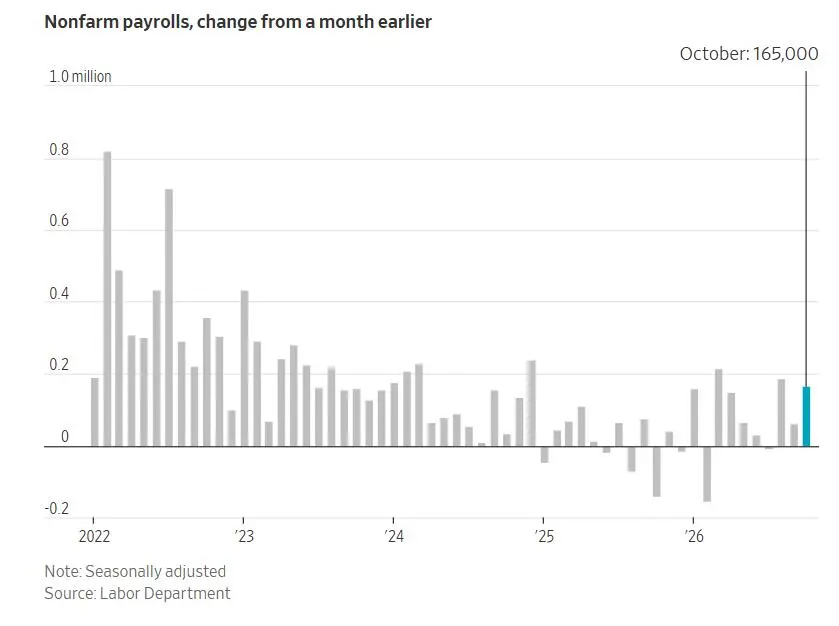
The report released by the U.S. Bureau of Labor Statistics (BLS) on Friday, November 6, shows that non-farm employment increased by 165,000 in October, far exceeding Wall Street's expected increase of 70,000; the unemployment rate fell to 4.1%, and the labor force participation rate rose to 61.9%, both not remaining flat as the market had anticipated in September; average hourly earnings rose by 0.4% month-on-month, accelerating more than the market expected compared to the 0.1% increase in September. Overall, employment, unemployment, and wage indicators are strong.
Several Wall Street analysts believe that this report provides a stronger basis for the Federal Reserve to raise interest rates further in December. However, energy prices and subsequent inflation trends, as well as the recent sell-off of AI-related assets affecting financial conditions, may still influence the Federal Reserve's next steps.
Journalist Nick Timiraos, known as the "New Federal Reserve Correspondent," believes that this employment report does not shake the Federal Reserve's judgment on economic growth and inflation, but whether the recent sell-off of AI-related assets will change financial conditions may become another variable in the December policy decision. The focus will be on whether Federal Reserve Chairman Waller places more importance on lagging employment data or forward-looking market signals.
Probability of December Rate Hike Rises to 85% as Wall Street Sees Strong Employment Providing Room for Federal Reserve Action
After the employment report was released, the interest rate market quickly adjusted its policy expectations. Reports indicate that traders' bets on a 25 basis point rate hike at the Federal Reserve's December meeting rose to about 85%, up from about 75% before the report was released; the market's expectations for the timing of the next rate hike have also been moved forward.
Lindsay Rosner, head of fixed income investments at Goldman Sachs Asset Management, believes this non-farm report has cleared the way for the Federal Reserve to raise rates in December. She stated, "This non-farm data has removed the traffic lights for the Federal Reserve at the crossroads of December policy." The tightening labor market provides room for the Federal Reserve to raise rates further without necessarily harming its employment goals.
Jeff Schulze, chief investment strategist at Franklin Templeton Institute, stated that the strong performance of the October employment report has renewed pressure on the Federal Reserve to raise rates against the backdrop of market concerns that a slowdown in AI development could weaken rate hike expectations after the midterm elections.
Ryan Weldon of IFM Investors also believes that although an inflation report will be released before the Federal Reserve's December meeting, the strong economic performance and sticky inflation make it difficult for the Federal Reserve to avoid the option of raising rates.
Olu Sonola, an analyst at Fitch Ratings, pointed out that this is a very strong labor market report. Combined with robust GDP and consumption data, the U.S. economy remains resilient, and concerns related to AI have not significantly altered this judgment; as the labor market remains strong, the Federal Reserve's policy discussions may further shift towards inflation and a rate hike in December.
Employment and Wages Strengthen Simultaneously, but Structural Concerns Remain in the Labor Market
In October, non-farm employment increased by 165,000, significantly exceeding market expectations and marking the third-highest monthly increase since March and August 2026. The employment data for the previous two months was also revised upward: August's employment figure was revised from 133,000 to 186,000, and September's from 29,000 to 60,000, totaling an upward revision of 84,000.
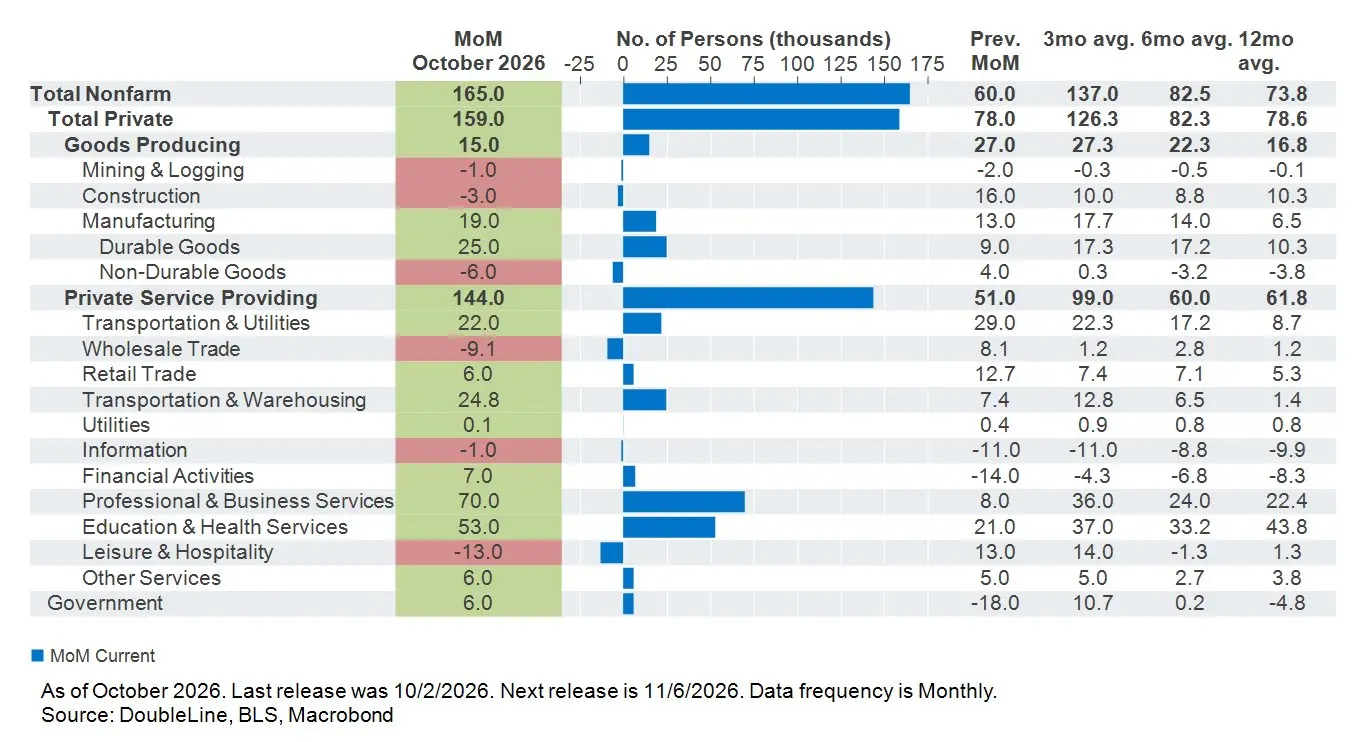
By industry, in October, professional and business services added 70,000 jobs, healthcare added 42,000, transportation and warehousing added 25,000, and manufacturing added 19,000; leisure and hospitality, however, saw a decrease of 13,000 jobs. The significant acceleration in job growth in professional and business services also provides a noteworthy counter-signal to concerns that AI is rapidly eroding white-collar jobs.
Carl Weinberg, chief economist at High Frequency Economics, believes that the U.S. economy is already at or very close to full employment. Strong job demand means that the Federal Reserve needs to pay attention to whether labor demand is exceeding supply.
Wage data also reinforces the signal of a hot labor market. In October, average hourly earnings rose by 0.4% month-on-month, higher than the market expectation of 0.3%, and significantly accelerated from the 0.1% increase in September; the year-on-year increase was 3.1%. The labor force participation rate also rose from 61.8% in September to 61.9%, indicating that employment growth is not solely driven by workers exiting the labor market.
However, the report is not without concerns. The number of people forced to work part-time for economic reasons increased by 339,000 to about 4.84 million, indicating that some workers are still unable to secure ideal full-time jobs.
Brian Jacobsen, chief economic strategist at Annex Wealth Management, pointed out that despite a year-on-year wage growth of 3.1%, if inflation exceeds this level, the real average hourly wage for workers will still decline. He referred to this phenomenon as "a single number presenting an affordability crisis." In his view, rising energy prices are pushing up living costs, which may further increase pressure on the Federal Reserve's policies.
Inflation and Energy Prices Remain Key Variables in the Rate Hike Path
Although the employment report has strengthened expectations for a rate hike in December, Wall Street analysts do not believe that a single employment data point can determine the Federal Reserve's policy path. The next round of inflation data, energy price trends, and the impact of high interest rates on financial markets and economic activity remain key variables.
Carl Weinberg, chief economist at High Frequency Economics, believes that the economy is at or near full employment, and the Federal Reserve needs to guard against inflation risks arising from labor demand exceeding supply.
Peter Cardillo, chief market economist at Spartan Capital Securities, believes that the drop in the unemployment rate to 4.1% and wage growth exceeding expectations indicate that the labor market remains strong. He assesses that the Federal Reserve will find it difficult to avoid a rate hike in December, with the remaining question being whether to raise rates by 25 or 50 basis points.
However, Anshul Sharma, chief investment officer at Savvy Wealth, reminds that attention must still be paid to inflation, especially energy prices. Even if employment and wage data support a rate hike, if energy prices fall and inflation pressures ease, the Federal Reserve may reassess its policy options.
Wall Street Divided: Stock Market Volatility and AI Investment Outlook May Restrain the Federal Reserve
Strong employment data has raised expectations for a rate hike, but recent volatility in financial markets has led some market participants to remain cautious about whether the Federal Reserve will take action in December.
Joe Saluzzi, co-head of Themis Trading, believes that the strong performance of new jobs, wage growth, and previous data revisions indeed increases the likelihood of the Federal Reserve's next rate hike. However, the volatility in the stock market has already significantly increased, and if financial markets are in an unstable state, it remains to be seen whether the Federal Reserve will choose to raise rates at this time. He stated that if the Federal Reserve were to meet tomorrow, he would not consider a rate hike a certainty based solely on this employment report.
Tim Holland, chief investment officer at Orion, also pointed out that strong employment data may push U.S. Treasury yields higher and put additional pressure on the stock market. The current market is already affected by the outlook for AI capital expenditure cycles and policy uncertainties; if interest rates rise further, risk assets may continue to be under pressure.
Susannah Streeter, chief investment strategist at Wealth Club, believes that the strong employment report has reduced the likelihood of a rate cut in the near term and reinforced the view that rates will remain high for a longer period. The resilience of the labor market also offsets some market concerns about a slowdown in data center construction and increased AI regulation potentially dragging down economic growth.
"New Federal Reserve Correspondent" Raises Policy Variables: Does the Federal Reserve Focus on Lagging Employment Data or Forward-Looking Market Signals?
Nick Timiraos pointed out on social media that the U.S. added 165,000 non-farm jobs in October, with the data for August and September revised upward by 84,000, and the unemployment rate slightly fell to about 4.14%. Regardless of the observation criteria used, U.S. employment growth has accelerated again after nearly stagnating last summer.
However, Timiraos believes that these data are not sufficient for the Federal Reserve to reconsider its judgment on economic growth and inflation. What is truly worth noting is whether the sell-off of AI-related assets will change financial conditions, thereby affecting the Federal Reserve's assessment of policy effectiveness.
He raised the core contradiction: Federal Reserve Chairman Waller has stated that he prefers to reference market signals that can reflect future economic trends rather than lagging economic data. Now, the employment report shows that economic growth remains resilient, but the sell-off of AI-related assets may influence the financial environment through stock prices, financing conditions, and risk appetite. As the December meeting approaches, which type of signal the Federal Reserve will prioritize may become a key point of policy discussion.
This also means that although the October non-farm report has renewed expectations for a rate hike, the final decision will not simply be an extension of employment data. The next round of inflation data will test whether wage and employment resilience translates into more persistent price pressures, while changes in financial markets may influence the Federal Reserve's judgment on future economic and policy transmission.
 Risk warning
 Risk warning





Popular articles