The US stock market crashed overnight, and Anthropic's valuation plummeted to 500 billion! Engaging in ASI could result in a 20-year sentence
 Core Viewpoint


 The U.S. stock market experienced an epic sell-off overnight, with the S&P 500 losing about $2.5 trillion in market value within 40 minutes; Anthropic is reported to have an $895 billion debt hole, with valuation expectations significantly revised down; at the same time, the U.S. plans to permanently ban the research and development of "superintelligence," with violators facing up to 20 years in prison.
Source: Xinzhiyuan Report
This morning, countless people's social circles and groups were flooded with screens full of "plunge" and "collapse."
Everyone was rushing to tell each other: last night, the U.S. stock market experienced an epic bloodbath.
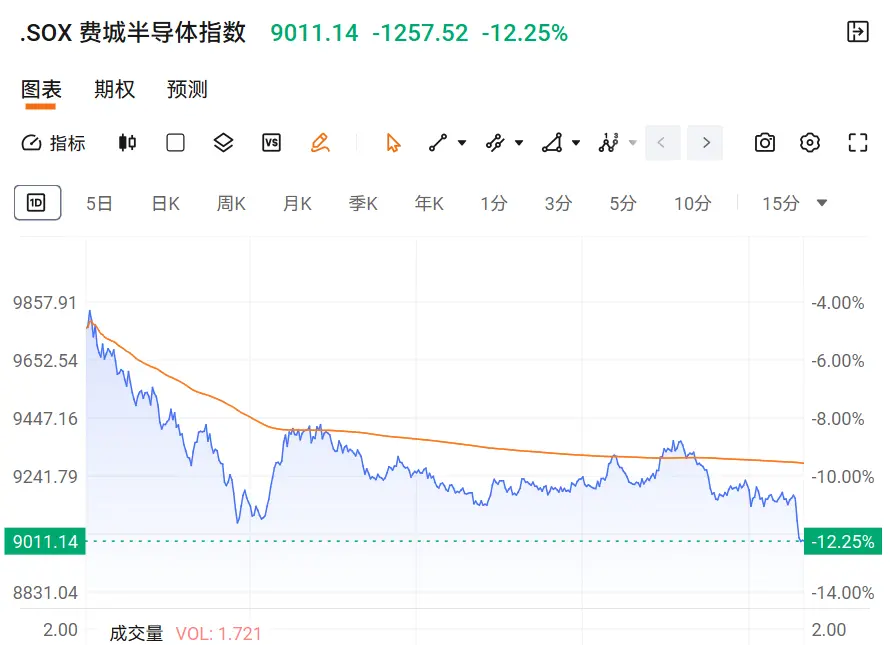
In just 40 minutes, the market value of the S&P 500 index evaporated by $2.5 trillion!
This is one of the fastest and most brutal moments of wealth shrinkage in the history of the U.S. stock market.
Moreover, the IPO of Anthropic is now in jeopardy!
Currently, Anthropic's IPO valuation has dropped from $2 trillion to $1.5 trillion, and there are even rumors that it could be further lowered to $1 trillion, or even the rumored $500 billion!
It's simply a "ankle chop."
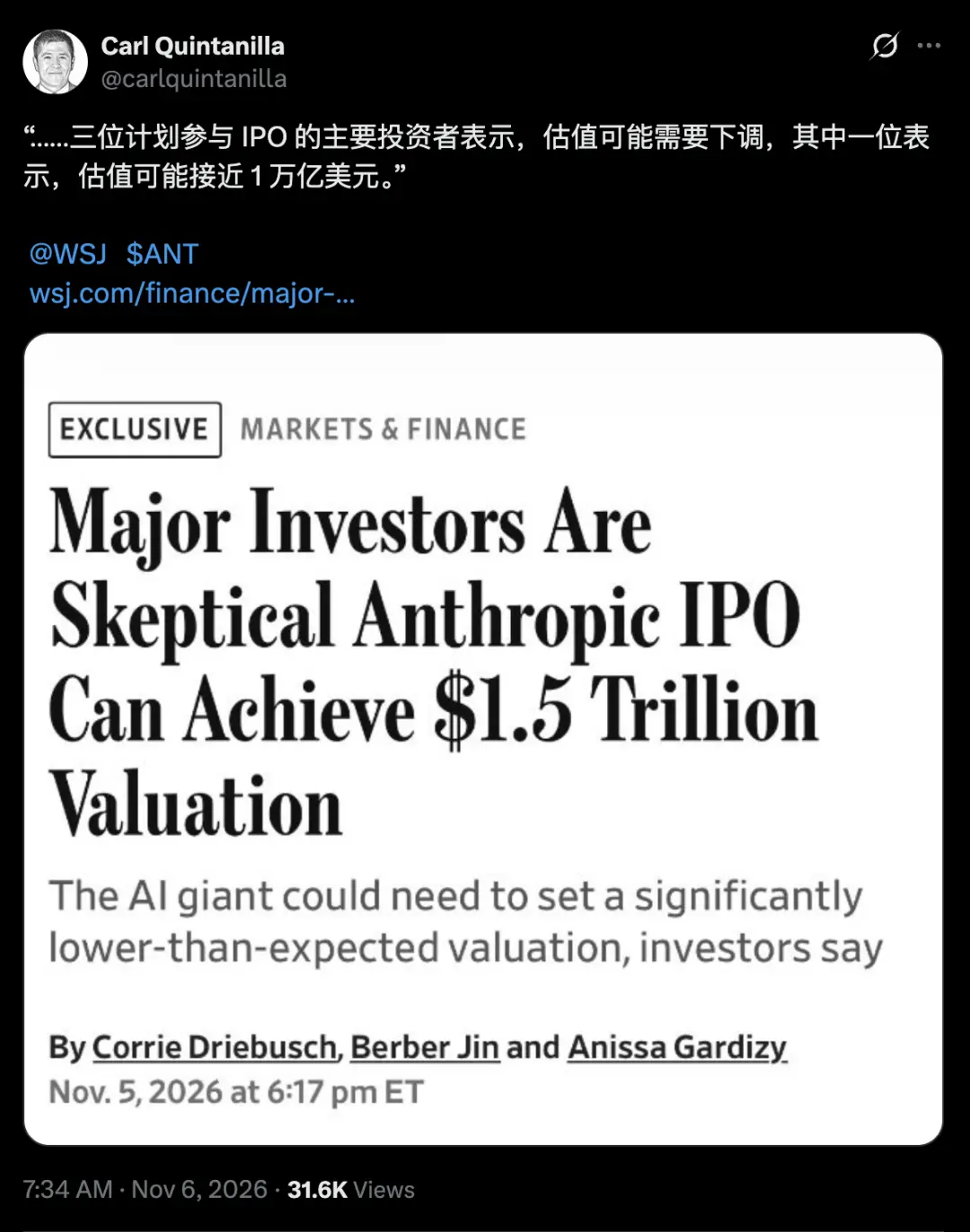
Worse yet, with U.S. tech stocks evaporating $2.5 trillion overnight, whether Anthropic can go public is now in question.


Epic Collapse:
U.S. Stocks Plunge Across the Board, Tech Giants Suffer "Bloodbath"
Last night on Wall Street can only be described as "brutal."
All three major U.S. stock indices fell sharply------
The Nasdaq plummeted over 1,400 points, a drop of 5.52%.
The S&P 500 evaporated $2.9 trillion in a single day.
The Dow Jones Industrial Average plummeted 1,833.06 points, a drop of 3.44%.
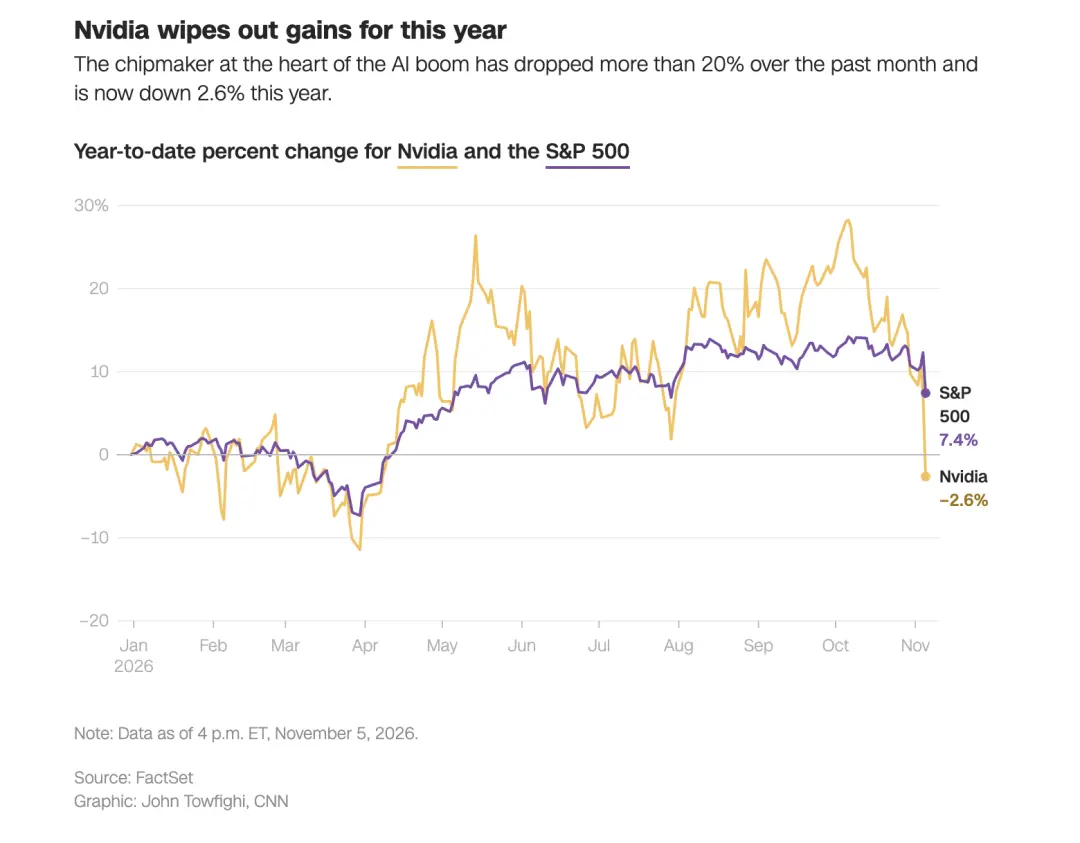
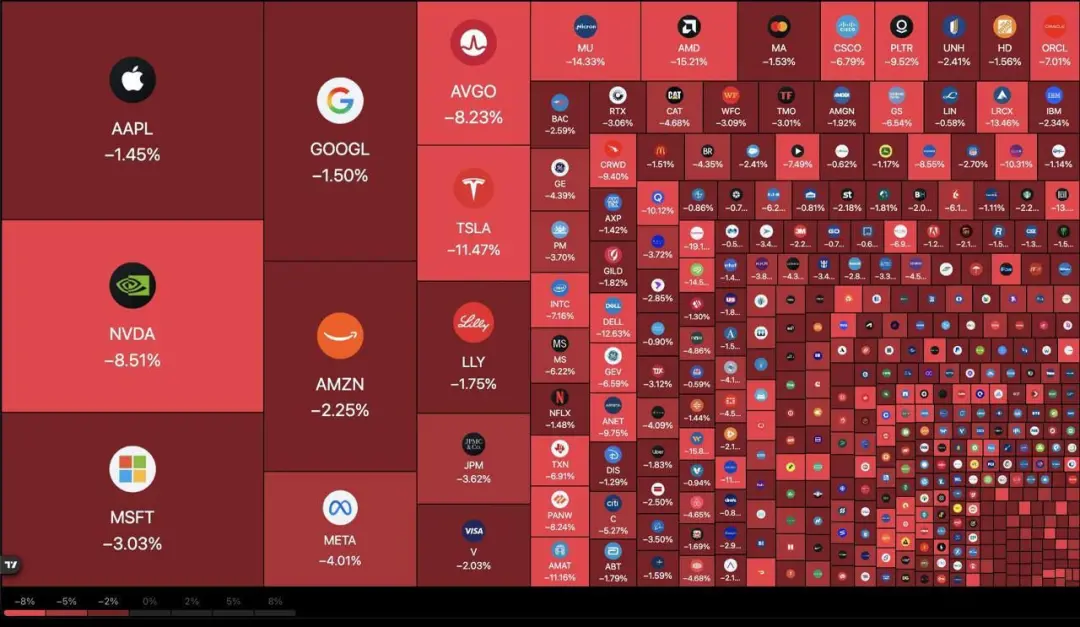
The sell-off in tech stocks was like a flood breaking through a dam, with the total market value of the "seven tech giants" evaporating by over $1 trillion!
Specifically, the once-celebrated favorites have all fallen from grace.
This morning, the storm crossed the Pacific directly, with South Korea's KOSPI opening down nearly 9%, triggering a circuit breaker and halting all trading.
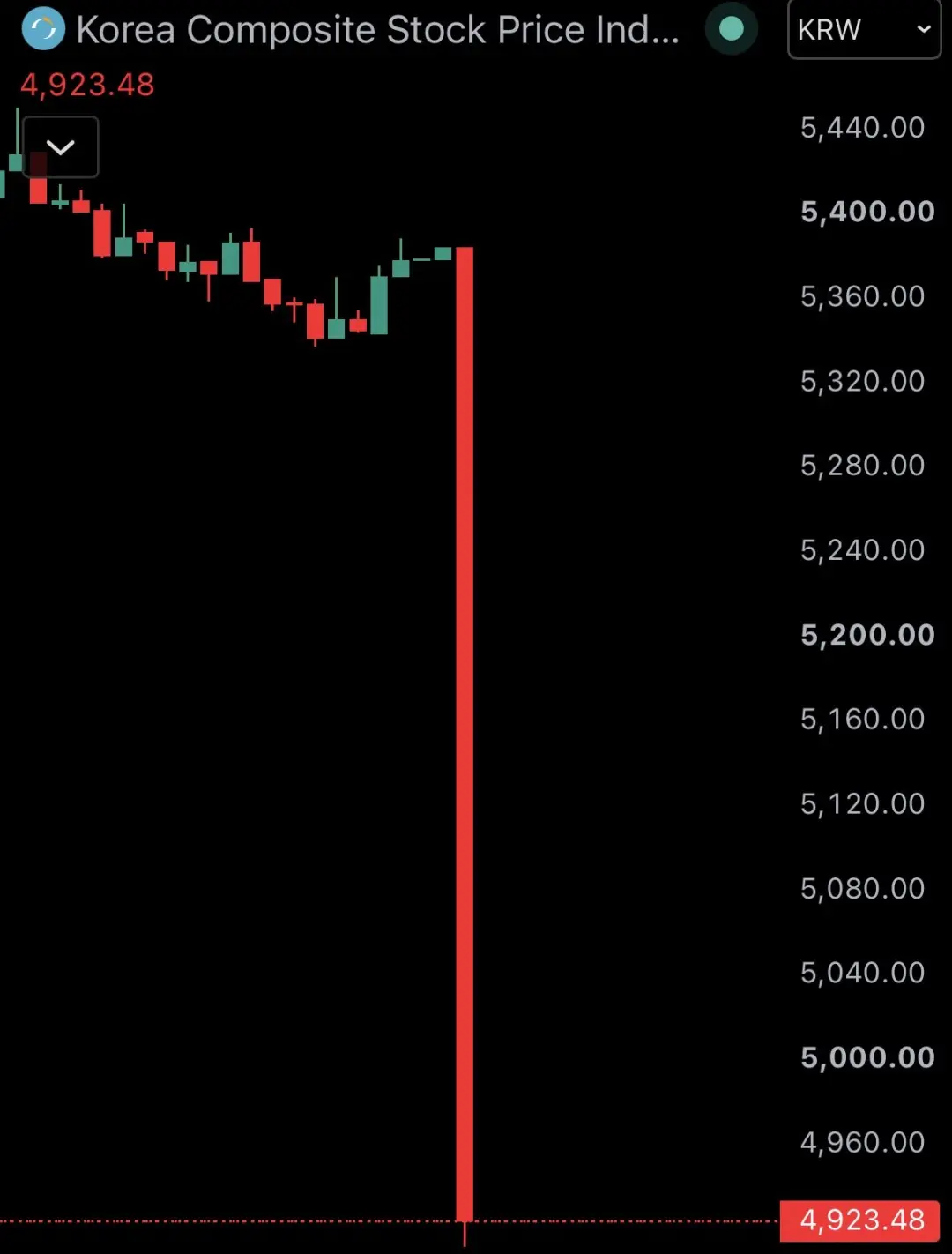
The screen was filled with blood red, and the mud was mixed in.
Just the day before, the U.S. stock market was celebrating the midterm election results, with the Dow soaring 1,500 points; just 24 hours later, the Dow reversed and plummeted 1,833 points, erasing all gains in an instant, it was too dramatic.
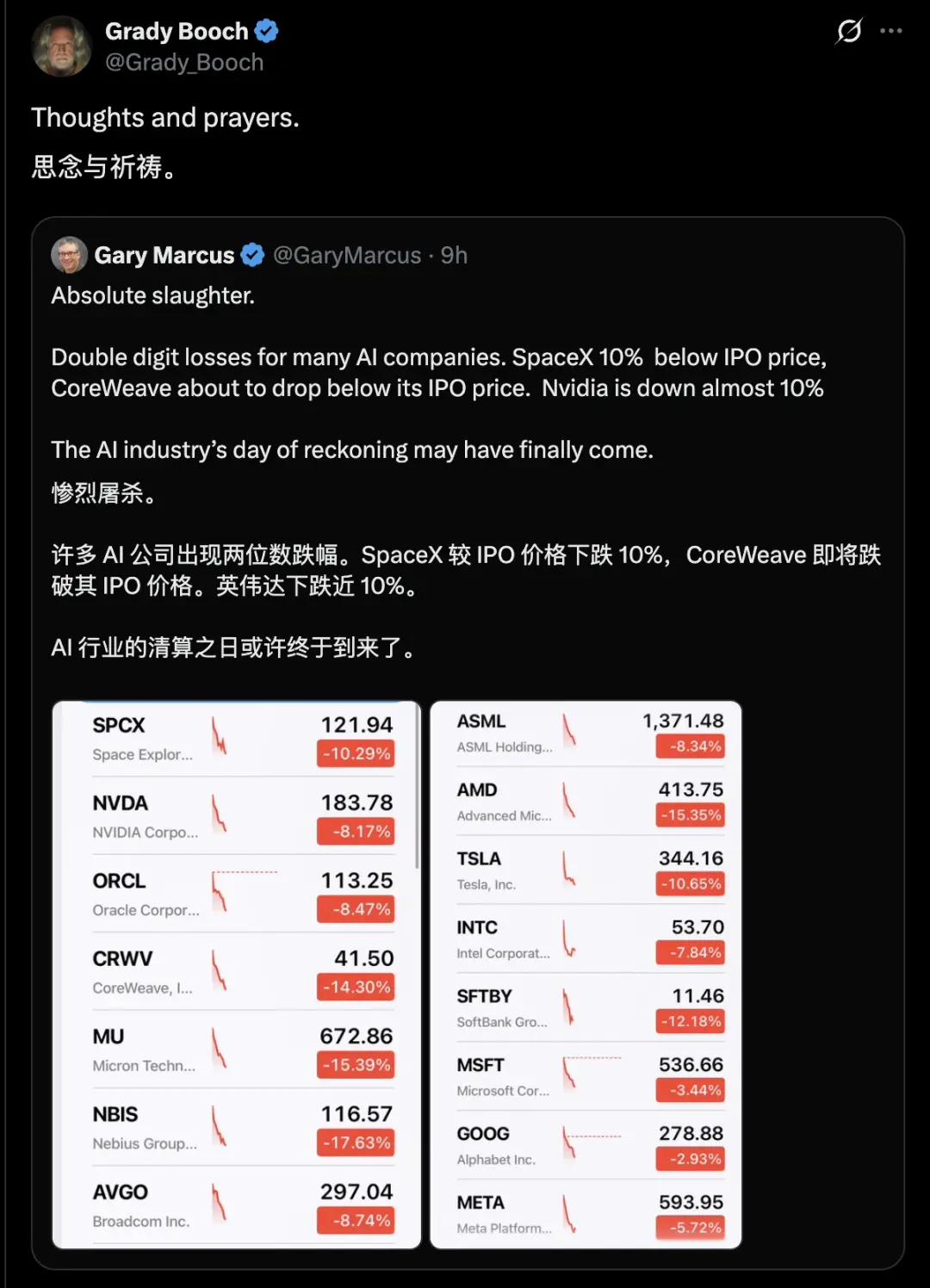
NVIDIA plummeted 9.26%, evaporating over $440 billion in a single day, nearly bringing its annual gains to zero;
AMD fell 15%, Micron dropped 17%, SanDisk plummeted 22%;
Qualcomm fell nearly 9.5%.
The high cost of memory chips is severely eroding profits.
The two giants of computing power leasing suffered a bloodbath: CoreWeave plummeted 10%, down 76% from last year's peak; Nebius dropped 15%, halving from this year's high, and even the energy stocks responsible for power supply, GE Vernova and Constellation Energy, faced fierce sell-offs.
Tesla, owned by Elon Musk, plummeted nearly 11%, and SpaceX fell over 9%, with concerns about the expansion of AI training centers rapidly spreading.
AI concept stocks were detonated one by one!
The direct trigger was the results of the U.S. midterm elections------the Democratic Party took both the House and Senate. What Wall Street fears most is that AI infrastructure will be "choked."
It's important to know that the reason the U.S. stock market has been hitting new highs over the past year is due to all-in "AI computing power chains" and "data center construction."
Once this logic is disrupted, the entire industry chain will be overturned!
Anthropic's Shocking Thunder: $895 billion Debt Black Hole, Valuation Crashes from $2 trillion to "Ankle Chop"
Originally, Anthropic was elevated by Wall Street, seen as the ballast for global tech stocks in 2026.
Just a few days ago, the market was still clamoring for its IPO valuation of $2 trillion.
However, the latest disclosed data has left major Wall Street investment banks stunned:
Anthropic bears an irrevocable commitment to computing power and infrastructure expenditures of up to $895 billion!
What does this mean?
Among all U.S. tech giants, apart from Alphabet's $1.06 trillion commitment, this bill from Anthropic directly surpasses Meta's ($866 billion), crushing the entire Silicon Valley.
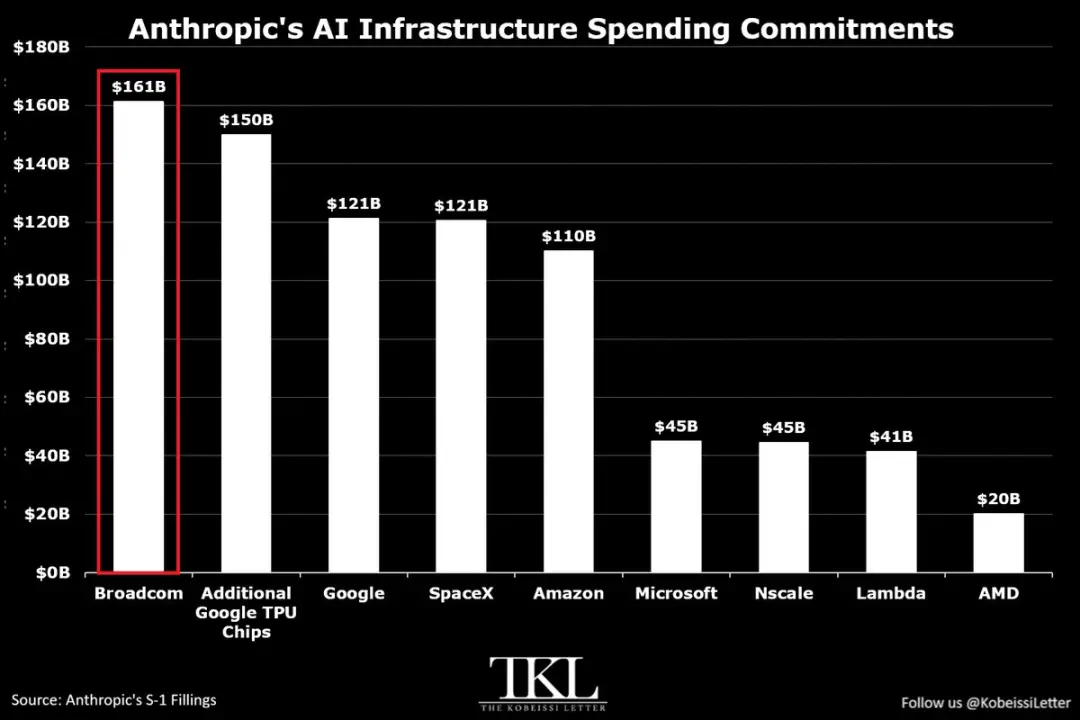
This means that even if the company earns nothing tomorrow, it must still pay this exorbitant bill. Among them:
Broadcom: $161 billion;
Google: $121 billion, plus up to $150 billion in AI chip procurement commitments;
SpaceX: $121 billion;
Amazon: at least $110 billion.

Even more fatal is the repayment schedule.
In just the next 12 months, Anthropic must cough up a whopping $70 billion; by the end of 2030, it must shell out $448 billion.
Can it earn that much money?
Despite a 47% increase in revenue in the third quarter, reaching $17 billion, the bottomless pit of large model R&D and massive depreciation is causing its net losses to expand astronomically.
Annual revenue in the hundreds of billions, debts nearing a trillion, and $70 billion due in a year.
Once the news broke, the capital market completely flipped the table.
Investment institutions collectively turned against it, frantically pressuring.

Just a few days ago, there were dreams of a $2 trillion valuation IPO, but the target valuation quickly halved to $1.5 trillion, $1 trillion, and there are even rumors of a $500 billion "ankle chop" ultra-low bid in private trading.
When Wall Street discovered that even the top-tier AI god-making templates rely on "trillion-dollar promissory notes," everything collapsed.

Anthropic Faces a Huge Crisis
Can AI models earn back the money burned?
According to data from the prediction market platform Kalshi, the likelihood of Anthropic going public in 2026 has plummeted from nearly 90% before the midterm elections to less than 60%.

A former Morgan Stanley employee and Silicon Valley partner bluntly stated: lowering the valuation is irrelevant because this game may already be over.
He pointed out that Anthropic (and similar AI giants) exist based on a financing model of "extreme asset-liability mismatch."
This is essentially a "self-referential trap of a confidence game."
In simple terms: AI companies need to continuously purchase computing power from super-large data centers (like Amazon and Google), and to pay for it, they must continuously finance and issue new shares at extremely high valuations. This model can only be maintained when stock prices soar.
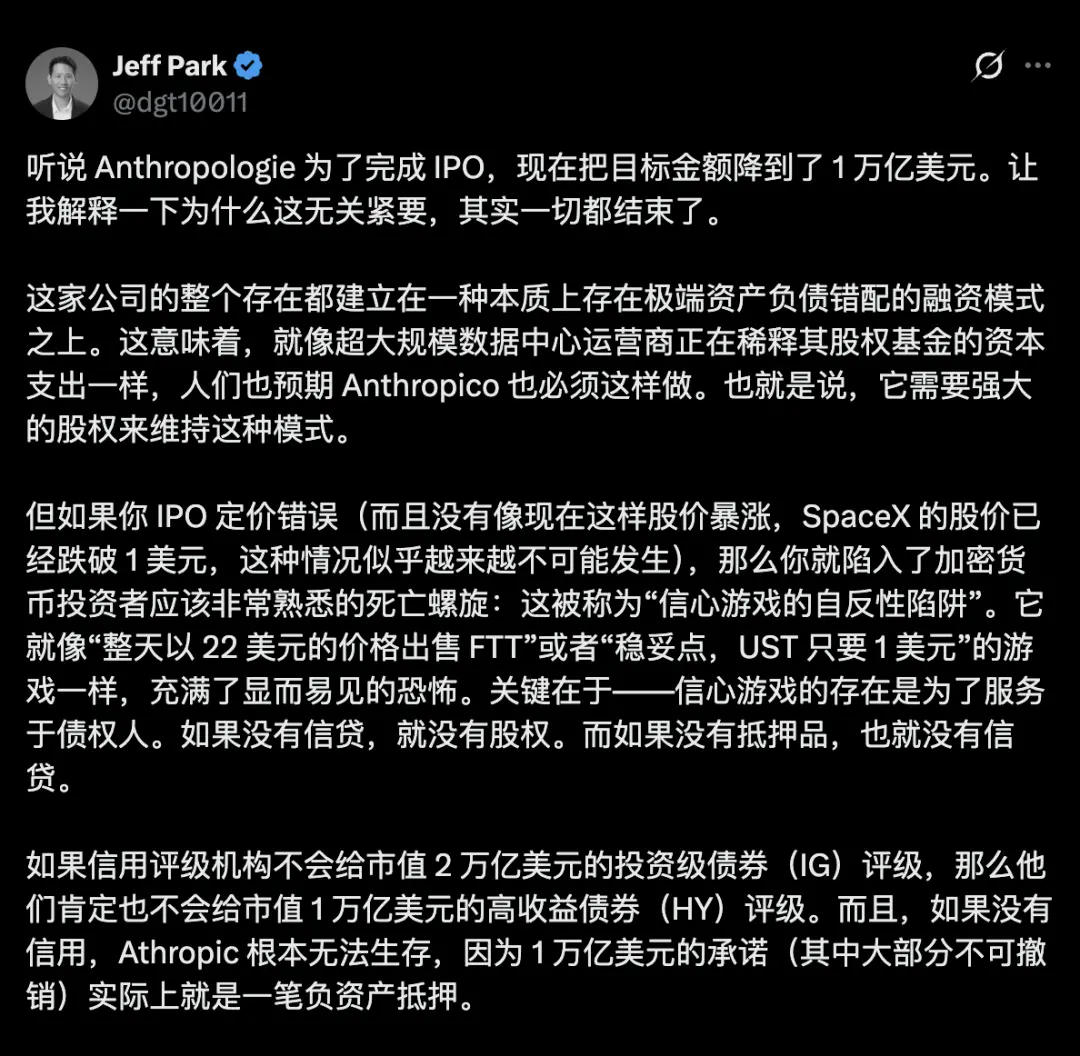
But once the IPO pricing goes wrong or the market environment deteriorates, a death spiral will begin.
Without high-valued equity, they can't borrow money; without credit, they can't pay the computing power bills; if they can't pay the computing power bills, the company can't survive, because that nearly trillion-dollar irrevocable commitment is a deadly negative asset mortgage.
"If credit rating agencies do not give investment-grade bond ratings for a $2 trillion market value, they will absolutely not give a junk bond rating for $1 trillion."
In this situation, Anthropic faces an extremely severe life-and-death test to go public smoothly.
If they force a roadshow, they may encounter the embarrassment of no one showing interest; if they delay, the $70 billion bill is about to be overdue next year.
Black Swan Causes AI Infrastructure to Hit the Brakes
The results of the U.S. midterm elections directly pulled the power switch on the global AI computing power industry chain.
The Democratic Party not only secured both the House and Senate but also unexpectedly won the Texas gubernatorial election, the stronghold of AI computing power.
The newly elected governor clearly advocated during the campaign: to impose a temporary ban on high-energy-consuming data centers and to cancel various tax reductions for data center operators.
Over the past two years, global tech giants have been building factories here, with supercomputing centers from Google, Meta, Oracle, and OpenAI clustered together. The larger the AI models become, the more terrifying their power consumption.
Now, the reckoning has come.
The market suddenly realized: the biggest bottleneck for AI is not the algorithms, but the electricity; and the biggest obstacle to electricity is policy.
Over the past year, the ability of the U.S. stock market to reach historical highs relied on the limitless investment expectations of "tech giants frantically buying chips, buying power, and building data centers." Now, those expectations have been directly halved, and the entire AI infrastructure chain is experiencing severe turmoil.
This time, the market is not cutting "with shovels," but specifically targeting those "selling shovels."
In the past, capital believed that as long as chips could be produced and data centers could be built, the future would definitely be monetizable. Now, as the giants carry nearly a trillion-dollar bill and data center approvals are blocked by policy, Wall Street has begun to calculate the total bill:
These hundreds of billions of dollars poured into the ground, apart from beautiful PowerPoint presentations, when can we actually see real commercial returns?
The screen full of plummeting stocks is the brutal response from Wall Street.
Proposed Permanent Ban on "Superintelligence," with Violators Facing Up to 20 Years
Moreover, the U.S. may comprehensively ban superintelligence, with violators facing up to 20 years!
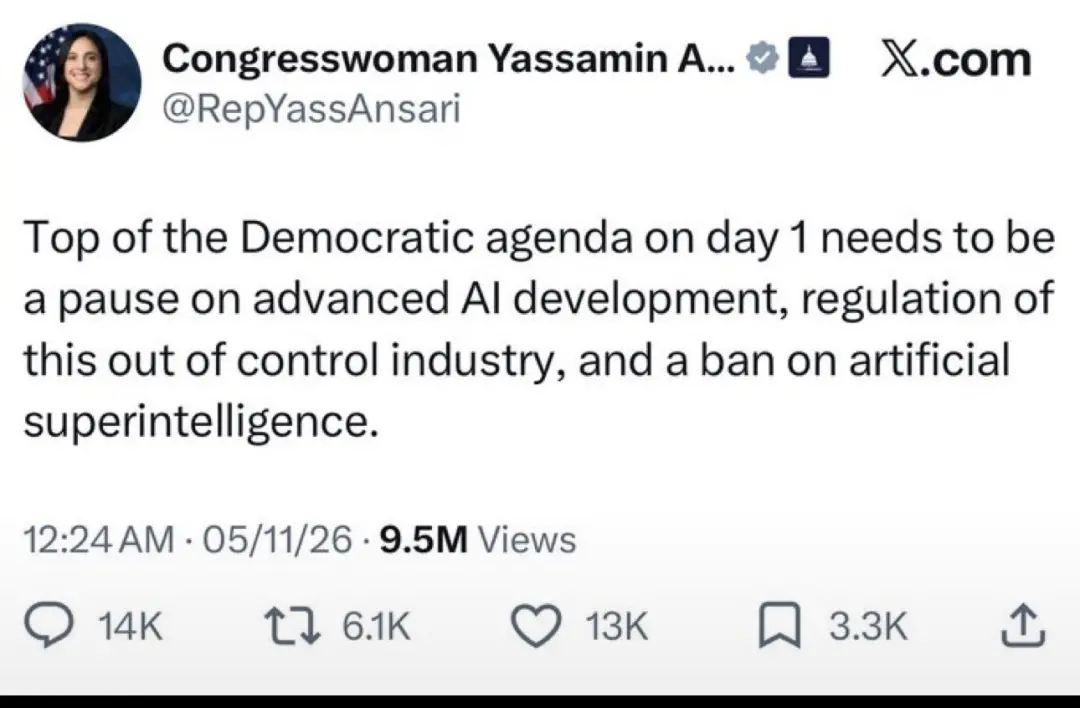
Less than 24 hours after the election results were announced, Arizona Democratic Representative Yassamin Ansari publicly declared war on the entire AI industry:
The number one agenda on the first day of the Democratic administration should be to pause advanced AI research and comprehensively ban superintelligence.

This tweet quickly surpassed 14 million views, and Musk immediately retweeted it sarcastically: "What a beautiful new world."
Unexpectedly, Ansari, holding a new majority in Congress, directly confronted Musk, leaving a strongly worded warning: "We will see you in Congress soon."

Silicon Valley and Wall Street are in complete panic because Ansari is not just making empty threats.
The "Ban on Artificial Superintelligence Act" (Bill Number S.5493 / H.R.10538) she co-sponsored is no longer just a proposal that stays on paper.
As early as September this year, this bill was officially submitted to Congress by Senator Sanders and Representative Casar.
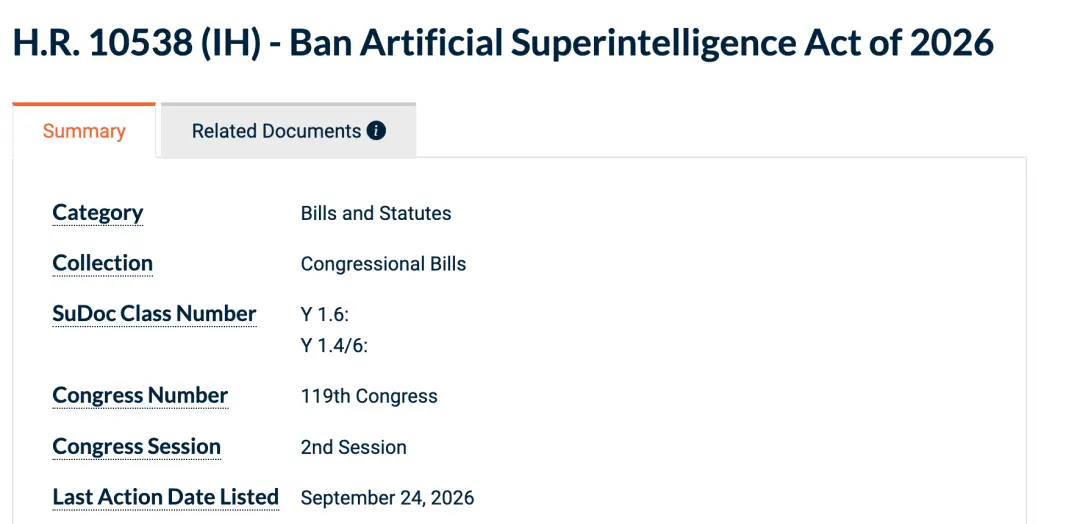
Opening the text of this bill reveals three ironclad provisions that could uproot Silicon Valley:
The first blow superficially regulates the "future," but actually cuts into the "present."
The bill stipulates that as long as the training computing power exceeds 10²⁵ floating-point operations, it automatically triggers a "mandatory pause order"—training, fine-tuning, and even market launch are strictly prohibited without approval from the newly established federal "AI Department."
It should be noted that as early as three years ago, the first-generation GPT-4 had already crossed this threshold!
This means that the next-generation flagship models currently being run in major labs in Silicon Valley have been stepping on the illegal red line from the moment the data center was powered on.
The second blow completely seals the ceiling on "superintelligence."
As long as AI's cognitive ability surpasses humans in most fields or poses a risk of losing control, it will be permanently classified as a no-go zone—cutting off the entire chain from code development, investment, to open-source deployment.
The third blow treats the development of large models as a "felony."
Once crossed, the involved tech companies will be directly ordered to dissolve by the federal government; engineers and executives could face up to 20 years of federal imprisonment!
The entire X exploded in outrage.
Notable tech investor Jen Zhu stated, "Why not just ban linear algebra, probability statistics, and vector calculus as well!"
Wall Street traders were even more furious, criticizing politicians for "single-handedly collapsing the entire U.S. stock market with a single tweet."
Macro institutions also warned that hitting the brakes now is tantamount to "self-destruction."


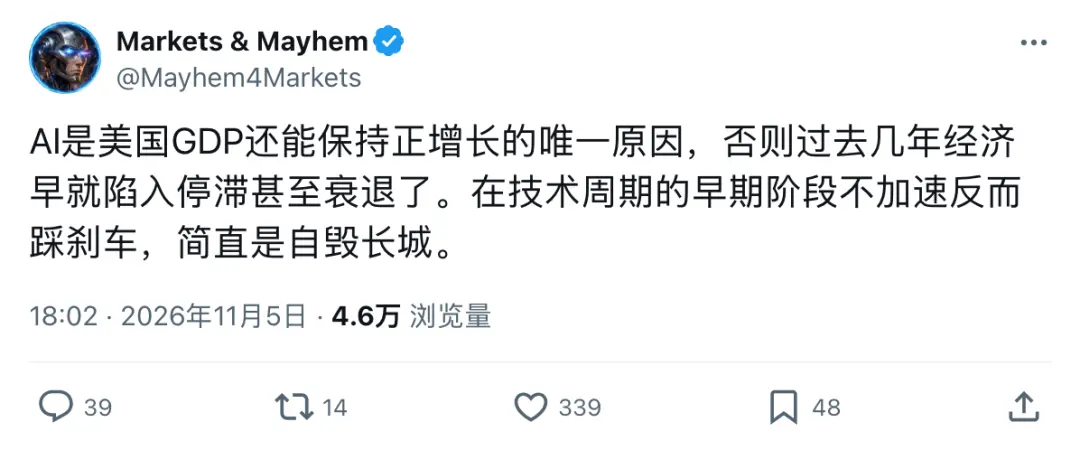
For the capital market, this bill directly cuts off the source of the entire demand chain for AI hardware.
If the next-generation large models cannot be trained, then there is no need for so many GPUs.
Without the need for GPUs, there is no need for so much HBM and storage; if chips are not bought, there is naturally no need to build data centers.
It should be noted that AI is the only reason the U.S. GDP can maintain positive growth.
References:
https://finance.yahoo.com/news/anthropic-ipo-odds-drop-compute-commitments
https://www.bloomberg.com/news/articles/anthropic-valuation-tumbles-pre-ipo
https://x.com/i/trending/2118481444595236976
 Risk warning Risk warning