








Why does Circle only keep 7 cents for every 1 dollar earned?
 Core Viewpoint

 In just the first half of 2026, Coinbase and others took away over 800 million dollars, but Circle seems to have no regrets.
Author: Kash Razzaghi, Chief Business Officer of Circle
Compiled by: Azuma, OdailyNews
Editor's Note: As the "first stock of stablecoins," Circle (CRCL) has always been a popular target in the market chasing cryptocurrency concepts. However, for many CRCL investors, Circle has always been accompanied by a significant controversy ------ to achieve ideal distribution, most of the revenue Circle earns needs to be handed over to distribution partners such as Coinbase, Hyperliquid, and Binance ------ some believe this is the core factor that has constrained the CRCL stock price, while others believe it is a necessary measure to ensure the fundamentals of USDC…
Recently, Chief Business Officer Kash Razzaghi personally published an article explaining the specific details of this expenditure and its strategic significance. As the executive directly responsible for Circle's business partnerships, Kash may be the person who understands best whether Circle should spend this money.
The following is the original content from Kash, compiled by Odaily Planet Daily.
In the first half of 2026, the on-chain transaction volume settled in USDC exceeded $36 trillion. Circle minted and redeemed USDC totaling over $315 billion, averaging about $1.7 billion per day (including weekends and holidays). During this period, Circle accumulated expenditures of $819 million for USDC distribution partners and transaction-related costs. As of June, USDC accounted for approximately 77% of the total transaction volume of global stablecoins, a significant increase from 60% in the same period last year.
These data depict a "digital dollar" that is fully engaged in actual production operations ------ a settlement scale of trillions of dollars, tens of billions of dollars in bi-directional conversion with fiat currency daily, and the vast majority of economic benefits returned to partners building businesses on it.
However, recently, some newcomers have claimed they can create a more "user-friendly" stablecoin. Their rhetoric is similar, stating that existing issuers retain too much economic benefit, redemption costs are high, and new models can solve both problems simultaneously.
This rhetoric is quite tempting, but it distorts the true operational mechanism of USDC today and seriously underestimates the cost required to truly make a stablecoin user-friendly.
I am responsible for Circle's business operations, and my team is tasked with advancing various business partnerships, promoting USDC's deployment in top wallets, exchanges, banks, fintech companies, large enterprises, and payment networks worldwide. Over the years, Circle has accumulated extensive experience in stablecoin partnerships, helping customers around the world acquire, use, and profit from USDC through a global network of partners. From this perspective, I hope to lay out the real facts and data, allowing everyone facing technical choices and ecological decisions to make their own judgments based on substantive content, rather than relying on one-sided rhetoric or false headlines.
First, there are three core facts that need to be stated clearly:
- Circle has been sharing the vast majority of USDC's economic benefits with partners who drive its adoption for many years.
- All Circle customers have always been able to redeem for free through standard banking channels, with settlements typically completed within at most two business days. Additionally, customers processing funds through the Circle Payments Network (CPN) or building businesses on the Circle platform can now enjoy 24/7/365 near real-time free USDC redemption capabilities.
- On the core metrics that truly matter for business operations, USDC is undoubtedly the most practical stablecoin in the current market. As Circle has invested over 8 years in continuously building and investing in its underlying infrastructure, this advantage gap continues to widen.
Next, we will analyze in depth one by one.
How is USDC's revenue distributed?
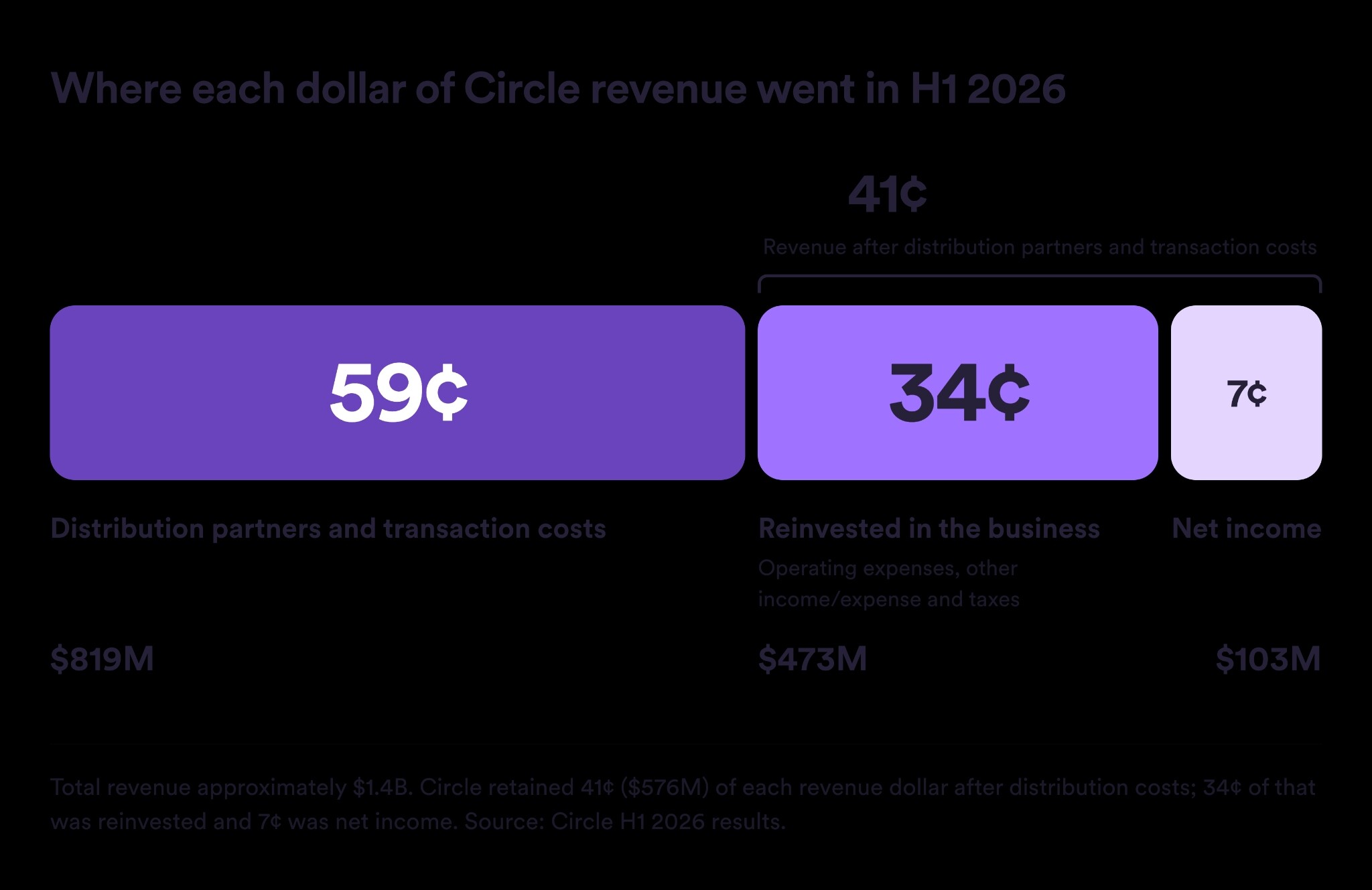
In the first half of 2026, Circle generated approximately $1.4 billion in revenue, of which about $819 million was paid to USDC distribution partners and transaction costs. This means that for every $1 of revenue, approximately 59 cents flowed directly to global partners ------ it is they who popularized USDC in wallets, exchanges, banks, fintech companies, enterprises, and payment networks around the world.
The remaining majority of the revenue is reinvested into network construction. Circle spent approximately $473 million (about 34 cents of every $1 of revenue) on acquiring compliance licenses, expanding banking partnerships, ensuring settlement liquidity, building compliance systems, developing new products, and advancing blockchain underlying integration. It is these continuous investments that have made USDC the most practical, compliant, and licensed stablecoin globally. Out of every $1 of revenue earned, Circle ultimately retains only 7 cents in net profit.
This reinvestment is by no means a heavy management expense; it is precisely the cornerstone that keeps USDC highly available, crystallizing over 8 years of deep cultivation. A digital dollar must be redeemable anytime and anywhere, securely held by regulated entities, and natively circulate across various public chains and platforms where businesses operate.
This means Circle must hold licenses in major jurisdictions worldwide to ensure that banks in Europe, fintech companies in Latin America, and payment networks in the United States can use USDC under their applicable regulatory rules. It also means Circle needs to complete native deployments across dozens of blockchains and provide inter-chain interoperability. At the same time, it means Circle needs to have ample liquidity and a robust banking partnership network to support the daily demand for minting and redeeming tens of billions of dollars across major financial centers worldwide.
Without this foundational layer, a stablecoin cannot be considered a true digital dollar; at best, it is just a token. This is precisely the issue that new issuers claiming to give up "the vast majority" of profits deliberately avoid ------ creating a stablecoin that exhausts profits but is unable to fund any infrastructure. Redemption costs, compliance costs, and system resilience construction costs will not disappear just because the issuer refuses to bear them. Every additional dollar Circle invests increases the competitive barrier.
Therefore, the real divergence has never been about whether "reserve income should be shared with enterprises building the ecosystem" ------ the financial data of USDC has already provided a definitive answer. The real question is how to reasonably allocate and maximize shared benefits while continuously injecting funds into the underlying infrastructure and ensuring the core utility of the stablecoin. The following sections will continue to break down: how partners participate in profit sharing, how the redemption mechanism operates, and what the actual costs of this infrastructure are.
How partners share USDC's economic benefits
Distribution revenue is directly linked to promotional effectiveness ------ partners that bring the most USDC into the market earn the most substantial profits. Coinbase, as our largest and longest-standing partner, is the most representative example. In its second-quarter financial report, Coinbase disclosed that the average size of USDC held across its various products reached a historic high of $20 billion, a year-on-year increase of 44%.
But Coinbase is just one member of this vast network. In September of this year, the world's largest exchange, Binance, signed a five-year commercial agreement with Circle and invested $100 million in Circle. Additionally, over 150 partners spanning the entire financial system and various industries share in the growth dividends of USDC, covering exchanges, wallets, digital banks, fintech platforms, payment platforms, traditional banks, and large enterprises. It is this broad base of participation that propelled USDC to account for approximately 77% of global stablecoin transaction volume in June (up from 60% a year ago).
Circle's business model is very clear; partners primarily participate in USDC's economic benefits through two avenues:
- Introducing and expanding the capital scale, thereby obtaining reserve income sharing. Distribution partners that host and accumulate USDC pools on their platforms can earn corresponding shares of reserve interest based on the scale they accumulate. The larger the USDC scale driven by partners, the higher the proportion they receive.
- Building businesses based on the platform, enjoying free instant redemption. Customers processing payment settlements through the Circle Payments Network (CPN) or utilizing Arc, Circle Mint, or Circle Wallets to build businesses can enjoy free near real-time redemption. The next section will detail how this mechanism works.
The factual truth of the redemption mechanism
The confusion surrounding redemption issues is the most prevalent, so I want to clarify the details. Global leading payment networks, including Visa and Mastercard, use USDC for settlements seven days a week, even during weekends and holidays when traditional banking systems are closed. The reason payment institutions worldwide trust Circle's underlying capabilities to convert USDC into dollars is that this system has withstood the test of year-round, large-scale operational demands.
In just the first quarter of 2026, Circle redeemed $71.8 billion of USDC, equivalent to about 90% of the total circulating market value at that time. In the second quarter, the total amount of minting and redemption further reached $170 billion, a year-on-year increase of 105%. No other stablecoin issuer can achieve a comparable scale in fiat redemption processing.
Circle's redemption terms are based on three fundamental principles:
- All Circle customers can redeem USDC for free. Redemptions made through standard banking channels are typically settled within a maximum of two business days.
- Payment transactions on the Circle Payment Network (CPN) now enjoy free near-real-time settlement. Institutions using USDC as the underlying settlement for payments on CPN—including card networks, acquirers, cross-border remittance service providers, large multinational corporations, and fintech companies handling significant real volume—can now achieve zero-cost, near-real-time fund redemptions. We welcome payment companies from around the world to connect to the CPN, which natively includes this feature.
- Circle platform customers can qualify for free near-real-time redemptions through various means. Pathways include holding a USDC balance on the Circle platform and deeply integrating with Circle's product matrix (including CPN, Arc, Circle Mint, Circle Wallets, and other applicable products). Eligible customers can enjoy zero-fee near-real-time redemptions.
The core support for achieving this near-real-time settlement speed is ample liquidity. To enable round-the-clock, unlimited, and nearly real-time instant redemptions (rather than waiting several days), Circle has pre-configured substantial cash limits within its global network of partner banks; once the on-chain redemption request is confirmed, funds can be immediately disbursed. These funds must always maintain high liquidity, which naturally results in lower yields than those allocated to U.S. Treasury bonds; at the same time, they must remain available around the clock (even during bank system weekends), meaning a long-term maintenance of a bank channel network that can mobilize funds at any time.
We fully bear this holding cost, thus eliminating the long wait for customers. Liquidity is the most weighted and costly component in the redemption model, and as long as customers actively participate in the network ecosystem, we will not impose any fees for this capability.
Building a Globally Trusted Digital Dollar
Anyone evaluating and comparing different stablecoin models should penetrate beyond superficial yield slogans and ask some deeper questions—can the issuer redeem on demand at any time? Can it operate smoothly during extreme market pressures? Can it consistently comply across different jurisdictions? And can it continuously reinvest in the ecological infrastructure day after day? These are also the core questions that regulators must ask during their reviews. Stablecoins are not merely software code; they belong to the financial monetary infrastructure, and the foundation must be rock-solid.
Circle has deeply experienced this balance of trade-offs. USDC was initially launched in 2018 in a consortium model; in 2023, Circle fully took over its governance and reshaped the operational system based on a core logic—issuers must have the capability to continuously invest in network infrastructure. This decision greatly advanced all subsequent processes. Today, every USDC in circulation embodies over 8 years of long-term engineering investment.
These accumulations include:
- Over 55 global financial licenses and registrations (covering the national trust bank license issued by the U.S. OCC and compliance with the EU MiCA license);
- Clearing and settlement relationships established with over 25 banks worldwide (including systemically important banks);
- Reserve assets allocated to government money market funds managed by BlackRock and custodied by BNY Mellon, with monthly independent attestation reports;
- An anti-money laundering and sanctions compliance management system covering 185 countries and regions worldwide;
- Native deployment support across more than 35 mainstream public chains;
- And a sufficient instant liquidity pool capable of smoothly handling approximately $1.7 billion in daily bidirectional minting and redemption.
This is "practicality" at an industrial scale. USDC is used as an underlying settlement by mainstream payment giants, incorporated into reserve asset allocations by an increasing number of banks, and regarded as the default standard dollar for on-chain applications by a wide range of developers. The entire industry is deeply rooted in this; recently, in the list of other newly established stablecoin alliances, over 70% of participating companies have already built their businesses on USDC. They are all partners we highly value, and we look forward to continuing to build together with them.
Self-Driven Flywheel
The operational model of USDC is essentially a continuously self-driven "flywheel," aimed at achieving symbiotic win-win for the entire ecosystem. The vast majority of economic benefits are directly passed on to partners driving market adoption, all customers can enjoy free redemption channels, while the profits retained by Circle are fully reinvested into the foundational infrastructure, keeping it firmly positioned as the world's most practical stablecoin.
Every link in the flywheel accelerates the next: partners actively expand the scale of USDC under the incentive of the sharing mechanism; this scale growth provides ample funding for obtaining more compliant licenses, thickening liquidity cushions, and expanding more public chain integrations; and a more mature and universal digital dollar, in turn, attracts more developers, entities, and end-users, sparking the next wave of adoption.
Since the birth of USDC over 8 years ago, this flywheel has endured the brutal tests of multiple bull and bear market cycles, consistently operating robustly. Looking towards the next cycle, we will continue to increase our investment to make it even stronger.
In the entire chain from distribution and customer acquisition, clearing and payment, banking channels, institutional trading, to blockchain underlying infrastructure, Circle has built the industry's most extensive and deeply integrated stablecoin ecological barrier. If you are considering where to build the next generation of business, we are always ready to walk alongside you.

 Risk warning

Popular articles





