








Peter Thiel Interview: After Fifty Years of Stagnation, Is AI the Last Self-Salvation of Civilization?
 Core Viewpoint

 An evil person at least has the ability to carry out their will and achieve their goals.
Original Title: "Peter Thiel Interview: After Fifty Years of Stagnation, Is AI the Last Self-Rescue of Civilization?"
Original Author: Sleepy
Editor's Note
Interviewing Peter Thiel has never been a comfortable task.
He never conforms to the assumptions of the questioners and is reluctant to provide any cheap reassurances. While the entire Silicon Valley is scrambling to take sides in the binary opposition of "accelerationism" and "apocalypse," Peter Thiel sits across from Axel Springer CEO Mathias Döpfner, seamlessly integrating the stagnation of the physical world, Goethe's Faustian bargain, the nascent global authoritarianism, and the almost offensive statement that "99% of leaders are utterly incompetent" into the same cognitive framework.
This conversation took place on Döpfner's high-end interview program "MDMeets." Döpfner leads the most powerful media group in Europe, which owns Bild, Welt, Politico, and Business Insider; but in front of Thiel, this dialogue feels more like a dissection of the internal pathology of Western civilization.
In the current mainstream narrative, civilization is being swept forward by the roar of superintelligence. But in Thiel's coordinate system, the West has actually been standing still for the past fifty years. Bits are racing in virtual space, while atoms are stagnating in the physical world. AI is not a technological miracle that adds the finishing touch; it is the last self-rescue of civilization to break free from the zero-sum quagmire and avoid the collapse of intergenerational contracts.
Following this main line, he conducted a full-throttle intellectual barrage.
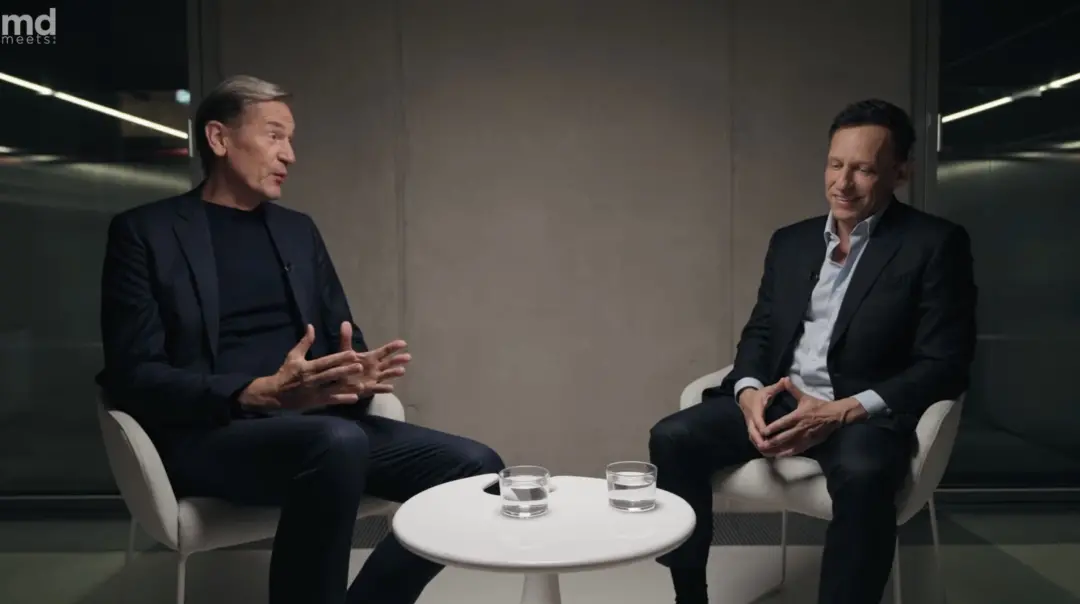
The following is the interview content
Stagnation Theory
Q: You have been emphasizing the lack of sufficient technological breakthroughs in the West for the past few years, even directly using the term "stagnation." But today, the public discourse is completely opposite; people feel that AI might be accelerating too much. Have you changed your mind, or do you still think current technological progress is far from enough?
Peter Thiel: To some extent, I have indeed changed my mind. But let's take a step back and return to the "stagnation theory" I proposed twenty years ago.
It is extremely difficult to comprehensively assess the development of technology; the dimensions of science and technology are simply too vast and complex. But the core logic is actually quite clear: since the 1970s, the overall speed of technological development has slowed down.
Computers, the internet, mobile connectivity, and software reflect our rapid progress in the world of "bits," but in the world of "atoms," physical breakthroughs are minimal.
Most engineering disciplines dealing with atoms are no longer the paths young people pursue for success. Mechanical engineering, chemical engineering, and aerospace are all in decline; as for nuclear engineering, it has long been viewed as a poor career choice since the 1980s.
For various reasons, this slowdown has indeed occurred. In my view, it is this comprehensive technological stagnation that has become the root cause of many systemic crises in modern society.
For example, the increasing polarization in politics is because when the economy loses incremental growth, the birth of each winner means the defeat of a loser, and society completely devolves into a zero-sum game, leading to a rapid deterioration of the overall ecology.
Looking at the historical cycle, we have been trapped in the quagmire of stagnation for decades. The internet of the late 1990s was a huge growth engine, surpassing everything before it, yet it still failed to push civilization into the next stage of qualitative change.
Perhaps today, AI is larger than the internet; at least it has the potential to reignite incremental growth, whether it brings sweetness or poison.
But the reason I still defend the "stagnation theory" is that, precisely because of the emergence of AI, today no one can come to refute my statement that "for the decades prior, we have actually been standing still."
Extinction Probability
Q: In recent weeks, Dario Amodei, Sam Altman, and Elon Musk jointly issued a warning that "this monster could completely get out of control." What do you think of this wave of high-profile warnings? Is it a public relations tactic, a form of expectation management before a trillion-dollar IPO, or are they genuinely afraid that AI will surpass human civilization?
Peter Thiel: The dispute over AI is extremely complex.
There are indeed scenarios that lean towards science fiction yet carry a hint of reality. If you create something that is far smarter than human intelligence in every way, is it possible for it to completely derail and break free from human control?
Everyone has seen dystopian sci-fi like "The Matrix" or "Terminator." Personally, I don't think the probability of such extreme disasters is very high. But from another perspective, even if the probability of destruction is only 5% or 10%, that is enough to send chills down one's spine.
The most dangerous consequence of this public discussion is that it directly pushes social sentiment into an extremely defensive, even entirely conservative, "preventive" dead end.
Q: If we really calculate by probability, a recent experiment posed the same question to six major mainstream language models: "Is there a risk of AI leading to human extinction?" The probabilities given by the models fell between 1% and 10%. Is this merely the models absorbing the pessimistic emotions projected by humans, or is it a genuine survival crisis?
Peter Thiel: Let's assume this is a real survival crisis. No one can guarantee that the probability is absolutely 0%.
But that does not mean we must permanently slam on the brakes and retreat into preventive bunkers. Because if you do nothing for absolute safety and allow civilization to stop evolving on all dimensions, society will instantly fall apart.
The reason the middle class in Europe and America can still endure the present is that they firmly believe the next generation will live better than themselves. The core intergenerational contract of our society lies in the gradual breakthroughs from one generation to the next, such as the growth of material wealth, breakthroughs in healthcare, and upward mobility in the social ladder.
Once this contract is torn apart, the entire society will fall into chaos in an extremely distorted manner. The reality is far from that.
Zero growth is by no means neutral, and time cannot be turned back.
Q: But if this danger truly exists, can we realistically put the brakes on AI? If the U.S. slows down while the other side of the ocean speeds ahead, are we not unilaterally giving up our advantage without solving any problems?
Peter Thiel: Theoretically, only by achieving a truly deep and seamless global collaboration can you genuinely put the brakes on technology. But the terrifying premise behind this is that you need a single world government with absolute power and enforcement capability.
My classical liberalism reminds me that this is like jumping out of the frying pan and into the fire, or even a remedy more dangerous than the disease itself. The more likely outcome is that we create a system filled with endless multinational meetings and hollow declarations of pseudo-global governance.
Another risk is that the West slows down unilaterally while the other side of the ocean speeds ahead.
The Pope recently issued a pronouncement on AI, specifically a "counter-AI pronouncement." The rulers on the other side of the ocean will never listen to the Pope, but thousands of Westerners will take it seriously. The ultimate objective effect is merely to reduce the Pope to a "useful idiot" in the opposing camp.
Q: I have spoken with founders of two leading AI platforms, and they insist they have evidence showing that opponents are spreading anti-AI panic through American social platforms to guide public sentiment and expand their own advantages. Have you observed similar signs?
Peter Thiel: I haven't deeply studied the specific evidence chain, but I tend to believe this is true. However, in my view, this is not the core driving force of the situation. What truly drags us into trouble is precisely what we are doing internally in the West.
I would love to simplify Greta Thunberg as an agent sent by the opposing camp, but she is entirely a product of our own Western society.
Q: But does Greta Thunberg really have such a significant impact on American social sentiment?
Peter Thiel: Her peak may have passed, but Western society has inflicted this kind of self-inflicted exhaustion on itself far too many times.
I have always been a harsh critic of China; we must face this great power confrontation with the utmost seriousness. However, at many times, it is too cheap and convenient to shift all the blame for the West's own weaknesses and failures onto China.
Q: So why is there such a strong anti-AI wave in the U.S. right now? In Europe, as long as people feel they can participate, public attitudes are actually quite mild or even positive; yet in the U.S., which is generally seen as embracing technology, people are protesting with placards. Where does this contrast come from?
Peter Thiel: Because the real technological transformation is happening in the U.S., while Europe has long been left behind.
In my coordinate system, Europe is too far behind and has even lost the possibility of catching up. In the U.S., domestic companies are under tremendous anxiety to completely restructure their businesses around AI. For example, in our company Palantir, the sales growth rate for U.S. enterprise clients is exploding, with every company chased by the urgency of "if you don't accelerate, you'll be out."
In contrast, Europe is still shrouded in deep inertia. They think, "We can wait; things that can be pushed to the day after tomorrow shouldn't be done tomorrow."
Mediocre, Not Evil
Peter Thiel: The public no longer believes that life will get better tomorrow; all interest games have devolved into brutal zero-sum struggles.
AI is by no means a panacea. But if we cannot reignite incremental growth, the parties occupying the far left and far right of the political spectrum will only see their bases further expand.
Q: Should we stop moralizing new technologies? Technology is like a knife; it can both cut vegetables and kill. Why do the public and elites always habitually conduct moral judgments in front of new technologies?
Peter Thiel: Our moral judgments of technology are indeed too rampant.
On the moral scale, the antonym of "good" is "evil"; but on the functional scale, the opposite of "good" is merely "mediocre and incompetent."
A Ferrari is an "evil" car because its fuel consumption is astonishingly high; but a Trabant (a dilapidated car from East Germany) is a "mediocre" car because it can hardly move on the road.
An evil person at least has the ability to implement their will and achieve their goals.
In Marlowe's "Faust," the protagonist is a fraudster engaged in shoddy pseudoscience who ultimately falls into hell; but in Goethe's version, Faust, despite making a pact with the devil, ultimately leads to genuine creation and achieves redemption.
The real collapse of today's society is filled with mediocrity and incompetence. 99% of politicians, business magnates, and corporate executives are not evil; they are simply utterly incompetent. This is the elephant in the room that we truly need to confront.
Incompatible Freedoms
Peter Thiel: That was an essay I hastily wrote one late night for the Cato Institute's libertarian online publication. Two weeks after it was published, I wrote a formal clarification.
What I was truly calling for at the time was some form of "depoliticization" and "de-escalation" of public life. My criticism was directed at those libertarian colleagues who had bet all their chips on "transforming the world by winning elections."
Q: Are you worried about the ongoing polarization of global society and the systemic failure of moderate leadership?
Today's moderate political elites underestimate the structural crisis caused by technological stagnation and the breakdown of intergenerational contracts. Look at the UK, where in just ten years, seven prime ministers have come and gone, yet none have presented a real solution to reverse the social decline.
Q: In the Berlin elections, the far-left party (Die Linke) received 25% of the overall vote, but among young voters aged 16 to 24, the vote share was as high as 47%. What do you think about the radicalization of this younger generation?
Peter Thiel: You must seriously confront the survival dilemmas faced by the younger generation. In Berlin, rents are exorbitantly high, new housing construction is obstructed everywhere, and young people find themselves with almost no hope for upward mobility.
Germany and much of Europe have long devolved into a gerontocracy dominated by the elderly, serving the interests of the elderly. The reason extreme parties can gain ground in elections is simply that they at least openly discuss the pain points that moderates choose to ignore, even if the remedies proposed by the extremists are utterly ineffective.
Q: What about the other end of the political spectrum, the Alternative for Germany (AfD)? Do you see this as an alternative form of conservatism, or is it equally concerning?
Peter Thiel: The rise of the AfD essentially reflects the incompetence of establishment parties—they have failed to explore an inclusive economic blueprint for Germany and lack even the basic ability to balance the budget.
On the diplomatic front, there should be ample public debate surrounding Ukraine, China, and Israel, but I believe the AfD's answers to these three core issues are all wrong.
Q: In 2016, you were one of the few in Silicon Valley to openly endorse Trump. Looking back today, how do you analyze his gains and losses over the past two terms?
Peter Thiel: Trump's emergence is essentially the inevitable result of traditional establishment elites delivering a dismal performance amid long-term stagnation, the aftereffects of globalization, and the geopolitical quagmire in the Middle East.
His first administration was filled with endless bureaucratic infighting; by the second term, he overcorrected by prioritizing loyalty tests above all else, resulting in the selection of a group of executors severely lacking in professional competence.
Q: You were one of the earliest supporters and guides for J.D. Vance. What irreplaceable qualities did you see in him initially?
Peter Thiel: I have always had a preference for truly intelligent minds. Vance is a person with deep thinking ability, an open mind, and great personal charisma. He worked at my Mithril fund and wrote "Hillbilly Elegy." I supported him when he ran for the Senate in Ohio in 2022.
Q: Looking ahead to 2028, who do you think will be the core competitors from both parties?
As Rich as Argentinians
Q: What insights can Javier Milei from Argentina provide to the troubled Western world?
Peter Thiel: Argentina is a mirror that fully demonstrates where a society can end up after experiencing a century of "below-average mediocre growth." In 1900, the phrase "as rich as an Argentine" was quite popular.
Milei is currently facing life-and-death issues. On a macro level, the Western world, mired in uncontrolled deficits, has only three paths to choose from: drastically cut spending like Milei, endure a socialist-style tax stagnation, or defer debt through borrowing.
Typical moderate politicians like Friedrich Merz from Germany have blindly chosen the third path.
Q: Since you repeatedly emphasize that you are an "unelectable politician," why invest so much thought and energy into politics?
Peter Thiel: I have a clear self-awareness that I am absolutely not someone who can run for public office. But the reality is that politics has permeated every pore of society; it is toxic, yet it is the air we must breathe.
I have invested a lot of thought into politics because I have been trying to isolate that layer of toxicity.
Q: In the geopolitical landscape of U.S.-China confrontation, what position should Europe take?
Peter Thiel: Europe should become a reliable ally of the United States. Reviving Europe's economic engine and maintaining a healthy business cycle aligns perfectly with America's strategic interests.
Looking back to the late 1960s, Europe overtook the U.S. in high-end aviation by vigorously developing the Concorde supersonic passenger aircraft. However, in today's AI battle, the extent of Europe's lagging behind is even more severe than France's embarrassing cling to the Minitel local area network in the 1990s.
Q: Why has Germany, known for engineering and manufacturing, not produced a globally competitive tech giant in decades?
Peter Thiel: Beyond a conservative culture that fears failure, a deeper-rooted issue is the "fear of success."
European entrepreneurs and capital have never dared to push a company's boundaries to the extreme, nor have they dared to build disruptive mega-machines like Elon Musk or Mark Zuckerberg.
The data is even more brutal. Among the 50 wealthiest individuals in the U.S., 12 belong to Generation X or younger, and among those 12, 9 are pure self-made entrepreneurs.
In contrast, among the 50 wealthiest individuals in Germany, 20 are from Generation X or younger, but all 20 are heirs to family fortunes.
For decades, this soil has not produced even a single new, scalable trillion-dollar tech giant.
Outsiders, Flesh, and the Antichrist
Q: You once said that rationally you try to expel Germany from your mind, but emotionally you cannot completely erase it. Where does this sense of tearing come from?
Peter Thiel: I grew up speaking German at home with my parents and grandparents. Germany has always been at the core of the European continent and Western civilization. To save the entire West, Germany is crucial.
Q: Talk about your two co-founders, Alex Karp and Max Levchin. What founding qualities do they possess?
Peter Thiel: Top founders often embody a rare dynamic tension of "insider and outsider." They have access to institutional resources that allow them to penetrate the power structure while retaining the raw drive of an outsider to disrupt.
Alex Karp and I graduated from Stanford Law School together, fitting the mold of standard elite insiders, but he has always had the blood of a rebellious outsider flowing through him; Max Levchin came to Chicago alone from Ukraine at 16, carrying that almost fierce desire to disrupt.
Q: Why are you so persistent about contrarian thinking?
Peter Thiel: Contrarian thinking is never about being contrary for its own sake; its core lies in defending the ability to think independently.
In a technological society filled with Adam Smith's "pin factory" style of narrow specialization, we must leave space for those polymaths who can connect history, science, economics, and human psychology.
Q: In your personal life, what hobbies do you pursue purely out of passion, with no commercial rationale?
Peter Thiel: Chess. It is a game that combines extreme intellectual beauty with dangerously addictive qualities.
Q: How have your four young children reshaped your perception of the world and your sense of time?
Peter Thiel: It completely shatters your existing sense of time. By 2100, my eldest daughter will be 81 years old. When you realize this, your mind is forced to think about what civilization in the 22nd century will evolve into.
Q: Why have you invested so many resources and attention in the field of health and longevity?
Peter Thiel: Reflecting on the early modern optimism pioneered by Bacon, Franklin, and Condorcet, the fundamental mission of science has always been to completely resolve the human condition, ultimately conquering terminal illnesses and death itself.
Today, our collective abandonment of this noble pursuit is a shocking regression of civilization. If we reframe biology as a foundational information science, then the entire aging process is essentially computable and reversible.
My current focus is on completely conquering brain atrophy, cognitive impairment, and Alzheimer's disease.
I have always held a form of identity rooted in physical embodiment, deeply influenced by Christian tradition. What I pursue is the genuine continuation of physical life, not uploading my consciousness to some cloud program; cold code does not constitute the real me.
Q: The last question remains your most famous one. What truth do you firmly believe in, but almost everyone else disagrees with?
Peter Thiel: Three years ago, I began publicly giving a series of talks about the "Antichrist." At the time, I thought this would be an extremely heretical and provocative contrarian viewpoint.
But now I gradually realize that its contrarian nature is not as high as I imagined; many people privately acknowledge that we are entering a nascent global authoritarian system.
On a metacognitive level, the real absurdity is that in public, everyone says "Antichrist" is the ramblings of a madman; yet when the spotlight dims, they all silently agree with my assessment.
Epilogue
In Silicon Valley, selling the future has always been one of the easiest ways to get rich.
Some sell superintelligence that leads to divinity, while others sell doomsday indulgences to escape destruction.
Peter Thiel wants to buy neither.
Throughout the conversation, his coldest deconstruction is to uproot the realities everyone takes for granted.
The clamor of digital prosperity over the past fifty years is merely a collective hallucination obscuring the atom; the public's moral judgment of new technologies is essentially a shameful cover for their own mediocrity and incompetence; and those who raise the banner of "safety" in global governance calls are invariably hypocritical pathways to a singular authoritarian system.
Yet, in this dialogue filled with Faustian contracts, imperial decline, and geopolitical confrontation, the most striking moments are not the grand extrapolations but the pauses in Thiel's life.
A venture capitalist who has bet his entire life on the technological singularity refuses to upload his consciousness to the cloud; a pragmatist who believes in capital and power finds his only late-night obsession is online chess with no commercial ROI; and a prophet who has extrapolated countless zero-sum deadlocks recalibrates his temporal anchor simply because he calculated that his eldest daughter will be 81 years old in 2100.
He spent a full twenty years going against the tide of the times, ultimately witnessing AI's validation of the stagnation theory. But he clearly has no interest in stopping to enjoy this belated correctness.
Sitting in the chair opposite DePufner, what Thiel left behind was actually a huge cold-toned question mark. If the technological frenzy is destined to be unstoppable, and human society is inevitably ruled by 99% mediocrity, then at the narrow gate leading to the 22nd century, are we rushing towards redemption, or are we heading towards that end that everyone keeps secret?
He did not provide an answer. He didn't even leave a single wish behind.
Just like the thousands of chess endgames he has played, the clock is still ticking, the pieces have crossed the river, and the true players never leave the stage early.
The end of the text.

 Risk warning
Popular articles





