Tron Industry Weekly Report: High interest rate expectations strengthen but BTC remains stable and strong, detailed explanation of RWA clearing infrastructure Zero Delta

 ZeroDelta is a clearing infrastructure for real-world assets (RWA). It provides compliant, zero-slippage execution services for large-scale capital flows by matching institutional-level RWA trading order flows.
# I. Outlook
1. Summary of Macroeconomic Aspects and Future Predictions
This week's macro summary (September 21, 2026 – September 27, 2026):
This week, the core contradiction in global asset pricing further focused on "the resilience of the U.S. economy remains strong + inflationary pressures are relatively high + the Federal Reserve re-enters a rate hike cycle." After the Federal Reserve completed its first rate hike since 2023 the previous week, several officials continued to signal the need for further tightening of policies, while U.S. data did not provide much support for cooling trades: as of the week ending September 19, the number of initial jobless claims was only 197,000, indicating a still tight labor market; August core capital goods orders performed better than expected, and September business activity surveys also showed a rebound in economic activity, leading the market to further raise expectations for another rate hike in October. The most obvious pressure came from the bond market, with the yield on the U.S. 10-year Treasury rising to about 5.20% on September 25, and the 30-year yield reaching about 5.51%, hitting a more than 20-year high, indicating a significant tightening of financial conditions; meanwhile, the U.S. current account deficit in the second quarter widened to $246 billion, accounting for about 3.0% of GDP, reflecting that external imbalances are still expanding. Overall, the period from September 21 to 27 was not characterized by "economic recession driving easing" but rather by economic resilience making it harder for high inflation to decline, thereby reinforcing expectations for higher interest rates and higher U.S. Treasury yields to persist longer; thus, even though large-cap tech and AI sectors in the U.S. stock market still provided support, the interest rate pressure faced by overvalued risk assets has clearly increased.
Future week prediction (September 28, 2026 – October 4, 2026):
Next week's macro market focus will shift from "Federal Reserve statements" to whether employment and inflation data can validate the necessity for continued rate hikes, with the U.S. non-farm payroll report on October 2 being the most critical point. The market will also pay attention to inflation indicators and JOLTS job openings data. Currently, the 10-year U.S. Treasury has already broken through the sensitive area of 5%, so there are two distinctly different trading paths for the next week: if employment remains strong, wage pressures are high, and inflation data shows no signs of cooling, the market may further strengthen expectations for a rate hike in October, with the risk of long-term U.S. Treasury yields maintaining above 5% or even rising further, the dollar may strengthen, while U.S. stocks, gold, and crypto assets sensitive to real interest rates will face more significant valuation pressure; conversely, if employment shows clear signs of cooling, job vacancies decline, or inflation is weaker than expected, the recently rapidly rising rate hike expectations may temporarily retreat, leading to a potential drop in U.S. Treasury yields and the dollar, thereby alleviating pressure on risk assets. Therefore, from September 28 to October 4, the most critical concern is not merely economic weakness, but rather the chain of "economic overheating → inflation stickiness → Federal Reserve continuing rate hikes → further rise in U.S. Treasury yields." The operational state of the 10-year U.S. Treasury around and above 5% will be an important observation point for judging whether global financial conditions continue to tighten.
2. Market Changes and Warnings in the Crypto Industry
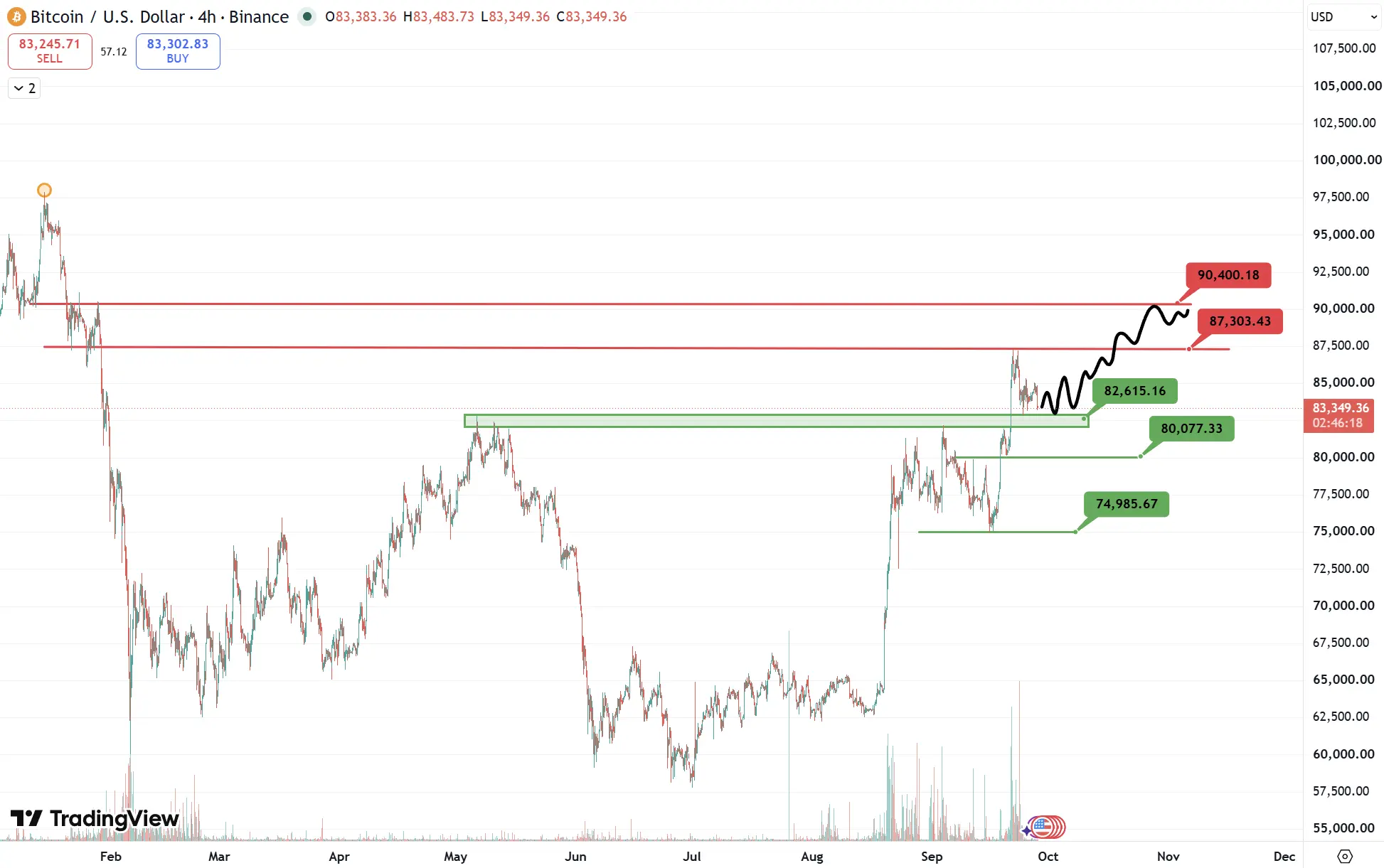
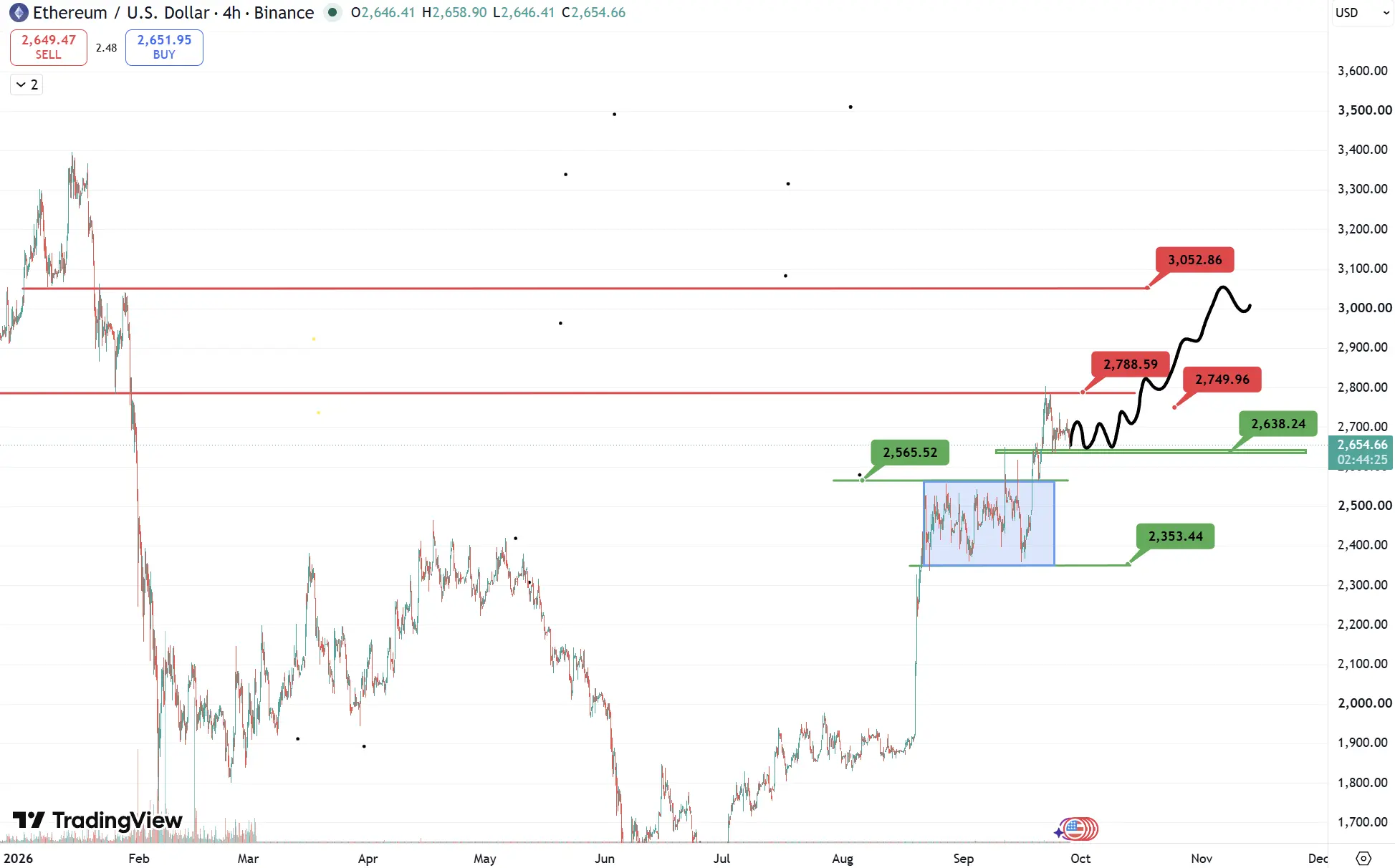
From September 21, 2026, to September 27, 2026, the crypto market overall exhibited a structure of "sharp rise at the beginning of the week, followed by a pullback." BTC quickly surged from around $81,200 on September 21, reaching a high of about $87,400 during the day, with a daily increase of over 6%. It then fell back due to profit-taking and derivatives expiration, dropping to around $83,500 on September 23, and maintained around $83,900 to $84,100 as of September 26; ETH simultaneously rose rapidly from about $2,645 to around $2,805, before retreating to around $2,690. This round of rebound was mainly driven by the decline in U.S. Treasury yields, a recovery in risk appetite, inflows into U.S. spot BTC ETFs, and short covering, but the rise did not form a sustained one-sided trend, with the quarterly options expiration around September 25 further amplifying volatility. Overall, BTC was significantly stronger than ETH this week, with market funds leaning more towards core assets, while altcoins had generally weak follow-through.
In the coming week (September 28 – October 4), it is essential to closely monitor the U.S. PCE, ADP, JOLTS, and the October 2 non-farm employment data for potential re-pricing of interest rate expectations. Among these, the PCE released on September 30 is one of the inflation indicators most closely watched by the Federal Reserve. If inflation remains high and employment is still strong, the market may reinforce expectations for high interest rates, putting pressure on BTC and ETH. In terms of price levels, BTC should focus on the support zone of $83,000 to $84,000 in the short term; if it effectively breaks below this, the next step may retest around $80,000; on the upside, it needs to stabilize above $86,000 to $87,500 to restore stronger upward momentum. ETH should closely observe the support at $2,630 to $2,650; if it breaks below, it may retest the $2,500 to $2,550 area, while the $2,780 to $2,800 range remains the main pressure point above. The current core risk in the market is not that the trend has reversed, but rather that after a rapid rise at the beginning of the week, leverage and sentiment are heating up again, making it easier to experience significant two-way volatility before the release of important macro data.
3. Industry and Sector Hotspots
From September 21, 2026, to September 27, 2026, the primary market financing hotspots in the crypto industry were notably concentrated in stablecoin payment infrastructure, RWA, DeFi yield protocols, and on-chain financial infrastructure: among the larger disclosed projects this week, HIFI completed a $37 million Series A financing on September 24, led by Left Lane Capital, with participation from Tether, focusing on expanding stablecoin payment and tokenized capital market infrastructure; stablecoin financial infrastructure Limited completed a $18.5 million seed round financing on September 24; open payment network Atum raised $13.5 million on September 22, supported by Variant and PayPal Ventures; TRON ecosystem self-custody wallet MeshWallet disclosed $10 million in private placement financing on September 24; RWA collectibles platform CatchBack completed an $8 million seed round financing on September 21, led by Foundation Capital, with participation from Coinbase Ventures, Robinhood Ventures, and Solana Foundation; AI + stablecoin financial platform Infini completed a $6 million seed round financing on September 22; DeFi yield protocol InfiniFi completed a $3 million seed round financing on September 23, led by Electric Capital; prediction market protocol functionSPACE completed $1.7 million in Pre-Seed financing on September 24; additionally, Brazilian digital finance platform NG.CASH received a $15 million strategic investment from Blockchain Capital on September 23.
# II. Market Hotspot Sectors and Potential Projects of the Week
1. Overview of Potential Projects
1.1. Detailed explanation of total financing of $8.9 million, led by Lightspeed Faction, Arrington Capital, and Paper, with participation from Coinbase and Franklin Templeton—building a secure and efficient cross-chain interoperability infrastructure, Zero Delta
Introduction
ZeroDelta is a clearing infrastructure aimed at real-world assets (RWA). It provides compliant, zero-slippage execution services for large-scale capital flows by matching institutional-level RWA trading order flows.
ZeroDelta is designed to remain neutral:
No Token
No Preferred Routes
Users submit a request once to receive a deterministic institutional-level settlement, maintaining stable execution even in the face of large-scale capital transactions.
This clearing system serves the entire market rather than competing with or profiting from it.
ZeroDelta's smart contracts have passed Halborn security audits, and all significant security issues have been resolved. The platform has already completed over $1 billion in asset clearing volume.
ZeroDelta does not use unverified self-developed cross-chain bridges but is based on mature industry infrastructure:
Circle CCTP V2
LayerZero V2 OFT
As underlying technical support, ensuring safer and more stable cross-chain asset transfers.
ZeroDelta adopts a non-custodial architecture.
Funds only flow through audited smart contracts and are executed strictly according to the contract's preset conditions. User assets are always controlled by smart contract rules, and the platform does not directly hold or control funds.
Overview of Zero Delta Protocol Mechanism
- Three Components
ZeroDelta consists of three core components: Users / Integrators, Escrow Contracts, and Clearing and Settlement Layer. Together, they complete order submission, asset custody, order matching, and final delivery, forming an on-chain clearing process for RWA and stablecoin transactions.
① Users / Integrators
Operating entities: Users and their application integrators
Users or integrators are responsible for initiating on-chain orders and ultimately receiving target assets.
Ordinary users can directly submit trading requests; application integrators can also submit orders on behalf of users, integrating ZeroDelta's clearing capabilities into wallets, financial applications, or other trading entry points.
② Escrow Contracts
Operating entities: Audited smart contracts deployed on supported chains
Escrow Contracts are the asset security layer of ZeroDelta, responsible for holding user assets during the period from order submission to final settlement and strictly executing the trading conditions set by users, including:
Destination
Minimum Output
Deadline
These contracts are designed to be permissionless, allowing any qualifying transaction to trigger execution. At the same time, the contract layer restricts the range of usable assets through the isSupportedToken mechanism, ensuring that only verified assets can enter the system.
③ Clearing and Settlement Layer
Operating entities: Currently operated by Glacis, gradually opening in the future
The clearing and settlement layer is responsible for matching incoming order flows, completing asset differential settlements, and delivering target assets to users.
ZeroDelta's orders will be cleared on the central Hub Chain. Since similar assets on different chains can achieve equivalent mapping through standardized cross-chain mechanisms:
USDC uses Circle CCTP's Burn & Mint mechanism
USDT, USDe use LayerZero OFT
Therefore, ZeroDelta can match and settle equivalent assets across different chains without the requirement that assets must be on the same chain, while also being able to send assets to a specified target chain according to user needs.
- Order Settlement Mechanism
Each order in ZeroDelta is a Cross-Asset Swap, for example: USDC → USDT
Since the two stablecoins are not completely equivalent assets, there must be a determined price for the transaction.
The pricing mechanism of ZeroDelta is as follows:
Users first request a quote through the API, and then submit an order based on that quote. Users do not need to calculate the price or decide the transaction path themselves; the system returns a fixed quote and completes the final settlement at that price.
The quote results mainly include:
askTokenAmount: The minimum transaction amount that the solver must satisfy during on-chain execution;
finalAmount: The final amount sent to the recipient's wallet.
- How an Order Clears
The order clearing process of ZeroDelta is built on the Glacis Core messaging system and Glacis Airlift cross-chain asset transfer capability, achieving a complete process from order submission, asset locking, cross-chain clearing to final delivery.
Throughout the process, user assets are always held in an Escrow contract and executed according to the preset rules of the smart contract. If the order cannot be settled, the cancellation process is triggered by the user, and the system will not automatically refund; the Hub Chain will also not proactively return funds. All fund recovery operations must be executed on the Hub Chain, so regardless of which chain the order initially came from, the cancellation operation must bear the Gas cost of the Hub Chain.
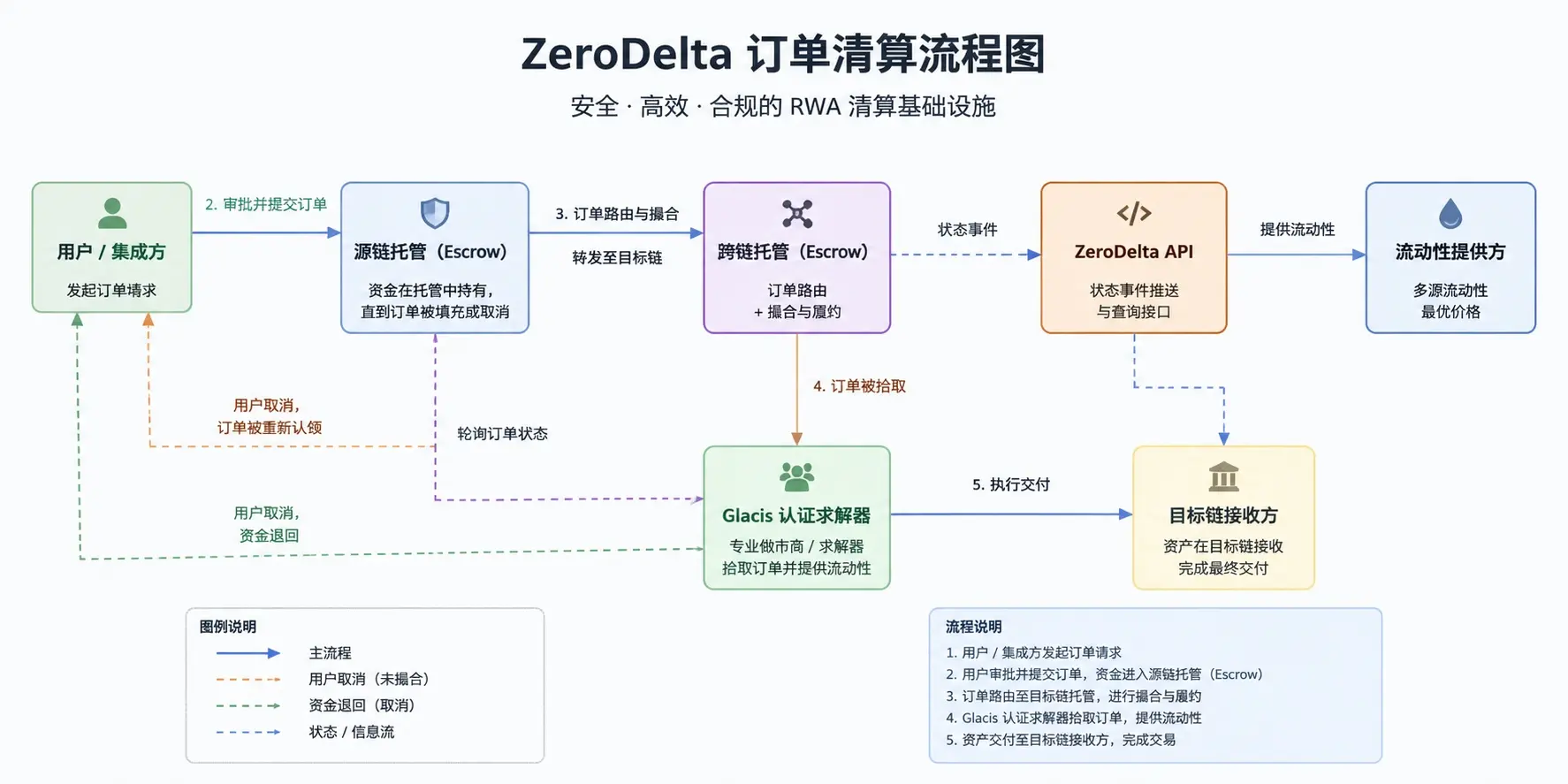
The order clearing process of ZeroDelta revolves around four stages: Quote → Approve & Submit → Settle → Deliver, achieving deterministic delivery of cross-chain stablecoin assets through escrow contracts, Hub Chain clearing layers, and cross-chain infrastructure.
This design gives ZeroDelta's cross-chain clearing process three core characteristics:
Deterministic execution, non-custodial security, and full traceability.
User assets do not enter a centralized custody system but are locked, cleared, and delivered under the constraints of smart contracts, suitable for institutional-level RWA assets and large-scale stablecoin liquidity scenarios.
Overview of the Airlift Mechanism
AirLift is a Universal Token Registry that allows various cross-chain tokens based on the Burn & Mint mechanism to quickly connect through a unified API, enabling efficient cross-chain asset transfers.
Currently, different cross-chain token standards usually require separate configuration and maintenance. Although many protocols have provided standardized verification and cross-chain transmission mechanisms, each asset still needs to configure security parameters, data formats, and receiving logic specific to itself when connecting.
This leads to any protocol wishing to support these cross-chain assets having to separately conduct:
Manual integration;
Testing and validation;
Continuous updates and maintenance.
As the number of supported assets continues to increase, this brings significant development costs and maintenance pressure. AirLift solves this problem through unified registration and standardized interfaces, allowing cross-chain aggregation services like LiFi and Jumper to quickly access thousands of new cross-chain asset paths, providing users with more available routes.
The integration method of AirLift is very simple. Developers only need to contact AirLift to obtain API access permissions and will receive the corresponding API specifications for front-end estimation of cross-chain paths.
Its smart contract interface contains only two core functions:
quote
send
If a project has already integrated with LiFi, it can automatically obtain the efficient cross-chain routes provided by AirLift without additional development.
- How it Works
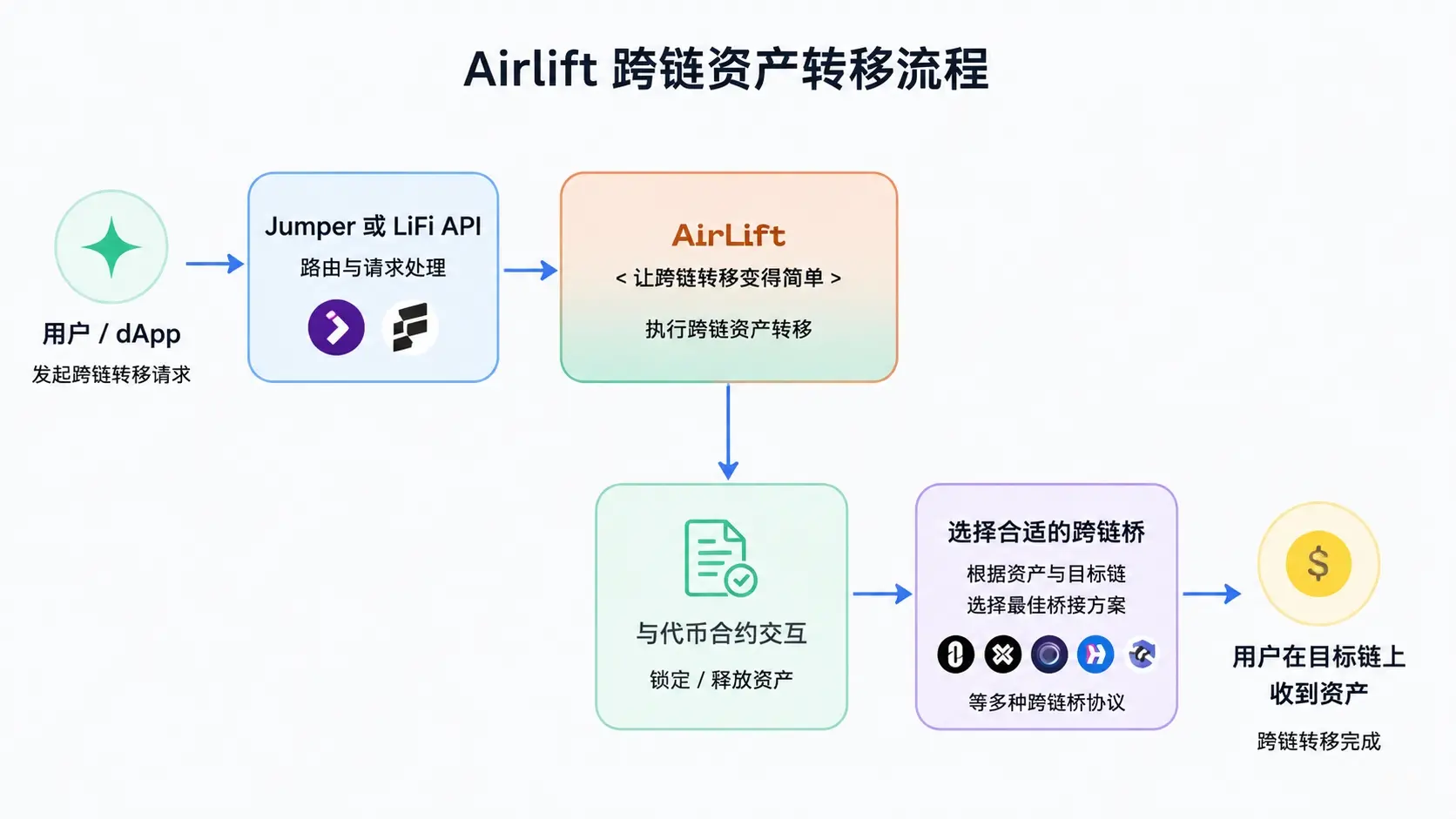
Glacis has partnered with LiFi to distribute AirLift to all LiFi integrators. Developers wishing to use AirLift directly can also connect to the AirLift API.
① DApp uses LiFi or directly integrates AirLift
DApps or users can access cross-chain functionality through:
LiFi API;
Glacis AirLift API;
where LiFi is responsible for aggregating different cross-chain asset routes, and AirLift provides efficient cross-chain asset transfer paths.
② AirLift is chosen as the best route
When users initiate a cross-chain transfer request, the system selects AirLift as the optimal cross-chain solution based on:
Asset type;
Target chain;
Available routes;
Execution efficiency;
③ Users transfer assets through AirLift
User assets will enter the AirLift cross-chain process:
Source chain assets
→ AirLift processing
→ Cross-chain transmission
→ Target chain receives
Ultimately, users will receive the corresponding assets on the specified target chain.
Overview of the Glacis Core Mechanism
Cross-Chain Risk Management
As the blockchain ecosystem continues to evolve, the complexity, fragmentation, and security risks of cross-chain technology are increasing. The design goal of Glacis is to allow developers to decouple applications from the underlying cross-chain transfer layer, thereby reducing dependence on a single cross-chain infrastructure and helping developers manage and control cross-chain risks more flexibly.
Here is a deeper introduction to the core design of Glacis:
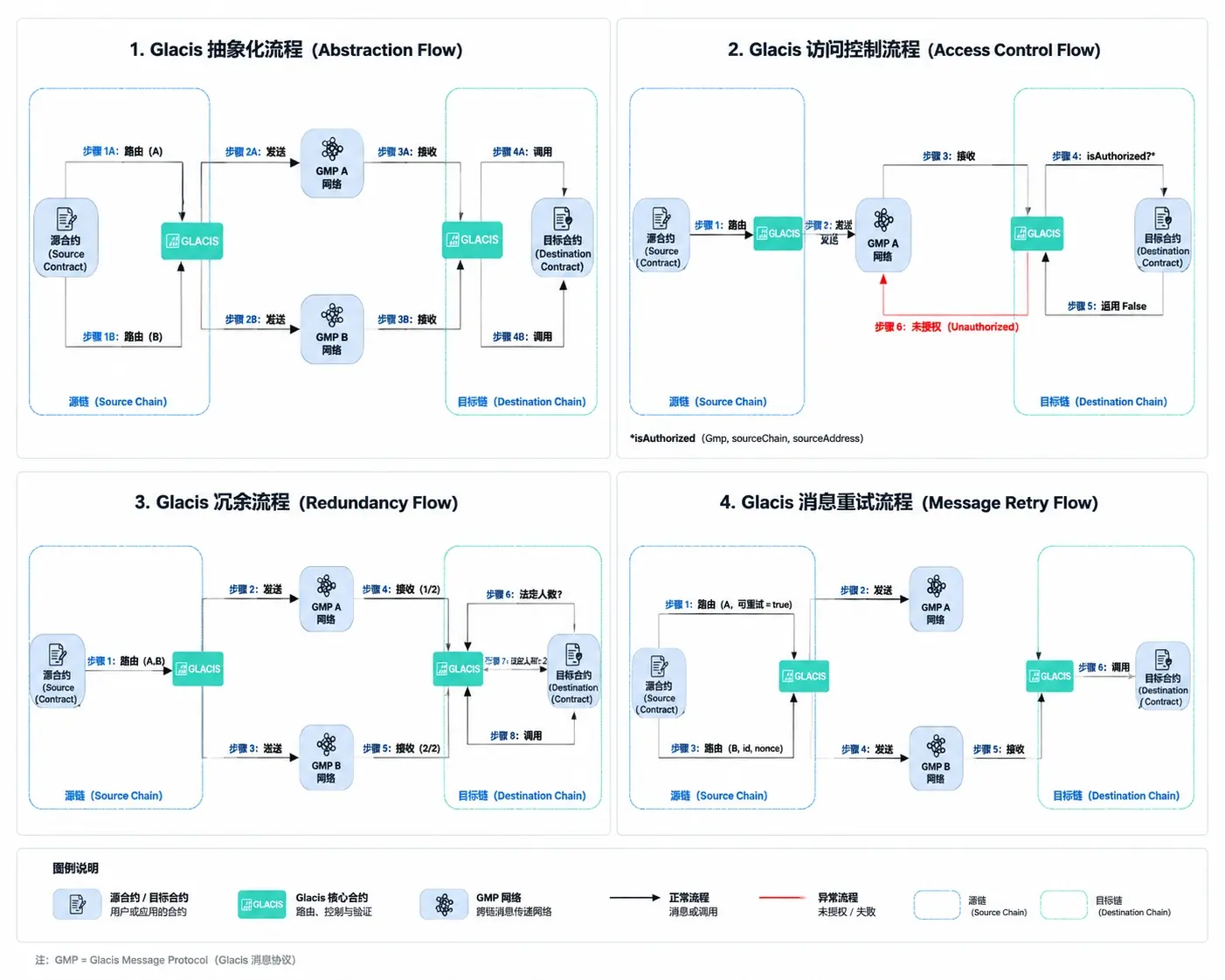
Abstraction
Building cross-chain DApps with Glacis can significantly reduce the risks developers face when choosing a General Message Passing (GMP) protocol.
With Glacis, developers can choose any GMP service for message delivery at any time and switch underlying GMPs without modifying the application interface.
This flexibility is especially important in the following situations:
A particular GMP service fails;
A particular GMP has a security vulnerability;
A particular GMP modifies service terms or usage rules.
By abstracting the cross-chain transfer layer, applications do not need to rely on a single cross-chain provider, allowing them to continue running even if the underlying infrastructure changes.
Access Control
All smart contracts based on Glacis must enable access control mechanisms to protect cross-chain interactions like a security firewall.
Developers can finely manage through access control rules:
Which smart contracts can be called;
Which blockchain networks are trusted;
Which GMP cross-chain services can be used.
Glacis provides a basic smart contract, GlacisClient, to help developers quickly integrate access control logic, enhancing the security of cross-chain applications from the ground up.
Redundancy
Through redundancy and Quorum mechanisms, Glacis allows the same cross-chain message to be sent through multiple GMP services simultaneously.
This design brings two advantages:
On one hand, when the system completes verification using any one of n GMPs (1-of-n), it can improve message execution speed and overall availability;
On the other hand, when the system raises verification requirements, for example, requiring at least x out of n GMPs to reach consensus (x-of-n), it can further enhance security and reduce the risk of a single GMP error or attack.
Through multi-path verification, Glacis achieves a flexible balance between speed, reliability, and security.
Retry Management
As cross-chain infrastructure is still in a continuous development stage, GMP protocols may experience instability during actual operation.
There are multiple potential failure points in the cross-chain process, including:
Oracles;
GMP consensus mechanisms;
Relayers;
Message transmission processes.
Any issue in one of these links can lead to the loss of cross-chain messages. Glacis provides a secure message retry mechanism that allows the original smart contract to resend the exact same message (keeping the same Message ID).
This method is safer than simply sending a new message, as lost old messages, if recovered later, could be maliciously exploited for replay attacks.
Glacis ensures through the message ID management mechanism that:
Newly successfully sent messages will invalidate old messages;
Old messages, when recovered and executed, will also invalidate duplicate messages.
In this way, Glacis effectively avoids the risk of repeated execution of cross-chain messages while ensuring message recoverability.
- Architecture
Glacis is a Pure On-chain Protocol, meaning all its core components are composed of Smart Contracts.
These components can be divided into two main categories:
Infrastructure Components
Maintained by Glacis and deployed on each supported blockchain network.
Mainly includes:
Router
Responsible for the overall routing and scheduling of cross-chain messages, selecting appropriate cross-chain transfer paths based on configuration, and coordinating different components to complete message sending and receiving.
Adapters
Used to connect different GMP protocols.
Different cross-chain infrastructures have different communication methods, and Adapters are responsible for unifying these protocols into the Glacis architecture, allowing developers to avoid developing integration logic for each GMP separately.
Mediators
Responsible for handling intermediate logic in the cross-chain asset and message transmission process, such as token conversion, message validation, and data coordination between different chains.
Client Components
Maintained by Glacis and provided in the form of a software package. Developers can deploy these components into their own smart contracts through inheritance.
It mainly includes Clients, where the Client contract serves as the entry point for developers to access Glacis's cross-chain capabilities, providing functions such as calling cross-chain messages, access control, and security verification.
Differences between Source Chain and Destination Chain components
All Glacis components exhibit different behaviors depending on their location:
Source Chain component: Responsible for initiating cross-chain messages, processing user requests, and sending messages to the target network.
Destination Chain component: Responsible for receiving cross-chain messages, verifying message validity, and executing operations on the destination chain.
- Component Diagram
This component architecture diagram shows the data flow and interaction processes between various components in the complete architecture of Glacis.
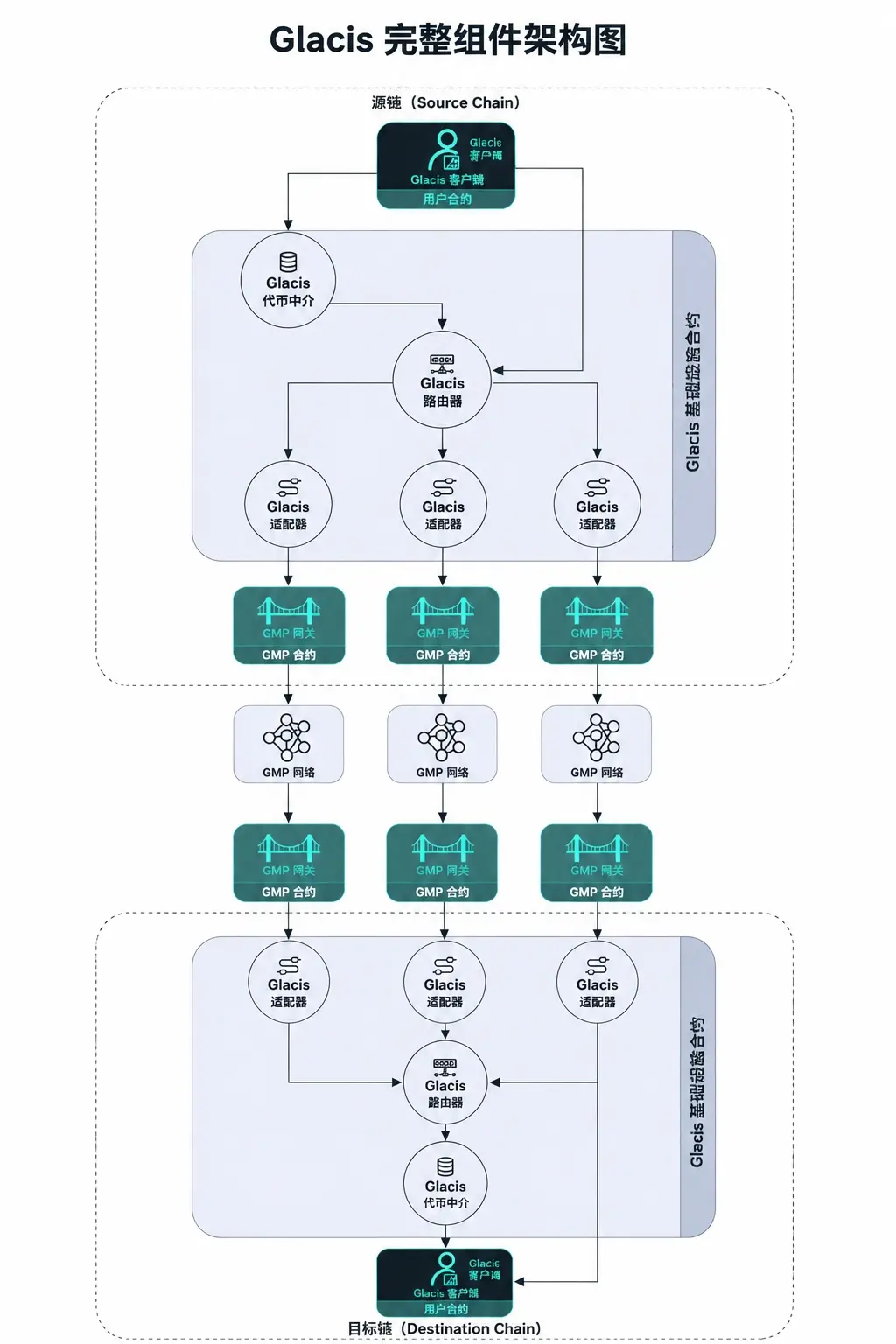
This architecture separates the application layer from the underlying cross-chain transmission protocol through modular design, allowing developers to flexibly choose different GMP services while reducing the risks associated with changes in cross-chain infrastructure.
Tron Commentary
The advantage of ZeroDelta lies in its positioning as an on-chain clearing infrastructure for real-world assets (RWA), providing efficient and compliant cross-chain trading and settlement capabilities for institutional-grade real-world assets through order matching, zero slippage execution, non-custodial escrow contracts, and hub chain clearing mechanisms. It adopts a neutral design, does not issue tokens, does not favor specific trading paths, and is based on mature cross-chain infrastructures such as Circle CCTP V2, LayerZero V2 OFT, and Glacis Core, reducing cross-chain risks while supporting large-scale asset flows, stablecoin exchanges, and institutional-level fund settlements.
The disadvantage is that its business is highly dependent on the market size of RWA, institutional adoption rates, and the maturity of the cross-chain ecosystem. Currently, it mainly targets institutions and professional users, with relatively limited scenarios for ordinary users; at the same time, cross-chain clearing itself still faces challenges such as underlying bridging protocols, liquidity depth, price quotation stability, and multi-chain security risks. In the future, it will need to continuously expand the liquidity network and cooperative ecosystem to form stronger market barriers.
Industry Data Analysis
1. Overall Market Performance
1.1. Spot BTC vs ETH Price Trends
BTC
ETH
Macroeconomic Data Review and Key Data Release Points for Next Week
This week, U.S. macroeconomic data was relatively light, focusing on real estate, manufacturing orders, employment, and consumer confidence. New home sales in August were at an annualized rate of 684,000 units, a month-on-month increase of 6.4%, showing some resilience in real estate demand; as of the week ending September 19, initial jobless claims were 197,000, a decrease of 1,000 from the previous week, with no significant deterioration in the labor market; August durable goods orders were basically flat, but increased by 0.3% when excluding transportation, indicating overall moderate corporate demand; the final value of the University of Michigan consumer confidence index for September was 48.1, down from 51.7 in August, with a clear weakening in consumer expectations. Overall, this week's data presents a combination of "employment remains stable, real estate improves, but consumer confidence and manufacturing momentum are relatively weak."
Next week (September 28 - October 4) is a significantly more critical data week: on September 29, August JOLTS job openings and September consumer confidence will be released; on September 30, September ADP employment, the final value of U.S. Q2 GDP, August personal income/expenditure, and PCE inflation will be released, with PCE being an important data point for observing the Federal Reserve's subsequent policies; on October 1, the September ISM manufacturing PMI will be released; on October 2, the most important September non-farm payroll report, unemployment rate, and wage growth will be released for the week. Therefore, next week's core trading clues will quickly shift from "economic growth" to "inflation + employment," with particular attention to whether PCE and non-farm payrolls jointly change market expectations for the Federal Reserve's subsequent interest rate cuts.
Regulatory Policies
United States
September 22 | SEC provides temporary regulatory exemption for tokenized U.S. stock on-chain trading. The SEC's relevant exemption order was published in the Federal Register on September 22, allowing qualifying Tokenized Securities Venues (TSV) to trade tokenized NMS stocks through licensed AMM/liquidity pools, and granting partial dealer registration exemptions to qualifying liquidity providers. This exemption is valid until September 17, 2031, but comes with restrictions on participant access, trading records, and prohibition of leverage, marking the first clear trial run channel for regulated tokenized public securities on-chain trading in the U.S.
September 24 | The Federal Reserve launches consultation on GENIUS Act stablecoin implementation rules. The Federal Reserve proposed two regulatory schemes for payment stablecoin issuers under its supervision: one requires issuers to maintain sufficient reserves in highly liquid assets such as short-term U.S. Treasury securities, and sets capital, risk management, and reserve asset custody requirements; the other establishes a dedicated approval process for banks to apply for issuing payment stablecoins. This marks the transition of U.S. federal stablecoin regulation from legislation to specific capital, reserve, and licensing execution rules.
September 24-25 | SEC and CFTC further clarify the regulatory boundaries of crypto assets and tokenized assets. The CFTC updated its FAQ on September 24, clarifying how regulated entities can manage client funds using tokenized forms of qualified investment products and how to use blockchain for record-keeping while meeting existing regulatory requirements; on September 25, the SEC's Division of Corporation Finance released new crypto asset FAQs, providing further explanations on how federal securities laws apply to network upgrades, token buybacks, and marketing representations.
United Kingdom
September 22 | Consultation on rules for systemically important pound stablecoins officially ends. The Bank of England's consultation on the Code of Practice for Sterling-denominated Systemic Stablecoins concluded this week. The framework focuses on regulatory requirements for reserve assets, redemption, liquidity, operational resilience, and systemically important stablecoin issuers; the Bank of England plans to finalize the rules by the end of 2026 in preparation for the official operation of a regulated stablecoin system in the UK in 2027.
European Union
September 22 | The European Central Bank system formally responds to the MiCA revision consultation. The European System of Central Banks (ESCB) submitted a response to the European Commission regarding MiCA, focusing on further improvement of the regulatory framework for stablecoins and crypto assets. Meanwhile, the EU's regulatory focus is shifting from the initial implementation of MiCA to further regulatory optimization of stablecoin reserve structures, financial stability risks, and tokenization.
September 21 | ECB further promotes tokenized financial infrastructure. The European Central Bank announced the promotion of settlement connections between central bank currencies and tokenized financial markets, and continues to advance DLT settlement systems such as Pontes. Strictly speaking, this falls under financial infrastructure policy rather than MiCA rule amendments, but it has significant policy implications for European RWA, tokenized securities, and institutional-level on-chain settlements.
South Korea
September 23 | Financial regulatory authorities strengthen enforcement against virtual asset market manipulation. The Financial Services Commission (FSC) and the Financial Supervisory Service (FSS) of South Korea decided to refer four cases of unfair trading in virtual assets to investigative authorities, including three cases of ultra-short-term price manipulation and one case involving the management of a virtual asset operator suspected of unfair trading and market manipulation. This reflects that South Korea's regulatory focus under the Virtual Asset User Protection Act has further shifted from institutional building to substantive enforcement against market manipulation and insider trading.
 Risk warning