In the first half of 2026, the TRON ecosystem advances simultaneously in "DeFi + AI": The value of DeFi assets undergoes a comprehensive upgrade to solidify the foundation, while innovative AI products are intensively launched to explore new blue oceans

 In the first half of 2026, the TRON ecosystem achieved counter-cyclical growth with a dual strategy of "solidifying the DeFi ecosystem as a stable foundation + expanding new tracks with AI products": the value foundation of the DeFi sector continued to be strengthened; innovative products in the AI sector were intensively launched, opening up new growth space.
In the first half of 2026, the global cryptocurrency market entered a downward adjustment cycle influenced by multiple factors such as fluctuations in traditional financial cycles and the diversion of funds in the AI industry. Market liquidity tightened, and most sectors faced stagnation in growth. However, the TRON ECO ecosystem emerged independently against the trend, achieving breakthrough developments in several core businesses: from the scale leap of the stablecoin settlement network to the collective upgrade of asset values in the decentralized finance (DeFi) sector, and the intensive landing of products in the new AI sector, the entire chain delivered impressive results far exceeding the industry average.
As the liquidity foundation supporting the efficient operation of the entire ecosystem, the stablecoin business has always been a core advantage of TRON. In the first half of 2026, despite the overall stable supply of USDT globally, the circulation of USDT on the TRON chain expanded against the trend, successfully breaking the $90 billion mark and continuously refreshing historical peaks, currently steadily moving towards a scale of $100 billion, continuously consolidating its position as the industry leader in global mainstream stablecoin settlement networks, providing ample and low-cost liquidity support for various DeFi and AI applications in the upper ecosystem.
While solidifying its core dominant position in the stablecoin sector, TRON formed a clear new pattern of "DeFi foundation + AI new layout" for ecological construction in the first half of 2026: The DeFi ecosystem landed multiple core projects with normalized buyback and burn mechanisms, coupled with continuous product function iterations, continuously strengthening the overall value capture capability of the ecosystem; the AI sector welcomed the intensive landing of several core products, quickly building a complete AI intelligent ecosystem from the upper-level multi-model AI unified service entrance to AI Agent infrastructure, and down to the underlying distributed computing power, successfully seizing the development opportunity in the Web3 AI industry.
DeFi Ecosystem "Buyback and Burn + Product Iteration" Dual-Line Coordination, Driving TRON Ecosystem Value to a Comprehensive Leap
Faced with industry headwinds, the TRON ecosystem's DeFi sector in the first half of 2026 consistently advanced with "buyback and burn value empowerment + product function iteration upgrade" as its dual main lines. On one hand, it constructed a normalized deflationary system covering the entire ecosystem through the continuous landing of buyback and burn mechanisms for multiple core projects; on the other hand, it continuously refined the functions and experiences of core protocols, achieving a two-way enhancement of token value and protocol fundamentals.
In terms of deflationary value construction, multiple core projects within the TRON ecosystem have already implemented buyback and burn operations, forming a comprehensive deflationary matrix covering liquidity infrastructure, lending, oracle services, and distributed transmission, significantly enhancing the ecosystem's asset value capture capability:
- The liquidity infrastructure SUN.io continues to expand the funding sources for the buyback and burn of SUN tokens. In April of this year, during the 50th buyback and burn, based on the existing revenues from SunSwap V2 and SunPump businesses, the income from the new SUNX business was added to the burn fund pool, completing the 50th and 51st buyback and burn of SUN tokens in April and July respectively;
- The DeFi infrastructure JUST ecosystem has fulfilled multiple rounds of large-scale buyback and burn plans for JST tokens as scheduled, with the second and third rounds of large-scale burns completed in January and April, and the fourth round of buyback and burn launched in July, with the scale of this round reaching a historical high;
- The oracle sector WINkLink launched the WIN token buyback and burn plan in July, using all service revenues for WIN buyback and burn.
- The distributed data transmission leader BitTorrent also launched the BTT token buyback and burn in July, using all decentralized business revenues for BTT buyback and burn.
In terms of product function iteration, the TRON ecosystem continues to optimize multiple core scenario products around trading, lending, oracle services, and decentralized file storage, continuously strengthening the ecosystem's core competitiveness:
- SUN.io completed a brand upgrade in January, adding a Chinese brand to achieve bilingual global development, and launched the SunSwap V4 version in March, enhancing trading depth and user experience;
- JustLend DAO launched the SBM V2 version in June, introducing independent isolated liquidity pools, covering more long-tail asset categories, further improving the product matrix and protective security mechanisms of the lending ecosystem; the ecosystem's "Gas" free transfer solution GasFree saw exponential growth in both stablecoin transfer transaction volume and user scale in the first half of the year;
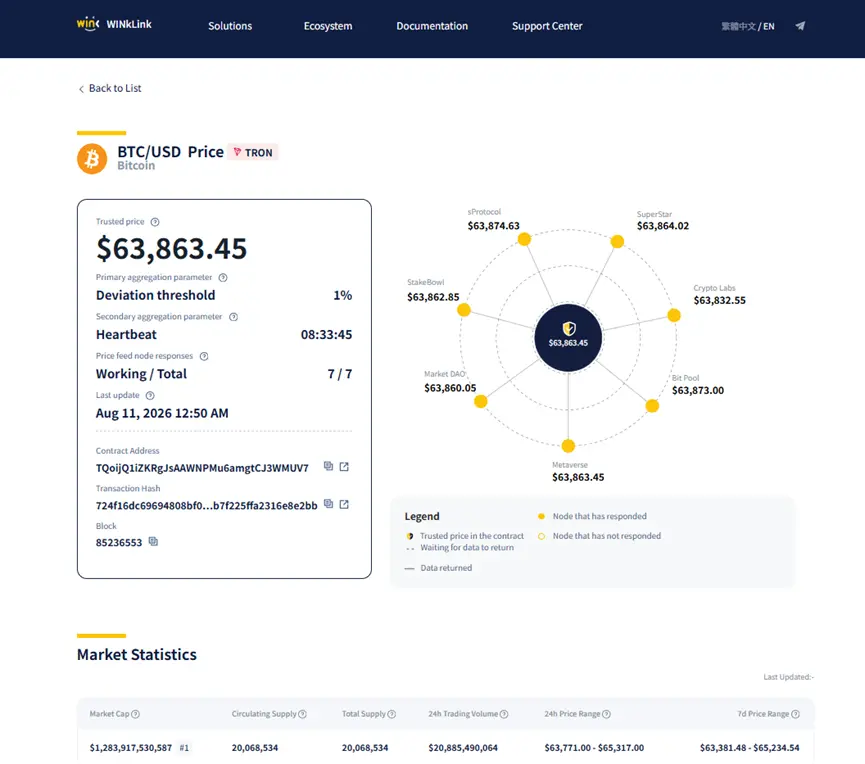
- The oracle WINkLink upgraded its price service page in March, adding a "Market Statistics" data section, continuously enhancing its on-chain data service capabilities;
- BitTorrent launched a new decentralized AI computing power product BTTInferGrid in June, officially entering the AI sector and opening up a new long-term growth space.
The continuous fulfillment of the buyback and burn mechanism, combined with the ongoing strengthening of product fundamentals, has not only steadily increased the activity of DeFi on the TRON chain but also provided solid support for the long-term value of ecosystem tokens.
As of September 1, DeFiLlama data shows that the total locked value (TVL) on the TRON chain has exceeded $5.18 billion, ranking among the top five public chains globally, on par with Solana and BSC, with the gap continuously narrowing, even surpassing both during peak periods. The advantage in user activity is even more significant, with over 3.88 million active addresses on TRON in 24 hours, nearly double that of the second-place BSC, firmly maintaining its position as the top public chain globally, fully validating the real user scale and on-chain vitality of the ecosystem.

Liquidity Infrastructure SUN.io: Launching SunSwap V4 to Reshape DEX Trading Efficiency, SUN Buyback and Burn Funding Sources Continue to Expand
In the first half of 2026, SUN.io implemented multiple key actions around brand globalization, product experience upgrades, and token value empowerment, completing a multi-dimensional upgrade from brand recognition and product capability to value mechanism, significantly enhancing the comprehensive competitiveness of the ecosystem.
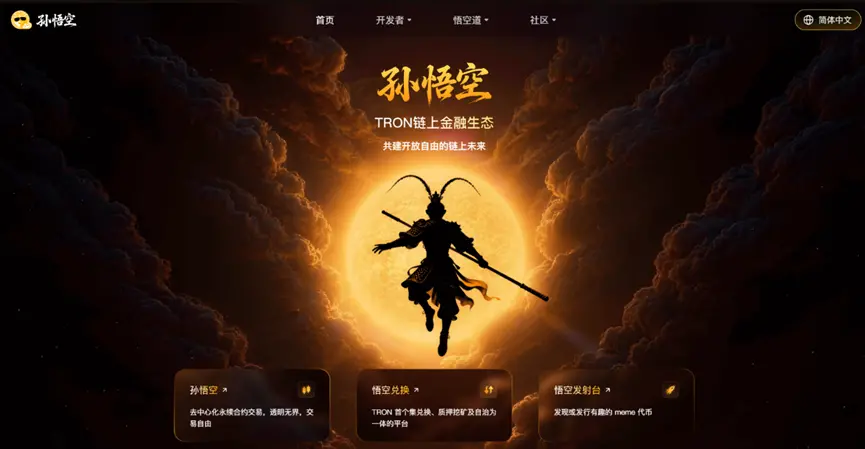
In terms of brand building, SUN.io has achieved a global development strategy of dual-brand synergy in Chinese and English. In January of this year, SUN.io completed a comprehensive brand renewal, adding the Chinese brand "Sun Wukong," with all core products simultaneously completing unified naming in both languages: The DEX platform SunSwap was named "Wukong Exchange" in Chinese, the meme issuance platform SunPump was named "Wukong Launch," and the derivatives trading platform SunX was named "Sun Wukong," along with the launch of the official Chinese version of the "Sun Wukong" website. Thus, the main product matrix of SUN.io has fully covered core DeFi sectors such as "DEX spot trading + meme asset issuance + perpetual derivatives trading," and leveraging the dual operational advantages of the bilingual brand, it accurately reaches user groups in different global regions, promoting the collaborative development of a global ecosystem.
In terms of product experience, SUN.io continues to iterate on core protocols, significantly lowering user trading thresholds and costs through technological innovation. On March 2, SUN.io's DEX platform SunSwap officially launched version V4, innovatively introducing six major features: singleton model (unified management of liquidity pools), native TRX direct access (TRX can be exchanged directly without wrapping), flash accounting (unified differential settlement), hooks (customizable trading rule plugins), customizable accounting (customized settlement strategies), and subscribers (real-time notifications of position changes), pushing the protocol's customizability and extensibility to a new height, unlocking more innovative scenarios for the DeFi ecosystem. More importantly, within less than five months of the SunSwap V4 launch, liquidity and trading volume have both seen rapid growth, with liquidity peaks stabilizing at $108 million and peak 24-hour trading volume exceeding $70 million, demonstrating strong growth momentum.
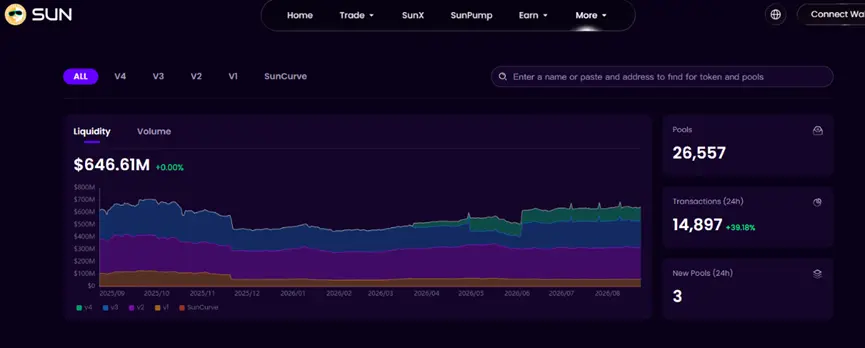
In addition, SUN.io completed a comprehensive upgrade of the Universal Router smart routing contract in May, supporting optimal path automatic exchanges across multiple liquidity pools, further enhancing trading efficiency.
According to the latest official data released on September 1, the current total locked value (TVL) on the SUN.io platform is approximately $650 million, with the number of launched liquidity pools exceeding 26,500, and the total trading volume on the platform exceeding $514 million in the past week, with over 112,000 transactions during the same period, maintaining a steady upward trend in all core operational indicators.
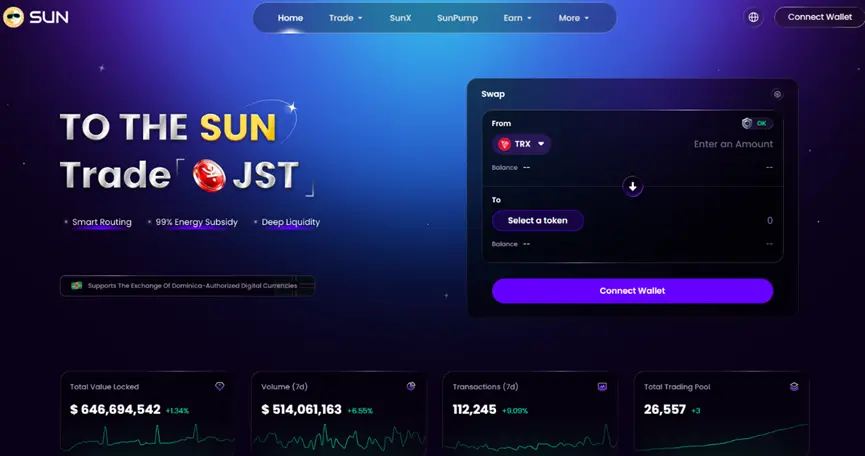
In terms of token value empowerment, SUN.io is accelerating the deflationary process of the ecosystem token SUN by continuously broadening the sources of buyback and burn funding. Since the 50th buyback and burn (executed on April 25), SUN.io has officially included the income from the SunX derivatives business into the SUN token buyback fund pool, significantly expanding the boundaries of funding sources for the burn, while adjusting the execution cycle of the burn to be uniformly announced in mid-month of each quarter, making the deflationary rhythm more transparent and predictable.
As of September 1, since the buyback and burn mechanism was officially launched in December 2021, SUN.io has continuously executed 51 rounds of burn operations, with a total of 678,547,188.32 SUN tokens burned, just a step away from the 700 million mark, continuously strengthening the deflationary force of the ecosystem token.
JustLend DAO Continues to Increase Real Earnings for JST Buyback and Burn, Diverse Product Matrix Advances Together
As the core value pillar of the TRON DeFi ecosystem, the JUST ecosystem in the first half of 2026 leveraged the continuous stable profits of its core protocol JustLend DAO to drive multiple rounds of large-scale buyback and burn of JST tokens, successfully constructing a complete value closed loop of "real business revenue → normalized deflation landing → token value positive enhancement." Driven by this closed loop, the value of JST tokens has achieved exponential growth: the price rose from $0.04 at the beginning of the year to a peak of $0.11, with a cumulative increase of over 275%; the market capitalization rose from about $400 million at the beginning of the year to over $868 million, setting a new high since 2022, with a price of $0.101 on September 1.
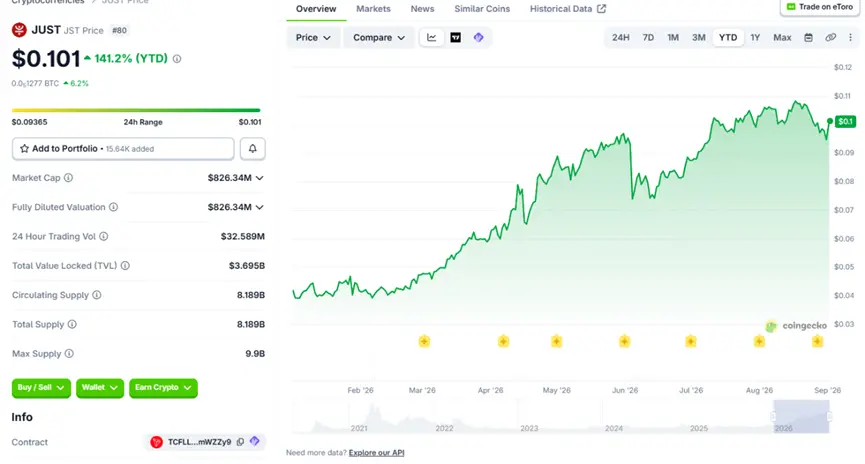
At the same time, JustLend DAO's diverse product matrix is blooming in multiple areas, covering lending, liquidity staking, energy leasing services, smart wallets, and other high-potential sectors, opening up new long-term growth spaces for the ecosystem.
As the year began, JST has completed three rounds of large-scale regular burns, each with a funding scale exceeding $20 million, with a total of over $70 million invested in buyback and burn in the first half of the year, nearly 90% of which comes from the real operating net income of JustLend DAO:
Second round (January 14): Burned approximately 525 million JST, accounting for 5.30% of the total supply, corresponding to $21 million;
Third round (April 15): Burned approximately 271 million JST, accounting for 2.74% of the total supply, corresponding to $21.3 million;
Fourth round (July 17): Regular burn combined with a special burn of historical stability fees for USDJ, totaling approximately 355 million JST burned, accounting for 3.59% of the total supply, corresponding to $34.59 million, setting a new historical high for single-round burn funding.
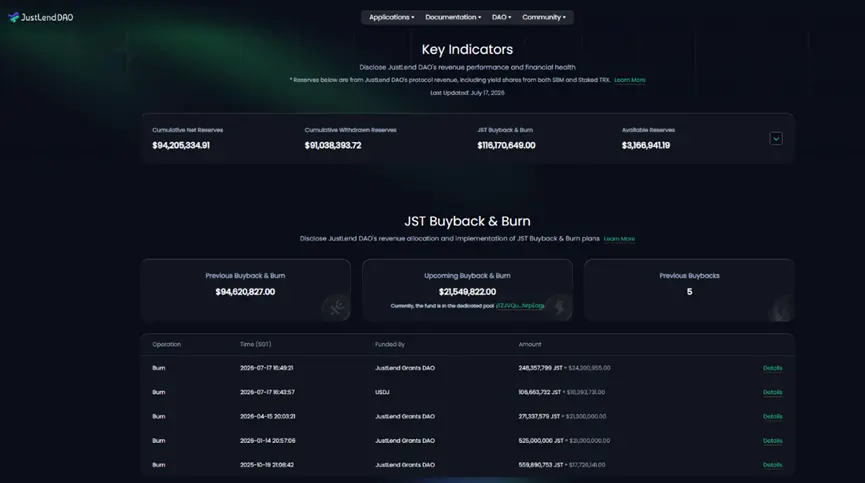
So far, JST has completed four rounds of large-scale buyback and burn plans, with a total of 1.711 billion JST burned, accounting for about 17.29% of the total token supply, with a total funding scale exceeding $94.62 million. Except for the special historical stability fee burn of USDJ in the fourth round (valued at about $10.39 million), all regular buyback and burn funding for JST comes 100% from the real business income of JustLend DAO.
According to data disclosed on the official financial page, JustLend DAO's cumulative net income has exceeded $94.2 million, and the total scale of funds invested in the JST buyback and burn fund pool has approached $105 million. After deducting the $10.39 million for the USDJ special historical stability fee, nearly $94 million of the buyback and burn funds all come from the real income generated by the platform's daily operations. The platform still reserves about $10.34 million in stock reserve income, which will be invested in the next regular burn process according to the established plan.
As the core protocol of the JUST ecosystem, JustLend DAO has formed multiple core business segments including the lending market (SBM), liquidity staking (sTRX), energy leasing (Energy Rental), GasFree transfer solution, and energy direct purchase (Buy Energy), with each segmented track firmly positioned at the industry forefront, forming a stable and diverse revenue matrix.
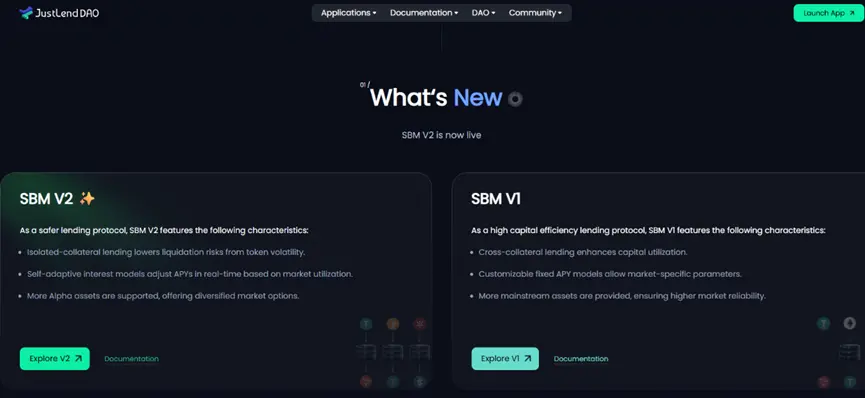
In the core lending sector, JustLend DAO's lending market SBM has long maintained a TVL ranking among the top five in the global lending sector. According to DeFiLlama data released on September 1, the current TVL of JustLend DAO's lending market SBM has reached $3.38 billion, ranking fourth in the global decentralized lending sector. In June, the platform officially launched the SBM V2 version, innovatively introducing an isolated liquidity pool mechanism, broadening the coverage of new asset types while significantly enhancing the overall security of the platform. On the asset side, the platform also added a dedicated lending market for U assets in the first half of 2026, continuously improving its asset layout.
In the liquidity staking sector, JustLend DAO's sTRX product has currently staked over 9.73 billion TRX, with the number of participating addresses exceeding 17,000, and the total staking scale and number of participating users have consistently maintained a steady upward trend. The energy leasing market (Energy Rental) derived from the liquidity staking ecosystem, with its "pay-as-you-go" flexible model, addresses the pain point of needing to stake large amounts of TRX long-term to reduce on-chain gas costs, with over 80,000 users participating so far.
In August of this year, JustLend DAO further launched a new TRON energy on-demand service—Buy Energy, allowing users to purchase the required energy in one go based on actual needs. Compared to directly burning TRX to obtain on-chain resources, this product can save users up to 64% in transaction fees.
Thus, JustLend DAO has constructed a gas cost optimization tool matrix covering "Energy Rental + Buy Energy + GasFree no gas transfer solution" around the core goal of "lowering on-chain usage thresholds."
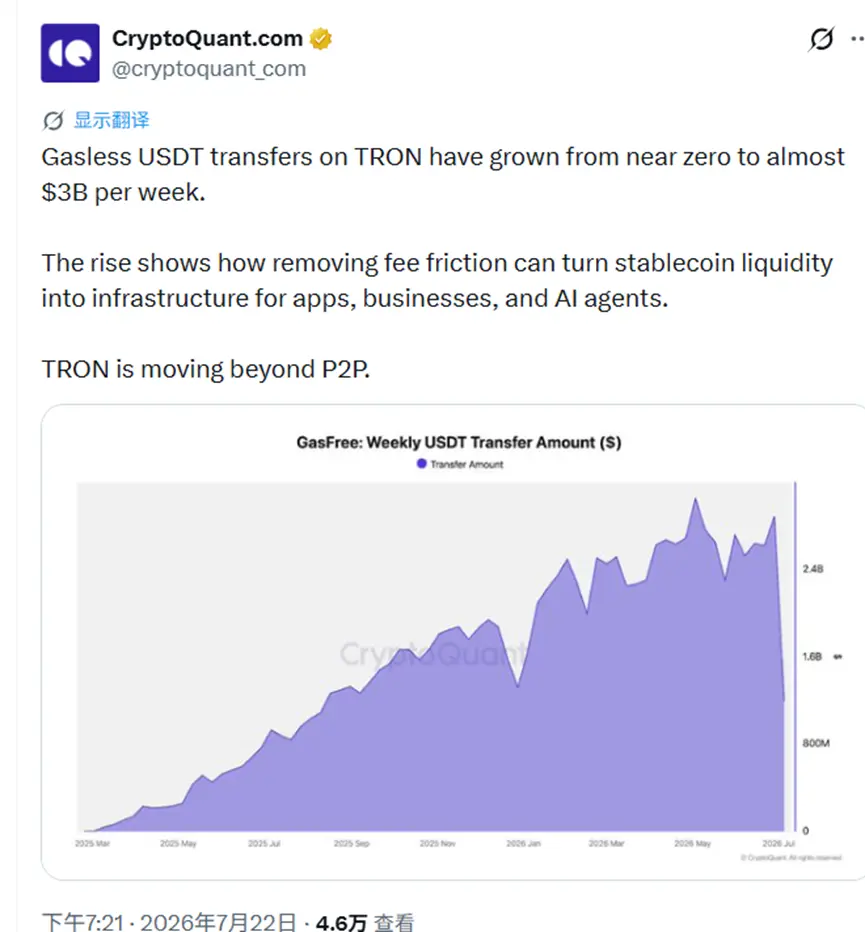
Among them, the GasFree no "Gas" transfer solution has grown into a new growth engine for the platform: this feature allows users to transfer without holding the native token TRX, directly deducting on-chain transaction fees from the target asset, fundamentally removing the native token holding threshold for ordinary users to participate in on-chain transactions. Currently, GasFree supports the transfer fee deduction for two major stablecoins, USDT and USDD (with USDD officially integrated in August of this year), and the user scale and transfer amount are in a phase of rapid growth.
According to the data from CryptoQuant's "TRON Q2 Report," the turnover scale of GasFree reached $2.9 billion in the last week of June, having set a weekly record of $3 billion in early May. As of September 1, the cumulative transaction volume of stablecoin transfers through GasFree has exceeded $132.6 billion, processing over 7.7 million transactions, saving global users over $8.48 million in fees, and is rapidly growing into an irreplaceable new growth curve for the JustLend DAO ecosystem.
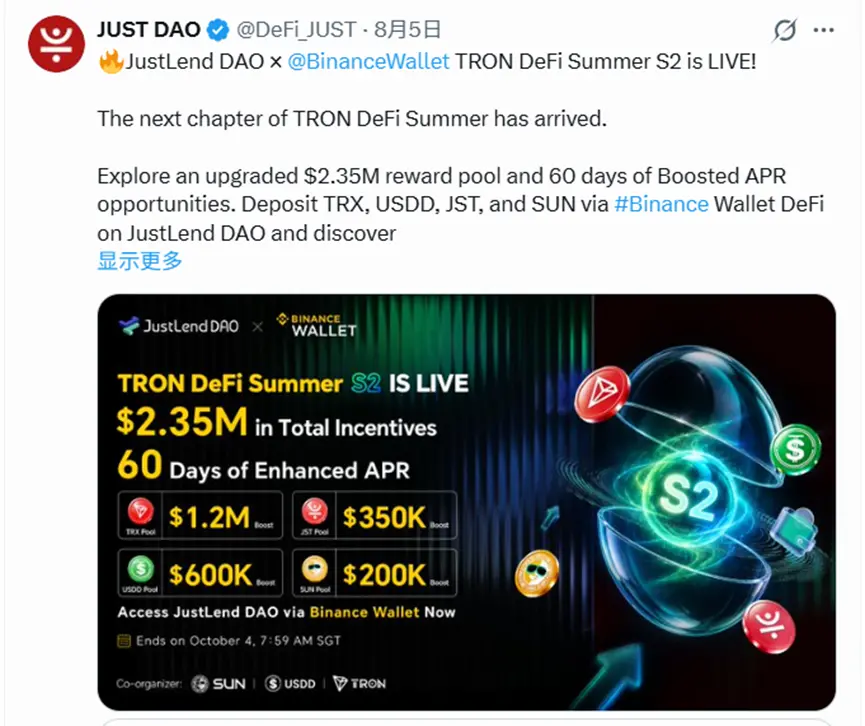
In addition to continuous product iteration and accelerated growth of core businesses, JustLend DAO is also expanding external collaborations to open up user acquisition channels. On July 6, JustLend DAO was officially integrated into the DeFi interface of the Binance wallet, with its liquidity pool going live simultaneously, directly reaching a massive user base of top CEXs; subsequently, the platform also collaborated with core projects in the TRON ecosystem such as USDD and SUN.io to launch the "TRON DeFi Summer" carnival with a total prize pool of up to $4.5 million. This series of cross-ecosystem initiatives not only brought considerable incremental funds and new user groups to JustLend DAO but also built a complete user conversion chain from the top CEX traffic pool to the TRON ecosystem, opening up new upward space for the platform's long-term revenue growth.
BitTorrent Launches Decentralized Computing Power Network BTTInferGrid to Enter AI Sector, Initiates Long-Term BTT Buyback and Burn Plan
The first half of 2026 marks a period of value reconstruction for BitTorrent, with key breakthroughs in three dimensions: regulation, business, and token economics. From the complete elimination of regulatory uncertainties to steady iteration of core business products, the launch of decentralized AI products entering the AI sector, and the initiation of the long-term BTT buyback and burn plan, it has achieved a comprehensive upgrade from external environmental barriers to intrinsic value reconstruction.
The starting point of this round of value reconstruction is the complete clearance of regulatory risks that have plagued the ecosystem for three years. On March 6, the U.S. Securities and Exchange Commission (SEC) officially agreed to withdraw all charges against Justin Sun, the TRON Foundation, and the BitTorrent Foundation, marking the end of a three-year regulatory dispute and eliminating policy uncertainties that hindered ecosystem development, clearing institutional barriers for subsequent strategic advancement. Following this, on May 27, BTT was listed on Thailand's largest cryptocurrency exchange, Bitkub, with the BTT/THB trading pair launched, allowing Thai users to trade directly in Thai baht, effectively broadening the liquidity depth and global market coverage of the token.
In terms of core business, BitTorrent's product iteration is steadily advancing. On June 5, the BitTorrent Neo client, designed for macOS, was officially launched, achieving efficient and smooth file sharing with a lightweight architecture and simple interface, further consolidating its user experience advantage in the P2P transmission field.
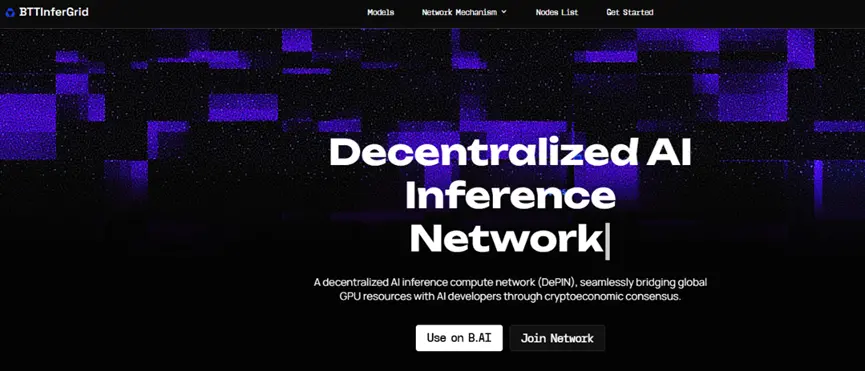
In the layout of emerging sectors, BitTorrent officially entered the decentralized AI computing power field. On June 17, the core AI strategic product BTTInferGrid was launched, constructing a DePIN computing power network aimed at AI inference scenarios. BTTInferGrid not only reconstructs the traditional computing power supply model through decentralization but also marks BitTorrent's entry into the decentralized AI sector, opening up a new growth curve for the entire ecosystem.
In the token value system, BitTorrent initiated the BTT buyback and burn mechanism to achieve asset value upgrades. On July 6, the official announcement stated that 100% of the revenue generated from decentralized business would be allocated to the exclusive BTT buyback fund pool, executing normalized buyback and burn on a natural quarterly basis. This mechanism fundamentally reshapes the value capture logic of BTT, upgrading it from a circulation and governance tool within the ecosystem to a core asset anchored to real business revenue with continuous deflationary attributes, allowing community users to share the long-term dividends of ecosystem development alongside business expansion.
WINkLink: Continuous Upgrades of Oracle Services, Buyback and Burn Boosting Token Value
As the core oracle infrastructure of the TRON ecosystem, WINkLink has continuously upgraded across multiple dimensions such as product functionality, asset coverage, and token value in the first half of the year, solidifying its on-chain data service capabilities while converting business dividends into long-term token value through the implementation of buyback and burn mechanisms.
In terms of product functionality, WINkLink completed an upgrade of its price service page on March 27, adding a "Market Statistics" section that visualizes core indicators such as market capitalization ranking, circulation and total supply, and 24-hour and 7-day price ranges, significantly enhancing the completeness and readability of data services, better supporting the diverse needs of developers and financial protocols.
In terms of asset coverage, the range of assets for WINkLink's oracle price feeds continues to expand: On April 13, U price information was added, along with the launch of U/TRX and U/USD trading pairs; on June 9, KGST price information and KGST/TRX trading pairs were added, continuously enriching the supply of on-chain price data and covering more asset types.
In terms of token value empowerment, WINkLink launched a long-term buyback and burn plan for WIN tokens on July 6, clearly stating that all revenues from providing oracle services to the TRON ecosystem would be used for WIN buyback and burn, with each round of burn data disclosed around mid-next quarter. This mechanism directly binds ecosystem business revenue to token value, continuously optimizing the token supply structure, resulting in a positive resonance between the underlying protocol service capabilities and token value. Since the announcement of the buyback and burn plan, the price of WIN tokens has rapidly climbed, rising from about $0.00002055 on the day of the announcement to $0.00002514 on July 29, with an increase of about 22.5%, intuitively demonstrating the value enhancement effect brought by the deflationary mechanism.
In addition, WINkLink was recognized by multiple exchanges at the beginning of the year, with WIN officially listed on Thailand's leading cryptocurrency exchange Bitkub on January 30, and again on Baltex exchange on February 28, broadening the global market coverage of the token in advance.
Emerging AI Sector Products Intensively Land and Rapidly Expand, TRON Ecosystem AI Product Matrix Taking Shape
If the mature DeFi ecosystem is the financial foundation for TRON to traverse market cycles, then the systematic layout for the Web3 AI sector is the core strategic pivot for seizing the dividends of the next technological revolution. In the first half of 2026, TRON entered a concentrated explosion period in the AI ecosystem: In February, the AI Agent exclusive financial infrastructure Bank of AI was officially launched; in April, the multi-model unified service entrance B.AI was fully opened; in June, the decentralized AI computing power network BTTInferGrid was launched, with a series of milestone products landing intensively.
As of now, TRON's AI ecosystem has formed a product matrix centered around B.AI, Bank of AI, AINFT, and BTTInferGrid, comprehensively covering key links such as AI large model service entrances, AI Agent financial transaction ecosystems, and distributed computing power supply. Each level of products has clear positioning, complementary capabilities, and collaborative scenarios, collectively constructing a complete multi-layer AI service architecture system from "upper-level service entrance --- middle-layer core infrastructure --- bottom-layer computing power foundation," forming an efficient and rigorously structured decentralized AI ecosystem framework.
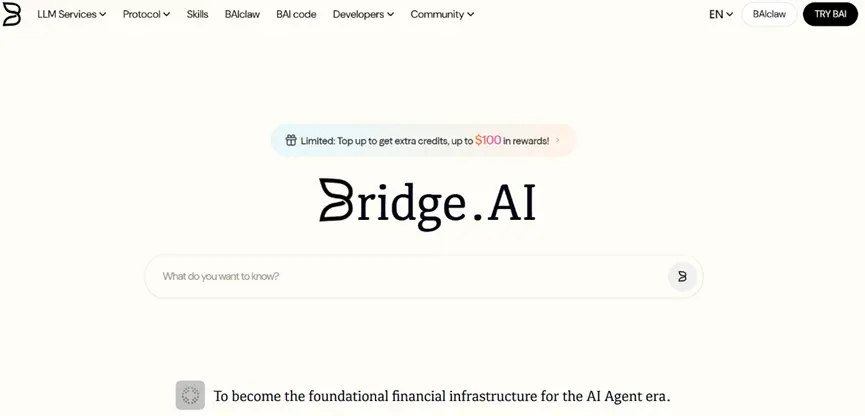
At the upper service entrance level, B.AI has become a unified service entrance for multi-model AI across Web2 and Web3. As a leading AI infrastructure, B.AI serves as the global settlement layer—sitting above all models and below all Agents, completing routing, computation, and settlement with each call. Its LLM service has now integrated the dialogue capabilities and standardized API services of multiple mainstream large models, supporting one-click switching between models and providing a unified API interface for quick access. Additionally, the platform has launched AI Agent desktop application BAIclaw, AI programming assistant BAIcode, as well as underlying general components such as x402 payment standards and 8004 identity protocols, providing ordinary users with a low-threshold smooth AI interaction experience while significantly lowering the technical costs for developers to access AI capabilities, offering unified large model service support for all AI applications within the ecosystem.
At the middle-layer core infrastructure level, AINFT and Bank of AI cover two core scenario centers: the financial capability access of AI Agents and the verification of trading strategies in the ecosystem. Bank of AI focuses on the exclusive financial sector for AI Agents, relying on native components such as the x402 payment standard, 8004 identity protocol, MCP Server, and Skills, providing one-stop Web3 on-chain financial service access capabilities for AI Agents, supporting AI Agents to call mature DeFi functions such as trading and lending with one click without additional development, becoming the core hub connecting AI Agents and the TRON DeFi ecosystem; AINFT plans to build a financial trading ecosystem center for AI Agents, launching standardized AI trading strategy evaluation infrastructure, providing capabilities for AI trading strategy verification and benchmarking, laying the foundation for trust and value transfer in the AI Agent trading ecosystem.
At the bottom-layer computing power support level, BitTorrent's BTTInferGrid decentralized AI inference computing power network provides underlying computing power guarantees for the entire ecosystem. The platform leverages over twenty years of global distributed node resources accumulated by BitTorrent, aggregating massive idle GPU computing power and bandwidth resources through cryptoeconomic incentive mechanisms, transforming scattered hardware resources into a standardized computing power pool that can be uniformly scheduled, providing low-cost, highly available, and on-chain verifiable AI inference computing power services for all upper-level AI applications, fundamentally breaking the monopoly of centralized computing power platforms and significantly reducing the computing power usage costs for Web3 AI projects.
In addition to the intensive landing of products, TRON has also completed forward-looking positioning at the industry standard level—officially joining the Agentic AI Council hosted by the Linux Foundation as a gold member in March this year, participating in industry governance alongside global tech and financial giants such as OpenAI, Anthropic, Circle, and JPMorgan. This layout further highlights TRON's industry voice and frontier advantages in the decentralized AI sector, adding important weight for its competitive edge in the next generation of technological revolution.
B.AI Builds Full-Stack AI Infrastructure, Becoming the Preferred AI Service Entrance for Global Users
B.AI was officially launched in April this year, rapidly growing into a phenomenal AI product spanning Web2 and Web3 within just a few months, serving as the core unified AI service entrance for TRON's AI ecosystem open to ordinary users and developers. As of September 1, the cumulative number of registered users on the B.AI platform has surpassed 2.2 million, achieving a scale of millions; on August 31, the single-day token throughput strongly exceeded 1.1 trillion, officially entering the era of 1T+ super computing power scheduling, with user penetration speed ranking first among similar AI products in the industry.
In just four months since its launch, B.AI has built a full-stack AI infrastructure system covering all scenarios from C-end interaction to B-end development: the core layer is the LLM multi-model unified service platform, the application layer is equipped with practical products such as the AI Agent desktop tool BAIclaw and the AI programming assistant BAIcode, and the underlying capability layer is supported by core infrastructure for AI Agents such as the x402 payment standard, 8004 identity protocol, and Skills component tools, forming a multi-layer closed-loop full-stack AI service architecture of "unified entrance - scenario application - underlying capabilities."
At the core multi-model service level, B.AI's LLM multi-model unified service platform aggregates dozens of mainstream AI large models globally in one place, covering both top overseas flagship models and high-cost-performance domestic models: it includes leading overseas flagship models such as ChatGPT (GPT-5.4/5.5/5.6 series), Claude (Opus/Sonnet/Haiku series), Gemini (Flash/Pro series), Grok (4.5 series), as well as domestic high-cost-performance models such as MiniMax (M2.7/M3), DeepSeek (V4 series), Kimi (K2.5/K2.6/K3), Zhiyu GLM (5.1/5.2/5.3), Qwen (3.6/3.8 series), Tencent Hy3, and MiMo (V2.5/V2.5 Pro), with the model list continuously expanding. Users can freely switch between all models for dialogue interaction on the same page without repeatedly jumping between multiple platforms.
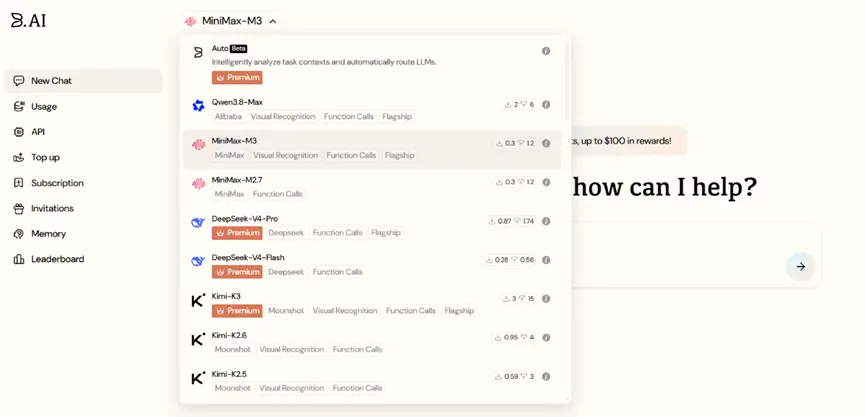
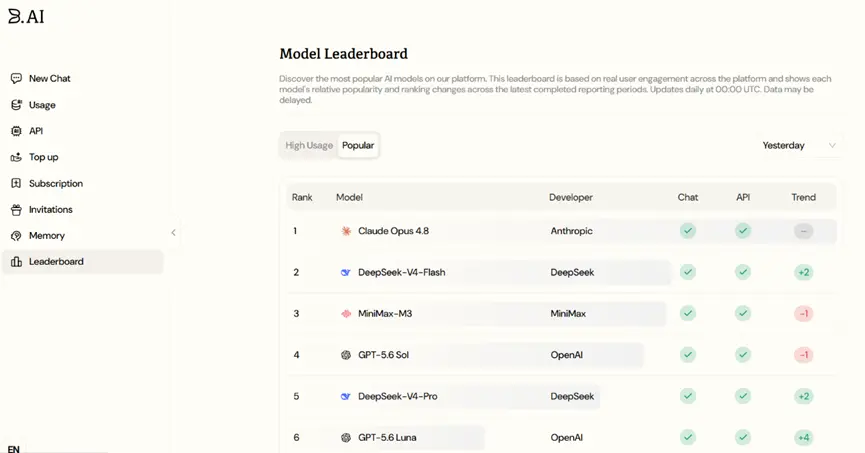
To address the pain point of users selecting models, B.AI recently launched an Auto intelligent routing mode, where the system automatically matches the AI model with the best overall performance based on the type, complexity, and cost requirements of the user's input task, significantly lowering the usage threshold for ordinary users across multiple models. Additionally, the platform has set up a "Model Ranking" page that displays the highest call volume and most praised AI models in real-time, helping new users quickly find popular models that fit their needs.
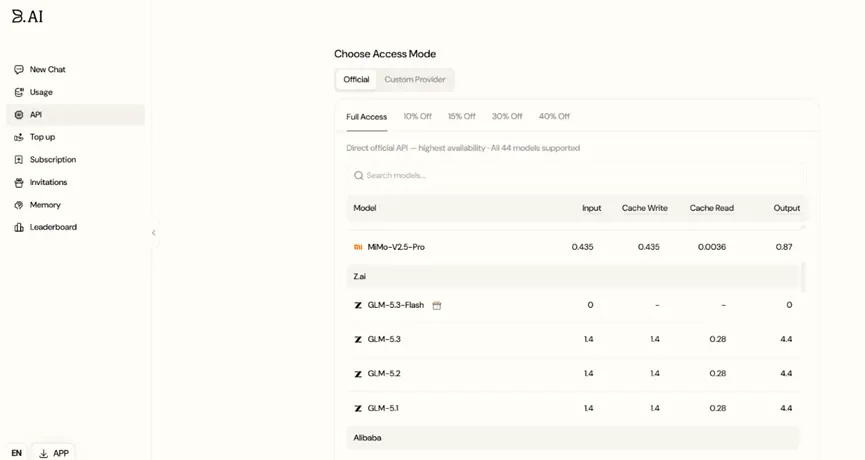
In the API calling field, B.AI has launched a unified API Key service interface, achieving a convenient experience of "one B.AI API Key, calling all AI model APIs on the platform." To meet the cost and flexibility needs of users of different scales, B.AI API has launched a "official" and "self-selected service provider" dual mode:
- Official Mode: Directly connects to the original factory API, currently offering official discount resource groups of 60%, 70%, 85%, and 90%, covering series such as GLM-5.2, Grok, Gemini, GPT, and will continue to expand more model resources in the future;
- Self-Selected Service Provider Mode: Supports users to choose model service providers based on their business needs, enjoying various tiered discount plans. Currently covering discounts of 10%, 20%, 40%, 60%, 80%, and 90%, adapting to the full range of mainstream models such as Claude, GPT, Gemini, Kimi, GLM, and will continue to add service providers and tiered discounts to provide developers with richer AI API access options.
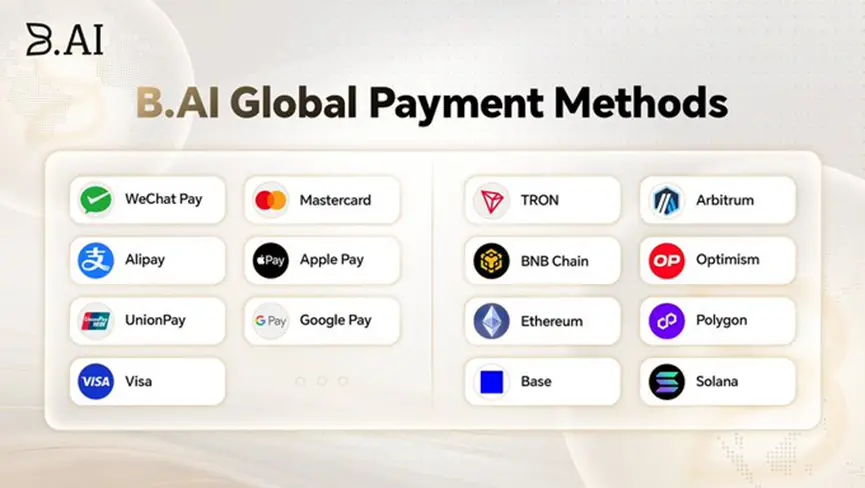
In terms of login and payment systems, B.AI fully supports dual-track access for Web2 and Web3, enabling zero-threshold usage for users across different circles. The login side supports one-click login via Web2 methods such as Google accounts, as well as multi-chain Web3 wallet logins from TRON, Ethereum, BNBChain, Optimism, Arbitrum, and non-EVM Solana chains. The payment side seamlessly connects the two major systems of crypto assets and fiat currencies: the Web2 side supports traditional fiat payment channels such as Visa, WeChat, Alipay, and UnionPay; the Web3 side connects with dozens of mainstream wallets globally, including TronLink, Binance Wallet, OKX Wallet, MetaMask, and Trust Wallet. The "full wallet coverage + full payment connectivity" hybrid model provides a smooth interaction and payment experience for users across different circles globally.
In terms of ecosystem building, B.AI has established partnerships with dozens of cutting-edge technology and leading Web3 companies, including top global cloud service providers such as Alibaba Cloud and Tencent Cloud, AI large model unicorn MiniMax, and leading innovative forces in the Web3 industry such as Biconomy, MoonPay, Pundi X Labs, KuCoin Web3 Wallet, Symbiosis, CROSS, and deBridge.
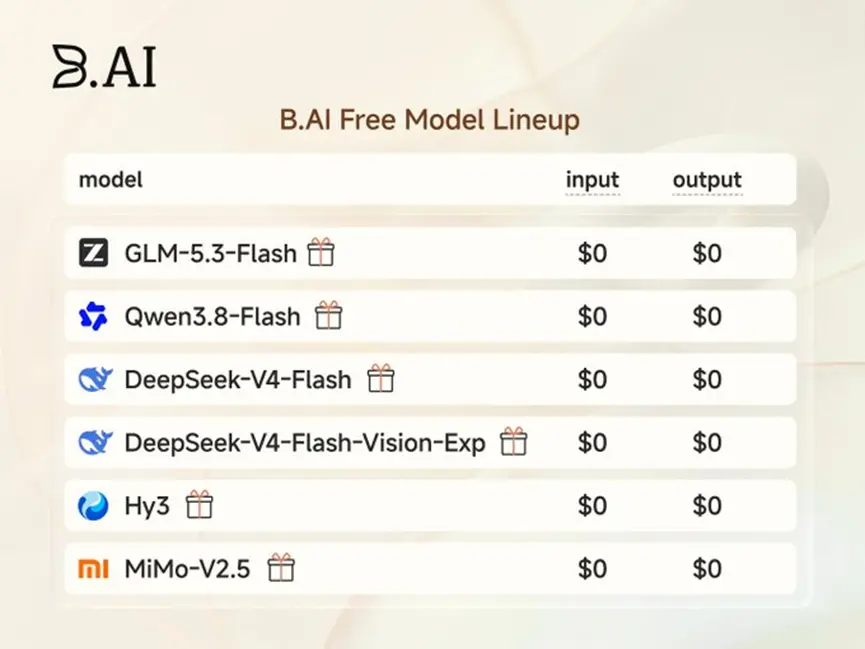
In terms of user benefits, B.AI launched a full free access event for AI large models on August 17, gathering six top models including GLM-5.3-Flash (Ox Alpha), Qwen3.8-Flash, DeepSeek-V4-Flash, DeepSeek-V4-Flash-Vision-Exp, Tencent Hy3, and Xiaomi MiMo-V2.5, offering unlimited free access to users for a limited time.
According to the latest operational data from the official, the AI welfare event significantly boosted the platform's call volume growth. On August 31, B.AI's single-day token throughput strongly exceeded 1.1 trillion, officially entering the era of 1T+ super computing power scheduling. In the 14 days since the event started, the platform's cumulative throughput has reached 6.86 trillion, with over 196,000 new API users added.
Bank of AI Constructs AI Agent Financial Infrastructure, Enabling AI Agents to Access On-Chain Financial Functions with One Click
Bank of AI was officially unveiled in February this year, aiming to become the financial protocol hub between AI and Web3, enabling every AI Agent to autonomously execute on-chain financial actions, promoting a qualitative leap for AI agents from "passively responsive intelligent dialogue tools" to "actively decision-making intelligent executors."
Focusing on the "one-stop AI Agent full-function toolbox," Bank of AI has created a standardized financial tool for AI Agents that is ready to use out of the box. It deeply integrates core foundational components such as the x402 payment standard and the 8004 on-chain identity protocol, and has launched the standardized AI large model on-chain service interface standard MCP Server, AI model expansion capability plugins Skills, and OpenClaw Extension components. Ordinary developers and even zero-code users can access complete financial capabilities such as automatic payment settlement, on-chain identity verification, and various DeFi operations for any AI Agent with just a few lines of simple code or by directly using natural language dialogue to call relevant service interfaces.
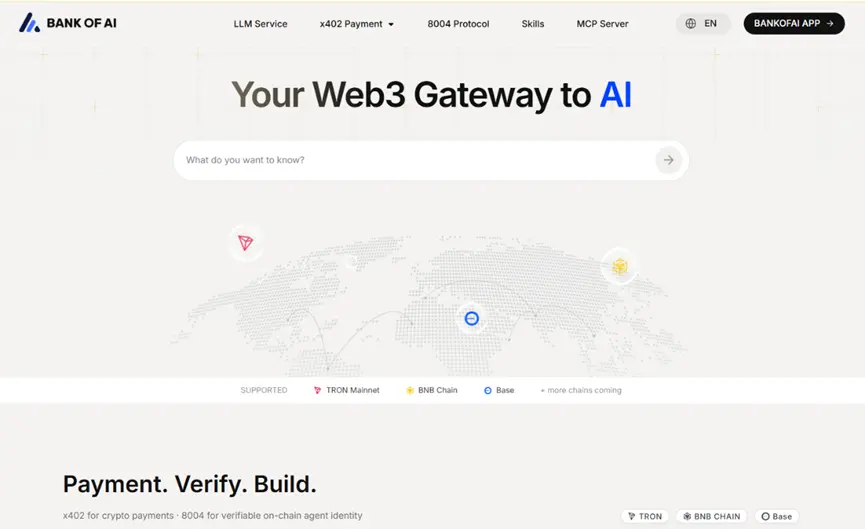
Currently, the MCP Server and Skills plugin system of Bank of AI supports the three major public chains of TRON, Ethereum, and BNB Chain. After integration, AI Agents can not only access the latest on-chain data from each public chain in real-time but also seamlessly connect with top DeFi protocols such as SUN.io, JustLend DAO, Uniswap, and PancakeSwap, autonomously completing various complex financial operations such as asset exchange, staking lending, liquidity mining, and cross-chain arbitrage, truly enabling AI agents to manage on-chain assets independently and increase returns, laying a solid foundation for the infinitely expandable underlying financial execution layer of the entire Web3 AI economy.
AINFT Plans to Build AI Agent Financial Trading Ecosystem Center, Establishing a Standardized Trust Base for AI Trading
AINFT plans to provide standardized infrastructure for AI Agent intelligent body trading, creating a financial trading ecosystem center for AI Agents. Targeting the AI Agent developer community, AINFT will launch a dedicated benchmark testing platform for AI Agent intelligent body trading, supporting developers in efficiently implementing AI investment trading strategies from "creative ideas" to "auditable quantitative backtesting results," providing a verification system and effect benchmarking for AI Agent trading strategies.
Specifically, AINFT will enable AI developers to conduct comprehensive and objective quantitative assessments of AI trading strategies' performance, risk control capabilities (such as loss control ability, maximum drawdown level, etc.), operational stability, relative benchmark excess returns, and full-link decision logic based on real simulated market conditions of mainstream core assets like BTC and ETH, allowing high-quality AI Agent strategies to naturally stand out in market competition and gradually build an industry-recognized "AI Agent capability rating" and "trust certificate" system.
Currently, the AINFT product has not yet been officially released, but a preview version is available on the official website. For more product progress and official updates, please follow the official X social media account @AINFT.
BTTInferGrid Constructs Decentralized AI Inference Computing Power Network, Restructuring the Computing Power Supply Economy
BTTInferGrid is the core strategic AI product launched by BitTorrent in June this year, positioned as a decentralized computing power network for AI inference scenarios, aiming to achieve seamless connections between global idle GPU and other computing resources and AI developers, creating an inclusive and open new generation of computing power infrastructure, serving as the foundational computing power for the TRON AI ecosystem.
In terms of operational mechanisms, BTTInferGrid is supported by both cryptoeconomic incentive mechanisms and distributed consensus systems. Through a distributed architecture, the network efficiently aggregates fragmented and underutilized idle GPU computing power globally, transforming it into a standardized resource pool that can be uniformly scheduled, precisely matching the inference computing power needs of AI developers. This model fundamentally reconstructs the production, distribution, and value transfer logic of traditional computing power, effectively breaking the long-standing monopoly of centralized platforms.
Currently, BTTInferGrid has completed the adaptation and integration of multiple mainstream open-source models, covering popular models such as Qwen3.6 27B, Qwen2.5 7B Instruct, and Meta Llama 3.1 8B Instruct, which developers can call with one click through the B.AI platform. In the future, the platform will also open standardized API interfaces, allowing developers to flexibly schedule computing power resources as needed, further shortening the development and launch cycles of AI applications.
Looking ahead, BTTInferGrid aims to establish AI-native infrastructure as its ultimate goal. According to the plan, by 2028 and beyond, the platform will create a collaborative network integrating computing, storage, and smart contracts, providing underlying support for AI Agents and various automated applications, ultimately becoming the preferred decentralized computing power infrastructure for global open-source AI applications.
TRON Ecosystem "DeFi + AI" Advances in Dual Wheels, Building Core Competitiveness to Traverse Cycles
Overall, against the backdrop of pressure on the entire industry, TRON has not only avoided being affected by the market downturn but has instead achieved counter-cyclical growth through the dual-line strategy of "solidifying the DeFi ecosystem as a foundation + expanding AI products into new sectors": The DeFi sector continues to consolidate its industry-leading advantage, with its value foundation being continuously strengthened; the AI sector rapidly completes the landing of full-stack products, opening up emerging growth spaces. The synergy of both efforts forms the core competitiveness supporting the long-term growth of the ecosystem and provides a highly valuable practical paradigm for the counter-cyclical development of the Web3 industry.
In the DeFi sector, TRON has long established a diverse and mature DeFi ecosystem: on the issuance and trading side, SUN.io has formed a comprehensive trading service matrix covering DEX (SunSwap), meme issuance (SunPump), and perpetual contracts (SUNX); on the asset and value-added side, the JUST ecosystem has created an integrated layout covering JustLend DAO (including SBM lending market, sTRX liquidity staking, energy leasing), GasFree smart wallet, and USDD stablecoin; on the underlying support side, WINkLink oracles and BitTorrent distributed transmission jointly provide data and file transmission services for the entire ecosystem.
The collaboration of various sectors is further supported by real project revenues, driven by product iterations, and leveraging deflation as a value tool, not only continuously consolidating the industry position of the DeFi foundation but also providing a solid value base and ecological resources for the layout of emerging sectors such as AI through stable business revenues and a large user base.
In the emerging AI sector, TRON has completed deep positioning through high-frequency product innovation and landing practices, constructing a top-down full-stack closed-loop ecosystem, firmly seizing the first-mover advantage in the industry. Relying on the current four core products—B.AI, Bank of AI, AINFT, and BTTInferGrid—TRON has built a three-layer architecture of "upper-level AI model service entrance - middle-layer Agent infrastructure - bottom-layer computing power foundation." This system is not a simple stacking of scattered products but an organic whole with interlinked capabilities and scenario empowerment: B.AI serves as the unified entrance for user traffic and model services, Bank of AI and AINFT realize the financial capabilities of AI Agents, and BTTInferGrid provides underlying distributed computing power support. The collaborative interaction of these products collectively constructs TRON's core competitiveness in the Web3 AI sector and lays the ecological foundation for the deep integration of AI and blockchain technology.
Recently, TRON founder Justin Sun stated at the 2026 Malaysia Blockchain Week that TRON is becoming the core cornerstone of the integration of AI and finance. He mentioned that DeFi, TradFi, and AI are accelerating integration through the same assets, payment channels, and user groups, and that the future financial system will be composed of institutions, open blockchain networks, and AI, with TRON's infrastructure capabilities playing an important role in this change.
Looking back at TRON's development path, if the forward-looking layout in the stablecoin field in 2019 laid the foundation for its current industry-leading position in the global stablecoin sector; and the deep investment in the DeFi sector in 2020 built the ecological foundation for inclusive finance; then the current systematic deployment in the AI sector will become a new engine for TRON's next phase of growth, driving the ecosystem to continuously advance into more cutting-edge technological fields.
 Risk warning