How does Strive outperform the stock price strategy?
 Core Viewpoint

 With the increasing popularity of spot Bitcoin ETFs, as well as various structured ETFs and Bitcoin products, investors now have many more channels to gain exposure to Bitcoin than in the past.
Author: Zhou, ChainCatcher
Recently, Bitcoin has rebounded from about $62,000 to above $80,000, and the listed companies in the Bitcoin treasury sector have also seen a surge: over the past four trading days, Strive has increased by about 54%, Strategy by about 32%, and other small players like Twenty One Capital have generally recorded double-digit rebounds.
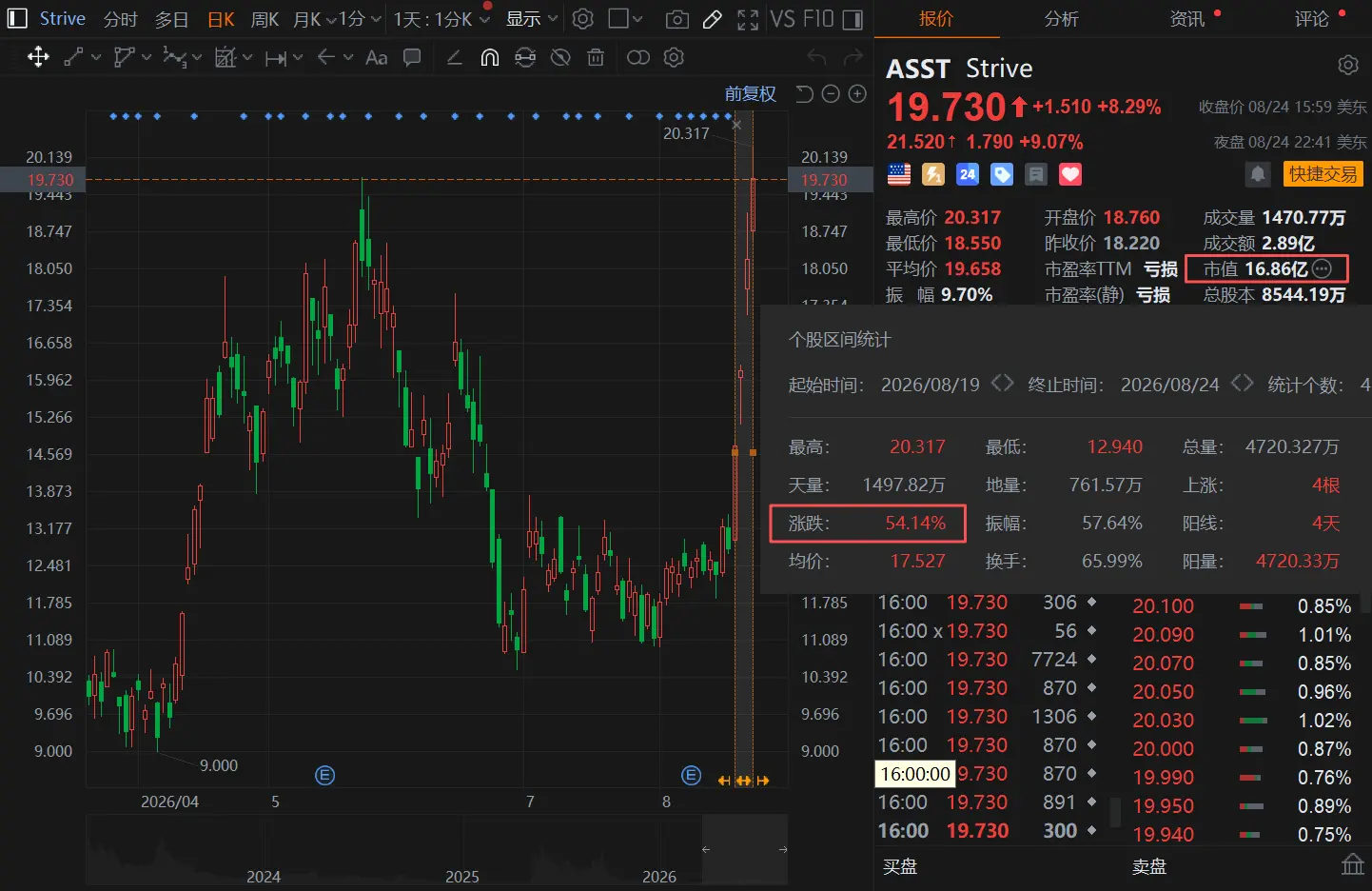
In fact, Bitcoin treasury companies have entered a clear differentiation phase in 2026. The largest player, Strategy, is no longer just buying; since the end of June this year, it has sold nearly 7,000 Bitcoins. Meanwhile, nearly 40% of the companies in the sector have seen their stock prices fall below net asset value, with many choosing to deleverage or pause large-scale acquisitions.
Against this backdrop, Strive has become one of the few public market players that continue to disclose purchases, currently holding a total of 21,356 Bitcoins.
The perpetual preferred stock SATA issued by the company has a set annual dividend of 13% and will be adjusted in June 2026 to become the first listed security in U.S. history to pay dividends daily.
Although the company's size is currently far less than that of Strategy, at this stage, Strive's buying pace and capital structure choices make it seem to have more differentiated potential. The company's CEO, Matt Cole, has also publicly emphasized his long-term belief in Bitcoin multiple times recently.
From Anti-ESG Fund to Bitcoin Treasury
Many people know Strive by the label of Bitcoin treasury, but it initially had nothing to do with cryptocurrency.
In 2022, Vivek Ramaswamy and former Anheuser-Busch executive Anson Frericks co-founded Strive. The company initially relied on an anti-ESG energy index fund called DRLL, which focused on an investment philosophy that does not consider environmental, social, and governance factors, quickly attracting a batch of funds that resonate with this value system.
In February 2023, Ramaswamy resigned as executive chairman to run for U.S. president. In April of the same year, Matt Cole took over as CEO, becoming the actual helmsman of the company's strategy in the following years.
The real turning point occurred in 2025. By then, Strategy's hoarding model had largely reflected in its stock price. From May to September of that year, Strive transformed itself into a publicly listed company focused on Bitcoin treasury strategies through a reverse merger with the Dallas-listed company Asset Entities. The transaction also completed a $750 million PIPE financing, retaining the stock code ASST, which trades on NASDAQ.
After the transformation, Strive quickly began to expand. From September 2025 to January 2026, it fully acquired another Bitcoin treasury company, Semler Scientific, incorporating about 5,000 Bitcoins held by the latter into its balance sheet. Upon completion of the acquisition, the merged company held about 12,798 Bitcoins, ranking 11th globally among publicly listed companies in Bitcoin holdings.
With this acquisition, Strive also built its own management team. Avik Roy was appointed Chief Strategy Officer, former Semler Scientific Chairman Eric Semler joined the board, and Joe Burnett became Vice President of Bitcoin Strategy, becoming another key figure for the company's external communications.
Market sentiment can also be seen in stock prices. Initially, following the transformation news, ASST was pushed up to over $200, but after experiencing a reverse stock split and valuation correction, it fell back to the current range of just over ten dollars.
As of August 21, the company held a total of 21,356 Bitcoins, along with 505,000 shares of Strategy STRC preferred stock, with a fair value of about $48.57 million, and approximately $171.9 million in cash.
Not Just Hoarding Bitcoins, Strive's Product and Financing Design
Strive's financing tools are relatively conventional. One is the issuance of common stock ASST at market price, known as ATM. The second is the perpetual preferred stock SATA. In May of this year, it announced in its quarterly report that it had repurchased and cleared all long-term notes, achieving zero debt, zero margin, and zero pledged Bitcoins.
The SATA under the company is the first listed security in the U.S. market to pay dividends daily, with a par value of $100 and an annual dividend of 13%. Each trading day, it pays about $0.0516 per share, totaling about $13 over a year of 252 trading days, exactly corresponding to the 13% coupon.
SATA fell to about $75 twice this year, only three-quarters of its par value, but has since risen back to par along with the Bitcoin recovery.
As a perpetual preferred stock, SATA, like Strategy's STRC, has no maturity date, and dividends can be deferred at the company's discretion, with no hard clauses for mandatory redemption or liquidation if Bitcoin prices fall below a certain threshold. This year, Strive increased the limits of both ATM plans for ASST and SATA by $2.1 billion each.
During the first half of this year, when SATA fell sharply, Strive's accumulation was interrupted for more than two months, and it only resumed buying Bitcoin in August when SATA returned to par and the channel reopened.
As a Bitcoin treasury company, the market inevitably compares it with Strategy. The main differences between the two companies are fourfold.
The first is the type of debt. Strategy accumulated a significant amount of convertible bonds from 2020 to 2024, such as a $3 billion zero-coupon convertible bond issued in November 2024, maturing in 2029. In the past two years, Strategy has not continued to issue convertible bonds in large quantities but has instead turned to repurchases to reduce debt. Strive, on the other hand, has no convertible bond debt; the company's Chief Investment Officer Ben Werkman stated that it has only relied on equity financing without issuing convertible bonds, allowing it to continue operating during the bear market.
The second is the hoarding model. Strategy is deleveraging, repurchasing convertible bonds, and buying back STRC, having sold nearly 7,000 Bitcoins this year. Strive, however, is still expanding, issuing SATA and buying Bitcoins.
The third is the difference in interest payments. STRC currently has an annualized rate of 12%, paying dividends semi-monthly at $0.50 per share. Strive's SATA pays dividends daily, with a coupon rate of 13%.
The fourth is cross-holdings. Strive has purchased about 505,000 shares of Strategy's STRC preferred stock, with a book value of about $48.6 million. This means holding a competitor's preferred stock as interest-earning reserves, using the approximately 12% return from STRC to support its own SATA dividends.
Narrative Shift and Management Belief
The narrative around the Bitcoin treasury business is changing.
The core commitment over the past few years has been to only buy and not sell, locking Bitcoin into the balance sheet and never using it. In 2026, this commitment was broken by the largest player, Strategy. Although the amount sold is less than 1% of its total holding of 840,000 Bitcoins, the symbolic significance is considerable.
Strive is currently at an earlier stage in the cycle and has not yet reached the point of selling Bitcoins. CEO Cole repeatedly emphasizes his long-term belief in Bitcoin, citing reasons such as the structural weakening of the dollar, capital chasing scarce assets in the AI era, and Bitcoin's price ratio to gold leading to a bottoming out. He also pointed out that even if Bitcoin drops to 1 cent and stays there for 18 months, Strive would not need to sell even a single BTC.
Compared to this macro narrative, insiders putting their own money on the line is a more significant signal. Cole stated that February 19 was the bear market bottom for ASST, when the company's CFO, CLO, and several executives and directors bought shares in the open market, and three independent directors transitioned to full-time roles within six months, with the team maintaining high confidence in their Bitcoin exposure, structural amplification, and mutual cooperation.
However, beyond the team's belief, there is a more realistic question: how much Bitcoin have ordinary shareholders truly gained from such high-profile purchases?
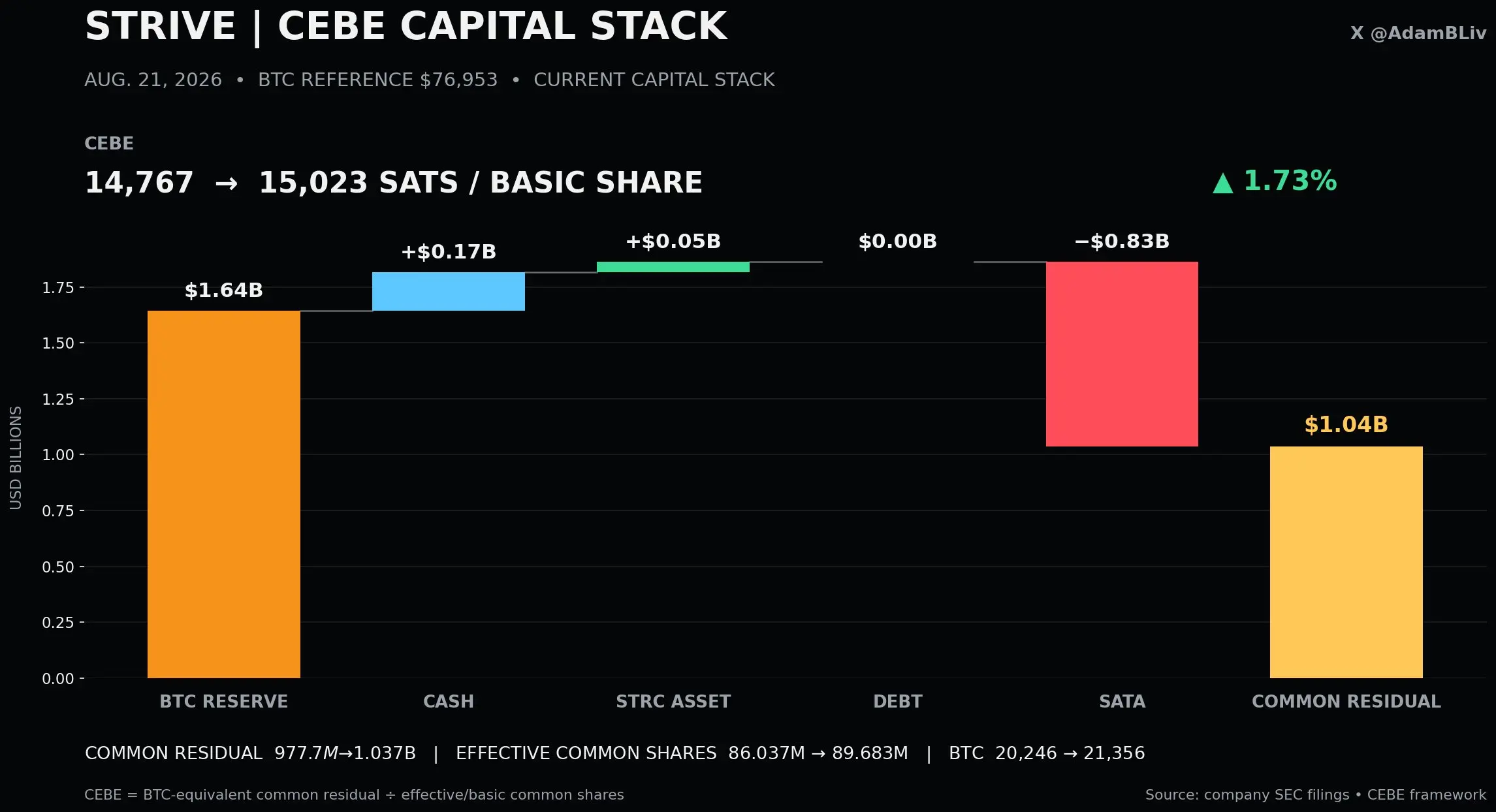
Looking solely at the growth rate of holdings may lead to overestimation. For example, in the week from August 17 to 21, the company's Bitcoin reserves grew by about 5.48%, but the money for buying Bitcoins mainly came from the issuance of new shares, with the common stock expanding from about 86.04 million shares to about 89.68 million shares during the same period, diluting by about 4.24% in one go, while the SATA preferred stock, which is prioritized for repayment ahead of common stock, also increased in size simultaneously.
Subtracting the dilution and the priority of preferred stock, according to the CEBE metric, which indicates how much Bitcoin value corresponds to each share of common stock, the actual growth for that week was only about 1.73%, from about 14,767 satoshis to 15,023 satoshis, showing that the actual numbers are not always as bright as they appear.
How to Withstand Downturns and Amplify Upsides?
In fact, Strive faces a common challenge in the entire treasury sector—the slowdown of the flywheel in a bear market.
Strive's solution is digital credit. It treats Bitcoin as a credit asset that can generate stable returns rather than merely betting on appreciation.
Chief Investment Officer Burnett cited Saylor's algorithm, stating that as long as Bitcoin grows at an average annual rate of 3.3%, capital gains will be sufficient to cover preferred stock dividends, making holding itself a business that can continuously pay interest, with SATA's daily dividends being a product of this approach.
Cole believes that to maximize the expected total return of $ASST, the company should increase its participation in Bitcoin's appreciation as much as possible within a responsibly manageable range while maintaining strict capital discipline.
The real difficulty lies in considering both bull and bear market scenarios. Downward, how much of a decline can it withstand; upward, if Bitcoin truly rises, will it miss out on gains due to being too conservative?
During the downward process of the bear market, the company avoided hard liquidation by not using debt, not setting margins, and not adopting any financing structure that could trigger forced liquidation. However, its financing heavily relies on SATA and ASST trading above par or net asset value; this year, SATA fell sharply to three-quarters of par, and accumulation was halted for more than two months, which was a rehearsal of this reliance.
As for the upward direction, Cole referred to ASST's capital structure as an amplification structure, relying on three mutually reinforcing mechanisms to amplify the company's participation in Bitcoin's rise, increasing the size of the scarce asset pool, the share of Bitcoin, and further amplifying the structure of ASST.
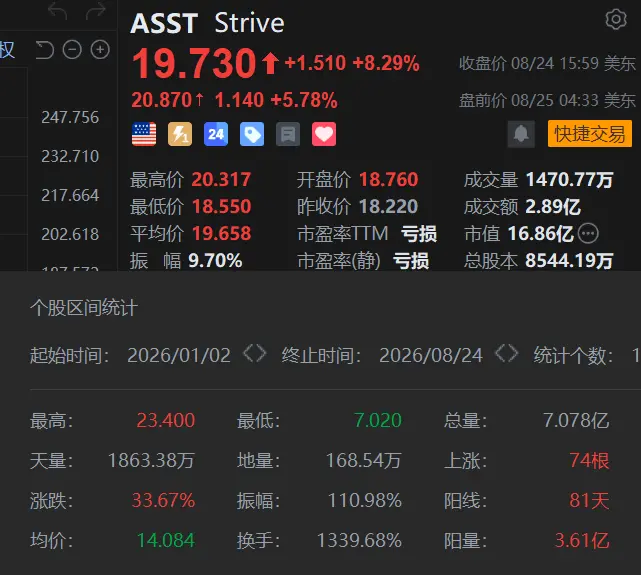
Strive is smaller and has thinner liquidity, making it a Bitcoin exposure with greater elasticity and higher beta. This year, ASST has risen about 34%, while Strategy's MSTR has fallen about 19%, with ASST experiencing a range fluctuation of about 111% compared to MSTR's approximately 76%.
Conclusion
Overall, Strive has made some differentiations on top of Strategy's model—no debt, daily dividends, and digital credit, which sound safer and more innovative. However, peeling back these designs, it essentially remains a high-volatility exposure to Bitcoin.
This exposure is facing an increasing number of alternatives. With the emergence of spot Bitcoin ETFs, as well as various structured ETFs and Bitcoin products, investors now have many more channels to gain Bitcoin exposure than in the past, intensifying competition for treasury companies like Strive.
For a small company like Strive, the limitations are even more pronounced. With a small market cap and thin liquidity, large funds find it difficult to enter and exit, and the pool of participating investors is relatively limited.
Its advantages are equally clear—greater elasticity and higher beta. For those willing to endure high volatility and specifically seeking such exposure, this is precisely its appeal.

 Risk warning