How did the "AI Stock God" collapse? A frontline review of the entire liquidation process on Wall Street
 Core Viewpoint

 4x leverage, Wall Street short-selling hunt, and a massive heist of 100 billion in assets.
Author: Xu Chao, Wall Street Journal
AI computing power and infrastructure trading are undergoing a severe bubble burst. Recently, the hedge fund Situational Awareness LP (SALP), founded by former OpenAI employee Leopold Aschenbrenner, suffered a catastrophic liquidation due to high leverage on AI concept stocks and Anthropic equity during a market correction, triggering a competitive scramble among Wall Street giants to acquire its remaining assets.
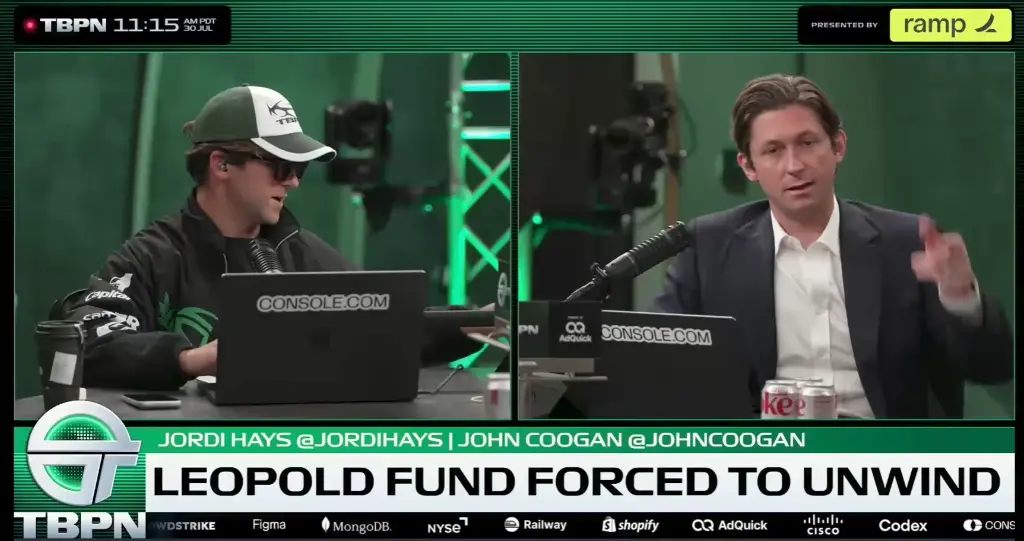
In a recent podcast interview, former hedge fund manager and well-known financial commentator Martin Shkreli deeply analyzed the insider details of this liquidation event, Wall Street's "Darwinian hunting" rules for short selling, the underlying mechanisms of large position liquidations, and the deeper reasons why traders repeatedly fall victim to leverage and the Kelly Criterion.
Key points compiled by Wall Street Journal are as follows:
4x leverage triggers severe liquidation: The SALP fund had an asset size of $45 billion (including $10 billion in Anthropic equity), and through its prime broker, it added 4x leverage, bringing its total market value (GMV) to as high as $120 billion. Under the impact of a 25% drop in publicly traded stocks, its net equity quickly shrank and even faced negative risk, forcing the prime broker to trigger liquidation.
Wall Street's Darwinian hunting: When the market learned that the fund was forced to liquidate, several hedge funds adopted a "shooting against a fund" strategy—selling similar positions in advance and heavily shorting, accelerating its bankruptcy process.
Citadel and giants' bloody acquisition: Citadel, Millennium, and Jane Street participated in a closed-door bidding for SALP's remaining assets. Buyers like Citadel acquired its stock book at a massive discount of 20%-50%, gaining billions of dollars in immediate paper profits.
Discrepancy between AI fundamentals and marginal traders: Although OpenAI, Anthropic, and tech giants performed strongly, the short-term price movements were determined by that 5% of leveraged marginal buyers. When the weakest funds panic and flee, any minor negative news can trigger a crash.
Ultimate warning of leverage and the Kelly Criterion: Most traders tend to overbet severely. According to the Kelly Criterion, even with a 60% vs. 40% win rate advantage in a single trade, if the position size exceeds a reasonable proportion (overbetting), it will inevitably lead to bankruptcy under probability variance.
Wall Street's Darwinian Rules: Rumors Materialize and Short Selling Hunts
Martin Shkreli pointed out in the interview that Wall Street experienced a severe shock triggered by a liquidity crisis in the past 24 hours. He compared this event to the historical Long-Term Capital Management (LTCM) and Amaranth liquidation cases.
According to Martin, rumors about the SALP fund being in trouble had already circulated early in the week. Some hedge fund institutions quickly executed a "shooting against a fund" short-selling strategy after keenly capturing this signal. When it became known that a certain institution was forced to liquidate, the market peers, driven by the "Darwinian rule" of the weak being preyed upon, would first sell overlapping positions and establish large short positions, thus accelerating the fund's bankruptcy.
Dissecting 4x Leverage: How $100 Billion in Assets Quickly Went to Zero
Regarding the reasons for the recent correction in the AI sector, Martin Shkreli emphasized that fundamentals are not the core factor determining short-term stock prices; the marginal willingness of buyers and sellers is key.
He analyzed that the SALP fund previously managed about $45 billion in assets (with about $10 billion in Anthropic equity) and retained about $30 billion in cash in its bank account. By obtaining up to 4x leverage through its prime broker, its total market value (GMV) soared to $120 billion. When the publicly held stocks it owned experienced a roughly 25% correction, although this seemed limited relative to the $120 billion base, its principal net equity plummeted from $35 billion to $5 billion. The prime broker, to prevent net equity from going negative and causing its own losses, would quickly take over the portfolio and force liquidation.
Discounted Acquisition and Asset Grab: The Arbitrage Frenzy of Giants like Citadel
During the liquidation process, Wall Street giants like Jane Street, Millennium, and Citadel were invited to participate in closed-door bidding. Martin stated that buyers like Citadel ultimately acquired the fund's stock assets at a massive discount of 20% to 50%.
According to insiders, the acquirers disposed of these assets without disturbing the market, gaining up to $3 billion to $4 billion in immediate paper profits (Insta-markup). Additionally, the SALP fund manager had attempted to contact multiple parties to liquidate its holdings in Anthropic private equity to supplement liquidity, with the quotes benchmarked against a total company valuation of about $1.1 trillion. Martin pointed out that this type of large-scale crisis management further solidified Citadel's position as Wall Street's "ultimate savior" and shadow bank.
Narrative Frenzy in the Bubble: FOMO Emotion and Disconnection from Fundamentals
Martin Shkreli reviewed the evolution patterns of past financial bubbles, pointing out that from the 2000 internet bubble to Cathie Wood's innovation fund, every generation of market cycles has seen traders betting their entire fortunes due to excessive faith in a grand narrative (such as the arrival of AGI).
He noted that although leading AI companies like OpenAI and Anthropic performed strongly and tech giants maintained high capital expenditures, when the market is dominated by that 5% of marginal buyers with high leverage, the weakest hands at the top will panic and flee first. At this point, any minor negative signal—such as a giant announcing a moderate reduction in capital expenditures—will lead to a collapse of the entire trading structure.
Large Position Liquidation Mechanism: The Dilemma of Unwinding in a Liquidity Trap
In response to the question of "why large institutions cannot directly liquidate in the secondary market," Martin detailed the disposal process of large positions.
He explained that selling directly into the screens is likely to expose intentions and trigger front-running by quantitative algorithms and peer institutions. Therefore, prime brokers typically conduct discreet inquiries through four-digit market maker codes (like Goldman Sachs' GSCO) or directly package the asset book for large sell-offs. Under the forced control of the prime broker, the goal of the clearing institution is to quickly cut off risk rather than wait for a market rebound, and such large-scale sell-offs exerted severe downward pressure on the market for several weeks.
The Curse of Leverage and the Kelly Criterion: Inevitable Bankruptcy from Overbetting
When discussing the trading mentality of fund managers, Martin referenced the "Kelly Criterion" proposed by scholars at Bell Labs.
He pointed out that most traders generally have a severe tendency to overbet, with their position sizes often reaching 2 to 10 times the reasonable building standard. Simulation data shows that even if a trade has a 60% vs. 40% win rate advantage, once it violates the Kelly Criterion through overbetting, the final result under long-term variance fluctuations will inevitably be capital going to zero. Martin concluded that regardless of how talented a trader is, once they ignore position management and leverage risk, the market will ultimately teach everyone to remain humble.
The following is the full interview:
Host: Let's connect with Martin Shkreli for an in-depth analysis. I think he’s online. How have you been, Martin? Great to see you again.
Martin Shkreli: Hey, guys, I'm doing great. How about you?
Host: Awesome, perfect. Uh, take us through how the past 24 hours have been for you. What has the experience been like for you in the last 24 hours?
Martin Shkreli: It's been very interesting. I invest myself, so… this is probably one of the craziest months in Wall Street history. Well, I was talking with some friends last night about Long-Term Capital Management (LTCM), Amaranth, and other famous liquidation tragedies triggered by liquidity crises.
Well, this event definitely ranks up there. Yeah, it's really a crazy thing. We heard rumors about it mid-last week, and then last night and this morning, those rumors started to materialize.
Clearly, it almost became a "fait accompli." I actually think they did a pretty good job of keeping it quiet. But I think some players had already started positioning early in the week (Monday, Tuesday), wanting to do what my old boss Jim Cramer used to call "shooting against a fund." If you know someone is being forced to liquidate, the unfortunate and cruel thing is that from a Darwinian perspective, the best thing for you to do is to sell all the positions you share with them and start shorting every asset they own.
Yes, that would accelerate their downfall as quickly as possible. When this kind of thing happens, it's a very common operation. Well, of course, I'm not saying I had overlapping positions with them, so I definitely wouldn't do that; but I know there are a lot of funds shorting all these stocks hoping to trigger panic and collapse.
Host: How do you trace the starting point of this correction? Is it due to the war? Is it oil? Is it anxiety over open source, or simply because of hyperscalers' capital expenditures? There are so many different theories about why AI infrastructure trading and bottleneck trades might be weakening. But at the same time, it feels like the models are making very solid progress, and the progress is basically in line with expectations. Yes, yes. The lab companies are experiencing one of the most glorious months in business history. Yes, but all the infrastructure is correcting.
Martin Shkreli: Yes, those things are completely irrelevant. [Laughter] The only thing that matters is the willingness of buyers and sellers to buy or sell. What actually happened is that smart people got in early, started buying, saw prices go up, and bought more.
Then less smart people noticed and said, "I want to do that too; I want to make 400% this year."
People like me started buying near the top. [Laughter] It’s like, "Hey, this is great, I love memory chips, I love the bottleneck concept." [Laughter]
Then, the weakest hands bought at the top. So they were also the first to sell. Of course, they panicked first. Yes.
This creates a… you know, every bubble is basically the same. You go through this frenzy, the peak, and then everyone panics at the same time. You know, fundamentals basically don't matter. I know they will determine the buyers and sellers at the margin, but, you know, 80% or 90% of asset shareholders don't turn over. It's that 5% of marginal trading that determines the price. If that 5% is in a state of 3x or 4x leverage—just like we heard SALP (Situational Awareness LP, Leopold's fund) is a 4x leveraged fund—that's quite high leverage. You know, a 25% drawdown can lead you straight to bankruptcy.
Martin Shkreli: Yes. Well, interestingly, we heard that three companies were bidding for these assets.
So, Jane Street, Millennium, and Citadel were pulled into a closed circle late Friday to bid for the sale of the institution's remaining assets. We got a chance to take a look at $1 billion worth of Anthropic stock, which left us puzzled. You know, sometimes you see these SPVs (special purpose vehicles) occasionally circulating, and we thought that was interesting. Well, I raised an eyebrow and thought, "Is this Leopold?" Because sometimes when you want to sell $4 billion of some asset, you don't publicly say you want to sell $4 billion. [Laughter]
You would run out and say you want to sell $1 billion of it. Usually, someone wanting to buy $1 billion has the strength to buy $5 billion or more.
You tentatively reach out to them and say, "There's $1 billion, how about it, do you happen to want $5 billion?" Then your eyebrows start to raise, realizing he might have more.
Well, of course, this is a very strange situation. So, we heard that Millennium did indeed make an offer. Citadel's offer was better. You know, I think Ken (Ken Griffin, founder of Citadel) wants to be the person everyone turns to when they get into trouble. It's like… you know, Buffett is getting older, and this kind of thing isn't something Buffett would want to do.
But Citadel did this during the Amaranth trade. You know, when Amaranth blew up in natural gas futures, I think Citadel took over that portfolio. In fact, they have stepped up to rescue almost every liquidation event in finance. For example, Enron, they directly bottomed out and absorbed all the top talent.
Host: Yes, they also wanted to take over Enron.
Martin Shkreli: Yes, Ken is a very smart guy. He just shows up and demonstrates, "How can I become the partner of Goldman Sachs, Bank of America, and other big banks when they need to get rid of high-risk positions?"
They basically took over the asset book, right? So, if you… let me give you an example to respond to your earlier question.
Suppose you have $45 billion in scale, trying to trace this process, of which $10 billion is invested in Anthropic. So you have $30 billion in cash in your bank account. Running at 4x leverage means your total market value (GMV) reached $120 billion. Oh.
So, if your GMV drops, say, 25%. At a $120 billion base, 25% doesn’t sound that bad. Well, that's about $30 billion. So your GMV drops to $90 billion. But that's not your net equity. So your principal net equity drops from $35 billion to $5 billion. Yes. No prime broker would allow you to continue holding a total market value of $90 billion with only $5 billion left in net equity because once your net equity falls below zero, the loss is on the broker, not you.
After the Archegos and other similar liquidation events, brokers absolutely will not lose a dime anymore; that's not their responsibility. They basically have the right to take over your portfolio, and this kind of thing… you know, I hope no one ever has to go through. But they basically call you over and say, "Listen, these assets now belong to us, and we will decide how to dispose of them." Rumors say that over the weekend, he contacted about 10 parties to liquidate Anthropic, trying to supplement liquidity, and the reported quotes for selling Anthropic equity were benchmarked against a total valuation of $1.1 trillion. Well, I think that's probably its current trading valuation. Well, it’s still unclear whether it was all sold or half sold; we reported it as half sold. Currently, it's still a bit murky who bought it and what exactly happened, but that's the latest information we have. Then, you know, speaking of…
Speaking of the publicly traded stock book, it sounds like the buyer of that stock book, according to what we learned, basically gained $3 billion to $4 billion in immediate paper profits (Insta markup).
So, they now need to gradually liquidate/dispose of this $3 billion to $4 billion. Yes. Uh, far more than $3 billion to $4 billion, much more. But essentially, if they can dispose of these positions without disturbing the market, they can make $3 billion to $4 billion out of thin air in this trade, which is really rare, interesting, but also very exciting. One of the parties among those three contacted me last night; interestingly, it was after I published the report. They said, essentially, yes, Leopold flew too close to the sun (Icarus-like arrogance), but your numbers are a bit off. I asked if they were too high or too low, and they refused to confirm or deny. Regarding my report, whether privately or publicly, I received a lot of deflections/rebuttals, just like you said, they said it wasn't that bad, he only lost 30%. A 30% loss is still bearable.
But if the valuation mark for Anthropic hasn't changed, it means you lost 60% on the publicly traded stock book.
If you added 4x leverage, you know, that means you actually lost 15% on the publicly traded stock book.
Well, that sounds a bit too good to be true. If you trade these stocks, they drop 15% in a day. Yes.
So we also heard that other AI funds are also suffering. They may not be in the same dire straits, but they are definitely being hit. So where does this fund go from here?
It provides a good cover for all those funds that are actually copy trading him. Oh, of course.
They might even have a higher risk appetite and entered positions later because if you want to copy someone else's homework and try to catch up, you will inherently lag behind, you know. Yes, you want to catch up. Yes.
Martin Shkreli: Yes, higher leverage, you enter these trades at a much later point in time. Well, do you remember… for example, how did you view Ryan Jacob around 2000? Because at that time you were at Cramer's company. I remember when you joined, it might have been just before Ryan's Internet Fund started to collapse. Yes, there was also the Amarind Fund at that time.
In the 60s, there was a fund called Manhattan Fund, which Warren Buffett criticized as a kind of get-rich-quick fund managed by a guy named Gerald Tsai. So, like every generation, you've seen the meme about Cathie Wood, you know… every generation has someone like that, who firmly believes in a grand narrative (cycle) and then bets everything on that narrative.
Listen, I have great respect for those willing to do that. I once told a friend who did the same thing, he also followed this trade, but he got in very early, so his numbers were once as bright as Leopold's.
And he seemed to have hedged near the top—this is a miracle trader, the best trader I know. I joked with him, "If Leopold sells at the top and turns to shorting, I would absolutely regard him as the greatest trader of all time (G.O.A.T.)." [Laughter]
Just, you know, when you are completely enchanted by that kind of narrative (whatever happens, in this case, AGI general artificial intelligence), there are indeed people outside saying, "Listen, AGI has arrived or is about to arrive. When it arrives, the entire financial world will no longer matter." Yes.
You know, "Let's blow it up and witness the end of the world in this way." Of course, for someone sitting at a Goldman trading desk, you would think, "These people are really crazy." [Laughter] You know, this is just stock market trading, you know.
Host: Given that Leopold worked at FTX until just before its collapse, do you think that despite his high risk appetite, he might feel, "You know, I really can't go through another collapse like that"? He may not necessarily have a direct connection to any illegal activities at FTX, but he did witness and experience everything firsthand, and I believe he resigned on the day of the collapse. Yes… I would have thought he wouldn't come back so quickly and repeat the same mistakes. You would think…
Host: You would think that even if… you know, go through ten years of a normal and glorious career, and then return to the leveraged market saying, "I'm ready to dance again." But now there are many questions, like one question is: how is his performance carry? You know, in the hedge fund industry, believe it or not, many institutions have clawback provisions regarding carry, like high water mark provisions, right? You have to surpass a certain standard…
Host: Everyone has a high water mark, but increasingly common are carry clawback provisions: if you experience a severe drawdown, you must return the "2/20" (2% management fee, 20% performance fee) you earned previously, you know, this can really put you in an extremely difficult position. Also, as you know, this guy is getting married this weekend, you know, it feels a bit tragic and victorious intertwined. Well, but, obviously…
Host: Well, but how common are these clawback provisions? Because you can imagine that in this fundraising, he has extremely high leverage and bargaining power, you know, the demand is very, very high. The demand is very high. This sounds like a… the numbers are too good. Yes, this is more for institutional investors. Speaking of which, you know, obviously this guy basically has no experience.
Martin Shkreli: Again, at such moments, no one wants to kick someone when they are down, and I don't want to either. But I have some institutional investor friends, like one of New York's largest fund of funds, who at the time rejected investing in Leopold, basically laughed at him, saying, "You know, I would never invest in this." Of course, later he skyrocketed, earning about 20 times or whatever since its inception, performing extremely well, which made that friend feel a bit embarrassed; but after all this happened, he ultimately felt he got some degree of vindication.
So, you have an inexperienced fund manager, basically a long-only or extremely long-biased style, then starting to dabble in private equity, which for many hedge funds is often the death knell. You know, when hedge funds put on the VC hat and try to do what venture capital firms do, it often doesn't end well. This can be traced back to the history of hedge funds over the past 50 years.
Very few can balance both. Another thing I want to point out is that we will soon see a large number of hedge funds that participated in the same trade publish their July data. Of course.
So this involves not only Leopold's $100 billion total position but possibly 5 to 10 times that number. While the market has liquidity, bearing such huge downward pressure within weeks… you know, seeing all this compress and explode in just a month is astonishing, while the internet bubble took three to four years to patiently rise and patiently fall. Well, seeing this instant compression is very interesting. What happens next will be very intriguing. There is a theory that now all this liquidity has been cleared, we will see new historical highs again. There is another theory that we are actually just beginning to welcome this considerable downward trend, and this liquidity rebound will fade, and we will further decline.
Well, no one knows what will happen, but one thing is certain… although you are right, Anthropic and OpenAI are in the best business performance period in history, Microsoft, Google, and Meta are too.
But I think there are still some sharper questions: is this capital expenditure investment worth it? Of course.
You know, they rewarded Microsoft's prudence but punished Meta and Google's lack of prudence.
So people want to know what the future will bring. But this is probably one of the craziest moments on Wall Street in years.
It may be at least the craziest since FTX, definitely crazier than the venture capital frenzy brought by Tiger and SoftBank in 2021, and you could even say it’s the craziest since the chaotic years of the 08 financial crisis. So this…
This is definitely a spectacle. I think no matter how much people want to learn the lesson of leverage over and over again, we seem to keep repeating it. Well, that's just the way it is. But I think it's very interesting that the entire hedge fund complex like Jane Street, Citadel, Millennium is gradually evolving into some kind of "shadow bank." You know, usually banks would take on this kind of shock, but now there are others… like Jane Street was a limited partner (LP) in that fund, and reportedly they were not interested in bidding, which is interesting. But they might have taken a share of Anthropic, very uncertain. As the days go by, we will obviously learn more, but this is an unprecedented era, an extremely crazy story, and as we grasp more details, it may become even crazier.
Host: Is there a possibility that this fund can continue to exist? Because I listen to these numbers, it's like… you know, at the peak there was $45 billion, and the actual principal entering the fund, if you sell the positions, might only be around $5 billion. Is there a possibility: in the end, you have $10 billion left in your bank account, and the LPs say, "Well, we gave you $5 billion, keep going, get back in the game." You know…
Martin Shkreli: I hope so, for those great LPs and for that fund manager who clearly endured a huge psychological whiplash. But you know, ultimately, as you all know, there is this notion on Wall Street: once there is a whiff of blood (implying there are injured/weak), those positions will be smashed to zero. For example, "I'll smash Micron down to $5 just to sweep this guy out at $3," right? [Laughter] This is… the craziest thing is that this is Wall Street's nature when such things happen. When someone has to sell $100 billion, there will be $1 trillion of capital sitting there thinking, "Let's see how this guy begs for mercy." This is the most tragic and Machiavellian thing, but he has to blow up, you know, the tragedy is that there is no other outcome. Yes.
Just because the leverage level is too high. As long as there is a little slip… I remember my former boss, who was a portfolio manager at Tiger, reminded me of the 2000s when a very slight change in the statement of an optical component supplier led him and his partner at Soros to decide to short as crazily as possible.
Because they knew that after the easiest phase of the bubble ended, those weak funds were sitting there. You would think, "Well, what's next? Things have to get crazier." You saw Dwarkesh's tweet. Something similar has to happen to create enough second derivatives (acceleration) to shock everyone.
You know, everyone knows AI is in a boom period, everyone knows chips are in a boom period. What else can bring shock to the upside? Not much. So if you hear any minor sound, like "Uh, we won't spend that much money anymore," the whole thing will collapse; everything is too heavy. So I'm actually thinking, are we… you know, are we going to face a longer, more protracted decline? Today feels pretty good.
You know, after a huge boom, a relief rally. Well, a lot of bubbles have been squeezed out of the system, but what’s next? You know, I don't know if a patient and calm market will emerge because hyperscalers and big companies also have FOMO. Their FOMO is as strong as Leopold's, right? If not stronger. So this is not just him alone.
This is the entire world collectively saying, "Damn, I have to go all in on AI." Besides Tim Cook sitting in the back saying, "I’m not doing anything," who else has the guts? Yes.
Host: Yes, really, it’s Tim Cook.
Martin Shkreli: Yes.
Host: The funny thing is, you know, we were joking in the fourth quarter when the code Agent (programming assistant) really started to explode, OpenAI's revenue growth slowed a bit, and the market was a bit anxious. A lot of this wasn't publicly known at the time, but you could see that some crossover investors were starting to get a bit nervous, right? They were expecting to see MAU (monthly active users), DAU (daily active users) kind of data, you know. Yes.
Host: Then the data indeed peaked and stabilized, followed by a meta-adjustment that lasted about 8 weeks. Everyone thought, "Well…" and then it started to explode again. We even had a celebratory mindset, popping champagne (Victory lap), saying, "Great, AI corrected, the bubble burst, we can now sustainably rebuild, and from now on, it's all bright."
Host: Smooth sailing.
Martin Shkreli: Yes, I completely agree. I think the most unexpected thing is if we see the entire sector set new historical highs. I feel like almost everyone on Wall Street is skeptical about this, which means it has bullish potential.
Host: So you mean there is still hope? I like that phrasing. Can you… can you give us a bit more insider baseball about what it takes to liquidate a huge position as a major shareholder? Because many people not in the hedge fund circle might feel confused, like "Well, you have $50 million in stock in a $1 billion chip company; can't you just dump it to retail?" Can't you just hit market sell on E*TRADE or Robinhood? In fact, when you reach that scale, it’s much more complicated than that. It’s not as simple as hitting a big button. Can you walk us through what it takes to sell a large position when you are at that scale?
Martin Shkreli: Yes, interestingly, there are a lot of nuances to this. First is the advertisement announcement system. If you sell directly into the market, you can try, that’s called "selling into the screens." The screens are those numbers on your trading screen. Anyone can buy and sell through Robinhood and such.
So if you can avoid it, you usually wouldn’t do that. Selling into the screens is at least somewhat quiet; you can slowly place orders to seep out. But there’s always a conspiracy theory that when I’m selling into the screens, someone can see my screen, and they will think, "This guy has a VWAP (volume-weighted average price) market order to sell 10 million shares; I need to tell others." This information is extremely valuable. There are even crazier conspiracy theories that quantitative funds can sniff out what’s happening with various crazy ideas. So everyone is afraid of this. Then you can pick up the phone—this is the most conventional approach—you call Goldman Sachs and say, "Listen, I need to sell 5 million shares of Microsoft." They will say, "Well, are we taking it down ourselves, or are we finding a buyer who wants to take it?" They will try to assess. Selling Microsoft is easy, but if you try to sell Sharon AI (a nobody Australian emerging cloud vendor), that’s difficult. The shares you hold are equivalent to its 10 days of trading volume. If you try to dump it into the screens, you need to occupy all of the 10 days of total trading volume to clear it, which could cause the stock price to plummet by 50% or more; you definitely don’t want to do that.
So you try to go through this "advertisement announcement process." Well, you can basically put out an announcement in the stock market indicating that you are a seller of a certain stock and can post your four-digit market maker identifier (Market Maker ID). Goldman Sachs' code is GSCO. So GSCO would show as a seller of a stock (like Nebius, one of his holdings).
You would call and say, "Okay, Goldman, I’m also your client. What do you have on the book for Nebius?" The trader would say, "Listen, we have a pretty large seller." You would ask, "How large? 500,000 shares?" He would say, "Much larger." You would think, "Well, okay." Because they have to disclose they are handling your order; they have to tell everyone there is a seller. They try to keep it discreet in terms of size but also don’t want to waste anyone's time. So the guy who hears there is a large seller, he might turn around—though he shouldn’t do this—he might turn around and say, "There’s a huge seller of Nebius out there; I’m just a small fry, maybe I can borrow 50,000 shares to short and front-run this guy." If you are a real interested buyer, you would still feel nervous because you would think, "If he really has astronomical amounts, my timing and method of entry must be very cautious." If you combine this with the pressure in the market, plus usually you would say, "Oh, I know someone who works there, let’s see if he picks up the phone." When you contact that person and find out he’s not on the Bloomberg terminal, it’s hard to reach him, it feels like "It really seems they are selling."
There aren’t many people who hold that many specific stock shares. So you look at the holdings list and think, "Who can sell 10 million shares?" You call Fidelity, they say, "No, we’re not selling"; you call the next one, "Not selling"; the next is an ETF; the next is an index fund…
That’s definitely him, you know. If it really is them, and you start noticing all their holdings are going down, things become extremely difficult. So ultimately, the banks make the decision because you might say, "I don’t want to sell." The bank will say, "We don’t care whether you want to or not. [Laughter] We are going to sell anyway." Goldman Sachs is not meant for holding AI stocks long-term. "We are going to dump it at any price we can sell because our board would rather know we lost $1 billion and rip off the Band-Aid than worry about whether the loss will expand to $5 billion." So Goldman Sachs' position is: cut off this arm immediately before the cancer spreads. So they will conduct a fire sale. Of course, Goldman Sachs is smart; they will contact people like Citadel to carefully place these assets. But selling the entire portfolio in one go is a very smart move. We heard discounts could be as high as 20% to 50%, which is an enticing discount for buying quality companies. Yes.
But to end all this and gain certainty about the outcome, the real answer to your question is: the buyers of these stocks must have enough liquidity to hold them for 5 years and do nothing. Because market players—like me, a small player, and much larger giants—will sit there saying, "I don’t think you can hold," and then start shorting, shorting, shorting, trying to make you beg for mercy. For example, the Kosha he holds in Japan (referring to semiconductor equipment stocks like Kokusai Electric), which is also one of my holdings, is currently trading at only 3 times earnings (P/E). They are basically forcing you to sell. If you want to take over this stock, you must ensure you can hold it until it becomes 2 times or even 1 times earnings. And the only players big enough and strong enough to withstand $100 billion without flinching are institutions like Citadel. Even so, there are still rumors that someone is trying to hunt down Citadel—I wouldn’t recommend doing that, but in this case, they might also have to bear the same contagion effect now.
So this is an extremely crazy moment in the market; I don’t think we have seen the full picture yet because I do believe some large tech funds have also made the same trades. Fortunately, the liquidation is over, but I do think some funds are about to be exposed for losing 30% or 40%.
Host: Take me through Ken Griffin's (Ken Griffin) mindset a few weeks ago. At that time, there were rumors that he seemed to be pushing or hinting at possible interest rate hikes. But what I'm interested in is, if you suspect that Company X, Y, Z is about to undergo a fire sale, is there a possibility that you built a hedge position before acquiring these assets? Or is that too much like "4D Chess"? Because if they ultimately acquired these assets at a 20%-50% discount but already had a hedge in hand, then they would be market neutral when they came in. Is that possible?
Martin Shkreli: I don’t think so. I’m very familiar with Citadel’s performance this month, and surprisingly, they are up this month. So I think they might be one of the very few hedge funds that achieved positive returns this month. The increase is very small.
Host: You mean they actually hedged.
Martin Shkreli: Yes. They have a diversified business platform: some trade weather, some trade interest rates, some trade stocks—about 1,000 people trading stocks. They also have a computer fund called Citadel Securities, acting as a market maker, trading a large volume of every financial instrument globally.
Ultimately, I think the prime brokers like Goldman Sachs and Bank of America have extremely large business dealings with Citadel, and they have done this before. They know who to go to, just like when the U.S. government wanted to inject confidence into Goldman Sachs, they went to Warren Buffett. Yes. They know the best person to call is Ken (Ken Griffin), and Ken is doing everything he can to make himself the go-to person when others are in crisis. I think this is excellent branding because… you might only need to be that savior once every ten years, but look, making $5 billion or $10 billion for free every decade is an absolutely fantastic role. This makes him a trusted and reliable partner for these banks. If he wants something from the banks, they will cooperate because without him, the banks might have to sell assets at negative prices. In fact, some people think—I don’t think this happened, but some do believe that Leopold's net equity in the prime broker account turned negative. Well.
I believe that institutions like Goldman Sachs and Bank of America would forcibly stop you before you fall below zero. Of course. But as I said, they also don’t want to be stuck with illiquid, hard-to-sell junk assets like Sharon AI. They will quickly liquidate your Micron (Micron), or you will sell it yourself before that. But if you are left with a bundle of illiquid assets that require 60 days of trading volume to clear, it’s hard to sit there and tell your prime broker, "Don’t worry." That’s why I again think he needed cash. Maybe on Monday or Tuesday, someone tapped him on the shoulder and said, "Your margin looks a bit thin; can you add a few billion more?" Things happened too quickly, and there was no time. Well, yes, I think Citadel found out about this at the last minute, just like everyone should have. The fund did not leak news that they were struggling.
As far as I know, they did not have daily net asset value updates. In fact, as far as I know, as a young hedge fund, Situational Awareness (SALP) did not have very good situational awareness in communication. Not surprising. Especially regarding monthly and quarterly reports, some of which could have been more timely. They are a small team of a few people, so I think it’s not entirely the same.
Host: Backtrack a month ago, didn’t their 13F report get filed late?
Host: The 13F was filed late, and everyone was questioning whether he had reached some kind of agreement to keep it confidential, [laughter] but it sounds like he just didn’t have the time to do it; they probably had other priorities at that time.
Host: Do you think… I mentioned, do you think he can rebuild his career in venture capital (VC)? Because in the VC field, you just need to always maintain "super giga long" (Giga long always), which is one of the investment forms that is extremely difficult to exit.
Martin Shkreli: That’s the key. I mean, why become a hedge fund manager? I have a friend who wants to start a hedge fund, and I told him it’s the most painful, worst business in the world; why do that? If you run a subscription newsletter business, you can make $100 million or even $50 million a year, you would be doing better than almost all hedge funds on this planet. You absolutely wouldn’t want to do this. [Laughter] People go into this business (I did too, but I would never do it again) because it’s the sexiest thing in the world. You feel like… you know, the glory of the universe is incredible; you are the "Master of the Universe." I have friends who want to quit high-profile jobs to start hedge funds; I directly say, "You are crazy; you have no idea what this job is." It’s waking up at 3 AM to check the prices of the Korean stock market and then waking up again at 6 AM, thinking about what’s happening in the world. Things like that. What you do has no productive value, you know… you provide capital, [laughter] but beyond that, you are really just playing a high-stakes crazy poker game. You know, it’s certainly interesting and engaging, but when it brings severe pain and naked blows… I hope he can do something else. He is an extremely smart person.
People as smart as him… I mean, look at Peter Thiel; Peter Thiel once had a hedge fund, although it didn’t reach this level of liquidation, but he also went through extremely tough years. Then Thiel obviously not only continued his venture capital career, creating one of the largest and most successful funds in history, but also did very well in personal investments, and he reportedly returned to macro trading through Thiel Macro, performing quite well. I do think there’s a two to three-year transition period where he can reset and absorb lessons, starting again with undeniable talent, skills, and brilliance. I don’t see this as the end. Well, I hope he can maintain a calm mindset through all this because I feel many people still respect him very much. Regardless of the outcome, he will come back and succeed. But this is indeed a bit humiliating; I feel like most people on Twitter and elsewhere are saying, "The market often teaches you humility." From being one of the largest and most successful hedge funds on Earth just two months ago to being forced to liquidate, this rapid reversal is indeed very drastic.
Host: Also, imagine if you survive, what will this fund look like two or three years from now, right? Yesterday, there was a video circulating of him participating in a Dwarkesh interview, where he said, "Clearly, there’s 100 times the space before AGI arrives, right?" So at that time, he made about 20 times, thinking "I still have huge upside," but just couldn’t stay at the table. Extrapolating is always a risk.
Host: Yes, I have to say, for you and your business, this feels like a huge moment because the entire financial world learned about this situation from your post. I’m sure many people were glued to your terminal at that time; it feels like a "changing of the guard." Because you received doubts and rebuttals at that time, but two hours later, the Financial Times (FT), Bloomberg, Wall Street Journal (WSJ) all followed up. Clearly, they needed a few hours to run sources for verification. But you got this news first; I’m extremely impressed.
Martin Shkreli: Thank you. Yes, I mean, we’ve discussed this before. There is indeed a handover in this field. You guys have pushed this handover in your field. I think the people from the Wall Street Journal, Bloomberg, and those other companies are extremely excellent reporters, but they are not active or former market players. We always hear news before them, especially on Wall Street, because that’s… the craziest thing is that you actually wait until it’s basically completely over to share, right? You heard about it beforehand.
We suppressed a lot of news that wasn’t suitable to share; we’ve encountered that situation hundreds of times where sharing anything is inappropriate. Sometimes you sit there thinking, "I’m surprised traditional media hasn’t noticed this story yet; it feels like common knowledge." There are indeed times and occasions where you need to keep quiet and let things digest internally in the system. Yes, giving the devil his due (fairly speaking), The Information is also extremely excellent in this kind of reporting; they are particularly good at catching exclusive scoops on OpenAI, [laughter] I still haven’t figured out how they do it, but they are clearly excellent reporters. But reporters in that kind of place usually don’t care about burning bridges, resources, or relationships; they want the news out yesterday. And those who care are me.
This is also a conflict of interest for me because I don’t want to hurt those who provided me with good information; I don’t want to betray their trust because if I want to continue talking to them, I have to keep my mouth shut. But in this ongoing tragedy, you have to weigh between the "right to know that everyone needs to know" and "protecting friends and network relationships." You have to make that judgment every time. I hope our clients can understand that there are some things we know before others, but we cannot disclose them because we need to protect everyone and our friends. Bloomberg, Wall Street Journal will never do that; they only serve their clients—readers. We can’t do that completely. Just like you said, you might know hundreds of different financing developments, different insider news, and we all have to keep secrets because once you let something slip, that’s the last time you hear about that financing. I think this is a situation worth discussing; it will happen anyway. In fact, just like you said, the reason that prompted me to finally publish was that my friend said, "Now everyone has heard about this."
Once it reaches that point, I said, "Okay, it’s time to let the cat out of the bag (reveal the mystery), anyway, it’s about to run out." Yes.
Host: If you have time, I have two brief questions. One is about how leverage works in hedge funds. From the perspective of retail investors, from the perspective of small players, you might know you can ask brokers for a little leverage; but when you scale leverage to hundreds of billions of dollars, what does that process look like? At some point, do you have to go to all the banks or specific banks? What is the real process of obtaining leverage at that scale? Also, let’s feel… just a month ago, broadly speaking, the West Coast was still on a fervent victory tour, shouting "The West Coast is devouring Wall Street! [Laughter] The best hedge funds are no longer on the East Coast; we now have everything—finance and technology!" Then within 30 days, they were deeply slapped in the face and taught humility. It turns out you guys on the East Coast really know a thing or two. And now we stand here asking you: how do you actually get leverage? [Laughter]
Martin Shkreli: One thing I think everyone doesn’t understand well is that prime brokers make money off financing spreads. If you go to a prime broker and say, "I never use leverage, [laughter] never, and I won’t really trade frequently through your company," they will just sit there and say, "Okay, we will still accept your assets because we can rehypothecate these assets and lend them to those who want to use leverage," but overall you are not a quality client. If they earn a 1% spread (which is actually a pretty large amount), and you borrow at 4x leverage, you are actually giving them 400 basis points of free capital, which is fantastic. In fact, their borrowing costs might be lower than SOFR (secured overnight financing rate).
So they might earn net profits of up to 600 to 800 basis points on extremely large capital scales. So leverage is the prime broker's best friend. Now, risk control personnel sit there saying, "Wait a minute, I like lending, but I don’t like lending to highly concentrated portfolios; I don’t like lending to short sellers. Short sellers' positions can experience extremely large leaps, like GameStop. Longs can lose a maximum of 100%, but for a long with 4x leverage, you can only bear a maximum of 25% loss." So you need to weigh these risks. I think getting into private equity is an extremely bad signal for almost all hedge funds. Because while private companies are enticing, there’s a whole group of people on the West Coast who are better at this than those on the East Coast.
Of course, now institutions like Altimeter are doing both. And the reason Leopold was so enamored is clearly because he was too close to Anthropic; it couldn’t be closer. And in the past 6 months, the demand for Anthropic’s quota was 100 times the actual quota, right? So it feels… although I don’t know what the specific structure of these investments is, if you are going to break your principles to invest in private equity, Anthropic is the company most worth breaking principles for. But you still find yourself in a dilemma: "Oh my god, I really wish this thing had better liquidity; I can’t just hit the big button to close out."
Host: Before you leave, give us an update on the overall situation in the Korean market because many people are discussing how Leopold's approach is similar to Korean retail investors. I don’t know how true that is, but I can imagine it’s a bloodbath over there, and the whole country might be in shambles.
Martin Shkreli: Yes, I think so. I made a Kelly Criterion calculator and a small investment portfolio simulator. Paul Trader Joe said this a long time ago, and I had some objections at the time. But every trader in the market seems to be making the same mistake over and over again, which is that their position sizes are probably 2 to 10 times larger than they should be. If you calculate this, it sounds crazy, right? But if you really run the simulator… we used the Kelly Criterion. Kelly (John Kelly) was a member of Bell Labs; he was one of the top scientists of the old generation.
Kelly proved the famous "Kelly Criterion." Gamblers use it the most—before it became a financial tool, it was first a gambling thing. It proved the optimal bet size. The optimal bet size is your edge minus the probability of its opposite. If you have a 55% edge, your optimal bet size is 10%. For everyone, this is still extremely volatile, so people will do half Kelly or quarter Kelly. Most people actually have no edge when trading, but if they do, their trading behavior is like having a 4x or 5x Kelly edge. This sounds like "Well, that just seems to be taking a lot of risks." No, if you run the simulator, you will go to zero every time. The simulator is a very cool tool; it shows you that even if every trade has a 60/40 win rate edge, if you overbet, you will still go bankrupt.
This is very enlightening. We might ask, who in the stock market can have a 60/40 edge? No one has a 60/40 edge. But if you don’t control your positions correctly, you will absolutely go bankrupt. This is a lesson I learned painfully over the years: I almost always overbet. I think every hedge fund is somewhat the same, and every retail investor is too. It’s just a peculiar variance math game, and very few people actually draw graphs and extrapolate and ask, "Can I simulate a portfolio and see what the correct approach is in most cases?" In fact, after I left the Tiger sub-fund I worked at, I briefly worked in the office of a guy who had worked at SAC Capital (now Point72) for many years. He was one of the best managers, a quiet and low-key person whose name no one has heard of, and he is basically retired now. But before I started my own hedge fund (and then went on to overbet severely on everything), I was fortunate to sit with him for a few months, and I was shocked. I found he managed about $300 million of his own capital, but he almost never used that capital. 80% to 90% of the funds were just cash, and he would only make very small trades. This guy had almost never experienced a losing quarter in over 20 years of trading, with an annualized return of around 20%-30%, which is amazing. This guy just makes these small nibble trades, and he never loses money; it’s incredible. Then of course, as soon as I had the opportunity to get capital, I added 8x leverage! [Laughter] This is the dumbest thing in the world; you know, people always learn the hard way.
Host: Mindset, that’s psychology. Thank you very much for coming on the show to break all this down; it’s always a delightful time.
Martin Shkreli: Yes, I’m looking forward to seeing where we go next. Have a great week, enjoy your weekend, and we’ll talk soon.
 Risk warning