Vitalik's vision for Ethereum's next 10 years
 Core Viewpoint

 It is not a single upgrade, but a series of protocol improvements that will be implemented in phases over the next three to four years, covering almost every core module of the protocol, including verification methods, cryptography, finality, and state storage, all of which will be completely restructured.
Author: Chloe, ChainCatcher
On July 5, 2026, Vitalik Buterin published a long article on X, unveiling a long-term roadmap named Lean Ethereum. Vitalik positions it as the third major evolution of Ethereum after the Merge: it is not a single upgrade, but a series of protocol improvements that will be phased in over the next three to four years, covering almost every core module of the protocol, from validation methods, cryptography, finality to state storage, all being restructured.
This roadmap was born at a time of reorganization within the Ethereum organization and must be understood in a more complete temporal context. To interpret this comprehensive restructuring, one must not only clarify the specific technical upgrade contents but also see how its design reallocates the trade-offs between "migration costs" and "verification thresholds," and explore how this underlying transformation will ultimately affect ETH's price performance.
Three Development Stages of Ethereum
To locate this upgrade, we can first outline the three generations of Ethereum:
The first generation is the original architecture of "PoW + EVM," where the core is that all nodes directly re-execute (Re-execution) all transactions. Although this model is secure, general, and open, its scalability is limited as a result.
The second generation is the PoS Ethereum after the "Merge" in 2022. This transition of consensus mechanism fundamentally changed Ethereum's security model, issuance model, and staking system, while also proving to the market that Ethereum possesses the high engineering capability to replace its core engine without downtime.
The third generation is the current Lean Ethereum. It is no longer satisfied with the existing division of labor where "L1 is responsible for settlement and L2 is responsible for scaling," but instead integrates L1 performance, proved verification, privacy, quantum resistance, state structure, and client architecture into a single long-term restructuring framework.
Origin of the Lean Ethereum Roadmap
The Lean Ethereum roadmap was published on strawmap.org, which is a public draft initially proposed by foundation researcher Justin Drake in February of this year, planning for seven network upgrades by 2029. The term strawmap is derived from straw, positioning the document as a modifiable draft. The strawmap also notes that it is an ongoing coordination tool rather than a locked timeline, and any upgrades still require research, testing, client implementation, and rough consensus.
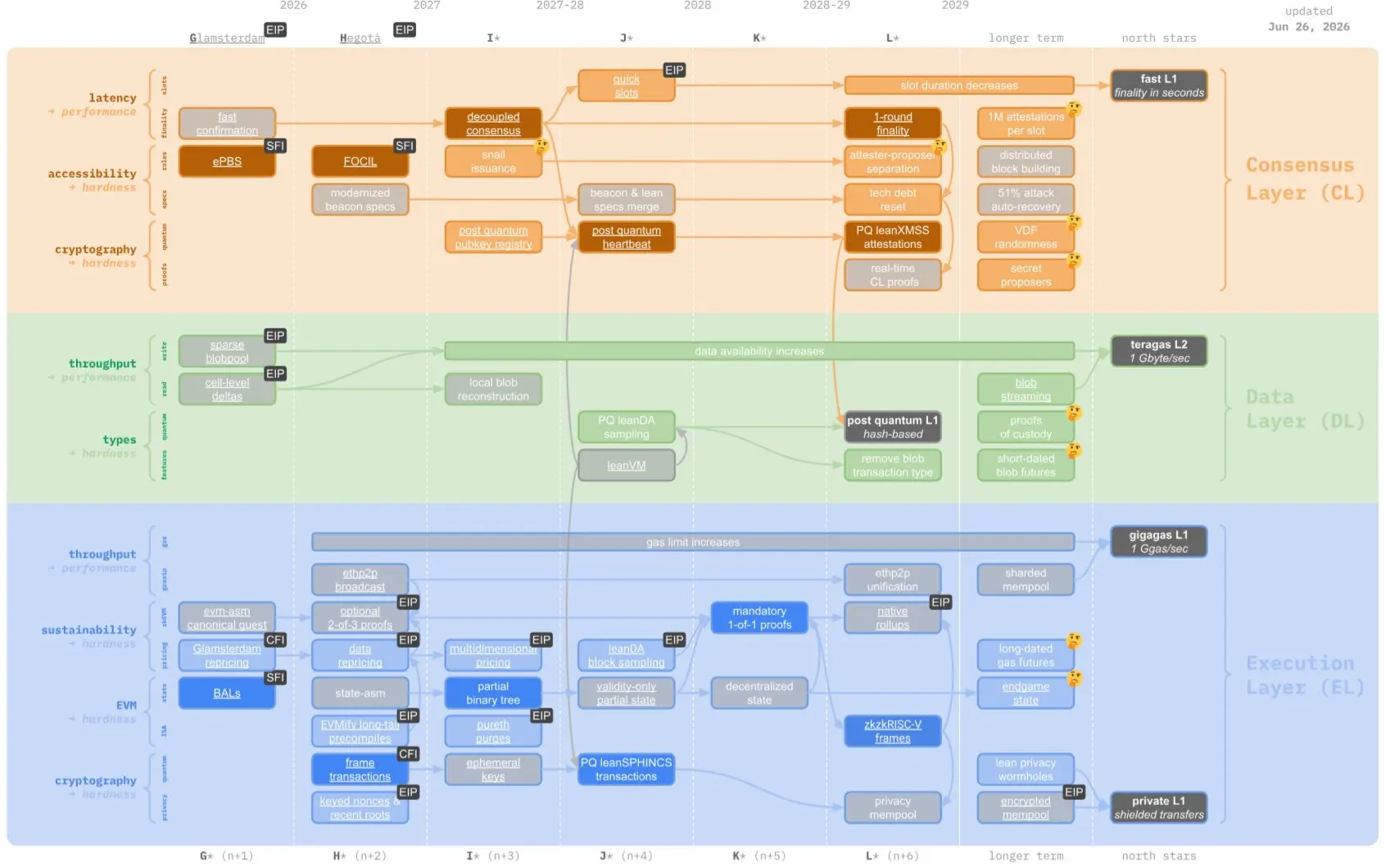
In this vision, five long-term strategic goals are clearly outlined: faster L1 finality, achieving L1 throughput of 1 gigagas (capable of handling tens of thousands of TPS under extreme conditions), L2 scaling with a teragas-level ecological vision, comprehensive defense against quantum cryptography security, and L1 native privacy transactions.
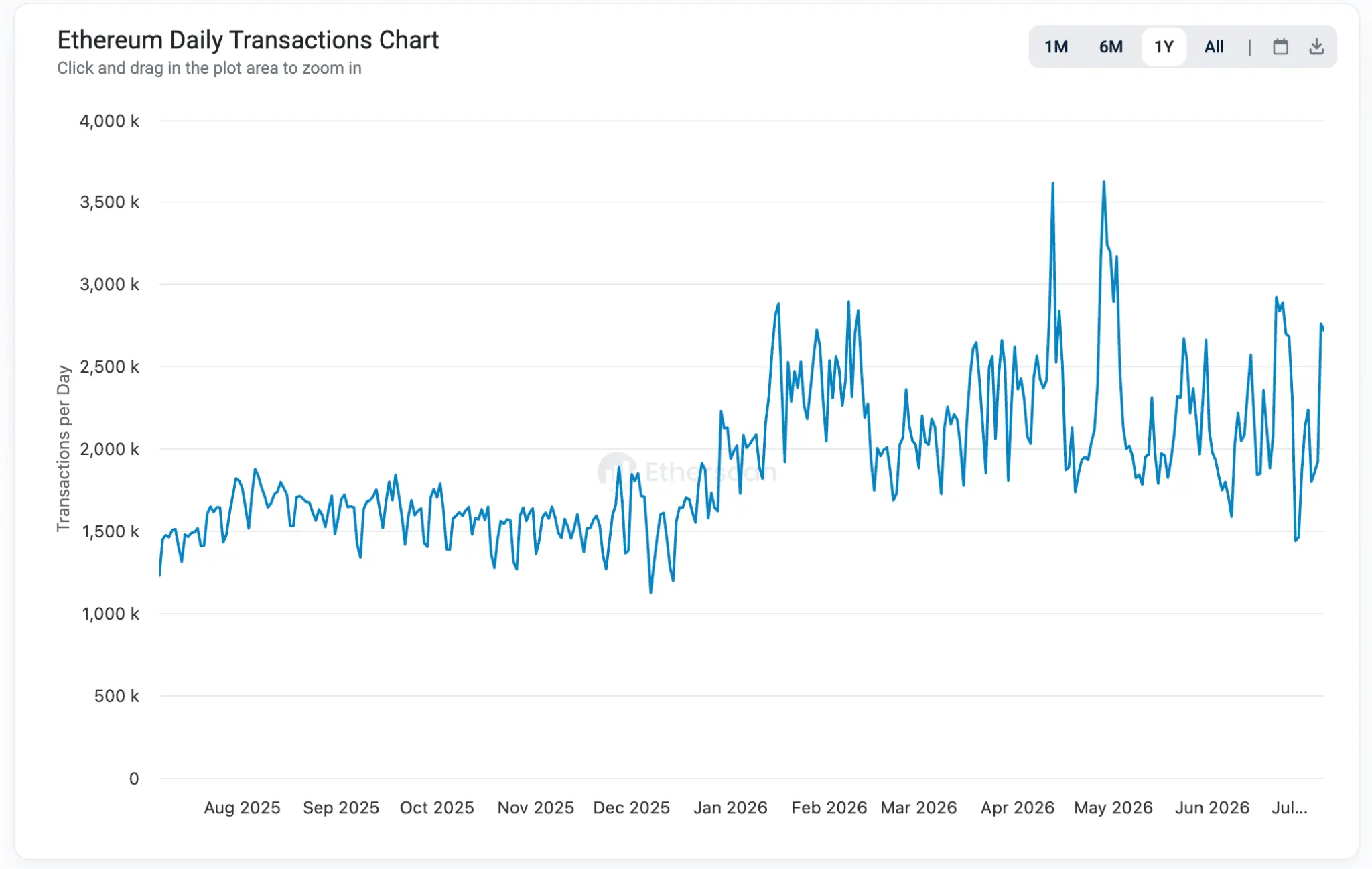
In contrast to the current situation, one can feel the radical nature of these goals. According to Etherscan data, Ethereum L1 currently processes an average of only about 32 transactions per second (approximately 2.7 million daily); the goal of 1 gigagas means that L1's computational capacity will experience a several hundred-fold explosion. It is worth noting that on-chain demand for L1 has actually been in a growth channel over the past year: daily transaction volume has rebounded significantly from 1.4 million in mid-2025, stabilizing between 2 million and 2.9 million for most of 2026, and even approaching 3.6 million during the market peak in April and May. The launch of this roadmap is precisely to address this recovering demand for on-chain activity.
The timeline is also clearly marked, with the second upgrade scheduled for 2026, Hegotá, likely being Ethereum's last "pre-Lean era" hard fork. Every subsequent upgrade, in theory, will be part of this restructuring. The upcoming Glamsterdam upgrade is expected to bring a significant increase in gas limits; this upgrade was originally anticipated to start in the first half of 2026 but has yet to go live.
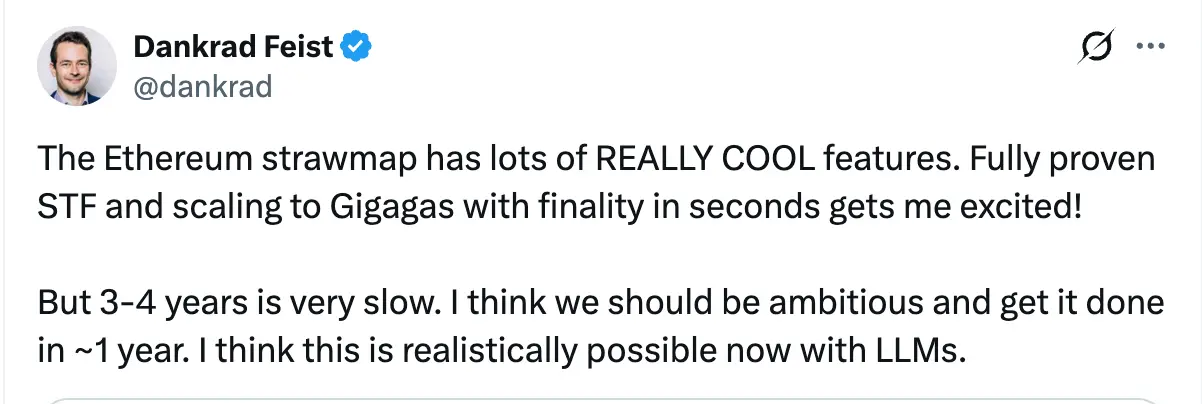
The timeline has also become one of the most concentrated discussion points since the roadmap was announced. Former core researcher of the Ethereum Foundation and proposer of the Ethereum Danksharding plan, Dankrad Feist, stated on X that he supports this strawmap, but the three to four-year timeline is indeed too slow, suggesting that with current large language model technology, this upgrade should be completed within a year.
Major Core Technology Upgrades: Proved Verification and State Restructuring
The technical core of Lean Ethereum is fundamentally changing the verification model. Currently, Ethereum's security model requires each node to re-execute every transaction to confirm the state is correct. The new design incorporates recursive STARK proofs as a native core component of the protocol: a single prover performs the heavy computation, while all other nodes only need to verify a streamlined mathematical proof.
This choice also corresponds to another issue: STARK uses hash cryptography and currently has no known quantum attack vectors, while Ethereum's existing signature scheme has related risks. Vitalik stated that the priority for quantum security has been "significantly raised," with the roadmap planning to gradually replace all quantum-vulnerable components with Winternitz signatures, with the most urgent task being to find a quantum-safe design for the blobs that L2 relies on to reduce fees.
The consensus layer is also within the scope of changes. Currently, Ethereum transactions go on-chain in just a few seconds, but finality takes about fifteen minutes. The new design separates "continuous block production" and "finality" into two distinct processes, aiming to achieve finality with one to two rounds of validator voting, compressing the fifteen minutes to near real-time. Additionally, there will be multi-dimensional gas pricing, meaning that different resources such as computation, storage, and data transmission will be priced separately, similar to how water and electricity are billed separately, rather than all being lumped together.
Changes to the state architecture directly affect application developers. The state can be understood as Ethereum's real-time ledger, recording all account balances and smart contract data. This ledger will only grow thicker over time, and currently, all full nodes must maintain a complete copy, leading to high on-chain storage costs.
Vitalik's proposal is to structurally layer the storage architecture: the existing fully functional "Dynamic State (Core Essence Zone)" will be strictly limited to a hardware threshold of 2 TB to prevent unlimited expansion; at the same time, the protocol will open a new "New State Storage Layer (Large Warehouse)" with a capacity of up to 100 TB, which is more scalable. In Vitalik's envisioned scenario for 2030, most tokens (ERC-20), NFTs, and regular DeFi applications, if willing to rewrite contracts to move into this new architecture large warehouse, are expected to see transaction fees drop by more than ten times. The protocol layer does not force or subsidize this; it simply places the significant two-layer price difference there, allowing the market to decide when to migrate.
The status of privacy has also been redefined. In the past, Ethereum's division of labor was: everything on-chain is public and transparent, and users wanting privacy had to find third-party privacy protocols themselves. Vitalik wrote this time, "Privacy is no longer an afterthought, it is a first-class goal," meaning that privacy has shifted from being "installed by the residents themselves" to "a part of building regulations": every new component of the protocol will be examined during the design phase for whether it can support low-cost, intermediary-free, and quantum-resistant privacy features. However, whether this can be achieved remains to be verified, but the evaluation criteria have already been written into the roadmap.
Controversy Over EVM Replacement: The Game of L2 Ecology
The engine that Ethereum has used for the past decade is called EVM, around which all contracts, development tools, and programming languages have been built. Now, Vitalik proposes to replace this engine, with reasons related to the earlier STARK: generating mathematical proofs for transactions is costly using EVM, and switching to an engine that is more friendly to proofs would be much cheaper.
The candidates he named are two architectures, RISC-V and leanISA, with the ideal outcome being that the new engine becomes the core of the protocol, while EVM becomes a translation layer: old contracts can still run, but the underlying instructions will first be translated into commands that the new engine can understand before execution. Changing the engine is relatively more complex, so this proposal has faced ongoing controversy since Vitalik first introduced the RISC-V concept in April 2025.
The core developer behind L2 Arbitrum, Offchain Labs, publicly advocated last November that another architecture, WebAssembly (WASM), is a better choice, but WASM was not included in the candidate list Vitalik provided this time. Why is this important? Because Arbitrum is one of the largest L2s on Ethereum, and its contract technology, Stylus, is built on WASM.
It can be understood this way: if L1 changes its engine, it is equivalent to redefining the "plug specifications" for the entire ecosystem; if your devices happen to use the same type of plug, they can be used directly; if not, you will have to spend money to make an adapter. Who is selected on the list determines which L2's past investments can seamlessly connect to the future L1 and which will incur adapter costs.
Ethereum does not have a voting mechanism to resolve such differences; whether to change and to whom it should change ultimately depends on the rough consensus of developers at the All Core Devs meetings and whether various client teams are willing to implement it. As of now, changing the engine remains a long-term goal mentioned by Vitalik, and there has been no formal conclusion from developer meetings.
Will the Roadmap Affect ETH Prices?
Mapping the technical roadmap to ETH prices can correspond to two temporal levels.
The first level is the mechanism of transmission path. Since EIP-1559, the base fee for each transaction on Ethereum is burned, and the scale of L1 transaction activity directly affects the supply dynamics and settlement value of ETH. According to this mechanism, if the gigagas target is achieved and L1 transaction volume rebounds with increased throughput, gas consumption and destruction will amplify in sync; this is the most direct transmission path between the roadmap and ETH pricing. However, it is important to emphasize that this path is valid only if "demand returns after capacity increases"; capacity itself does not automatically create demand.
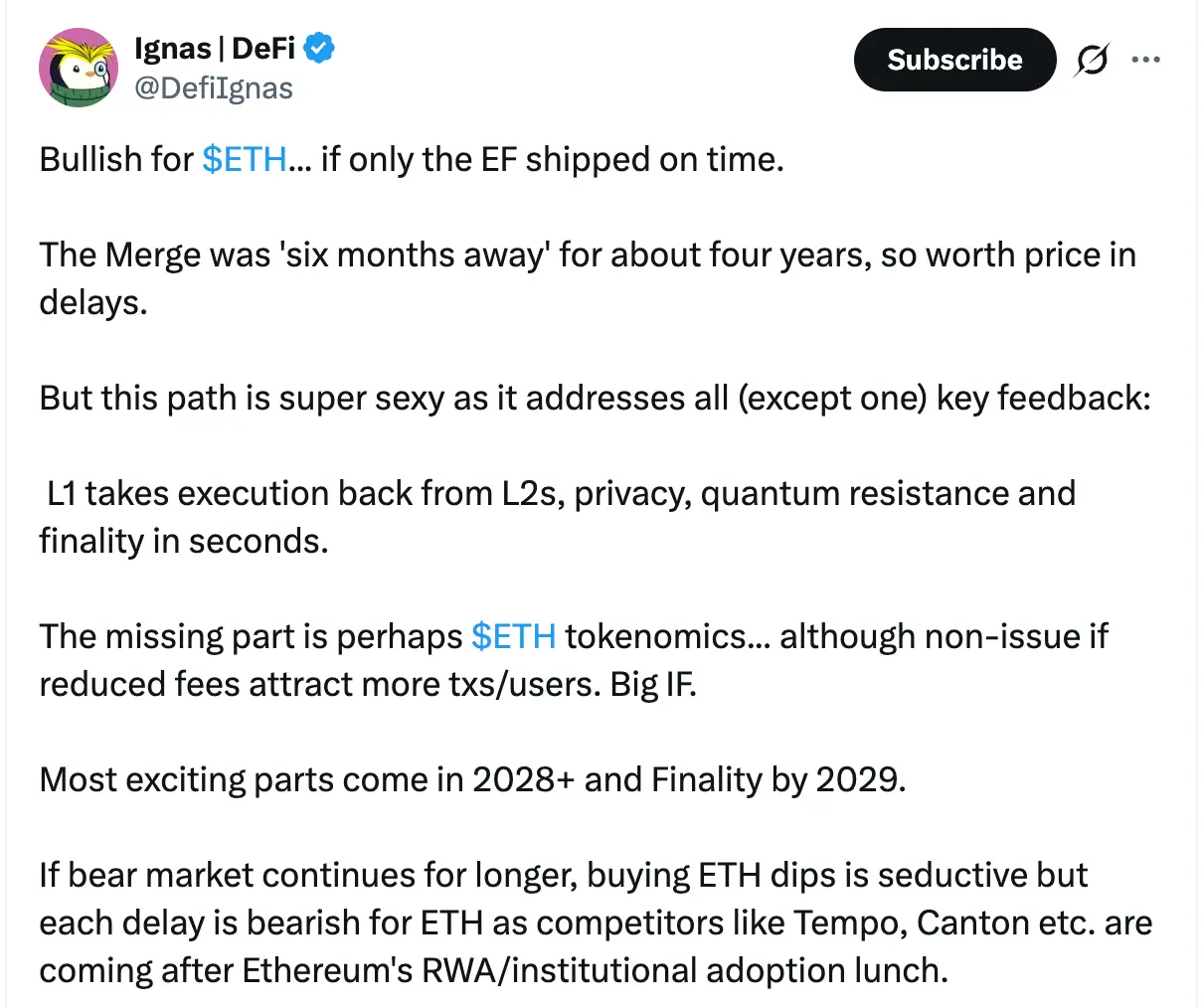
The second level is the time lag. The roadmap outlines a phased engineering project over three to four years; within 2026, this roadmap will not change any current state of Ethereum; it is a directional commitment, and Ethereum's directional commitments have a record of delays in the timeline, with the Merge itself being several years later than initially estimated. In other words, this roadmap raises Ethereum's long-term capacity ceiling but does not address the mid-term value capture issue of ETH; analyst Ignas's criticism of the roadmap points precisely to this, as it does not cover adjustments to ETH's own token economics.
Observation Checklist for the Next Decade
After consolidating the previous content, the final answer actually points to the same structure: this strawmap raises Ethereum's long-term ceiling but does not immediately solve the mid-term value capture issue of ETH; now is not the time to FOMO based on the roadmap.
Rather than pricing the roadmap itself, a more actionable approach is to track several nodes that can be tested in the near term:
Whether the Glamsterdam upgrade can be successfully launched and complete the gas limit increase
Whether blob demand can continue to grow with L2 activity
Whether L1 fee revenue and ETH destruction can improve
Whether L2 growth can feedback to L1 through blob payments and settlement demand
Whether the relative performance of ETH against BTC can recover
These indicators correspond to various aspects of the roadmap and can be verified weekly on public dashboards such as Etherscan's chart page and DefiLlama; any change in any of these will be closer to pricing basis than the roadmap document itself. Any change will tell the market earlier than the roadmap document itself whether this three to four-year restructuring is being realized or postponed.
 Risk warning