The survival dilemma of small and medium-sized exchanges behind the withdrawal anomalies of AscendEX
 Core Viewpoint

 Living space is constantly being compressed.
Author: momo, ChainCatcher
Another small to medium-sized cryptocurrency exchange has been reported for withdrawal issues.
ZachXBT recently issued a community alert on platform X, stating that the centralized exchange AscendEX (formerly Bitmax) has been reported by multiple users for experiencing withdrawal delays ranging from several days to weeks, or even being unable to process withdrawals.
Feedback from Reddit, X, and other communities indicates that since early June, many users' withdrawal requests have been stuck in the "Initiating" status for extended periods. Some users have reported waiting for one to two months. More critically, these withdrawal requests have not generated on-chain transaction hashes (TXID), which typically means the transactions have not actually been sent to the blockchain network.
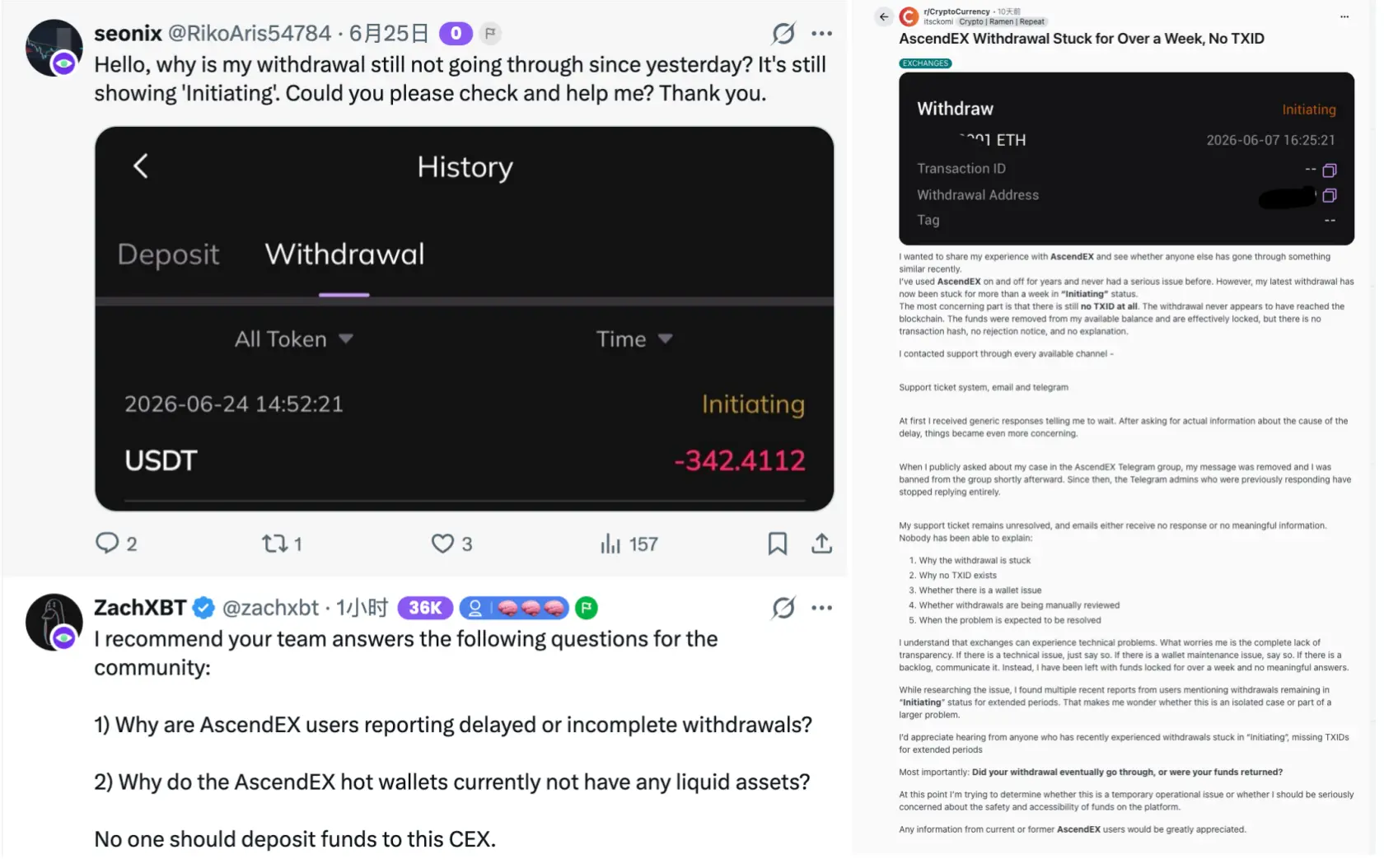
From user feedback, it appears that the affected assets are not limited to a single type. Mainstream assets such as ETH, USDT, and PAXG have all experienced similar issues. Several users have stated that funds have already been deducted from their account balances, but customer service has been unable to explain why the withdrawals have not been executed, only responding with template messages like "please be patient" and "submitted to the technical team."
ZachXBT noted that upon checking the known hot wallets of the exchange through Arkham and TRM, it was found that its reserves lack mainstream high market cap tokens such as ETH, USDT, and SOL, which may indicate liquidity issues.
Recently, multiple users have continued to inquire in the official X comment section of AscendEX about when withdrawals will be restored, but as of the time of publication, AscendEX has not issued a formal statement regarding the recent large-scale withdrawal delays, nor has it explained the cause of the issues or the expected recovery time. The latest updates from its official X account date back to June 23.
AscendEX was hacked, losing $78 million
For many new users, AscendEX may seem somewhat unfamiliar.
Its predecessor was BitMax, founded in 2018 by two founders with backgrounds in quantitative trading on Wall Street. During the last bull market, the platform quickly accumulated users through products like trading mining and leveraged trading, and in 2021, it completed a brand upgrade, renaming itself AscendEX. In the same year, it also secured $50 million in Series B funding with participation from institutions including Polychain Capital and Hack VC.
However, shortly after the funding was completed, AscendEX encountered the most severe security incident since its establishment.
In December 2021, the exchange's hot wallet was hacked, resulting in the theft of assets from multiple networks including ETH, BSC, and Polygon, with losses amounting to approximately $78 million. Subsequently, several on-chain security agencies attributed the attack to the North Korean hacker group Lazarus Group. AscendEX stated at the time that it would bear all losses and that user assets would not be affected, and the platform eventually resumed normal operations.
More concerning than the security incident itself is the platform's transparency.
In recent years, following the collapse of FTX which prompted the industry to strengthen asset transparency, leading exchanges like Binance and OKX have successively published reserve proofs and regularly undergone third-party audits, allowing users to verify the platform's asset reserves.
In contrast, AscendEX has yet to continuously publish similar reserve proofs and lacks records of regular comprehensive third-party security audits. AscendEX's transparency rating on RootData is 46%, classified as C-level, indicating low transparency.
As recent withdrawal delays have continued to escalate and the community has begun to question liquidity, the low transparency has made it even more difficult for the market to independently assess the platform's current financial situation, further amplifying external concerns.
Behind withdrawal anomalies and frequent closures: The survival dilemma of small to medium exchanges
In the past year, several small to medium-sized cryptocurrency exchanges have faced difficulties with withdrawals, suspended operations, closed businesses, or exited the market entirely.
In 2025, XeggeX filed for bankruptcy after suffering a hack; Bibox has been mired in a trust crisis due to prolonged withdrawal delays and liquidity exhaustion. In February of this year, digital asset trading company BlockFills announced a suspension of customer deposits and withdrawals due to losses of approximately $75 million and sought to sell the company; in April, Websea also drew community attention due to withdrawal difficulties (and subsequently announced a gradual restoration). Additionally, Bit.com announced a phased shutdown plan at the end of last year, exiting the exchange business.
Although the reasons for these platforms' issues are not entirely the same, they may reflect a common trend: the survival space for small to medium exchanges is continually being compressed.
On one hand, new narratives such as ETFs, stablecoins, and tokenized securities are driving the industry towards institutionalization and compliance, with more funds and users concentrating on leading platforms; on the other hand, the cooling of altcoin trading, reduced income from listing fees, and ongoing competition in trading fees are posing increasing challenges to the business models that small to medium exchanges rely on for survival.
For ordinary users, these cases may serve as a reminder that paying attention to a platform's reserve transparency, risk control capabilities, and decentralized custody risks is always more important than seeking redress after the fact.
 Risk warning