Major Changes in Exchange Listings
 Core Viewpoint

 Currently, most major exchanges have entered a state of "more delistings than listings."
Author: Hu Tao, ChainCatcher
The cryptocurrency exchange listing ecosystem in 2026 is undergoing an unprecedented structural reshaping. On one side, the issuance of crypto-native tokens has plummeted sharply, leading major exchanges into a state of "more delistings than listings," with DeFi coins, GameFi, and other once-popular categories being batch delisted; on the other side, traditional financial assets such as stock perpetual contracts and stock spot trading are rapidly expanding across major trading platforms, becoming a "second growth curve" to fill product gaps and attract new users.
I. Dramatic Decline in Listing Frequency
The significant shrinkage in new coin supply is the core underlying reason for the decline in listing frequency on exchanges. When primary market financing cools and quality project reserves are depleted, the industry faces a common challenge of "no coins to list," leading to a wave of delisting of existing assets across the entire industry.
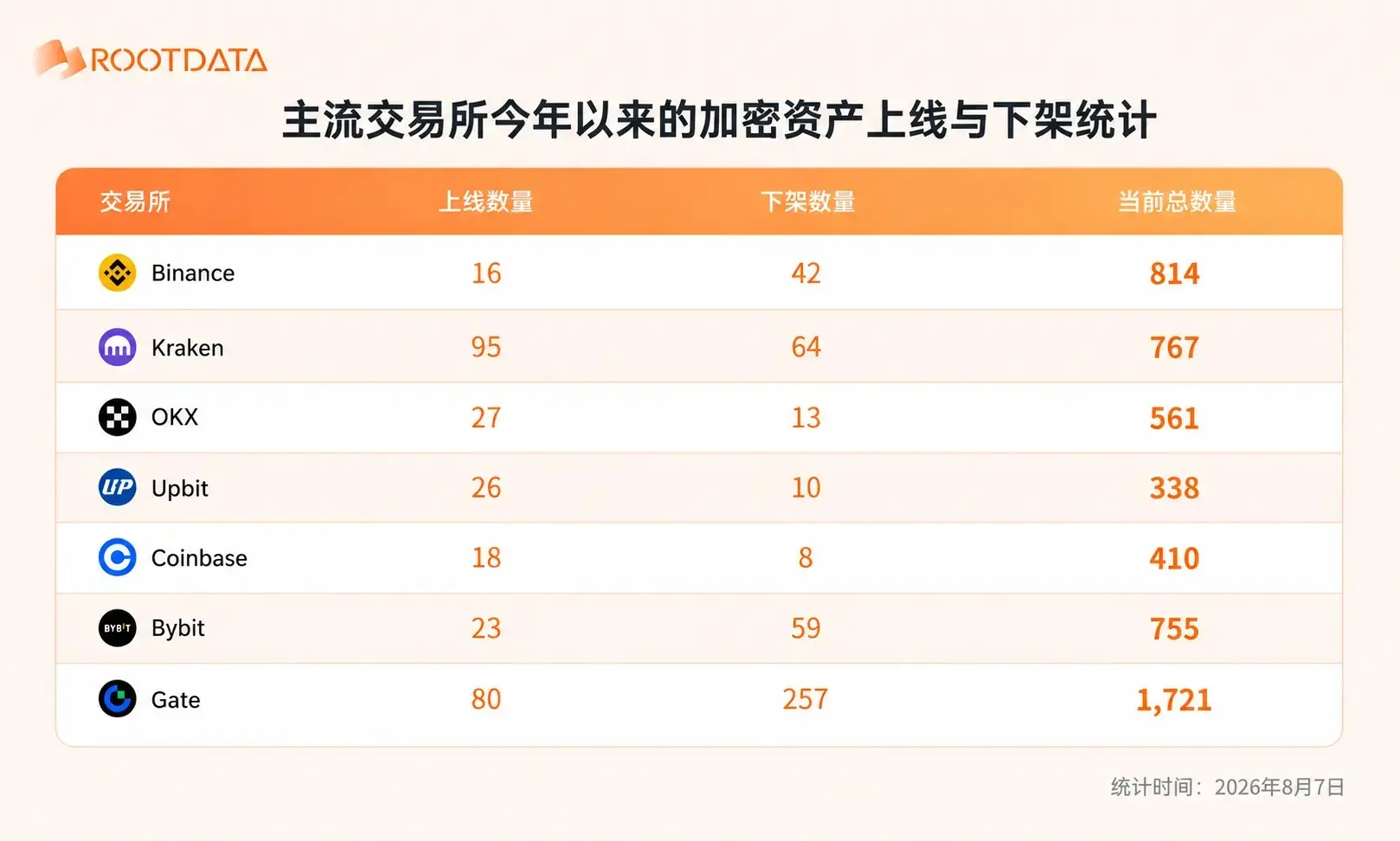
According to statistics from RootData, most major exchanges have entered a state of "more delistings than listings." Among them, Gate has delisted as many as 257 tokens this year, while only listing 80, resulting in a net decrease of 177, making it the platform with the most significant delisting efforts; Binance delisted 42, and Bybit delisted 59, both significantly higher than their respective new listings of 16 and 23; Kraken delisted 64, also in the net delisting range. Only OKX, Upbit, and Coinbase have maintained a positive expansion with more listings than delistings.
This large-scale delisting is not accidental. During the previous bull market cycle, many second-tier exchanges survived by relying on a "massive listing" strategy: by listing hundreds or even thousands of long-tail tokens, they attracted niche community users and speculative funds, creating a superficial trading volume through thin trading depth.
However, entering this bear market, market liquidity has significantly shrunk, with many long-tail tokens dropping over 99% from their peak prices, and trading depth nearly exhausted. The technical costs of maintaining trading pairs and risk control have far exceeded fee income. Batch delisting of low-quality assets and shrinking the spot trading lineup have become practical choices for second-tier exchanges to control costs and avoid risks.
From the current total token supply perspective, among the statistics, Gate still ranks first with 1,721 tokens, while Binance, Kraken, and Bybit maintain scales of 814, 767, and 755, respectively.
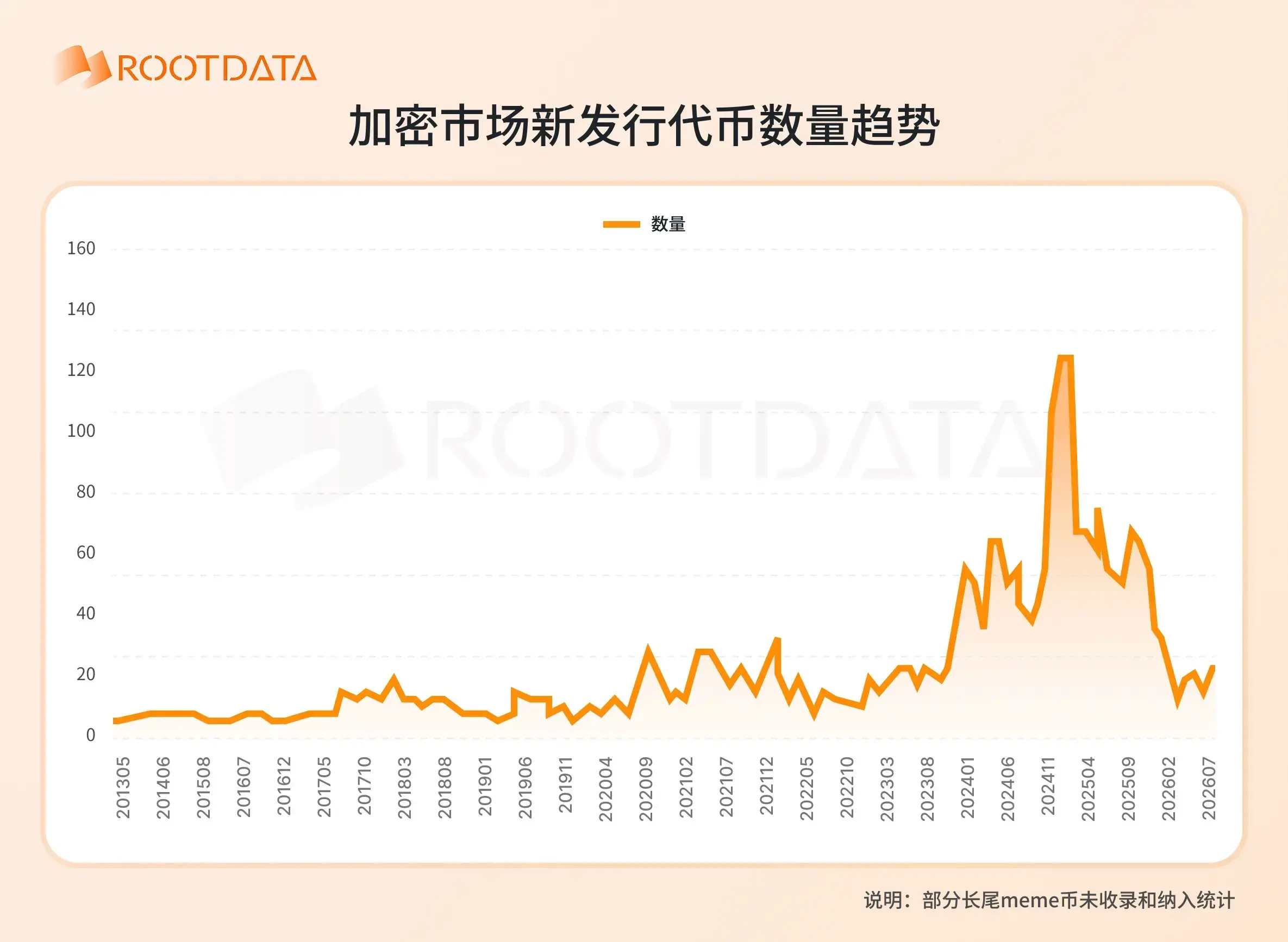
In the context of widespread contraction across the industry, Kraken's performance is particularly unusual. This U.S. exchange, known for its compliance and conservative listing practices, has listed 95 new tokens this year, far exceeding peers like Binance and Coinbase, making it the leading platform in terms of new listings.
This strategic shift may be closely related to its capital market process. The market generally believes that at the critical juncture of its IPO, Kraken has a stronger demand for trading volume, fee income, and performance growth. By accelerating the listing pace and covering more "old coins" and niche asset categories, Kraken aims to enhance platform trading volume and user activity within a compliant framework, providing stronger performance support for its valuation at the time of listing.
In contrast, Binance and Coinbase continue to maintain a relatively restrained listing pace, with only 16 and 18 new tokens listed this year, focusing more on asset quality and compliance risk control; OKX and Upbit maintain moderate expansion, slightly supplementing asset categories while controlling delisting risks. The strategic differentiation among major exchanges essentially reflects survival choices under different compliance environments and development stages.
II. Second Growth Curve: Stock Assets Become New Track for Exchanges
In the context of insufficient supply of crypto-native assets, traditional financial assets, especially stock-related products, are becoming a new battleground for major exchanges, with both stock spot and stock perpetual contracts expanding simultaneously.
In the stock spot trading market, Binance occupies a leading position with an absolute advantage, leading with a comprehensive score of 84.54, and a 24-hour open order book transaction volume of $284 million, capturing a market share of 49.83%, nearly half of the market.

Gate and OKX follow closely, with market shares of 13.27% and 15.36%, and 24-hour transaction volumes reaching $75.67 million and $87.64 million, respectively; Bitget ranks in the second tier with a market share of 7.95%. In terms of asset richness, Gate has over 12,500 real securities, and Kraken also exceeds 11,400, giving them an advantage in coverage breadth.
The competition in the stock perpetual contract space is even more intense. Compared to stock spot trading, stock perpetual contracts present an excellent opportunity for mid-tier exchanges to achieve a breakthrough: on one hand, contract trading inherently carries leverage and allows for both long and short positions, aligning closely with crypto users' trading habits, resulting in very low user migration costs; on the other hand, stock perpetual contracts do not require integration with traditional brokerage clearing and settlement systems, lowering the product launch threshold and allowing for faster iteration, enabling quick responses to market hotspots.

RootData data shows that five exchanges—BingX, MEXC, Gate, Bitget, and Ourbit—have listed over 180 stock perpetual contracts each, ranking among the top five in the industry. During periods of lackluster crypto-native market conditions, contract trading of popular tech stocks like Nvidia and Tesla has become a crucial means to activate user trading enthusiasm and drive platform fee income.
The collective push by exchanges into stock assets is essentially a necessary choice after the peak of incremental growth in the crypto-native space. By introducing mainstream global stock targets such as U.S. stocks, exchanges can fill the product gaps caused by the scarcity of new crypto coins, attract traditional financial users, broaden user boundaries, and achieve a positioning upgrade from "crypto exchanges" to "comprehensive asset trading platforms," while smoothing out performance fluctuations caused by a single crypto cycle.
III. Changes in Wealth Effect: From "New Coin Wealth Creation" to "Diverse Speculation"
The deep-seated shift in listing logic has also completely rewritten the path of wealth effects in the crypto market, marking the end of the once-popular "new coin wealth creation" myth, with the focus of market speculation shifting.
In the past few years, new coin listings were one of the core paths to wealth creation in the crypto market. During the hot phase of the bull market in 2025, the average first-day increase of new coins listed on major exchanges often exceeded 100%, with popular star projects even achieving returns of over ten times, making "snatching primary quotas" and "ambushing listing announcements" the core profit strategies for market participants. However, as the supply of new coins has significantly shrunk, coupled with overall weak market liquidity, the rate of new coin failures has risen sharply, marking the end of the era of wealth creation solely relying on new coin listings.
IOSG Ventures tracked the spot trading of six major exchanges—Coinbase, Binance Spot, ByBit, OKX, Bithumb, and Upbit—from 2026 to mid-May, totaling 207 listing records covering 92 independent tokens. The data shows that, based on average returns 30 days after listing, no trading platform recorded positive returns, with "listing being the peak, and buying leading to losses" becoming the norm in the new coin market.
According to RootData, among new coins that have been traded for at least 30 days this year, only LIT, ZAMA, CAP, BTW, MARSCOIN, and a few others—less than 10 in total—have maintained positive growth, accounting for no more than 8% of all new coins.
In this bear market, new listings no longer signify a universal rise in profits; they have become more of an exit window for early holders—including project parties, institutions, and early players. Listings often serve as a liquidity release window for early holders rather than a starting point for continuous inflow of new funds.
What is even more concerning is that the current market has formed a highly structured and solidified price transmission chain for new listings, with the value discovery cycle of new coins being extremely compressed: Coinbase and Bybit undertake early price discovery, often coordinating positive news to drive up prices in the initial stages of a project; Binance Perps verifies liquidity within a few days, testing the real acceptance strength through the contract market; Binance spot typically confirms after a pullback, completing the credit endorsement of top platforms; while Korean exchanges systematically occupy the high-end acceptance at the end.
A token typically takes just over 20 days to move from its debut to a Korean exchange, with its price generally completing a full cycle. Data confirms this transmission pattern: the peak return at debut is significant (ByBit +86%), the premium for entry into Korean exchanges is high (Upbit +27.4%) but the 30-day decline is the deepest (-25.7%). Behind this is a standardized exit path in the primary market: early funds complete most of their sales during the debut phase, and by the time the token lands on top exchanges and the Korean market, the chips have gradually shifted to retail investors, leading to inevitable price declines due to a lack of new funding support.
At the same time, the introduction of stock assets has brought a new paradigm of wealth effects to the market. On one hand, mainstream U.S. stocks like Tesla, Nvidia, and Apple have mature fundamental pricing logic, with relatively controllable volatility, providing crypto users with low-correlation asset allocation options, enriching the risk resistance of investment portfolios; on the other hand, the leveraged trading attributes of stock derivatives also continue the high-speculation characteristics of the crypto market, becoming an important supplement for traders to seek profits during periods of lackluster crypto-native market conditions.
Conclusion
From the batch delisting of crypto-native tokens to the collective expansion of stock assets; from the "broad net" quantity expansion to structured exit transmission; from the era of wealth creation through universal new listings to the bear market norm of stock speculation, the changes in the listing landscape of exchanges reflect the cyclical transformation of the entire crypto industry.
As the supply dividend in the primary market fades, the rough growth model relying solely on the expansion of listing quantities is becoming unsustainable. Refined asset selection, diversified category layouts, and compliant product designs will become the core of competition for exchanges in the next phase.
 Risk warning