The pioneer of perpetual contracts, BitMEX, waited for buyers for more than a year but ultimately shut down
 Core Viewpoint

 The liquidity collapse came first, followed by a heavy regulatory blow, and even Trump's pardon couldn't save this business.
Author: Zhou, ChainCatcher
On July 23, the veteran cryptocurrency exchange BitMEX announced its shutdown.
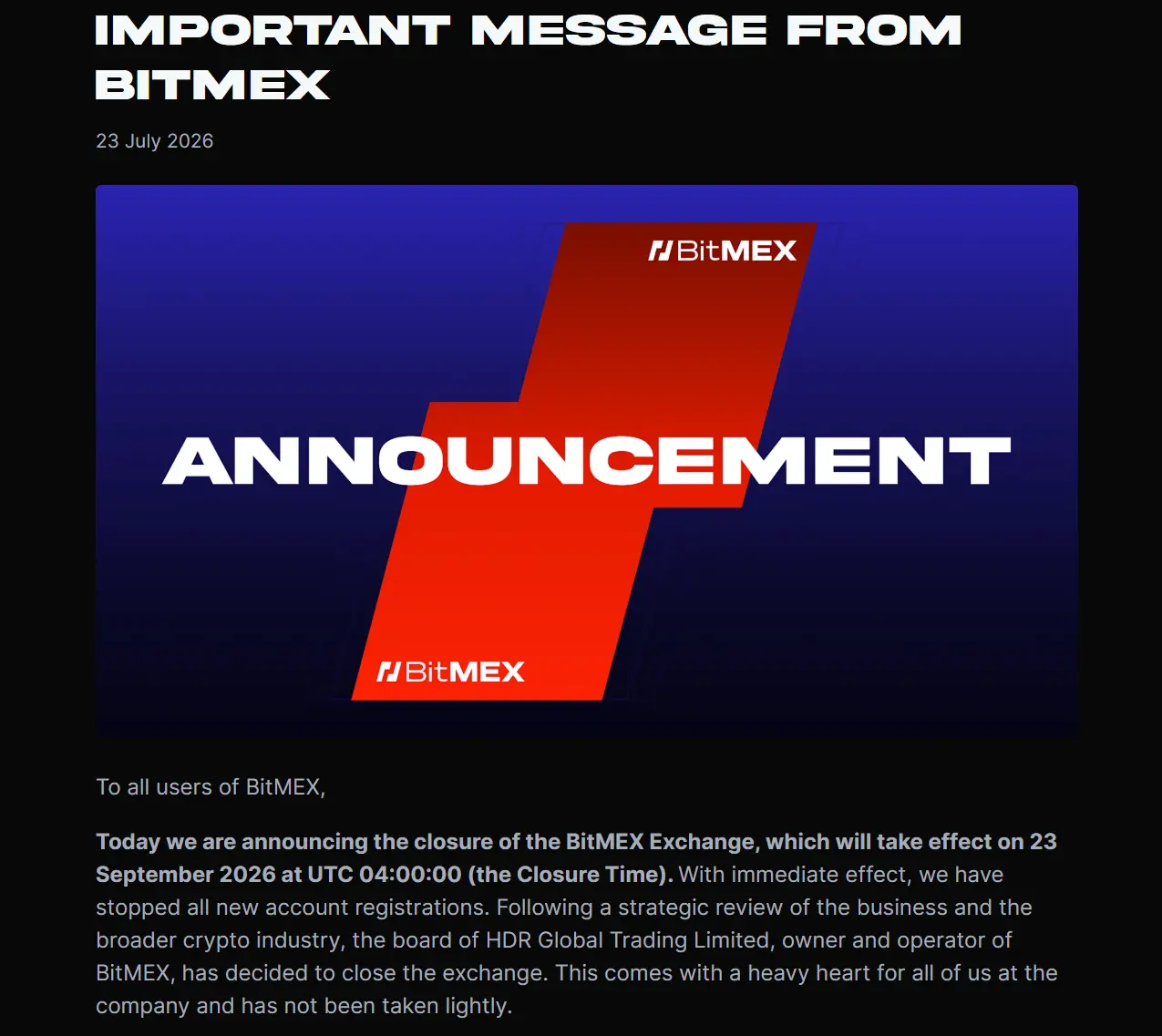
According to the official announcement, the timeline is divided into three phases:
- Immediately upon the announcement, BitMEX will stop all new user registrations, while existing trading functions will remain normal.
- Starting from August 26 at 04:00 UTC, the platform will impose risk limits, allowing users to only reduce positions and not establish new ones. From this point until the closing date, BitMEX will actively force liquidate existing positions to ensure an orderly exit from the market.
- The official closing time is September 23 at 04:00 UTC, at which point all remaining open positions will be forcibly liquidated. BitMEX states that the liquidation operations will be at the platform's discretion and will not be responsible for any trading losses incurred by users during this period due to their inability to liquidate positions themselves.
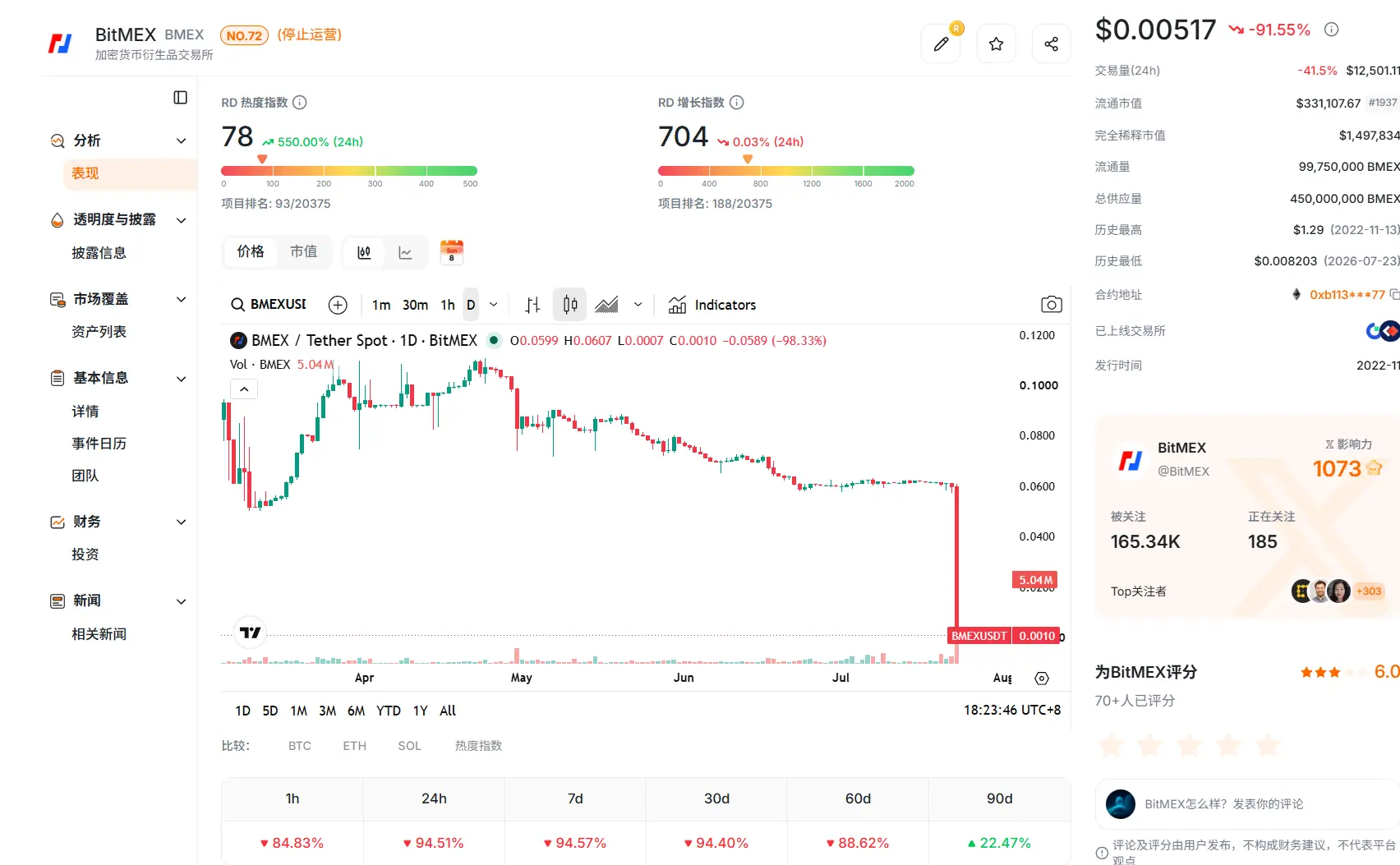
According to RootData market data, the BMEX token dropped approximately 94.51% within 24 hours after the announcement, with the price falling from $0.06068 to $0.00517, setting a historical low. Compared to the high of $1.29 reached in November 2022, the decline is 99.8%.
The sale process lasted a year and a half, ultimately failing to attract buyers
The announcement did not provide specific reasons for the shutdown, only stating that the board of HDR Global Trading made the decision after reviewing its own business and the entire cryptocurrency industry.
Connecting the publicly available information from the past year, the causal chain becomes clearer.
According to public information, BitMEX had hired boutique investment bank Broadhaven Capital Partners to handle the sale process as early as the end of 2024, at which time no buyer had been determined. This process has never publicly concluded with a transaction.
About three weeks ago, BitMEX replaced its CEO Stephan Lutz, CFO Ina Steiner, and Chief Growth Officer Raphael Polansky, with Peter Wilkinson, who previously served as Global General Counsel and COO, taking over as CEO.
The industry interpretation at that time was that the platform was cutting management costs to enhance its attractiveness in potential transactions. In hindsight, this was more like the first step in a liquidation process.
Liquidity collapse and regulatory blows
BitMEX's market position once faced few rivals; it pioneered Bitcoin perpetual contracts, launching the XBTUSD in May 2016, which eliminated expiration dates and anchored to spot through funding rates, offering up to 100x leverage.
According to a 2019 report by Bitcoin Magazine, BitMEX held about 53% of the cryptocurrency derivatives market share at that time, with the second-ranked Huobi DM at about 16% and OKEx at about 12.5%.
The turning point came on March 12, 2020, when Bitcoin's price fell uncontrollably, dropping nearly 50% within 24 hours. A chain of forced liquidations created positive feedback on BitMEX, with the liquidation engine flooding the already thin order book with sell orders, breaking through buy orders.
The platform experienced two service interruptions on March 13, which BitMEX initially attributed to hardware issues with its cloud service provider, but later confirmed that both interruptions were caused by distributed denial-of-service attacks.
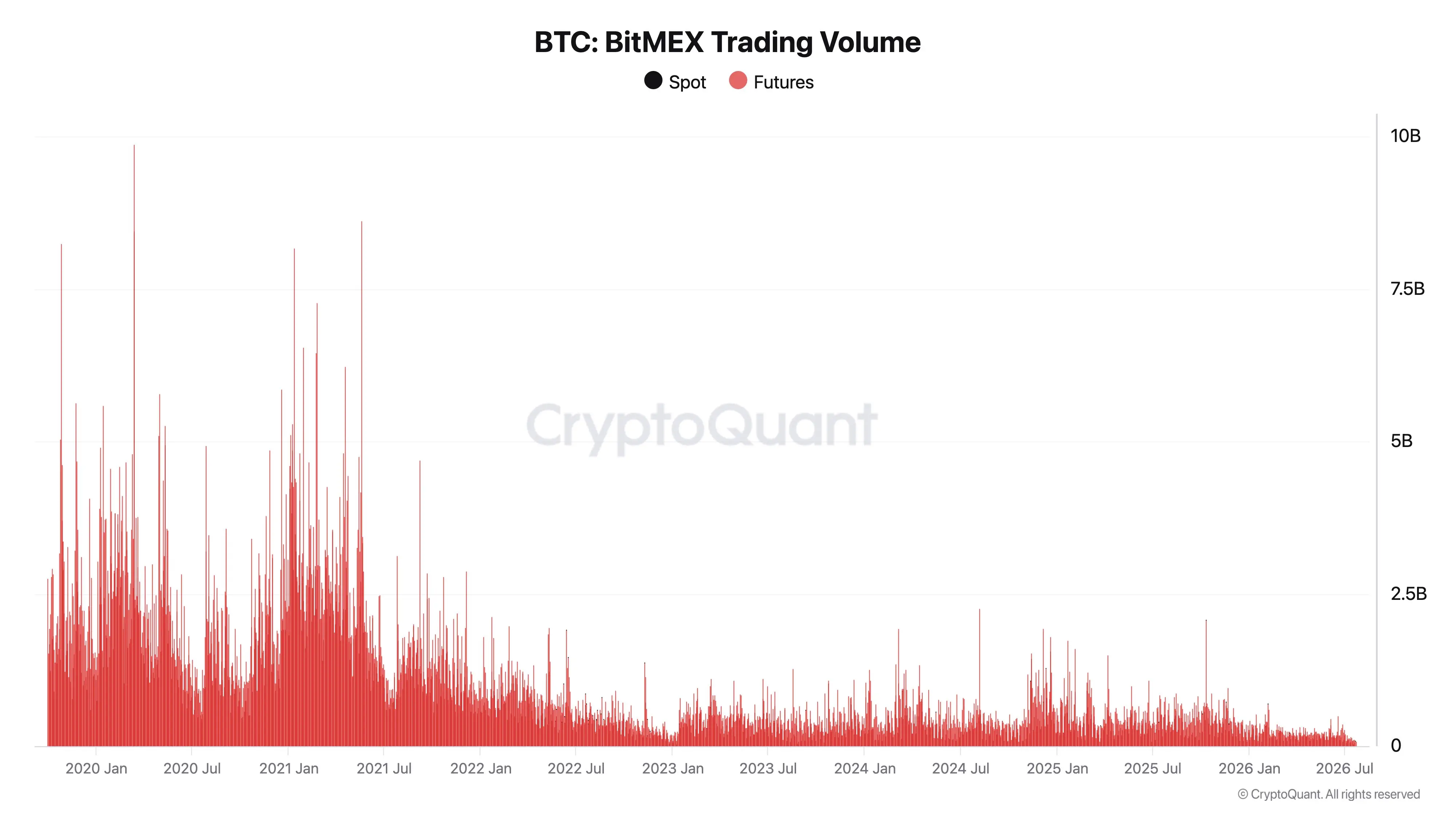
The market subsequently believed that this downtime interrupted the downward spiral, but the cost was that the trust of market makers and large traders in the platform's matching ability was shattered. Liquidity migrated to Binance Futures, Bybit, OKEx, and the then FTX over the following weeks, and did not return.
The exchange's moat was built on liquidity; once depth is transferred, even if the original platform resolves technical issues, it cannot bring back the trading habits that have already formed. Over the next six years, BitMEX launched spot trading, copy trading, trading bots, and TradFi perpetual products, all in an attempt to reverse an irreversible process.
Moreover, regulatory blows followed closely behind the liquidity collapse.
On October 1, 2020, the CFTC filed civil charges, and the Southern District of New York's Attorney's Office simultaneously filed criminal charges, with the core accusations being operating a derivatives platform without registration and violating the Bank Secrecy Act by failing to establish effective anti-money laundering and KYC systems.
The prosecution alleged in documents that BitMEX effectively operated as a money laundering platform, and its claim of exiting the U.S. market was not true.
CTO Samuel Reed was arrested in Massachusetts, and the founding team subsequently exited management.
The legal tail dragged on for four and a half years. In August 2021, BitMEX reached a $100 million settlement with the CFTC and FinCEN. In 2022, the three founders Arthur Hayes, Ben Delo, and Samuel Reed each pleaded guilty and paid fines of $10 million.
HDR Global Trading pleaded guilty on July 10, 2024. According to the U.S. Department of Justice, Federal Judge John Koeltl of the Southern District of New York sentenced the company to a $100 million fine and two years of probation on January 15, 2025, with total fines exceeding $200 million.
Subsequently, mandatory KYC was implemented, and the original advantage of anonymous account opening disappeared.
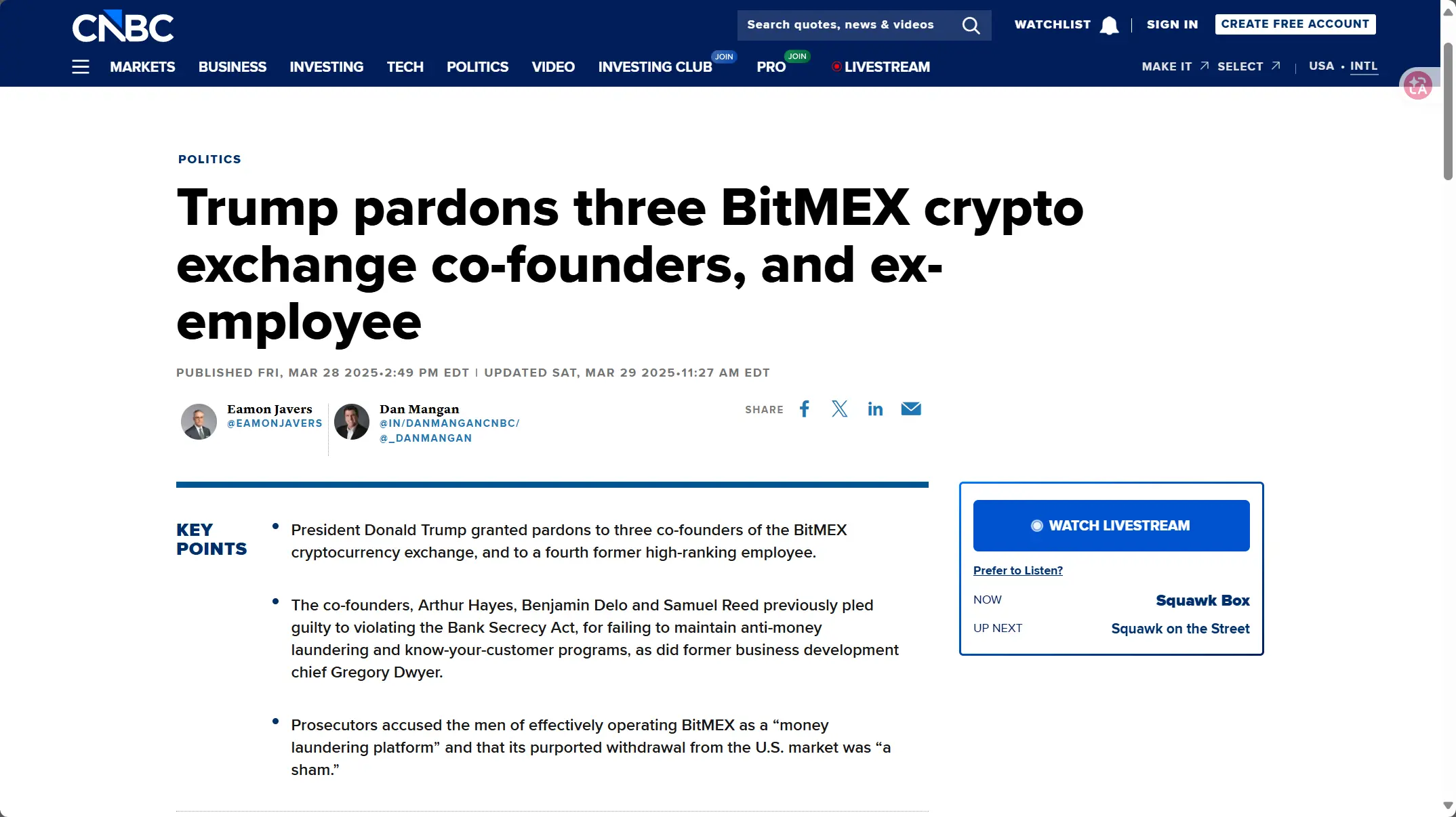
A turning point appeared two months later. According to CNBC, Trump pardoned the three co-founders Arthur Hayes, Benjamin Delo, Samuel Reed, and former senior employee Gregory Dwyer on March 27, 2025, while also pardoning HDR Global Trading, the company holding BitMEX, marking the first corporate pardon of his second term.
CoinMarketCap's latest data shows that BitMEX ranks 50th among derivatives exchanges, with approximately $177 million in open contracts and about $120 million in 24-hour trading volume.

According to CryptoQuant founder Ki Young Ju, BitMEX's Bitcoin futures trading volume yesterday was $84 million, accounting for only 0.08% of the entire market.
Perpetual contracts have been legalized, but the inventors are exiting
It is worth mentioning that besides the perpetual contracts themselves, funding rates, mark prices, and automatic liquidation mechanisms were also introduced by BitMEX and remain common components of risk control for contracts across exchanges.
Ten years later, this product has been legalized in the U.S.
On May 29, the CFTC officially approved KalshiEX to list Bitcoin perpetual contracts BTCPERP, and on the same day issued a no-action letter to Coinbase Financial Markets, recognizing its clients' access to Deribit perpetual contracts as offshore futures.
The current weight of this product can be seen from the reactions of traditional exchanges. According to Reuters, CME sued the CFTC on June 18, seeking to revoke the approval from May 29. After the approval, the stock prices of CME, Cboe, and ICE collectively dropped by over 10%.
In ten years, perpetual contracts have completed the journey from offshore gray areas to being legally classified by Chicago exchange giants suing regulatory agencies. The trading volumes have been taken over by Binance, Bybit, and Hyperliquid, now also including Kalshi and Coinbase (reportedly, Kalshi's crypto perpetual contracts have exceeded $8.5 billion in trading volume within weeks of launch).
Yet the platform that originally invented it announced its closure two months later. As former OKX listing business head Charles stated, the era of BitMEX has actually long ended; it defined the previous generation of crypto derivatives trading, but it was the later batch of Chinese exchanges that took operations and product iteration to the extreme.
This also explains why the sale process lasted over a year without any takers. The rights to invention, brand, technology stack, and licenses are still there, but liquidity is absent, and what buyers truly want to purchase may only be the latter.

 Risk warning