When Nvidia in Bitget starts paying dividends, the US stock market enters a Reality moment
 Choosing the difficult path is not because they enjoy suffering, but because the easy path cannot take them to where they want to go.
Author: David, Trend Research
Tokenizing U.S. stocks is one of the fastest-growing sectors in the crypto industry over the past two years, and it is also one of the most criticized sectors.
What are the criticisms? It is criticized as a shell.
For example, if you spend 100 USDT to buy a token called NVDA, you might think you own a small piece of Nvidia stock. In reality, what you receive is likely just a shadow that follows the stock price. There are no real stocks underlying it, no dividends, and no rights that any stock should have.
Yet, this criticized sector has become a trend in this version of the crypto industry.
Among them, one exchange has produced a set of numbers that are hard to ignore.
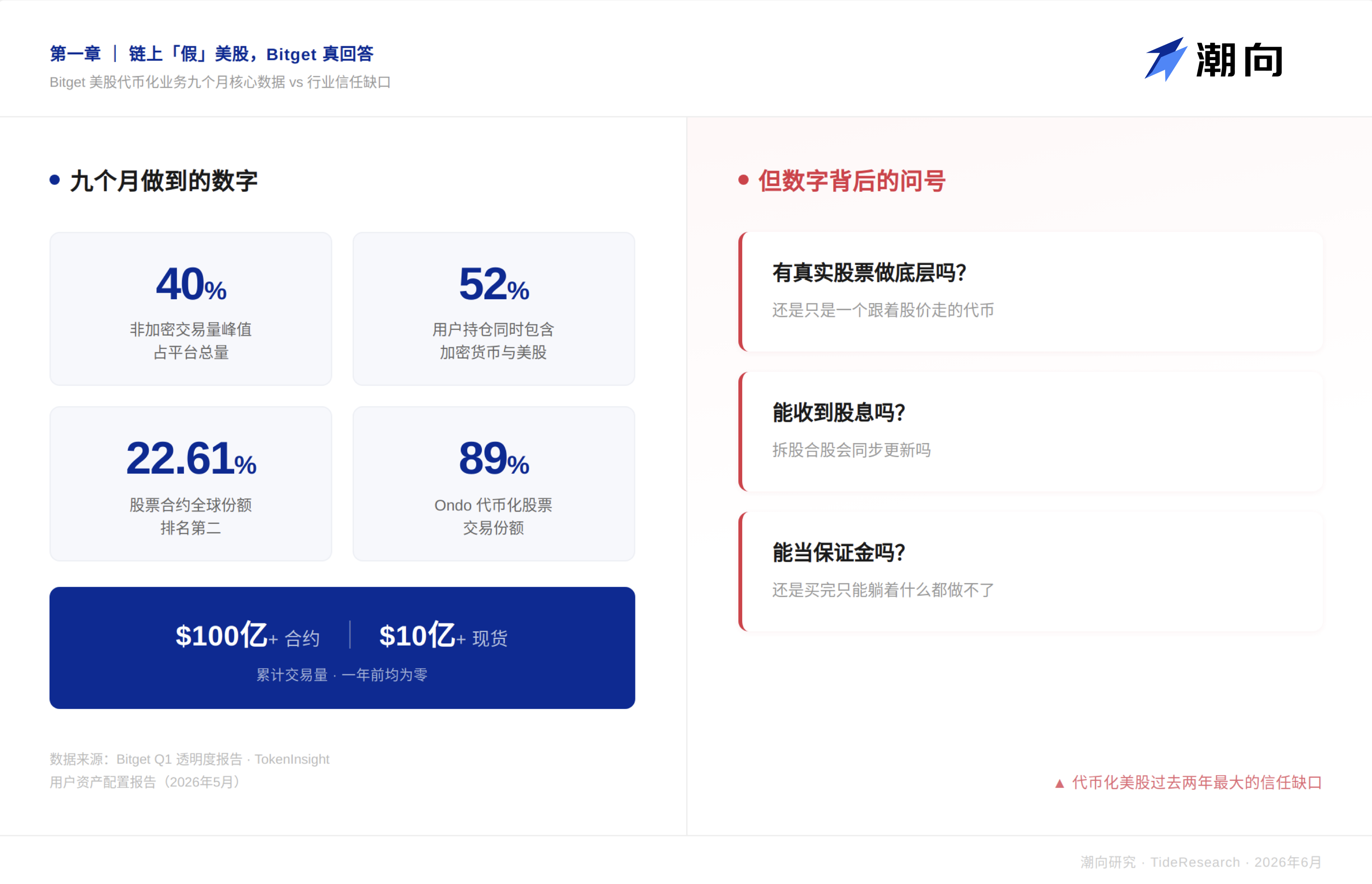
According to Bitget's Q1 2026 Transparency Report, the peak trading volume of non-crypto assets currently accounts for 40% of the platform's total volume. Stocks, gold, foreign exchange—these items that should appear in brokerage apps now see a significant portion of trading happening on crypto exchanges.
TokenInsight's Q1 report on the contract market provided another reference point, showing that Bitget's stock perpetual contracts rank second globally, with a market share of 22.61%.
Additionally, among the tokenized stocks issued by Ondo, Bitget accounted for about 89% of the trading volume. The cumulative trading volume of stock futures has exceeded $10 billion, and spot trading has surpassed $1 billion.
Now, looking at the user side.
According to the user asset allocation report released by Bitget in May this year, 52% of users' holdings already include both cryptocurrencies and U.S. stocks. Half of the users are no longer just buying coins; their accounts hold assets from two worlds.
And these numbers were all zero a year ago.
The numbers are certainly impressive, and the demand does exist. However, from our observations, a sharper question lies behind the numbers:
What exactly are these U.S. stocks on the blockchain that you have purchased? Or did you spend real money only to buy back a refined price shadow?
Bitget has taken nine months to answer this question.
Learning from Others to Tackle U.S. Stocks
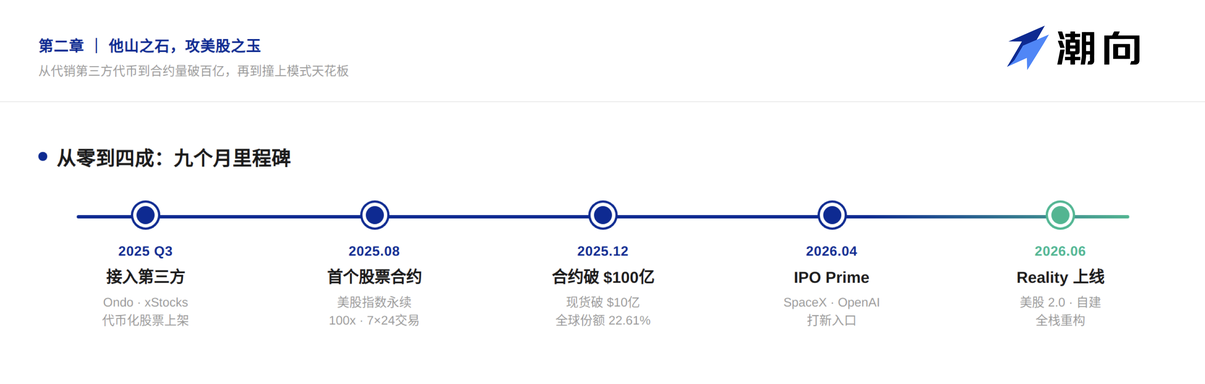
In Q3 last year, Bitget began to list U.S. stocks, using the approach of learning from others.
Ondo and xStocks are third-party issued tokenized stocks, with Bitget responsible for listing and trading matching. At the same time, they launched the industry's first U.S. stock index perpetual contract, with a maximum leverage of 100 times and 24/7 trading.
This model ran for a few months, and by the end of December last year, the contract volume reached $10 billion, which is quite a substantial scale. There was no issue with demand; users indeed wanted to trade U.S. stocks on crypto exchanges. However, the products themselves had issues.
Learning from others can help, but if the stone itself is too coarse, it still cannot create a smooth experience. Once the volume increased, the problems followed.
For example, if you search for Nvidia and buy 100 USDT of the on-chain NVDA token, the price does indeed follow Nasdaq. And then what?
First, the depth is at the level of a DEX; any slightly larger order has visible slippage. Secondly, regarding shareholder rights, if Nvidia pays dividends every quarter, you won't receive a penny. When there is a stock split, your holdings may take several days to update.
For on-chain U.S. stocks, you basically just bought a price, and nothing else.
In fact, these three issues are not just Bitget's problems; they are common ailments in the entire tokenized U.S. stock sector. Third-party issuers control the underlying assets and product logic, and exchanges are merely a shelf for displaying goods, with depth, dividends, and asset availability not determined by you.
The ceiling of the consignment model is the ceiling of others' products.
At this point, exchanges like Bitget face two paths. One is to continue patching things on someone else's infrastructure, and the other is to build their own ship. They chose the heavier one.
Self-Improvement: When Stocks on Bitget Start Paying Dividends
Recently, Nvidia announced an increase in its quarterly dividend from $0.01 per share to $0.25 per share, with the next payment date on June 26. If you hold rNVDA on Bitget, your account may receive a cash dividend converted into USDT, and the holding cost will be automatically updated.
In the on-chain U.S. stock sector, this is probably the first time for "real equity." The corresponding rights exist because the underlying assets of on-chain U.S. stocks have undergone a new evolution on Bitget.
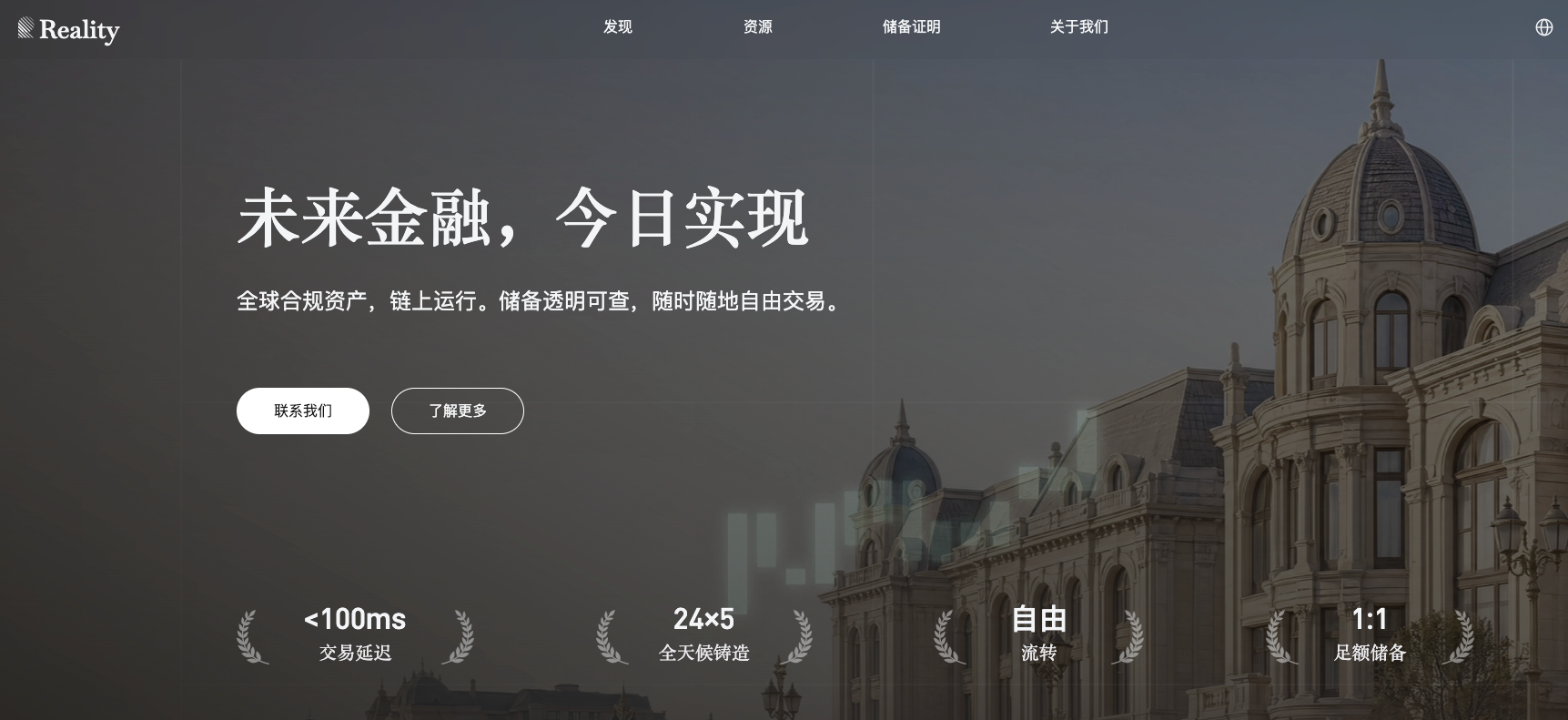
In June this year, Bitget launched a platform called Reality. This name translates directly to reality. In a crypto U.S. stock sector filled with shadow assets, the name itself feels more like a declaration:
When tokenized stocks become the mainstream in the future, they will shed the prefix "tokenized" and become the default stocks in people's conversations, while the stocks everyone trades now will be labeled with the prefix "traditional stocks."
This may sound sci-fi, but what Reality aims to do is to make it a reality.
What the platform does is not complicated. Instead of sourcing from the original Ondo or xStocks, it issues tokenized U.S. stocks independently through Reality. Issuance is handled by Reality, custody is entrusted to the licensed broker Alpaca, and auditing is independently executed by The Network Firm, with each link performing its own duties.
The stock tokens issued by the platform are called rToken, and the U.S. stock tickers you buy on Bitget will be presented in the form starting with "r."

How does rToken differ from the batch of third-party tokens from six months ago in terms of experience?
The most direct difference is that you can finally figure out whether there is something real behind it. In the 1.0 era of tokenized U.S. stocks, the underlying custody link was basically a black box for users; you had no idea whether the NVDA you bought had a real Nvidia stock behind it.
Reality has opened up this link. rToken, as a tokenized U.S. stock, has underlying real assets as a mapping.
For example, if you buy $100 of rNVDA on Bitget, Reality will purchase the corresponding amount of real Nvidia stock in the U.S. stock market through Alpaca and store it in Alpaca's custody account. Whatever you buy, it buys the same amount, 1:1 correspondence.
Public information shows that Alpaca is a licensed self-clearing broker in the U.S., registered with the Financial Industry Regulatory Authority (FINRA) and protected by the Securities Investor Protection Corporation (SIPC).
SIPC is a federal-level investor insurance mechanism in the U.S., meaning that even if the broker itself has issues, the securities assets in the custody account are backed up, with a limit of $500,000. Alpaca is currently one of the most used custodians in the tokenized securities field, with Binance, Ondo, and xStocks also being clients of Alpaca.
Independent auditing is handled by The Network Firm, which issues CPA-level reports for each period, confirming a reserve ratio of over 100%. Bitget has also created an on-chain reserve proof dashboard that updates in real-time and is accessible to anyone.
You have acquired an asset, and you know it is real. This is the change perceived at the usage level.
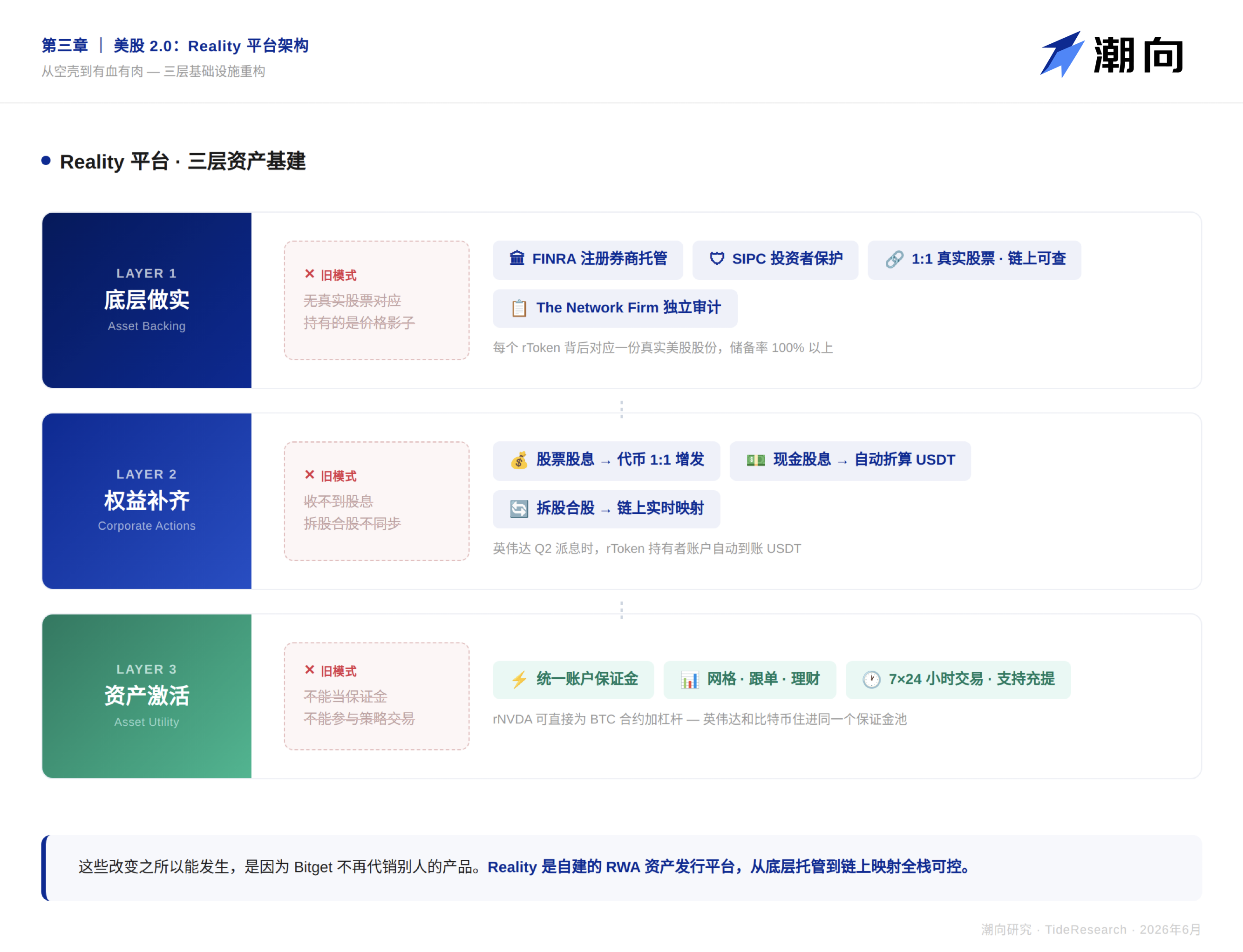
Looking deeper into this perception, you can see the entire design philosophy of Reality's architecture. Bitget has reconstructed tokenized U.S. stocks into three layers:
The first layer is making the underlying real. The previously mentioned Alpaca custody, 1:1 purchases, and on-chain reserve proof address the most basic trust issue of "is there something real behind what you bought?"
The second layer is completing the rights. Stock dividends are issued to the account in a 1:1 ratio as tokens, cash dividends are directly credited in USDT, and stock splits and consolidations are mapped to the chain in real-time. In the past two years, when you bought tokenized Nvidia elsewhere, you watched real shareholders receive money while your account remained unchanged. This time, it is the turn of rToken holders.
The third layer is activating the assets.
rToken is integrated into Bitget's unified account system, allowing your rNVDA to be used directly as margin. You can open a BTC contract using Nvidia's position, leveraging a U.S. stock for a crypto contract. In traditional brokerages, cross-asset margin is a privilege reserved for institutions; in previous on-chain U.S. stocks, it was unimaginable; now, an ordinary user on Bitget can achieve a similar effect.
After this round of self-construction, how about the cost of purchasing stocks?
According to the publicly disclosed rates of various platforms, buying $1,000 of U.S. stocks on Bitget costs about $0.4, while traditional internet brokerages typically charge around $2.
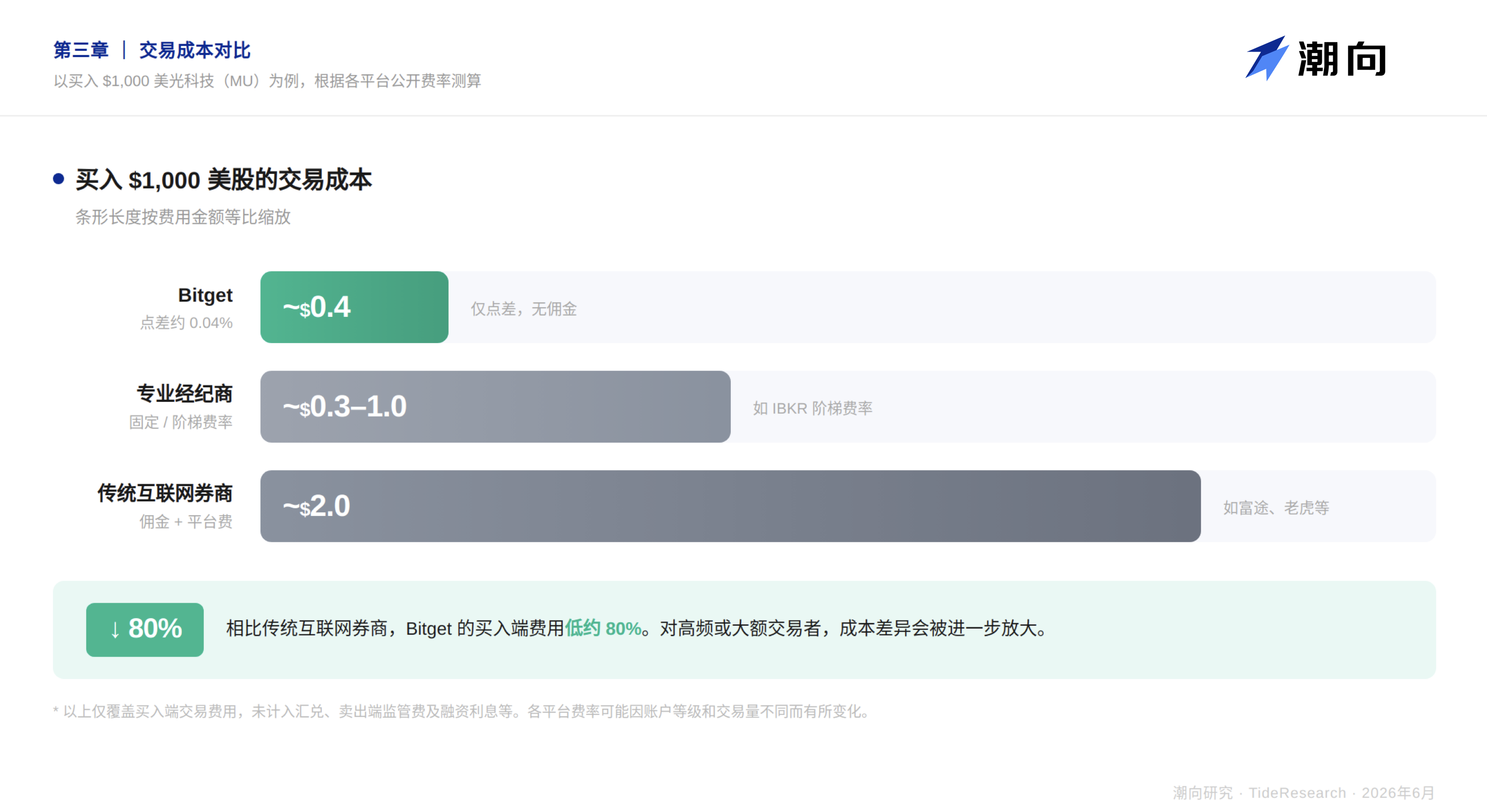
When viewed together, the category of tokenized U.S. stocks has undergone a qualitative change in Bitget: from a shadow token that can only follow the price to a financial product with real custody, complete rights, and the ability to mix with crypto assets.
This was something that brokerages would not do two years ago, and exchanges could not achieve.
Some may ask, since you want to do U.S. stocks, why not take a simpler route, such as directly connecting to a brokerage's channel and just creating a front end?
Bitget's choice is precisely the opposite; it does not rely on traditional finance but instead reconstructs this link using crypto and blockchain methods. Reality maintains full control from custody to distribution to on-chain mapping; rToken itself is an on-chain asset that can be charged, withdrawn, and combined, which is something that direct brokerage solutions cannot achieve.
As I write this, I am reminded of the famous line from "The Storm": The bigger the storm, the more valuable the fish.
However, to navigate the turbulent market environment to catch more fish, a reliable ship is needed. Renting someone else's ship is possible, but a self-built ship allows you to set the water level.
This is probably the ambition of Bitget's Reality platform, which is not explicitly stated in various promotions but is evident.
Moreover, it is clear that Bitget does not intend to use this ship solely for U.S. stocks.
Not Just U.S. Stocks: The Prototype of a Panoramic Exchange
The ship is built, and the first batch of cargo is not just stocks of listed companies.
In April this year, Bitget launched a product called IPO Prime, allowing ordinary users to subscribe to companies that have not yet gone public. The first phase was SpaceX, with a subscription price of $650 per share and a total pool of about $61 million. The result was an influx of $177 million, with 14,435 people competing.
The second phase switched to OpenAI, with a subscription price of $725 per share and a pool of about $21 million, but actual subscriptions reached $120 million, with 5,448 participants, nearly six times oversubscribed.
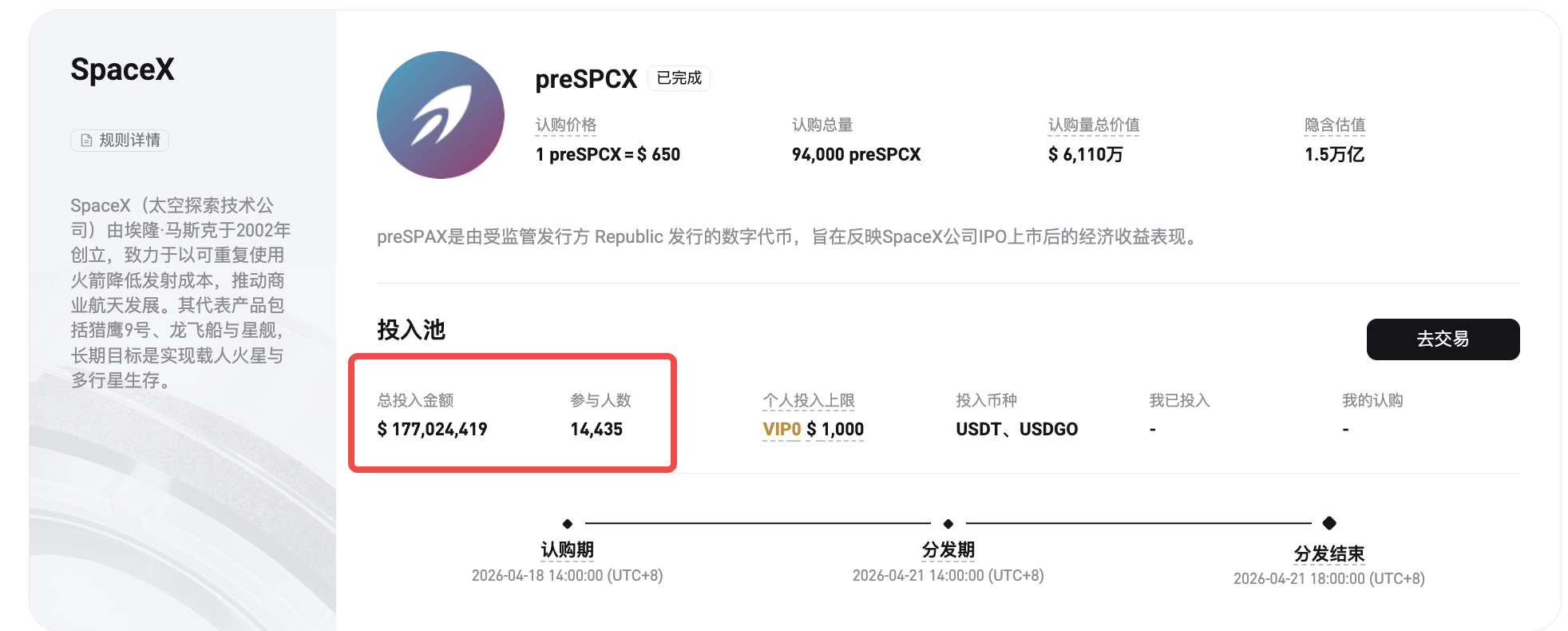
Combined, the two phases saw nearly $300 million in subscription amounts, with almost 20,000 participants.
The common feature of these two companies is that, in the world of traditional finance, ordinary people have no channels to buy equity exposure before they go public. IPO Prime is backed by a SPV structure in cooperation with Republic, anchored by real equity.
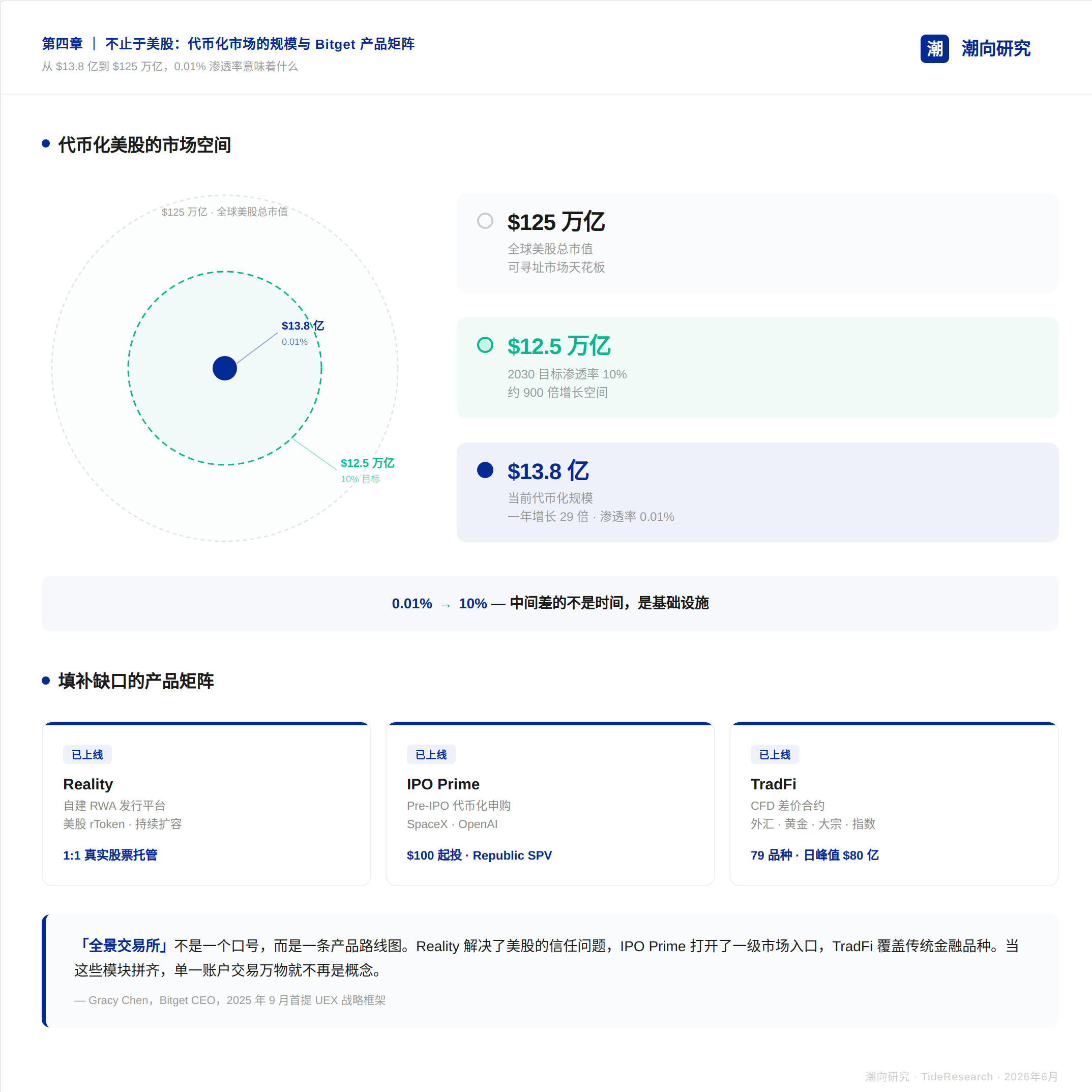
Beyond Pre-IPO, Bitget also launched TradFi at the end of last year, a CFD product priced in USDT, covering 79 varieties including foreign exchange, gold, commodities, and stock indices, with daily trading volume peaking over $8 billion.
Along with the continuously expanding U.S. stock rTokens from Reality, the types of assets that can now be encountered in a single Bitget account have far exceeded the traditional definition of "crypto exchange."
Internally, Bitget refers to this direction as UEX, a panoramic exchange.
When CEO Gracy Chen first publicly mentioned this concept in September last year, the goal was stated very directly: to cover crypto, U.S. stocks, gold, ETFs, and foreign exchange for global quality assets in one-stop trading through a single account.
To support this framework, the team is also expanding.
Public information shows that Bitget has intensively recruited a group of composite talents with backgrounds in traditional finance and internet growth over the past six months. The candidates who have joined come from companies like Futu, LongBridge, Robinhood, and eToro, with cross-market experience covering the U.S., Hong Kong, Singapore, Australia, and collaborations with traditional financial institutions like Nasdaq.
From the perspective of talent acquisition, this is not a crypto exchange catching up; it feels more like a new species building its skeleton.
I find it interesting that Bitget's attitude toward this matter is clear. There is a lighter path to engage in U.S. stock trading: connect to a brokerage's channel, put a shell on the front end, and users can buy and sell.
Many platforms take this route. Bitget, however, chose the heaviest path, building its own issuance platform, creating its own custody link, and allowing rToken to be charged, withdrawn, and combined on-chain.
Why?
From the product selection perspective, Bitget's attitude is already very clear. The direct brokerage connection solution essentially still serves traditional finance at the front end; the stocks users buy exist within the broker's system, cannot be charged on-chain, cannot be withdrawn to wallets, and certainly cannot be leveraged for BTC.
The rToken created by Reality is inherently an on-chain asset, capable of doing much more than a brokerage channel. Choosing the heavier path is not because they enjoy suffering, but because the lighter path cannot take them where they want to go.
I believe this choice is based on a larger judgment: Blockchain and Crypto, at this stage, are not just tools for issuing and trading coins; they can reshape the experience and distribution methods of financial products.
Reality is the first product to land this judgment. Saying this three years ago might not have been believed, but in light of the current product logic, it does not sound empty.
As for how far this path can ultimately go, it is still too early to draw conclusions.
But one thing is certain: Bitget is no longer the exchange that only traded crypto a year ago.
From consignment to self-construction, from U.S. stocks to Pre-IPO to foreign exchange and gold, from a cryptocurrency trading platform to a panoramic entry point for everything, every step on this path adds new decks to the ship they built.
The ship has already set sail; now it remains to see how far it can go.
This article is based on official product materials and public market information from Bitget. The product features and data mentioned are subject to the latest version of the Bitget platform. Trend Research has independently verified the product descriptions but does not guarantee platform operations or asset security.
Tokenized stocks are emerging financial products, and the custody, auditing, and compliance frameworks for underlying assets are still under development. Regulatory attitudes toward such products vary significantly across different jurisdictions, and investors should assess the associated risks independently.
The market has risks; decisions should be made independently.
Data sources: Bitget Q1 2026 Transparency Report · Bitget User Asset Allocation Report (May 2026) · TokenInsight Q1 Contract Market Report · The Network Firm Audit Report · Publicly disclosed rates from various platforms
Trend Research · June 2026
 Risk warning


Popular articles