Investing $400 million in Crypto.com, the crypto ambitions of market-making giant Citadel
 Core Viewpoint

 As traditional exchanges, clearing institutions, and market makers converge towards on-chain market structures, the issue of the ownership of tokenized securities is being defined in advance.
Author: Zhou, ChainCatcher
Recently, Crypto.com announced it has received a $400 million strategic investment from Citadel Securities, bringing the company's valuation to $20 billion. The funds will be used to expand its business in tokenized securities, derivatives, and other asset classes.
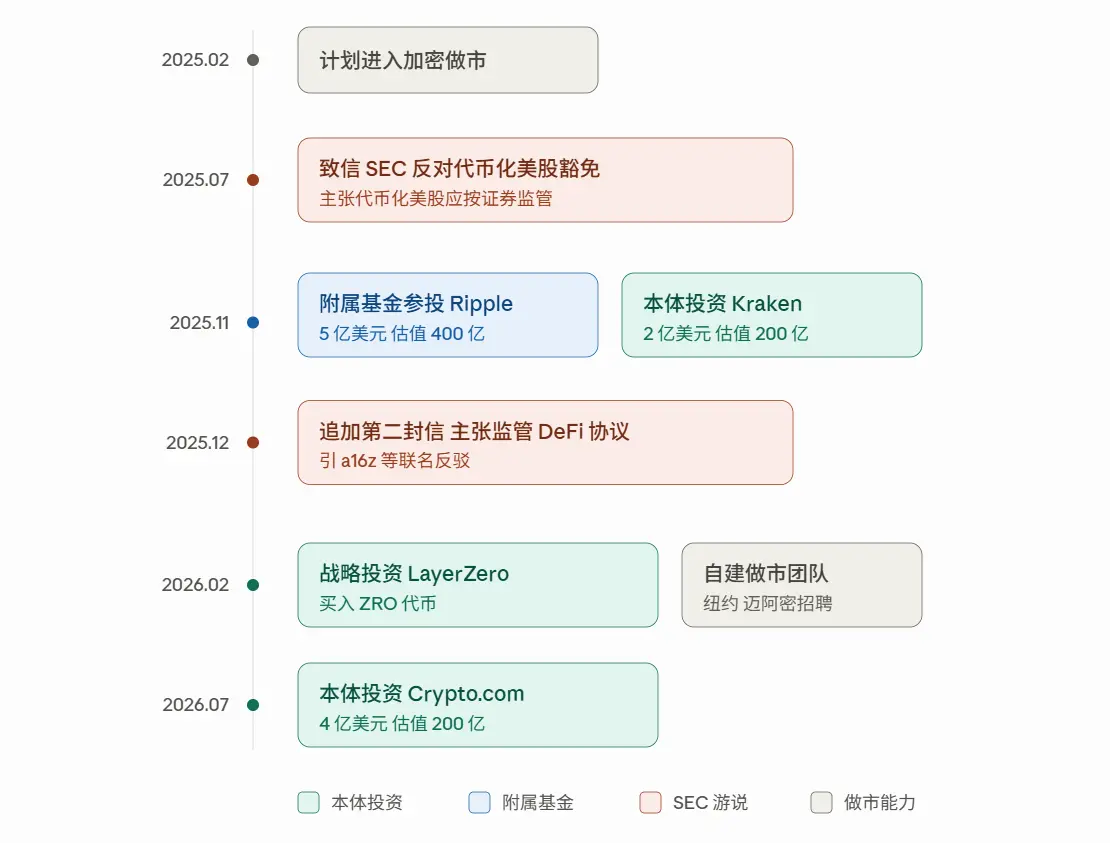
This is another significant investment by Citadel in the crypto space over the past year. In February of last year, one of the largest market makers in the U.S. stock market was reported to be planning to enter the crypto market and has already invested in Ripple through its affiliated fund, as well as invested in Kraken directly.
If we only look at the investment actions, Citadel seems to be quickly embracing the crypto market. However, on the other hand, it has expressed a clear regulatory stance before the SEC's crypto working group. It argues that tokenized U.S. stocks should be treated as securities and that DeFi protocols trading such assets should not receive broad regulatory exemptions simply because they use on-chain technology.
This makes Citadel's crypto strategy appear somewhat contradictory. On one hand, it invests in crypto trading venues, while on the other, it opposes certain DeFi trading models that circumvent traditional securities market rules.
This seemingly contradictory stance points precisely to the type of crypto that Citadel desires.
What Citadel Has Acquired in the Crypto Market
Citadel Securities has not been in the crypto market for long. In February 2025, according to Bloomberg, this market maker planned to join the list of market makers for platforms like Coinbase, Binance, and Crypto.com, and may initially form a market-making team outside the U.S.
In the following year, its actions became more frequent.
In November 2025, Ripple completed a $500 million financing round, with a valuation of $40 billion, and according to Ripple, Citadel Securities' affiliated fund participated as a lead investor. In the same month, Citadel Securities invested $200 million in the crypto exchange Kraken, which had a valuation of $20 billion. In July 2026, it invested another $400 million in Crypto.com.
The affiliated fund invested in Ripple, while Citadel Securities itself invested in Kraken and Crypto.com. The targets of these three investments are not the same, but they all fall on the more infrastructure-oriented side of the crypto market, namely trading platforms, payment settlements, and institutional liquidity gateways.
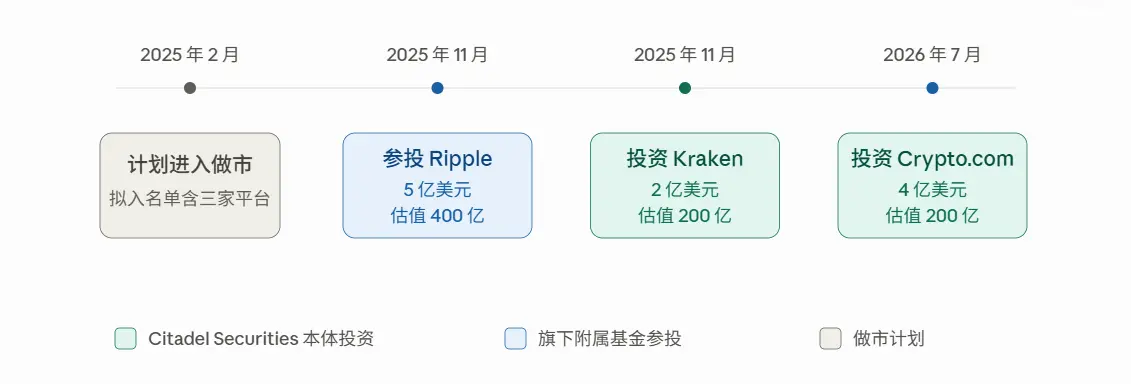
Putting the amounts back into the context of Citadel Securities' own scale makes the positioning clear. According to Bloomberg's March report, Citadel Securities achieved a record net trading revenue of $12.2 billion in 2025. The $400 million investment in Crypto.com is approximately 3.3% of this figure, while the $200 million investment in Kraken is about 1.6%.
Such expenditures are more akin to strategic positioning rather than directional bets.
Beyond investments, Citadel Securities is also personally building its crypto market-making capabilities. According to previously public information, since February 2026, Citadel Securities has been recruiting for crypto quantitative development and research positions in New York and Miami to build a low-latency trading system for the crypto market.
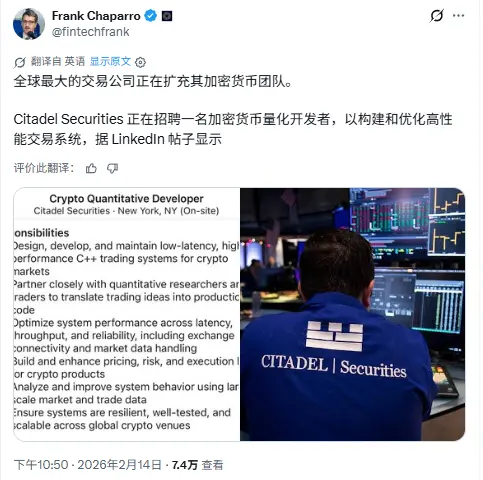
In other words, the trading platform seats it has acquired ultimately serve its own market-making desk.
Citadel Securities' involvement in institutional-grade trading venues goes beyond investing in others; it is also one of the supporters of the crypto exchange EDX Markets.
Reportedly, EDX Markets, supported by Charles Schwab, Citadel Securities, and Fidelity, applied for a national trust bank license from the Office of the Comptroller of the Currency in April to provide digital asset custody, asset management, and trading settlement. Its subsidiary EDXM International also plans to launch a perpetual contract product in Korean won.
What further illustrates its intentions is its layout in underlying infrastructure.
In February 2026, cross-chain protocol developer LayerZero launched a Layer 1 blockchain called Zero, positioned as institutional-grade financial infrastructure aimed at trading, clearing, settlement, and tokenization scenarios. Citadel Securities completed a strategic investment by purchasing its native token ZRO.
According to LayerZero, Citadel Securities' role in this collaboration is to contribute expertise in market structure and evaluate Zero's application in trading, clearing, and settlement processes. Alongside it in supporting this chain are the U.S. securities settlement core institution DTCC, the parent company of the New York Stock Exchange ICE, Google Cloud, Ark Invest, and Tether.
It is worth mentioning that directly purchasing tokens is not common for Citadel Securities; its previous investments in Kraken and Ripple were in equity form. In the same period in February, BlackRock, Citadel Securities, and Apollo successively disclosed plans to buy DeFi governance tokens.
Brukhman, founder of CoinFund, stated that each firm is buying the tokens of the protocol they intend to use as infrastructure, which is vendor binding rather than asset allocation. For years, traditional financial institutions' exposure to crypto has been limited to equity and venture capital, with direct holdings being rare, and this round breaks that convention.
It Opposes Regulatory Exemptions for Securities on the Blockchain
If we only look at investment actions, Citadel Securities appears to be embracing crypto. However, its statements on regulation point in another direction.
In July 2025, Citadel Securities sent a letter to the SEC's crypto working group. According to the public letter, it argues that tokenized U.S. stocks should be clearly regulated as securities, opposing broad exemptions for such products, and characterizing related demands as self-serving regulatory arbitrage, believing such practices do not constitute true innovation.
It is concerned that tokenized assets could siphon liquidity away from traditional markets, emphasizing that regulation should focus on market liquidity and investor protection.
Six months later, its stance tightened further.
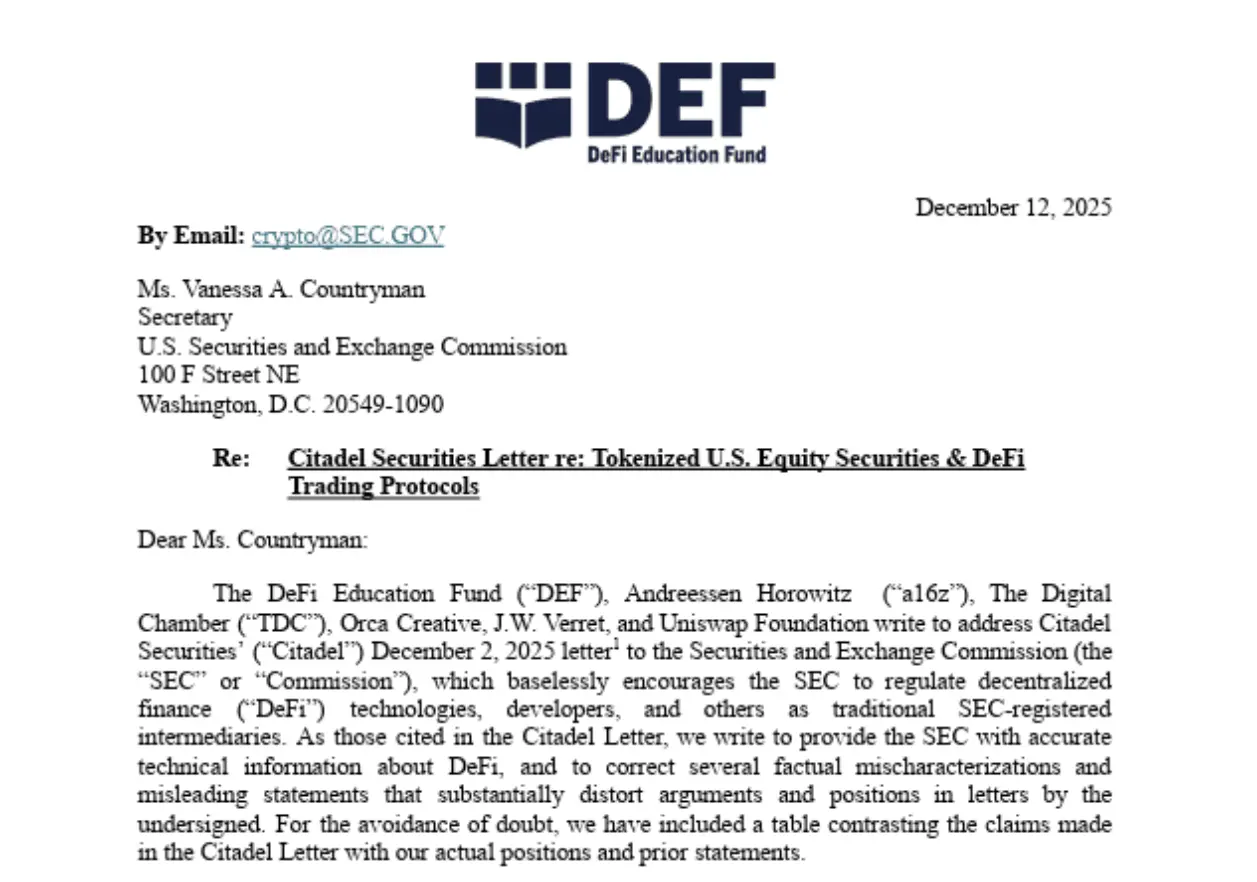
In December 2025, Citadel Securities submitted a 13-page letter to the SEC. According to the letter, it demands that DeFi protocols trading tokenized U.S. stocks be included in the regulatory framework for exchanges and brokers, arguing that the same security should not be subject to two sets of rules simply because of different technological packaging or trading venues.
This letter immediately triggered a collective backlash from the DeFi camp. The DeFi Education Fund, a16z, the Digital Chamber of Commerce, Orca Creative, lawyer J.W. Verret, and the Uniswap Foundation jointly wrote to the SEC, countering that Citadel Securities is attempting to incorrectly classify non-custodial software, developers, and on-chain infrastructure as traditional securities intermediaries, arguing that excessive regulatory expansion under the traditional intermediary framework could harm open financial innovation.
Jennifer Rosenthal, a spokesperson for the DeFi Education Fund, pointed out the business logic behind this debate. She stated that for Citadel, questioning the existence of a technology that threatens its business and significant market share is quite convenient.
The controversy has continued since then. In April 2026, the Blockchain Association again submitted comments to the SEC in response to Citadel's calls for increased regulation, emphasizing that DeFi protocol developers do not fall under the category of brokers or exchange operators, while also urging the SEC to advance an innovative exemption mechanism for on-chain assets.
The core of the disagreement lies in Citadel Securities emphasizing that the same security should be subject to the same rules, while the DeFi camp emphasizes that different technological architectures should not simply apply old intermediary regulations.
Notably, between the two letters, Citadel Securities made its investments in Ripple and Kraken. Investments are advancing, and lobbying is also being ramped up simultaneously.
More Than One Firm Is Positioning Itself in the Crypto Market Structure
Citadel Securities' choices are not isolated. In recent months, Wall Street institutions have entered the crypto market in increasingly specific ways, gradually focusing on trading venues and market structure.
In March 2026, the parent company of the New York Stock Exchange, ICE, announced a strategic investment in the crypto exchange OKX, with a valuation of $25 billion, and obtained a board seat. The two parties plan to establish a joint venture to provide tokenized NYSE stocks and ICE futures to OKX's 120 million users, pending approval from U.S. regulators.
Almost simultaneously, Nasdaq announced a partnership with Kraken's parent company Payward to develop a system for the issuance and distribution of tokenized stocks.
These layouts primarily fall on trading venues and market infrastructure, betting on who will build the structure of the crypto market.
There are also those directing funds toward exposure to crypto assets. In October 2025, Jane Street disclosed through a 13G filing that it holds approximately 5% stakes in three Bitcoin mining companies: Hut 8, Bitfarms, and Cipher Mining, all of which are passive trading positions. Almost at the same time, Citadel founder Ken Griffin disclosed to the SEC that he personally holds about 4.5% of the shares in Solana treasury company DeFi Development Corp.
Mining company stocks and treasury company stocks are aimed at the price elasticity of crypto assets. Citadel Securities is taking a different path, investing in places and structures themselves, from Kraken and Crypto.com to LayerZero.
As traditional exchanges, clearing institutions, and market makers simultaneously converge toward on-chain market structures, the ownership issue of the tokenized securities track is being delineated in advance.
Conclusion
Returning to the investment in Crypto.com. For a market maker with annual trading revenues exceeding $12 billion, the $400 million price tag is not high, but it secures a position in the tokenized securities track.
On one hand, it writes to the SEC arguing that tokenized securities must be regulated, while on the other, it buys platforms ready to engage in tokenized securities business. These two actions together outline the vision of the crypto market that Citadel Securities wants.
It does not oppose asset tokenization itself; what it truly cares about is that the rules remain dominated by the traditional framework after tokenization, and it has its own position at both ends of the rules and trading.

 Risk warning