TRON Industry Weekly Report: The expectation of a rate hike by the Bank of Japan hinders the rebound, but the subsequent trend still depends on the Federal Reserve's December decision. Dynamic, which integrates Web3 identity and wallets, is favored by A16z
 Core Viewpoint


 TRON Industry Weekly Report
# I. Outlook
1. Macroeconomic Summary and Future Predictions
Last week, U.S. macro data continued to be intermittently released due to the previous shutdown, with overall economic signals remaining weak. Consumer confidence continued to decline, manufacturing and service activities slowed down, and pre-holiday consumption was not strong, raising concerns about "weakening demand"; inflation still hovered around 3% without significant alleviation or further deterioration, putting the Federal Reserve in an awkward wait-and-see position.
U.S. stocks were under pressure due to the dual impact of weak economic signals and unclear policies, with the three major indices generally experiencing slight declines, led by the technology and consumer discretionary sectors, while safe-haven assets continued to attract capital. Looking ahead, the market will focus on the upcoming employment and GDP data: if a comprehensive confirmation of economic slowdown occurs, the Federal Reserve may be closer to cutting interest rates; if inflation and consumption rebound, policies may remain cautious, and short-term volatility is likely to intensify.
2. Market Changes and Warnings in the Crypto Industry
Last week, the overall crypto market maintained a volatile trend. The weekend was expected to see a technical recovery, but ultimately closed down on Sunday, indicating extreme weakness in market buying and a broadly bearish sentiment.
If Bitcoin cannot quickly return above $100,000, the market may continue to accelerate into a mid-term downward channel, potentially leading to a deeper "technical bear market" pricing. On the macro level, key U.S. economic data will be concentrated in release this week; if inflation is strong or employment exceeds expectations, it will further suppress risk assets; if data confirms economic slowdown, it may ease short-term pressure. Overall, the crypto market is in a weak and sensitive phase, with fragile liquidity and strong selling pressure, necessitating vigilance against the risk of retesting lower levels or even expanding declines in the short term.
3. Industry and Track Hotspots
The platform Dynamic, which integrates Web3 identity and wallet infrastructure to reshape multi-chain secure login experiences, has raised a total of $21 million, led by A16z, with participation from Solana and Circle; Printr, the first token issuance platform to achieve chain abstraction, has raised a total of $4.5 million, with investments from Mantle and Sui.
# II. Market Hotspot Tracks and Potential Projects of the Week
1. Overview of Potential Projects
1.1. Analysis of the $21 Million Funding, Led by A16z, with Participation from Solana and Circle ------ Dynamic, a platform that integrates Web3 identity and wallet infrastructure to reshape multi-chain secure login experiences
Introduction
Dynamic provides a multifunctional and secure authentication solution for Web3, offering a smart login process for crypto users while allowing non-crypto users to easily register and use the platform.
It focuses on simplifying wallet interactions, providing a non-custodial embedded wallet with the following features:
Passkey login and Secure Enclave protection for private keys;
Pre-generated wallets and user-friendly account recovery processes;
On-ramp integration for fiat deposits;
With these features, developers can build seamless and secure user experiences across multiple blockchains.
Core Mechanism Overview
Dynamic wallets adopt a multi-party computation (MPC) architecture combined with a threshold signature scheme (TSS), representing the next generation of wallet security and user experience standards.
1. Core Principles of TSS-MPC
Unlike traditional wallets controlled by a single private key (creating a single point of failure), TSS-MPC splits the key into multiple encrypted "key shares." These shares collaborate in calculations during signing but never reconstruct the complete private key.
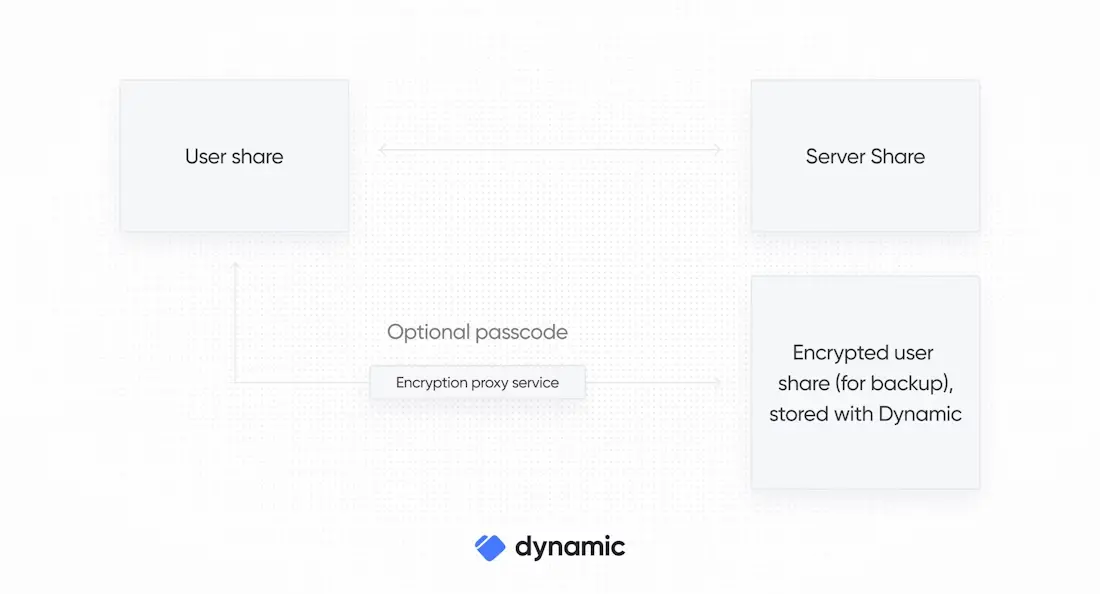
Dynamic's TSS-MPC implementation defaults to a 2-of-2 threshold signature scheme, with the following mechanism:
The user holds one user key share;
The Dynamic server holds one server key share;
Both key shares must be used simultaneously to complete the signing operation.
This means the complete private key is never generated or exposed, and neither party can sign or control the wallet independently, maximizing security and protection.
Key Share Management in Dynamic
Dynamic's wallet employs a TSS-MPC dual key architecture, generating two key shares during wallet creation:
The user share is stored on the local device;
The server share is encrypted and stored by Dynamic, participating in signing within a Trusted Execution Environment (TEE).
During transaction signing, both key shares collaborate in their respective secure environments, and the complete private key is never reconstructed or exposed.
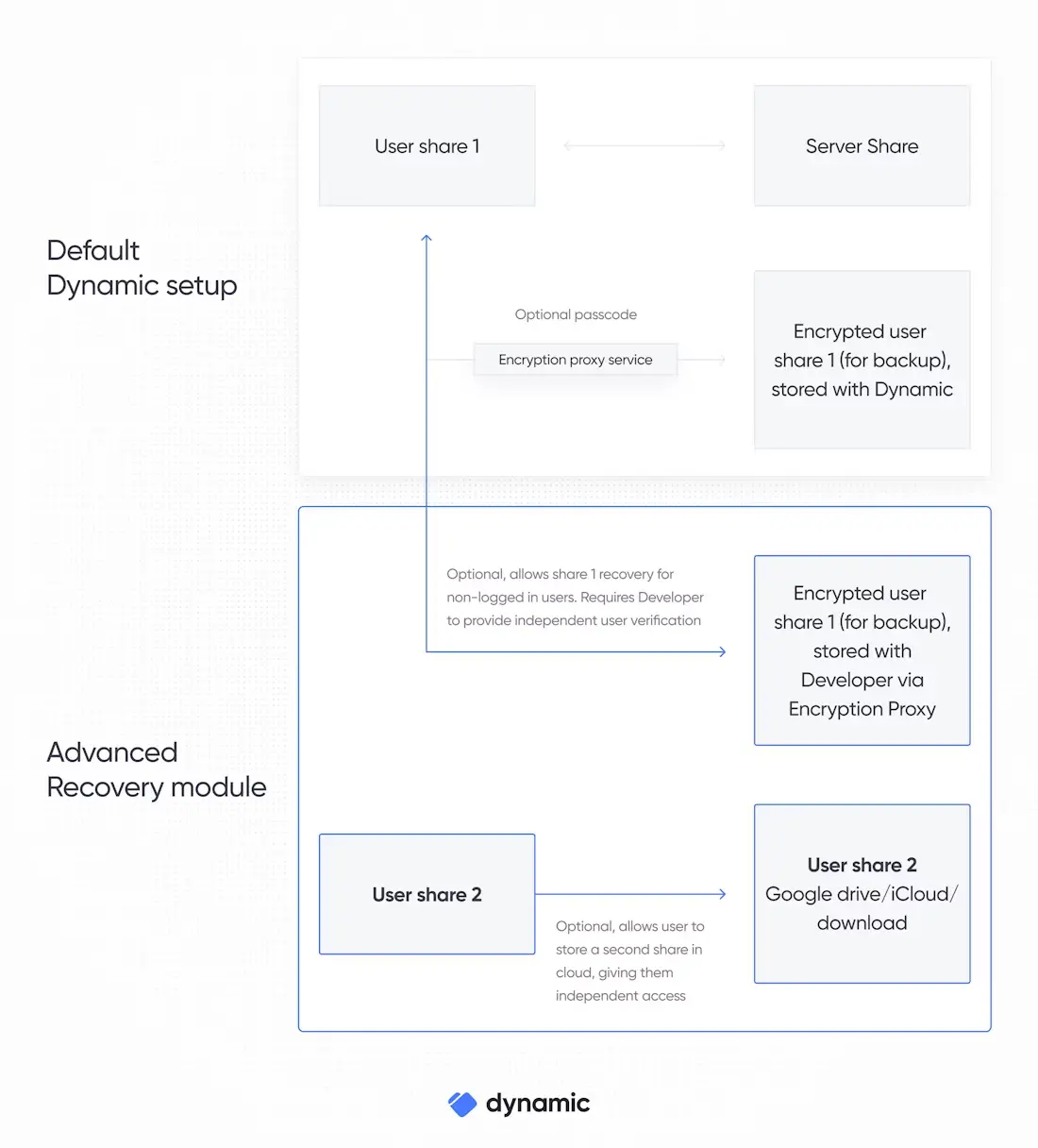
The system also supports encrypted backups, passcode encryption, and key recovery mechanisms, ensuring user self-custody, no single point of failure, and maintaining security even when under attack.
Multi-Chain Support
Dynamic's TSS-MPC supports three mainstream signature algorithms to cover different public chain ecosystems:
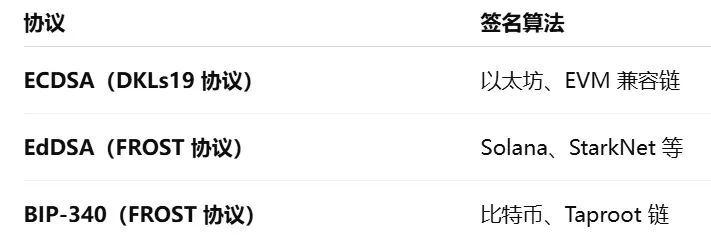
2. Non-Custodial Architecture
Dynamic's embedded wallet is non-custodial, meaning:
The wallet is fully owned and controlled by the user, and private keys are never entrusted to Dynamic.
TSS-MPC employs user shares + server shares:
User shares are stored on local devices;
Server shares participate in signing within a Trusted Execution Environment (TEE);
MPC Relay coordinates the signing process, ensuring keys are never leaked.
Additional Security Mechanisms
Users can enable local encryption or backup shares;
The default threshold scheme is 2/2, adjustable to 2/3 or 3/5 for enhanced fault tolerance;
Supports periodic key resharing to improve security;
Users can export wallets and migrate to other services;
Dynamic is SOC2 Type 2 compliant and undergoes regular independent security audits and vulnerability bounty testing.
3. Multi-Chain Compatibility
Dynamic supports generating embedded wallets on the following networks:
EVM, SVM, Sui (main networks);
When multiple networks are enabled simultaneously, corresponding wallets will be automatically generated and displayed as the "main address" after login.
Additionally, it natively supports:
EVM, SVM, Sui mainnets
And is compatible with Bitcoin, Cosmos, and other chains (via ECDSA / EdDSA / BIP-340 signatures)
4. Smart Accounts
Developers can upgrade these embedded wallets to smart accounts to achieve the following advanced features:
Sponsored Gas fees for users
Adding complex approval logic
Integrating more automated operations
Automation and Agentic Use Cases
Dynamic also supports developer-hosted MPC wallets (2-of-2 threshold),
controlled by developers for:
Automated operations (e.g., scheduled payments, batch executions)
AI / smart agent accounts (Agentic Wallets)
These wallets are not held by end users but are designed for specific automated applications.
Dynamic Advanced Features
Dynamic's embedded wallet system offers high customizability, designed for enterprise users and complex scenarios, providing flexible security and recovery strategies. Its core advanced features include:
- Developer-Hosted Backups
Enterprises can build their own key share backup infrastructure, fully controlling the backup and recovery processes.
Supports custom backup strategies, internal recovery mechanisms, and business continuity management.
- Custom Key Derivation Options
Supports flexible key derivation paths and schemes, enabling:
Hierarchical Deterministic Wallets (HD Wallet)
Custom address generation rules
Seamless integration with existing Key Management Systems (KMS).
- Advanced Key Sharing Configurations
In addition to standard 2-of-3, supports 3-of-5 or other custom threshold schemes.
Allows for more complex security models, such as:
Multiple backup strategies
Hierarchical access control
Enhanced leak prevention mechanisms
Independent recovery processes
Tron Comments
Dynamic's advantage lies in its integration of identity authentication, non-custodial wallets, and multi-chain support through the TSS-MPC security architecture, ensuring private keys are never exposed while balancing security, recoverability, and user experience; it supports enterprise-level customization (such as self-hosted backups, key derivation, and complex threshold configurations), achieving high security and flexibility in wallet and identity infrastructure; it can seamlessly operate across multiple chains like EVM, SVM, Sui, and Bitcoin, reducing integration costs.
Its disadvantage is that the system structure is complex, with high implementation and maintenance costs, requiring developers to have a deep understanding of MPC/TSS architecture; excessive configuration options may increase integration difficulty for enterprises; additionally, some features rely on server and TEE environments, necessitating a trade-off between complete decentralization and performance.
1.2. Interpretation of the $4.5 Million Funding, with Participation from Mantle and Sui ------ Printr, a cross-chain abstracted token issuance and liquidity infrastructure
Introduction
Printr is the first token issuance platform to achieve chain abstraction, allowing you to issue, trade, and discover tokens across more than 70 blockchains.
In this era of multi-chain coexistence, each chain has its unique advantages. Tokenization on a single chain has become limiting. As a creator, you should not be forced to choose among numerous public chains; your goal should be to reach more users and liquidity.
Printr was born for this purpose ------ to help you achieve truly cross-chain boundary-less token issuance and circulation, allowing Memecoins to truly become borderless assets.
On Printr, you can:
Issue tokens on any chain or all chains simultaneously;
Trade freely across chains, buying or selling from any chain;
Engage in cross-chain arbitrage, capturing price differences;
Earn points and rewards.
Architecture Overview
1. Bonding Curve ------ Pricing Mechanism Analysis
The bonding curve establishes a mathematical relationship between token supply and price. As users buy or sell tokens, the price automatically adjusts based on a preset formula, providing a predictable pricing mechanism for the market.
Printr's bonding curve can operate independently on different blockchains, with price and supply relationships not dependent on a specific chain.
Curve formula:
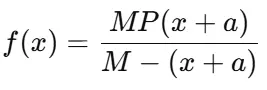
Where:
M = Maximum supply
P = Base price factor
x = New supply added
a = Virtual reserve, used to smooth price changes
Applicable range: 0≤x
 Risk warning Risk warning

Popular articles