






RWA Map: An Overview of the Progress of 10 Major Projects and Summaries of 20 Early Projects
 Core Viewpoint
 Many RWA projects received investments from well-known investors around 2021, but their overall subsequent development has been relatively slow.
?
Written by: flowie, ChainCatcher
Despite the ongoing skepticism surrounding RWA as an old story with a new twist, since the beginning of the year, various institutions have continuously entered the market to "add bricks and tiles" to RWA. The rising trend of RWA concept tokens has indeed brought some highlights to the sluggish cryptocurrency market.
Earlier this year, we briefly analyzed the reasons for the warming of RWA in the article "Is RWA, which major institutions like Binance and Goldman Sachs are scrambling to layout, the growth engine for the next round of DeFi or just a flash in the pan?". At that time, major institutions like Binance, Goldman Sachs, Hamilton Lane, and Siemens entered the market one after another, and the intensive layout of some on-chain US Treasury protocols drew attention to RWA. Behind the concentrated surge of on-chain bonds, a key driving factor is that the low yields in DeFi during the bear market cannot meet the return demands of crypto users. With the Federal Reserve's continuous interest rate hikes, on-chain US Treasuries indeed provide a new yield solution for crypto users.
A few months later, under the narrative of crypto entry by TradFi institutions like the SEC's regulatory crackdown and BlackRock's application for a Bitcoin spot ETF, RWA may once again explode due to compliance context, and recently, there have been a series of noteworthy events in the RWA field:
The founder of Compound established a new company "Superstate," seeking to tokenize US Treasuries on Ethereum;
Maker purchased $700 million in US Treasuries and raised the short-term US Treasury investment cap to $1.28 billion;
More notably, the entry of the national team: Bank of China International issued $200 million in digital notes for the Hong Kong market via UBS, marking the first such product compliant with Hong Kong and Swiss laws and tokenized on the Ethereum blockchain.
The Hong Kong Securities and Futures Commission (SFC) has changed its attitude towards RWA assets. Elizabeth Wong, head of the fintech group, stated in an interview with Eliptic that the SFC will soon release an update, indicating that Securities Tokens or RWA will not be defined as complex products and may have the opportunity to be opened to retail investors, with RWA regulated based on underlying assets.
Additionally, Sun Yuchen, who never misses a hot topic, has also been active. On July 4, the TRON ecosystem announced the launch of the RWA stable staking product stUSDT, allowing users to stake USDT to earn RWA rewards.
After several months of brewing since the beginning of the year, the continuous support from old DeFi protocols and the national team has led to a strong reaction in the secondary market for RWA, with tokens like MRK and COMP seeing significant increases.
Meanwhile, compared to the first half of the year, the skepticism from the crypto community towards RWA seems to have eased, with sentiments reflecting that many crypto natives currently scoff at RWA just as they did at the DeFi Summer in 2020, resulting in them missing out on a wave of innovation.
Due to the broad definition of the RWA concept, the actual development landscape in this field feels quite vague. This article mainly combines the RWA section of the crypto data platform RootData to sort out the progress of relatively leading projects under the RWA concept and some early projects with highlights in financing or models, providing an overview of the development situation in the RWA track.

Latest Progress of Leading RWA Representative Projects
According to statistics from CoinMarketCap, the total market capitalization of RWA concept tokens currently exceeds $2 billion.

Apart from some established DeFi projects, RWA projects are generally in the early stages. We first organize the relatively leading projects in different subfields to understand their actual progress or upcoming plans in RWA over the past six months. Overall, the top 10 RWA concept tokens by market capitalization have all risen in the past month, with Compound seeing the highest increase, exceeding 100%.

US Treasuries
1. MakerDAO (MKR)
The stablecoin DAI issued by MakerDAO, pegged to the US dollar, is currently one of the most common use cases for RWA. MakerDAO was also one of the first DeFi protocols to incorporate RWA into its strategic planning, passing a proposal in 2020 to use RWA as collateral in the form of tokenized real estate, invoices, and receivables to expand the issuance of DAI.
MakerDAO has established multiple RWA vaults, most of which are collateralized by US Treasuries. This year, amid the overall downturn in DeFi, MakerDAO has continued to increase its layout in RWA, especially in investments in US Treasuries.
 Source of MakerDAO's RWA vault: Source: Dune Analytics (@SebVentures), Binance Research
In April, MakerDAO approved the opening of a real-world asset (RWA) vault for Coinbase Custody Services, transferring up to $500 million in USDC stablecoins, with Coinbase's custody division paying an annual interest of 2.6% on deposits.
In June, MakerDAO purchased and invested in US Treasuries through RWA vaults. MakerDAO first passed a governance vote to add BlockTower Andromeda (RWA015) as a new vault type for real-world assets (RWA), managed by asset management firm BlockTower Capital, which will invest up to $1.28 billion in short-term US Treasuries, funded by Maker's over-collateralized stablecoin DAI. Maker will pay BlockTower Capital a 0.15% arrangement fee.
Shortly thereafter, MakerDAO purchased $700 million in US Treasuries through the digital asset management company Monetalis Clydesdale Vault, adding to its initial purchase of $500 million in bonds in October 2022, bringing its total bond holdings to over $1.2 billion.
By more effectively allocating assets on its balance sheet to government bonds and investment-grade bonds, along with increased fees charged to DAI borrowers, MakerDAO has seen substantial revenue growth. According to Defilama data, MakerDAO's profit reached $8.32 million in June, up from $5.48 million in May, and over $3 million in April. With rising income profits, in June, MakerDAO announced an increase in the DAI deposit rate from 1% to 3.49%, more than tripling.
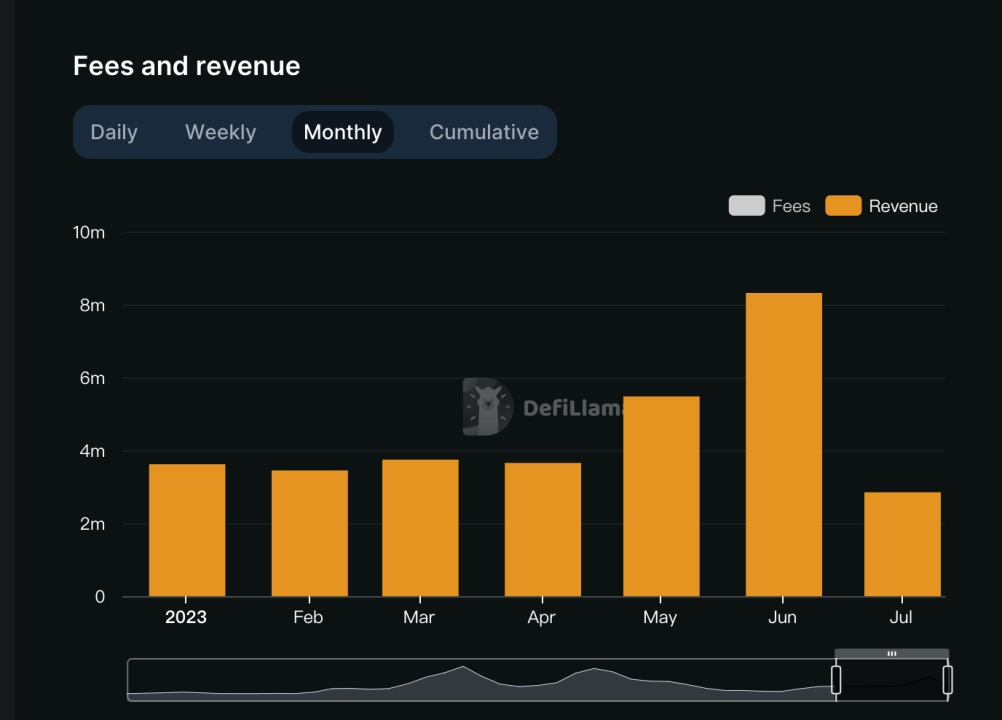
According to data analysis from the Dune panel organized by @SebVentures, MakerDAO's RWA assets have gradually expanded, accounting for 45% of all its assets, far exceeding the 26% share of its stablecoin assets, and contributing over 52% of MakerDAO's revenue.

2. Compound (COMP)
In contrast to MakerDAO's ongoing layout in RWA, Compound's sudden announcement of the establishment of a new company, Superstate, focused on on-chain bonds, quickly ignited the market.
It is reported that Superstate's fund will invest in "ultra-short government securities," including US Treasuries, government agency securities, and other government-backed instruments. Superstate announced that it has completed a seed round of financing, with specific amounts not disclosed, and this round of financing was participated in by ParaFi Capital, 1kx, Cumberland, CoinFund, and Distributed Global. However, Superstate is still in the application phase.
3. Aave (AAVE)
Aave closely followed MakerDAO and announced the launch of an RWA market in 2021, also allowing for the collateralized lending of real assets. Like MakerDAO, Aave uses Centrifuge as its RWA provider, and its RWA market enables Aave depositors to earn yields on real-world collateral, while Centrifuge asset originators can borrow funds from Aave. Currently, Aave's RWA market size is around $7.635 million, and only one USDC market can still provide lending APY, while other markets have ceased to offer.

In February of this year, Aave's native stablecoin GHO launched its testnet. GHO is an over-collateralized stablecoin supported by multiple crypto assets. Subsequently, the lending protocol Centrifuge proposed to introduce RWA into Aave and use it as collateral for the native stablecoin GHO.
In June, the Aave community initiated an ARFC proposal for "the launch of the native stablecoin GHO on the mainnet." If the proposal passes, GHO will operate on the Ethereum mainnet, and Aave V3 users on Ethereum will be able to mint GHO using collateral, with the DAO treasury receiving 100% of the GHO lending interest as additional income.
With MakerDAO and Compound continuously pushing in RWA, Aave is also rumored to be increasing its pace in RWA.
4. Ondo Finance
Founded in 2021, Ondo Finance has team members with rich backgrounds from various institutions and DeFi protocols, including Goldman Sachs, Fortress, Bridgewater, and MakerDAO. Ondo Finance has currently raised $34 million in investments from well-known institutions such as Pantera Capital, Coinbase Ventures, Tiger Global, and Wintermute.
At the beginning of this year, Ondo Finance launched a tokenized fund that allows stablecoin holders to invest in bonds and US Treasuries. Ondo Finance currently supports four types of investment funds—US Money Market Fund (OMMF), US Treasuries (OUSG), Short-Term Bonds (OSTB), and High-Yield Bonds (OHYG)—marking these investment funds as RWAs (referred to as "fund tokens"). After participating in the KYC/AML process, users can trade fund tokens and use these fund tokens in permitted DeFi protocols.
The Ondo Finance team also developed the decentralized lending protocol Flux Finance, which specifically invests in BlackRock's iShares Short-Term Treasury ETF (SHV). The protocol offers various tokens available for lending, such as USDC, DAI, USDT, and FRAX, with OUSG being the only collateral asset. Through KYC, OUSG holders can deposit into Flux Finance for lending, while lenders can provide stablecoins to earn yields. Earlier this year, Flux Finance went live on the Ethereum mainnet.
According to data analysis from Dune, the existing market capitalization of bond tokens exceeds $200 million, with Ondo (OUSG) holding nearly 50% market share, and its market capitalization has surpassed $130 million. Currently, Flux Finance's TVL has also exceeded $40 million.
Lending
5. Centrifuge (CFG)
Centrifuge is one of the earliest DeFi protocols to engage in RWA and is also the technology provider behind leading protocols like MakerDAO and Aave. Currently, Centrifuge has a total of 17 RWA asset pools.
According to Centrifuge's latest semi-annual report, the $220 million RWA vault BlockTower deployed by MakerDAO this year has brought significant growth to Centrifuge, helping its TVL rise to $210 million.
Additionally, another major development is that Centrifuge launched a service and technology suite called Centrifuge Prime to help DeFi protocols support RWA. Centrifuge Prime includes a compliance legal framework built specifically for DAOs and DeFi protocols, complex tokenization and issuance platforms, decentralized and objective credit risk and financial reporting, as well as diversified asset classes and issuers, addressing many issues related to KYC and legal recourse. Notably, with the popularity of RWA, Centrifuge will hold an RWA-themed summit in New York on September 19, which is worth paying attention to.
However, Centrifuge's RWA asset pools have also been reported to have some bad debt issues. According to data from the blockchain credit analysis platform rwa.xyz, approximately $5.8 million in unpaid loans exist in two of Centrifuge's lending pools, including consumer loans, invoices, and trade receivables.
The most troubled lending pool on Centrifuge is one that funds 1754 Factory to purchase bonds for short-term capital payments and provides small loans to French clients of the Bling fintech application. This lending pool has 16 active loans worth approximately $5.1 million that are overdue, with some loans having repayment times exceeding 150 days. Additionally, its REIF pool has four loans worth $3.3 million that are overdue for commercial real estate collateral.
6. Goldfinch (GFI)
Founded by former Coinbase employees, Goldfinch entered the market later than Centrifuge but has secured significant financing from well-known institutions through its innovative model. According to RootData, Goldfinch has completed three rounds of financing, raising a total of $37 million, with participation from a16z, SV Angel, Alliance DAO, Balaji Srinivasan, Ryan Selkis, and others.
Goldfinch primarily provides loans to debt funds and fintech companies, offering borrowers USDC credit lines and supporting their conversion into fiat currency. Goldfinch's model resembles traditional banking, but it features decentralized auditors, lenders, and credit analysts. Auditors auditing borrowers must hold staked governance tokens (GFI). Goldfinch can offer high yields due to its low collateral threshold, allowing borrowers to pay interest rates of 10-12%, and it has not experienced any bad debt situations so far.
Earlier this year, Goldfinch announced a pilot project that only utilizes on-chain cash flow to obtain credit on Goldfinch. Additionally, Goldfinch introduced a new transaction structure: redeemable loans. This product allows investors to choose to recover their investment before the loan's final maturity date. For the first transaction, the call payment deadline will be set at every three months, requiring 60 days of prior notice, but these parameters are customizable within the product's smart contract.
Goldfinch also announced a $2 million transaction with fintech company Fazz Financial, which can provide users with a fixed annual interest rate of 13% USDC, supporting 90-day redeemable loans with 60 days of prior notice. Notably, this alternative asset class is not affected by fluctuations in the cryptocurrency or stock markets, with returns derived from real-world economic activities. This issuance will not be registered with any securities regulatory agency under the 1933 U.S. Securities Act or any state or other jurisdiction in the U.S., and participants in this issuance are limited to U.S. accredited investors and non-U.S. persons who have completed accredited investor certification through Parallel Markets.
7. Maple (MPL)
Compared to asset-backed private credit protocols, Maple, due to its unsecured model, provided high active loans during the bull market. Unlike Goldfinch, which uses users as auditors, Maple employs professional credit reviewers to strictly audit borrowers' credit. However, under the unsecured model, following the collapses of Three Arrows Capital and FTX, Maple experienced $52 million in bad debt, and its requirement for KYC in borrowing has made it controversial for not being decentralized. Recently, Maple has also expanded its lending model to include real asset collateral to reduce risks.
In April of this year, Maple Finance announced the launch of a US Treasury pool, after which its token $MPL surged over 20%.
According to Maple Finance's latest report summarizing the first half of 2023 and progress for the second half, Maple Finance has reduced concentration and default risks through new loan products this year. 1) Open term loans will allow users to withdraw loans at any time, managing the concentration risk and liquidity required for processing withdrawals more effectively; 2) Active collateral management will allow users to request that the value of collateral remains above a specific threshold, reducing capital losses in the event of default; 3) Reducing refinancing principal will allow refinancing to be proposed in the event of a borrower's credit downgrade, minimizing capital losses during defaults and managing concentration risk more effectively.
8. TrueFi (TRU)
TrueFi is an unsecured credit protocol driven by on-chain credit scoring. Since its launch in November 2020, TrueFi has issued over $1.7 billion in loans to more than 30 borrowers and paid over $40 million in interest to protocol participants. Borrowers include leading cryptocurrency institutions, as well as fintech companies, credit funds, and traditional financial companies.
TrueFi has raised over $30 million in financing, with participation from a16z Crypto, BlockTower Capital, Foundation Capital, Distributed Global, ZhenFund, GGV Capital, Jump Trading, Danhua Capital, and others.
Synthetic Assets
9. Synthetix (SNX)
Synthetix is a decentralized synthetic asset protocol that allows users to mint synthetic assets (sUSD) by staking SNX, supporting not only synthetic stablecoins but also tracking prices of foreign exchange, stocks, commodities, and more with synthetic assets.
In March of this year, Synthetix completed a $20 million financing round with DWF Labs and announced that DWF Labs would provide liquidity and market-making for SNX. Additionally, Synthetix released version 3, increasing the types of collateral assets, compatible with EVM, supporting cross-chain deployment, and optimizing developer tools.
Security Token Dedicated Layer 1
10. Polymesh (POLYX)
Polymesh is an institutional-grade blockchain built for security tokens and other regulated assets. In April, Binance announced it would become a node operator for Polymesh, resulting in a more than 10% increase in POLYX.
On-chain Real Estate Investment Platform
11. Propy (PRO)
Propy is a blockchain-based real estate platform that supports buying and selling homes using cryptocurrency and trading homes in the form of NFTs.
On July 6, Propy announced the integration of AI to enhance the efficiency of real estate transactions. Under the dual narrative of RWA+AI, Propy's token PRO surged from $0.268 to $0.571, an increase of over 200%.

II. Overview of 20 Early Projects in Seven Subfields of RWA
According to the crypto data platform RootData, the RWA section currently has nearly 60 projects, with many innovative projects focused on on-chain bonds, credit, and real estate. In addition to some of the leading projects mentioned earlier, we have filtered early projects worth understanding in different sub-tracks of RWA based on their financing situations, partners, and market attention.
It is worth mentioning that many RWA projects received investments from well-known investors before 2020 and 2021, but their overall subsequent development has been relatively slow. The main narrative line still revolves around how to invest crypto funds into real-world assets such as real estate and bonds, while borrowers can use real assets as collateral for loans.

On-chain Bond Investment Platform
1. MoHash
MoHash provides yield products supported by real-world debt assets for investors. In June 2022, MoHash raised $6 million led by Sequoia Capital, with participation from Jump Crypto, Coinbase Ventures, Coinswitch, Balaji Srinivasan, LedgerPrime, and hash Ventures. It is reported that MoHash is not only experimenting with bonds but is also testing a pure on-chain asset special options trading platform called BBZ.
2. OpenEden
OpenEden is an on-chain US Treasury protocol that allows users to invest in US Treasury securities through its native stablecoin TBILL to earn an expected annual yield of 5.3%, increasing US Treasury holdings without being restricted by US trading hours, and TBILL can be redeemed at any time. Currently, TBILL's TVL has reached $12.96 million. OpenEden's founder, Jeremy Ng, previously served as the Managing Director and Head of Asia Pacific at Gemini. Before 2015, Jeremy Ng worked at Goldman Sachs and Morgan Stanley.
3. KUMA Protocol (MIMO)
KUMA Protocol is a project established this year that offers yield-bearing tokens backed by bonds for investors. The KUMA protocol originates from the work of two different organizations: Mimo Labs and the newly established Kuma DAO. Mimo Capital AG uses NFT technology to tokenize bonds, while the KUMA protocol is a decentralized entity managed by MIMO token holders that utilizes these bond tokens to issue KUMA yield-bearing tokens.
Lending Platforms
Defactor is a financing platform that connects traditional finance and DeFi, providing loans to small and medium-sized enterprises in traditional finance. Although Defactor is an early project, it is worth mentioning that Defactor was supported as a Web3 startup in Huawei's "Huawei International Scaling Program" held in Ireland with Dogpatch Labs. Earlier this year, Huawei's official Twitter recommended Defactor, causing its governance token FACTR to surge, with a peak increase of about 800%. In the past week, FACTR has also risen over 30% under the RWA narrative.

5. AlloyX
AlloyX is a decentralized credit protocol. Lenders provide funds to the treasury in the form of USDC, which aggregates the assets of the deposited tokens, distributing and operating them according to the treasury's preset parameters. By depositing USDC, users receive treasury tokens based on floating rates and earn yields.
Users can build and customize investment strategies based on their yield, risk, and liquidity preferences. AlloyX aggregates nearly all credit and U.S. Treasury protocol investments, including Credix, Goldfinch, Centrifuge, Flux Finance, and Backed Finance.
On June 29, AlloyX completed a $2 million pre-seed round of financing and announced its mainnet launch, with investors including Hack VC, Circle Ventures, DCG, and others.
6. OpenTrade
OpenTrade primarily provides investment avenues for on-chain supply chain financial products for Web3 enterprises, with Circle as its partner, allowing Web3 enterprises to provide financing to small and medium-sized enterprises through USDC assets and earn investment returns. OpenTrade recently completed $1.5 million in financing in May, with participation from Sino Global Capital, Kronos Research, Kyber Ventures, Polygon Ventures, Outlier Ventures, and Circle Ventures.
7. Clearpool (CPOOL)
Clearpool is a decentralized credit protocol where whitelisted institutions can borrow unsecured liquidity from a decentralized lender network. Clearpool raised $3 million in seed funding in 2021, with participation from HashKey Capital, Sequoia India, Sino Global Capital, Wintermute, Huobi Ventures, and others.
The founder of Clearpool also founded Hex Trust, an institutional-grade digital asset custody service provider, which has also raised nearly $100 million in financing from well-known institutions.
8. Polytrade (TRADE)
Polytrade, similar to OpenTrade, helps Web3 institutional investors invest stablecoins in small and medium-sized enterprises to earn returns. Currently, deposits on the Polytrade platform have exceeded $110 million. Polytrade has raised a total of $5 million through two rounds of financing, with investors including Polygon Ventures, LD Capital, Shima Capital, and Matrix Partners.
9. NAOS Finance (NAOS)
NAOS Finance is a decentralized lending protocol that allows Web3 users to lend to enterprises in traditional industries and earn fixed-rate returns.
NAOS Finance completed a $5.1 million private placement round in 2021, with participation from over 30 investors, including CMS Holdings, HashKey Capital, OKX Ventures, Spartan Group, Alliance DAO, Collider Ventures, A&T Capital, Hash Global, Hot DAO, Richard Ma, Liang Xinjun, SNZ Holding, Crypto.com Capital, and Coinbase Ventures.
However, according to NAOS Finance's official Twitter, NAOS Finance's finances have been affected by the FTX collapse, and after failing to launch the V2 version around the end of last year, the data on the funds pool on its official website cannot be displayed, and its TVL shows zero, but its token has risen over 10% in the past week.
10. ReSource Finance (SOURCE)
ReSource is a decentralized protocol for commercial credit backed by products and services. The platform automatically creates a novel credit rating system to rate creditors to select the best enterprises to expand credit limits. ReSource uses various data oracles to create credit scores by providing data on multiple factors, including FICO credit scores, bank statements, accounting software APIs, and market reviews. ReSource completed a $1.7 million seed round of financing in 2021, with participation from NGC Ventures, BlockRock Capital, Flori Ventures, and others.

11. Credefi (CREDI)
Credefi is a credit protocol that provides crypto loans to traditional SMEs in the EU, requiring lenders to use real economic assets as collateral. At the end of 2021, Credefi completed a $1.8 million seed round of financing.
12. Opulous (OPUL)
Opulous provides musicians with music copyright NFTs and DeFi loans, attracting fan investments. Opulous has completed two rounds of financing, including a seed round of $1.5 million, with investors including the Algorand Foundation and Kosmos Ventures.
On-chain Real Estate Trading Platform
13. Parcl
Parcl is a real estate derivatives protocol that allows Web3 users to long or short the real estate market in specific global regions using their cryptocurrency. Parcl completed its mainnet launch in January this year, having raised over $12 million through two rounds of financing, with investors including Dragonfly, Solana Ventures, Hack VC, Shima Capital, Solana Ventures, Slow Ventures, and Coinbase Ventures.

14. Intelly (INTL)
Intelly is a fragmented NFT (F-NFT) real estate investment platform. Investors will be able to use Intelly's INTL token to purchase partial real estate assets on the platform. In addition to directly linking wallets for investment, Intelly also allows users to stake cryptocurrencies from their Binance accounts to earn yields. Staking periods include options of 1 day, 1 week, 1 month, 90 days, 180 days, and 365 days.
Additionally, Intelly is about to launch a real estate trading market, Intelly Exchange, where real estate owners can create and publish related real estate F-NFTs for investors to invest in, with investors receiving returns in stablecoin form. The INTL token has risen 38% in the past month.
15. CitaDAO (KNIGHT)
CitaDAO is an on-chain real estate investment platform that allows investors to subscribe to part of its real estate tokens (Real Estate Tokens) issued by a specific real estate project at an agreed price through IRO (Introducing Real Estate On-chain). If they miss the IRO, they can also directly purchase its real estate tokens using USDC to earn returns.
After purchasing real estate tokens, investors can also choose to stake them in liquidity pools to provide liquidity and receive rewards in the form of CitaDAO tokens (KNIGHT).
On-chain Carbon Credit Trading Market
16. KlimaDAO (KLIMA)
KlimaDAO is a voluntary carbon credit trading market that issues an algorithmic currency KLIMA token backed by carbon—each KLIMA token is pegged to 1 BCT (Base Carbon Ton) token. Users can stake KLIMA through Klima DAO to generate yields. At the same time, KlimaDAO promotes the appreciation of carbon credits in the voluntary carbon market (VCM) by purchasing and hoarding as many credits as possible from the market and locking them in its treasury to encourage emission reductions. So far, KlimaDAO's trading volume has exceeded $4 billion.
It is reported that Klima DAO is a fork of the stablecoin protocol Olympus DAO, which accumulated over $110 million in treasury assets within a month of its launch at the end of 2021, making it a popular Web3 project in the carbon credit market. Last year, Polygon also announced it would purchase $400,000 worth of traceable carbon credits through KlimaDAO's on-chain carbon market, Klima Infinity.
Infrastructure
17. Realio Network (xRIO)
Realio Network is a Layer 1 focused on the issuance and management of digitally native real-world assets (RWA). It has received token investments from Algorand.
Notably, amid the continuous regulatory pressure on the crypto market in the U.S. this year, the founder of Realio Network published an article in June condemning the U.S. government's unfriendly stance towards crypto. He stated that since founding the company in 2018, the core focus has been on regulatory compliance, as investing in real-world assets, whether on the blockchain or not, typically must comply with securities laws. However, the U.S. government's inaction has made the path to compliance extremely difficult, ultimately leading him to decide to exit the U.S. market.
18. Boson Protocol (BOSON)
Boson is a public commercial infrastructure that can tokenize, transfer, and trade any physical item as a redeemable NFT. Boson has raised over $10 million in financing, with investors including Animoca Brands and FBG Capital.
Collectibles Investment Platform
19. Tangible (TNGBL)
Tangible is an NFT investment platform that allows investment in real-world physical assets such as gold, wine, and watches. On Tangible, users can purchase physical goods such as gold, wine, and watches from global suppliers using Tangible's stablecoin USDR, and upon successful payment, a TNFT ("Tangible Non-Fungible Token") is minted as proof of purchase. The physical items are sent to one of Tangible's secure and insured storage facilities, while the TNFT is sent to the buyer's wallet. Users can also create a market for selling goods backed by physical assets on Tangible.
It is worth mentioning that Tangible's stablecoin USDR primarily generates yields backed by tokenized real estate as collateral, and holding this stablecoin can generate yields. Currently, Tangible's TVL has reached $51.18 million, with its token rising over 40% in the past month.

Synthetic Assets
20. Horizon Protocol (HZN)
Horizon Protocol is a synthetic asset platform on the BNB chain, where synthetic assets on Horizon Protocol are called "zAssets." They can track price movements and risk-return conditions of traditional assets such as stocks or equities, commodities like gold and oil, currencies like the dollar or euro, and cryptocurrencies like Bitcoin. Users can stake their HZN to mint synthetic assets zAssets and earn interest.
 Risk warning
 Risk warning