In the trillion-dollar tide of RWA, Auvera Chain chooses to start from "people."

 Exclusive Interview with the Auvera Chain (AUV) Team | An EVM Layer 2 focused on consumer-grade RWA will conclude its two-year launch in late May.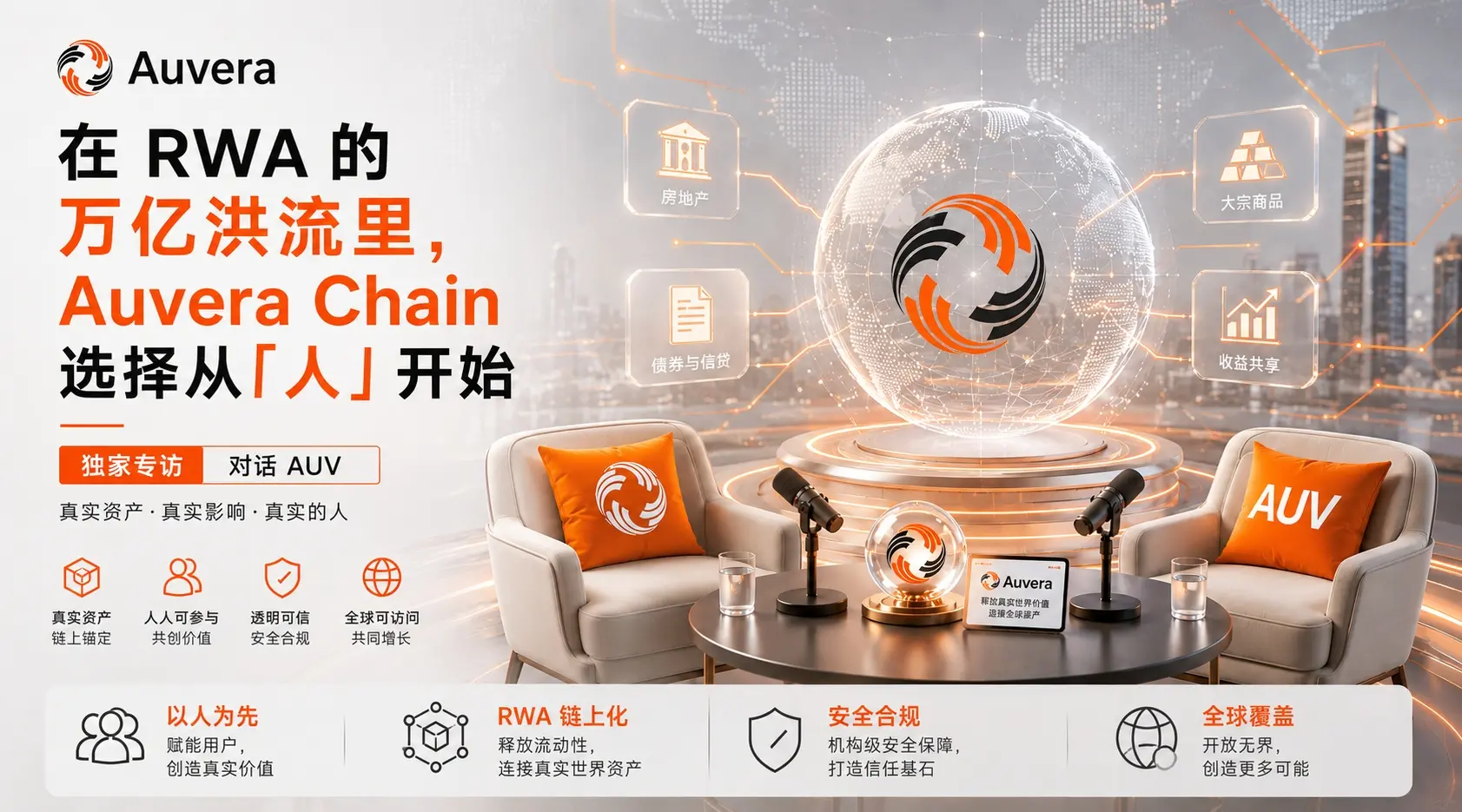
The year BlackRock pushed tokenized funds onto the blockchain, RWA completed its critical leap from conceptual experiment to asset management product. However, while all eyes turned to Wall Street, another hinterland of Web3 — the "consumer-grade RWA" composed of daily micro-actions like likes, completions, shares, and comments — remained a blank space not truly illuminated by infrastructure. Auvera Chain (AUV) has set its mainnet launch date for late May 2026, with the team hoping to create an EVM Layer 2 public chain focused on this hinterland, allowing the consumption of attention to be recognized and valued on-chain like financial assets.
1. The Invisible Corner That BlackRock Can't See Is Precisely Their Starting Point
In the past two years, RWA has been pushed to the forefront of the Web3 value narrative. BlackRock, Franklin Templeton, UBS — these names that were once far from the "crypto circle" have successively brought tokenized government bonds, money market funds, and credit products onto the blockchain. The potential scale of trillions of dollars is frequently cited, and institutional entry is seen as one of the keys to the next upward cycle.
But if we shift the lens from Wall Street to ordinary people, we find another side of RWA that remains blank. The attention consumed daily on short video platforms, the likes and shares converted into advertising fees by algorithms, and the content interaction data unilaterally possessed by platforms — they have never truly become personal assets. In the view of the Auvera team, this is the biggest absence in the RWA story.
"Financial-grade RWA is already being handled by BlackRock. But in the consumer-grade RWA track, there has been almost no dedicated infrastructure so far. This is our starting point."
2. For Two Years, They Didn't Rush to Launch the Chain — First, They Gathered People
In an industry where public chain projects generally pursue a rhythm of "launching the chain in six months, launching the token in nine months," AUV's start seems somewhat unusual. Over the past two years, the team did not rush to launch the mainnet but instead built localized operational nodes in various markets such as East Asia, Southeast Asia, North America, and Europe, country by country; and in these two years of practical experience, they completed token issuance for over 30 different industries.
This is a product rhythm imbued with traditional industry experience: first build relationships, then build the platform. In the view of the team members, the most fatal issue for new public chains is often not insufficient performance, but rather "no one uses it after going live" — no matter how impressive the technical parameters, they cannot compete with an empty ecosystem on the mainnet.
"We don't build a public chain first and then look for users. We thicken and densify the community and traffic first, and then let the public chain naturally take it on."
This statement sounds simple, but in the public chain industry, it actually reflects a rare patience — most projects have faltered on the path of "launching the chain first, then adding users."
3. Late May: A Start About "First There Are People, Then There Is a Chain"
The simultaneous launch of the mainnet and the $AUV token is set for late May 2026. This is not a randomly chosen time — according to official disclosures, the team has laid the groundwork for this specific time for a whole year.
Based on the existing community reserves, AUV has provided a relatively clear expectation for liquidity in the first month: within 30 days after the mainnet launch, approximately $100 million in buying funds is expected to concentrate on entering and introducing $AUV. This scale is not common in today's L2 space. Most new chains experience a long "cold start period" after launching the mainnet — with prices, ecosystems, and TVL all jointly sluggish. However, AUV theoretically possesses stronger initial absorption capacity because it has already thickened the community before launch — its start does not rely on airdrops or traffic granted by external exchanges, but is driven by endogenous community momentum.
In other words, late May is not the starting point of the AUV story, but the day it fulfills its "two-year opening."
4. Allowing a Like to Be Accounted for Like an Asset
To truly get consumer-grade RWA operational, the hardest part is not performance stacking, but cost control.
A complete view, an effective like, a community share — these actions have negligible individual value but occur very frequently. If every on-chain action costs one or two dollars in gas, then this will never happen.
AUV chose an EVM-based Optimistic Rollup Layer 2 architecture with a very specific goal: to reduce the cost of minting a single action to nearly negligible levels. According to official disclosures, the gas cost for a single action on AUV can be controlled to below $0.0005 — meaning that $1 can accommodate at least 2000 actions on-chain.
"If a like costs a dollar to go on-chain, then this will never happen. What we want to do is make going on-chain cheap to the point of being 'non-existent.'"
Around the main chain architecture, AUV has also equipped a complete set of financial infrastructure for RWA and AI Agent applications — a self-developed ZK + TSS hybrid cross-chain bridge responsible for multi-chain interoperability; Ve(3,3) DEX providing on-chain native liquidity; PoS consensus engine ensuring economic security; decentralized oracle market undertaking on-chain performance verification; and AI entity mining (AIBR) model incorporating computing power supply into a closed loop. These components may sound technical, but behind them is the same goal: to allow ordinary people's daily actions to be accurately claimed, valued, and generate revenue on-chain.
5. The Story of 2.1 Million: Making Scarcity a Byproduct of the Ecosystem
At the token level, the design of $AUV carries a philosophy of almost "restraint."
The total supply is rigidly capped at 2.1 million — a design that inevitably evokes thoughts of Bitcoin's 21 million. The difference is that BTC's scarcity comes from the mining curve; whereas $AUV's scarcity comes from the "usage" itself.
According to the "Mint-is-Burn" mechanism, every time an RWA asset is minted on-chain, an equivalent amount of $AUV will be simultaneously burned. The more active the ecosystem and the more frequent the on-chain actions, the more the scarcity of $AUV is continuously amplified. It is not a token waiting for buying pressure to push up its price, but an asset that makes network usage itself a deflationary force.
"We hope the value of $AUV is not determined by market sentiment, but by real usage."
This is a significantly different token philosophy: it does not rely on hype but on ecosystem operation; it does not rely on expectations but on the real frequency of minting. Scarcity is no longer a designed goal but a byproduct of the normal operation of the ecosystem.
6. Companions: Translating the Abstract Chain into Matters Close to Users
A public chain cannot complete its story alone. In AUV's ecological cooperation matrix, the most important type of partner is those who can truly translate the concept of consumer-grade RWA into concrete user scenarios.
Among them, the AI short drama × Web3 ecological project NobodyGlobal is one of the key partners frequently mentioned by the official team — it is responsible for translating abstract RWA narratives like "earn by watching" and "behavior as assets" into product experiences that ordinary audiences can directly perceive; AUV undertakes the underlying asset minting and rights confirmation infrastructure. In the partner matrix, exchanges that have completed account interoperability will serve as the initial liquidity entry.
According to the plan, after the mainnet launch, AUV will also negotiate with the top 50, top 20, top 10, and top 5 exchanges regarding listing and traffic interoperability, gradually establishing the global penetration of $AUV.
7. The Next Three Years: A Four-Level Ladder of Small Steps and Quick Progress
Compared to many new public chains that "tell all stories at once," AUV has broken down its development rhythm into finer phases, resembling an industrial-level plan:
· Phase 1 (2026 Q2): Mainnet launch, $AUV token debut — which is the key action in late May;
· Phase 2 (2026 Q3): Ecosystem expansion phase, focusing on introducing the first batch of RWA project parties and AI Agent application parties;
· Phase 3 (2026 Q4): Cross-chain integration, connecting assets and liquidity with mainstream public chains;
· Phase 4 (from 2027): Global expansion, replicating the already validated "community + public chain" model to more emerging markets.
The rhythm of these four phases is not aggressive — it resembles a "small steps, quick progress, steady and solid" industrial-level plan rather than the typical crypto project's approach of "maximizing expectations all at once."
8. In the Long Run of RWA, Some Have Chosen to Start from "People"
In an era where most public chains use technical indicators like "TPS, block time, gas optimization" as their calling cards, AUV's path seems somewhat counterintuitive: it does not place technical parameters in the most prominent position but instead highlights "two years of community accumulation" at the forefront.
This is a kind of slowness, but also a different kind of speed — fast in that there are real people using it, real project parties launching, and real funds flowing on the first day of the mainnet.
The 30 days following late May will be a critical window for this approach to undergo public market testing. In the early differentiation stage of the trillion-dollar RWA track, whether AUV can leverage its clear focus on consumer-grade RWA and the scarcity design of the "Mint-is-Burn" deflationary flywheel to carve out a different value path from existing L2s — this is a story worth long-term tracking.
After all, in an industry that venerates "performance," a public chain story starting from "people" has not been seen for a long time.
This article is compiled by RWA Daily from interviews with the Auvera Chain project team and official public information and does not constitute any investment advice. Cryptocurrency assets carry high market risks; please make independent judgments and participate cautiously.
 Risk warning