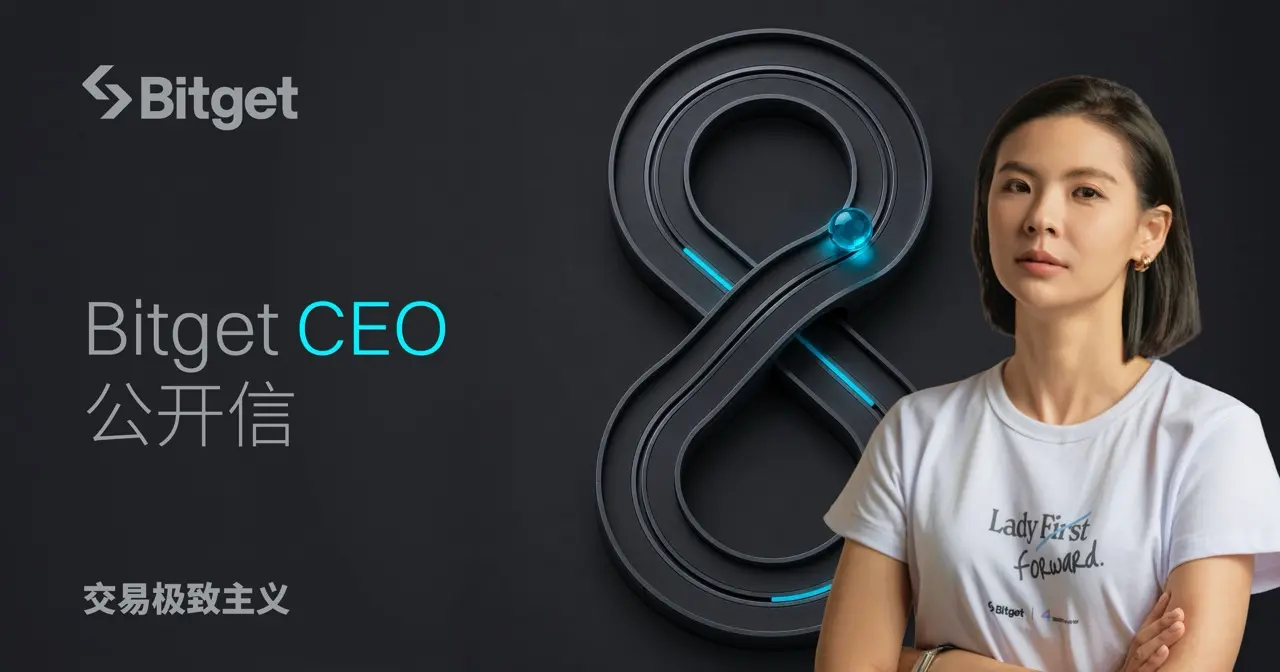
Bitget CEO 8th Anniversary Open Letter: From Chaser to Leader in Innovation, the Pursuit of Trading Excellence Has No Finish Line
Bitget celebrates its 8th anniversary, and CEO Gracy has released an anniversary open letter. She candidly stated that a year ago, when Bitget proposed the panoramic exchange UEX strategy, there were many doubts from the outside world, but the team chose to respond with product implementation. She mentioned that the starting point of UEX is to solve the fragmentation of assets, accounts, time, and geography, allowing users to trade high-quality global assets in one stop. Now, more and more leading exchanges are beginning to layout traditional financial trading, and Gracy referred to 2025 to 2026 as the "Year of Multi-Asset Trading."In her letter, Gracy wrote that over the past year, Bitget has transitioned from a "follower" to a "leader in product innovation," successively launching products such as stock perpetual contracts, Pre-IPO, cross-asset unified accounts, rToken, and Hong Kong stock Quanto contracts. Data shows that the peak trading volume of non-crypto assets has accounted for 40% of the platform's total trading volume, with daily trading volumes of TradFi contracts and CFDs both exceeding $10 billion, and the cumulative number of rToken transactions surpassing 3 million.Regarding the next phase, institutional business will become the core direction of Bitget. By the second quarter of 2026, the net asset scale of Bitget's institutional clients is expected to grow by 45% compared to the third quarter of 2025, with the number of core active market makers increasing from 90 to 248. In the future, the platform will continue to optimize trading execution, asset security, and institutional service links. Gracy concluded her open letter by stating, "The pursuit of trading excellence is never complete; it is always in progress. The era of multi-asset trading has just begun."