BTC $83,491.62 -0.81%
ETH $2,689.28 +0.51%
BNB $761.96 -1.75%
XRP $1.49 -0.91%
SOL $118.68 -2.28%
TRX $0.3358 +0.77%
DOGE $0.0935 -2.36%
ADA $0.2457 -2.77%
BCH $310.60 -6.40%
LINK $15.32 +9.94%
HYPE $87.30 -4.48%
AAVE $147.83 -4.00%
SUI $1.15 -7.61%
XLM $0.2256 +5.41%
ZEC $1,479.26 -6.69%
AAPL $338.80 -0.16%
AMZN $246.53 -1.04%
GOOGL $342.67 -0.24%
MSFT $510.02 -1.30%
META $718.72 -4.07%
NVDA $229.41 +2.20%
TSLA $358.55 -3.81%
SNDK $1,715.76 -3.25%
INTC $116.22 -5.72%
SPCX $146.16 -2.17%
MU $1,056.40 -3.14%
AMD $611.66 -3.01%
BTC $83,491.62 -0.81%
ETH $2,689.28 +0.51%
BNB $761.96 -1.75%
XRP $1.49 -0.91%
SOL $118.68 -2.28%
TRX $0.3358 +0.77%
DOGE $0.0935 -2.36%
ADA $0.2457 -2.77%
BCH $310.60 -6.40%
LINK $15.32 +9.94%
HYPE $87.30 -4.48%
AAVE $147.83 -4.00%
SUI $1.15 -7.61%
XLM $0.2256 +5.41%
ZEC $1,479.26 -6.69%
AAPL $338.80 -0.16%
AMZN $246.53 -1.04%
GOOGL $342.67 -0.24%
MSFT $510.02 -1.30%
META $718.72 -4.07%
NVDA $229.41 +2.20%
TSLA $358.55 -3.81%
SNDK $1,715.76 -3.25%
INTC $116.22 -5.72%
SPCX $146.16 -2.17%
MU $1,056.40 -3.14%
AMD $611.66 -3.01%

faq

All
Article
Flash

first_img SEC updates cryptocurrency FAQ, stating that token buybacks and network upgrades do not necessarily constitute securities

The U.S. Securities and Exchange Commission's Division of Corporation Finance updated its frequently asked questions document on cryptocurrency assets on Friday, clarifying that token buybacks, network upgrades, and marketing promotions do not automatically make cryptocurrency assets securities. The division stated that announcing a buyback plan for an already functioning cryptocurrency network does not, by itself, make the associated tokens constitute an investment contract; however, for networks that are not yet operational, if the issuer promotes the buyback as a source of returns for holders, this conclusion may not necessarily apply.Regarding the ongoing development issues of cryptocurrency projects after their launch, the document pointed out that once a cryptocurrency system is operational, services used to protect, maintain, improve, or enhance that system and its functions, or to promote network effects, do not fall under the managerial efforts referred to in the Howey test. The existing uses of marketing networks generally do not create profit expectations, and statements regarding future functionalities are similarly true, provided that profit potential is not promoted. The document reiterated that specific judgments still heavily depend on the actual circumstances of each case.This document is based on the interpretive guidance issued by the SEC in March of this year regarding the application of securities laws to cryptocurrency assets, released just weeks after the Clarity Act failed to advance in the Senate, with regulators continuing to operate under existing laws. Additionally, the U.S. Commodity Futures Trading Commission updated its cryptocurrency FAQs on Thursday, stating that futures companies and clearinghouses may invest customer funds in tokenized versions of previously permitted assets, provided that investment and custody requirements are met; regulated companies may use blockchain for record-keeping but must be able to provide relevant records when the blockchain or its block explorer is not operational.

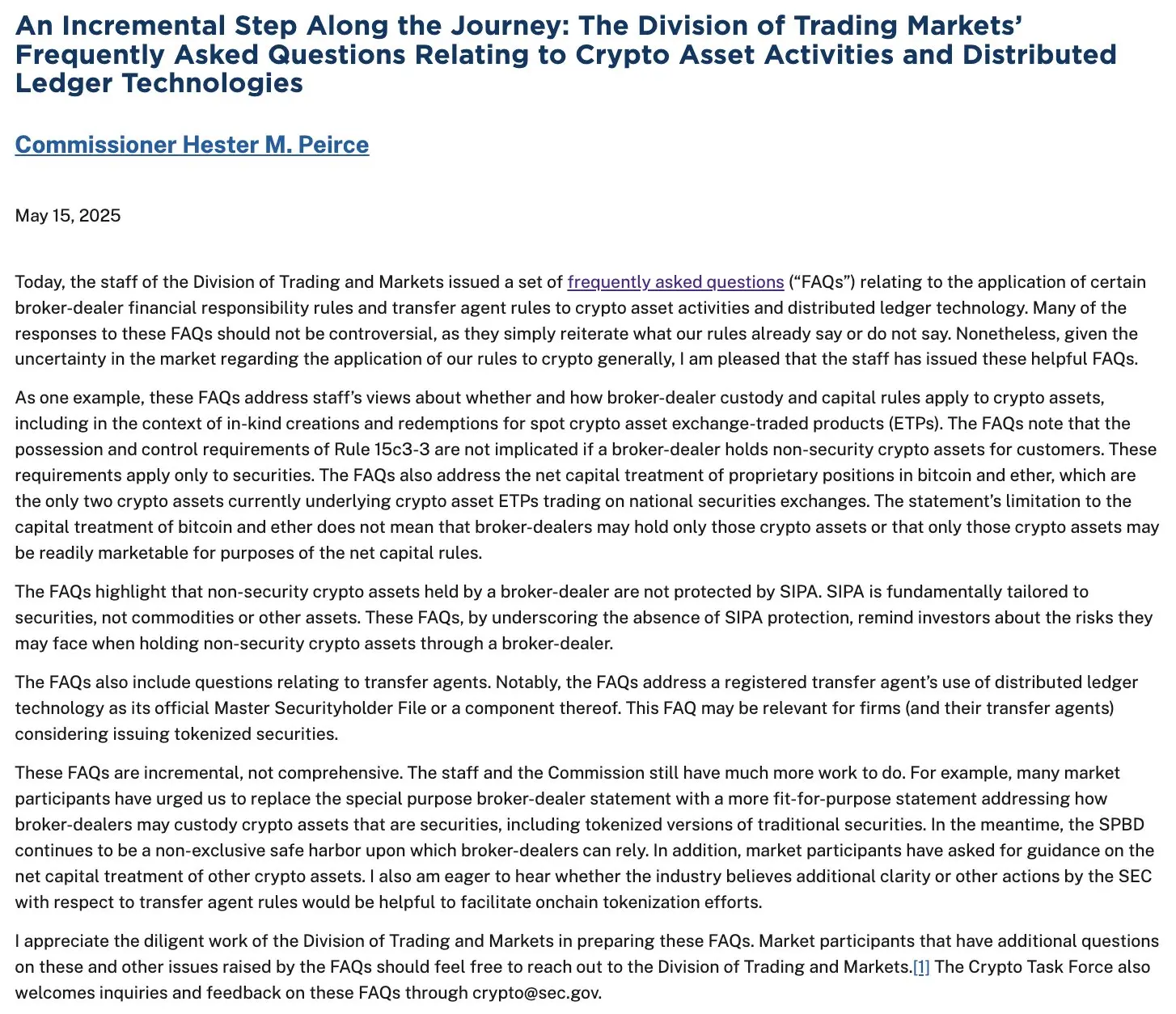
The U.S. SEC released regulatory FAQs related to crypto assets and distributed ledger technology

According to the announcement on the official website of the U.S. Securities and Exchange Commission (SEC), the SEC's Division of Trading and Markets recently released a Frequently Asked Questions (FAQs) document regarding activities involving crypto assets and distributed ledger technology (DLT), aimed at providing compliance guidance for market participants, covering the following core areas:Broker-dealer Responsibilities: Non-securities crypto assets are not subject to the provisions of Section 15c3-3 of the Securities Exchange Act; however, if they are "crypto asset securities," brokers may establish "control" under that section to meet compliance requirements. The SEC does not oppose non-paper form assets.Customer Asset Protection: If the crypto asset is not a registered product under the Securities Act, the SIPC (Securities Investor Protection Corporation) will not provide protection. The SEC recommends treating non-securities crypto assets as "financial assets" under UCC Article 8 and placing them in "securities accounts" to enhance the independence of customer assets in the event of liquidation.Dual Asset Trading Pairs: National Securities Exchanges (NSE) and Alternative Trading Systems (ATS) may offer paired trading of "crypto securities/non-securities assets," provided they comply with regulatory requirements and disclose relevant information in Form ATS or ATS-N.Transfer Agents and DLT: If a transfer agent provides securities transfer services for the issuer of crypto assets, and the assets are registered securities under Section 12, they must register with the SEC. The SEC does not oppose using blockchain as a master ledger, provided that all recordkeeping and regulatory requirements in federal regulations are met.Clearing and Settlement and ETPs: When registered brokers operate an ATS, they may clear customer transactions within their account ledgers, and the SEC does not mandate registration as a clearing agency. For ETPs referencing crypto assets, the SEC does not oppose their operation based on the no-action letter issued in 2006 for commodity ETPs.
app_icon
ChainCatcher Building the Web3 world with innovations.