Nebuis will release its financial report tonight, while CoreWeave has submitted its third-quarter report: how much cash flow can be realized from the $133 billion in orders?
CoreWeave's revenue surged by 168% in the third quarter, with adjusted operating profit margin rising to 10%, and the stock price skyrocketed by 24.7% in a single day; however, the yield on unsecured bonds once approached 15%. From renewing old GPUs, customer prepayments to project financing, let's see how much of the $133 billion in orders can actually translate into shareholder cash flow.
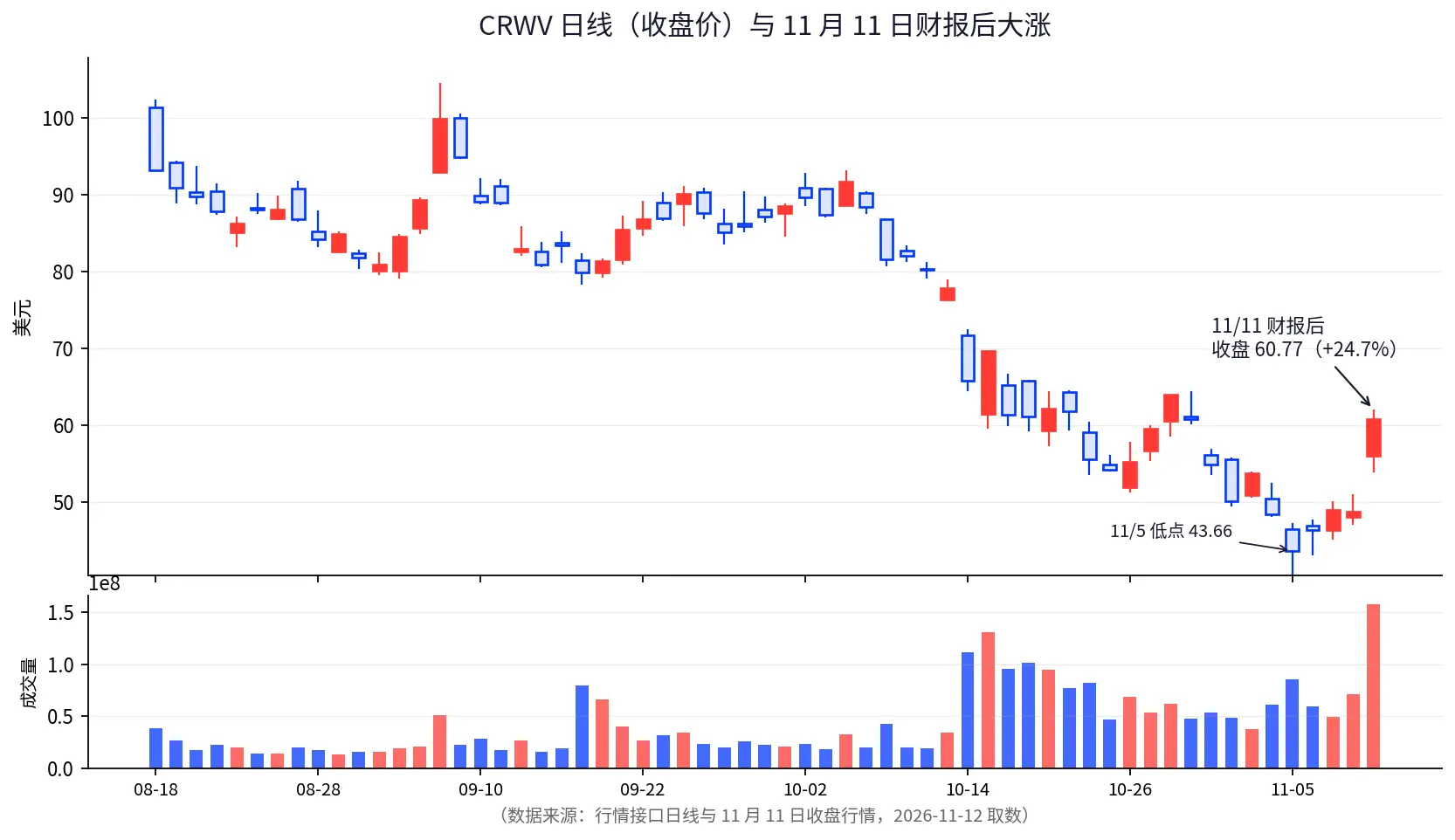
$133 billion in orders and a bond yield of around 15% are both associated with the same company. After the market closed on November 10, CoreWeave delivered its strongest quarterly report since going public, with third-quarter revenue of $3.661 billion, a year-on-year increase of 168%, exceeding the upper limit of guidance. On November 11, the stock closed at $60.77, up 24.7% from the previous close, reaching a high of $62.03 during the day, with a trading volume of 158 million shares, nearly four times the average daily trading volume over the previous three months. As of the evening of November 11, Eastern Time, it fell back to around $57 after hours. However, just a month before this financial report was released, the company's unsecured bonds had dropped to 79.5 cents, with yields approaching 15.2% (according to public reports).
The market over the past month has amplified this divergence. From a closing high of $91.72 in early October to a low of $43.66 on November 5, it retreated by more than 50%, with a single-day drop of about 15% on October 14, followed by another drop of about 12% the next day, during which unsecured bonds fell to 79.5 cents. The first trading day after the November 11 financial report closed at $60.77, up 24.7% in a single day, with trading volume increasing to nearly four times the average of the previous three months. Stocks and bonds are giving two different signals at the same time; the following content will break down these two directions and see what each is pricing.
A 15% bond yield essentially indicates that the market is worried about three things: First, I don't really believe you can smoothly survive until the 2027 debt maturity. Second, even if you do survive, I'm concerned that you won't be able to borrow cheap money by then. Third, if you really go under, I’ll be last in line, and getting back 30-40% would be good. Combined, these three statements equate to 15%. The stock price rises because of good performance; the bonds do not rise because even good performance cannot save the cash shortfall before 2027.
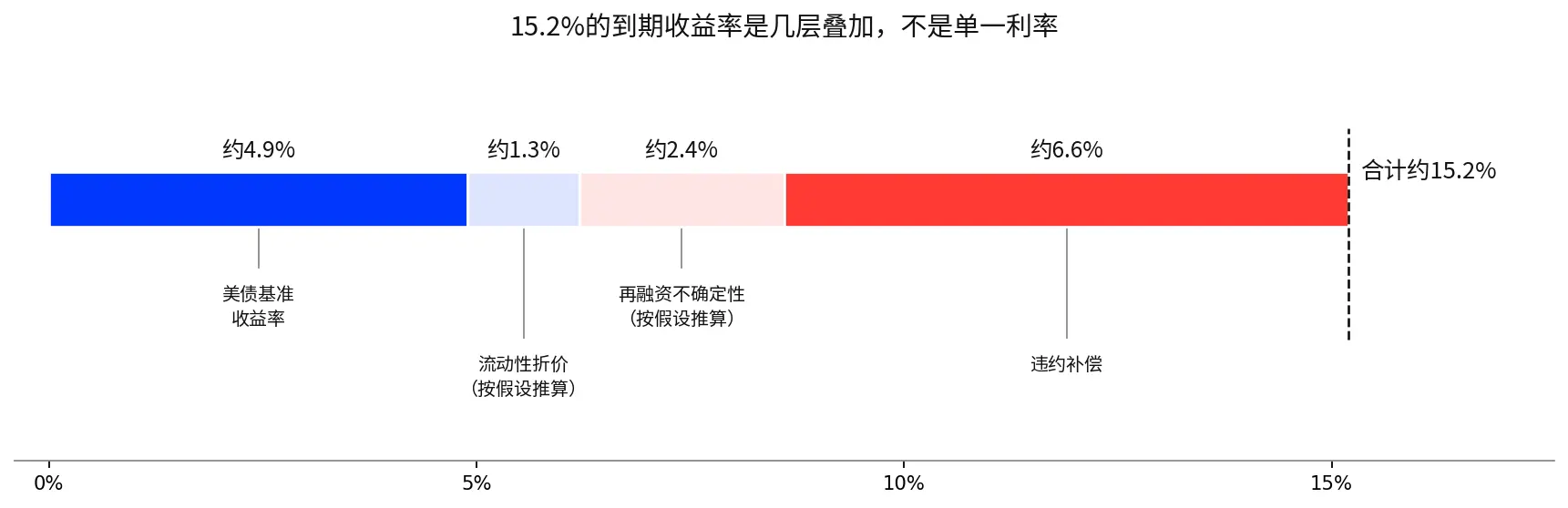
To elaborate, 15.2% is not just a single interest rate; it is a combination of several layers. At the bottom is the benchmark yield of U.S. Treasuries, which on November 10 briefly exceeded 5% for the 10-year Treasury yield (according to public reports). Above that is the credit spread, totaling about 10.3 percentage points, with default compensation making up the bulk and refinancing uncertainty and liquidity discounts making up the smaller portion (the layers are broken down based on hypothetical calculations). The bond market uses this 15% to express something unrelated to profit margins: who holds the pricing power when it comes to refinancing those maturing debts around 2027.
This is also why Nebius's third-quarter report is worth looking at in advance. Both companies are selling AI computing power, but one relies more on self-financing to buy GPUs, while the other emphasizes customer prepayments and commitments from investment-grade clients. Nebius's financial report happens to be released on the same day as this article, serving as a comparative experiment for everyone.
I. CoreWeave delivers an impressive report card: revenue surges, profit margin reaches 10%
Third-quarter revenue was $3.661 billion, a year-on-year increase of 168%, but what truly changed market expectations was the profit margin. The adjusted operating profit margin rose from about 1% in the first quarter and 5% in the second quarter to 10%. Management stated that a low double-digit profit margin was achieved a quarter ahead of the initial plan. Pricing on the sales side also increased, with a roughly 25% price hike across all products in July, followed by another increase of about 10% during the quarter. The long-term new contract price rose to $20 million to $25 million per megawatt per year, while short-term contracts could exceed $40 million.
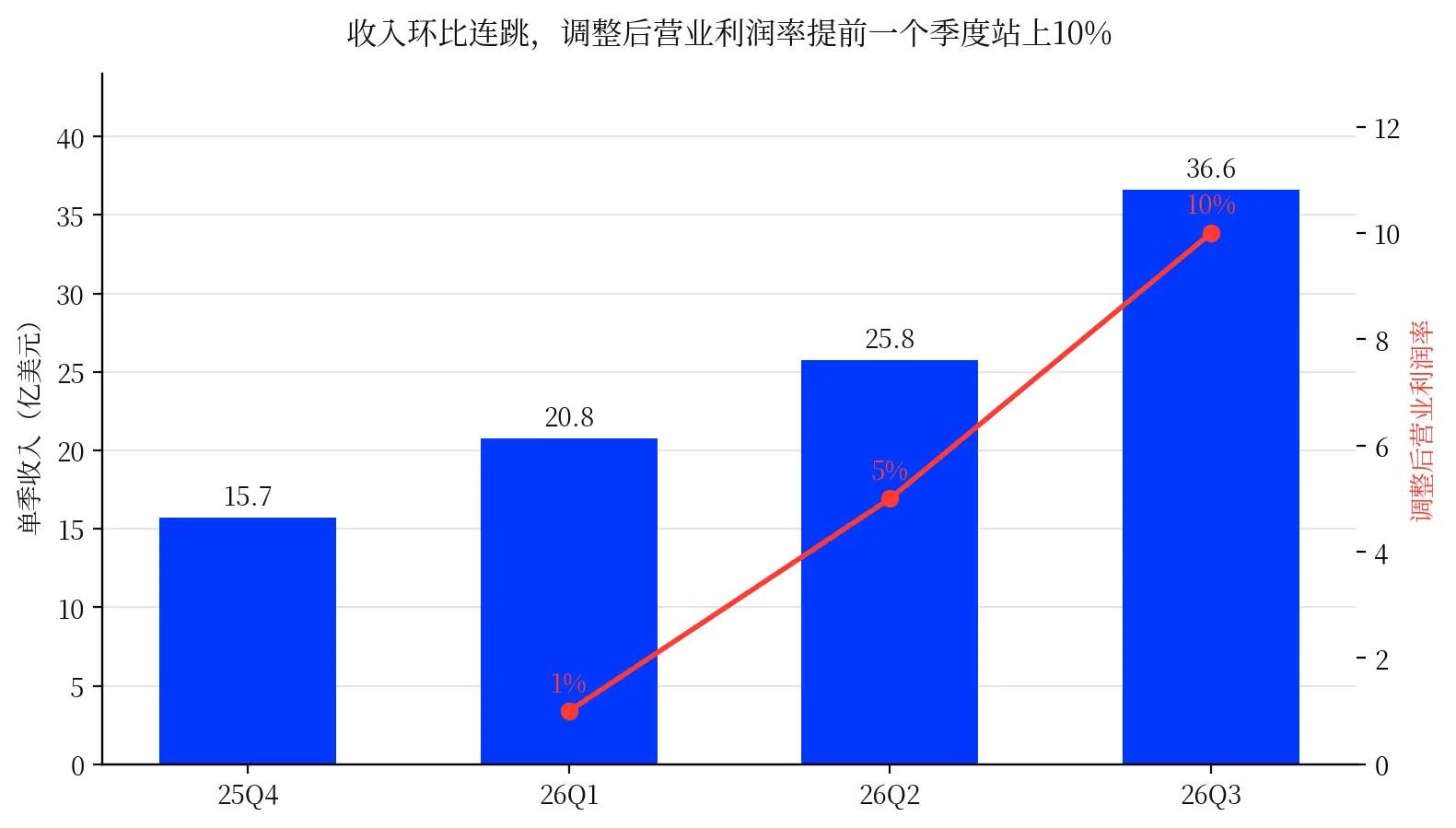
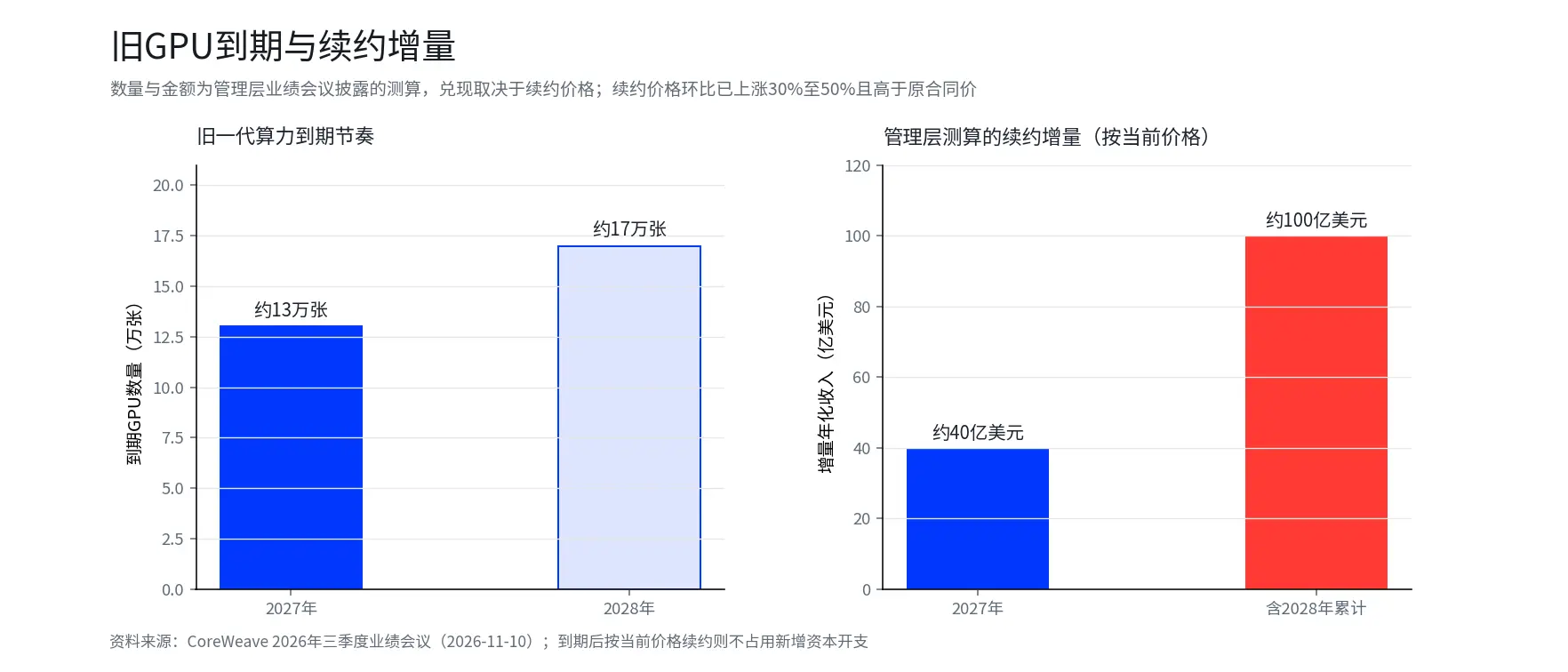
The rise in profit margin has two sources: one is the price increase of new contracts, and the other, often overlooked, is the renewal of old computing power. Management disclosed that the renewal prices for the old generation of computing power increased by about 30% to 50% quarter-on-quarter, exceeding the original contract prices. In 2027, over 130,000 GPUs will mature, and another approximately 170,000 in 2028. Based on current prices for renewals, management expects this to bring nearly $4 billion in incremental annual revenue in 2027, and close to $10 billion in 2028, without requiring additional capital expenditures. New GPUs require new money, while renewing old cards means monetizing already invested assets again, which is the most valuable segment in the profit and loss statement.
The increasing rental prices for old cards need explanation: the cost-performance ratio of GPUs has been continuously improving, and the cost per dollar of computing power for new cards has been declining. Therefore, the rental prices for old cards should have been driven down. Currently, there are three explanations:
Supply bottleneck: Power, data centers, and advanced packaging limit new production capacity, and customers cannot find fast enough alternative computing power. The pricing of old cards is based on "whether there are machines available now," not how high the cost per dollar of computing power is.
Extended economic lifespan: AI demand has made the residual value of GPUs higher than traditional depreciation assumptions.
Immediate delivery premium: Customers pay a premium to get computing power immediately. After new capacity comes online and wait times shorten, renewal prices may quickly fall back. The first two support the continuation of the premium, while the third suggests a potential retraction of the premium.
Distinguishing between them involves looking at renewal prices, the price difference between old and new GPU rentals, delivery wait times, and the utilization rate of old cards. If the renewal price in 2027 is lower than the original contract price, this bullish logic will be overturned for the first time.
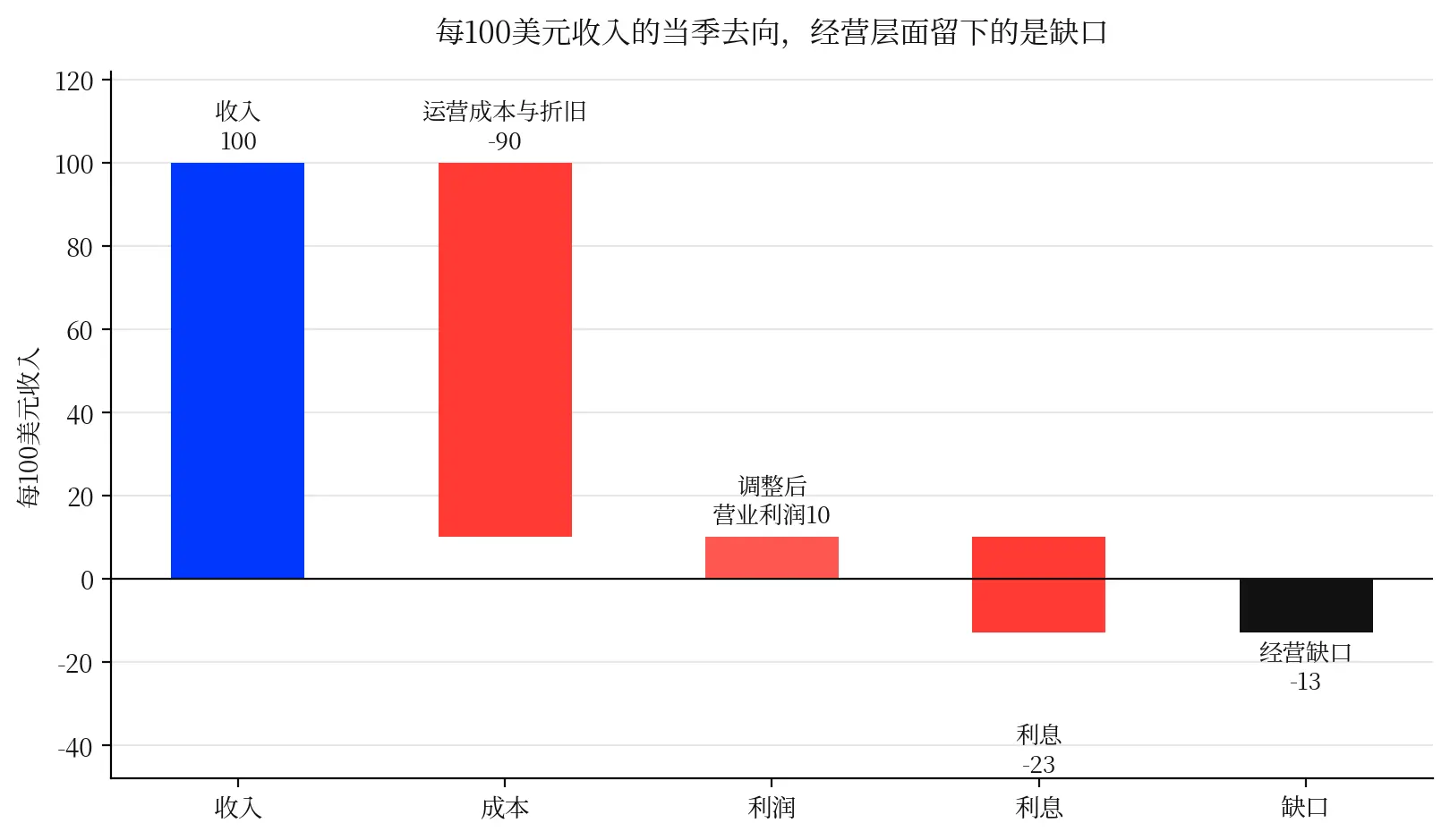
Interest always takes precedence over shareholders. In the third quarter, adjusted operating profit was $379 million, while interest expenses were $846 million, with interest accounting for about 23% of revenue; operating profit cannot cover interest. Based on the full-year guidance, interest is expected to be about $3.1 billion, accounting for 23% to 24% of revenue of $13 billion to $13.3 billion. Management expects significant narrowing of losses in 2027 and profitability in 2028. The market is trading on whether "profit growth can outpace interest growth"; otherwise, the valuation logic will reverse. The answer can only be seen in the orders and financing side, with the biggest change in the third-quarter report being a backlog of orders increasing by about $29 billion in a single quarter.
II. The $133 billion order is tempting, but orders are not cash: the real issue is how to finance them
By the end of the third quarter, CoreWeave's backlog of orders increased from about $104 billion at the end of the second quarter to $133 billion, with more than half expected to start delivery before the end of the year. Management further stated that capacity for 2027 is basically sold out, and 2028 is not yet fully sold out. The growth in orders addresses the demand issue but does not solve the financing problem.
A long-term computing power contract does not turn into cash on the day it is signed. CoreWeave must first build data centers, purchase GPUs, and pay for power and infrastructure costs before recognizing revenue according to the contract cycle. Based on a delivery cycle of five to six years, the $133 billion in contracts corresponds to an average annual revenue recognition of about $22 billion to $27 billion, which roughly aligns with the company's guidance of $20 billion to $21 billion in annualized revenue for 2026. Meanwhile, the company's cash capital expenditure guidance for 2026 reaches $37 billion to $39 billion; the faster orders enter the delivery phase, the more money needs to be invested upfront.
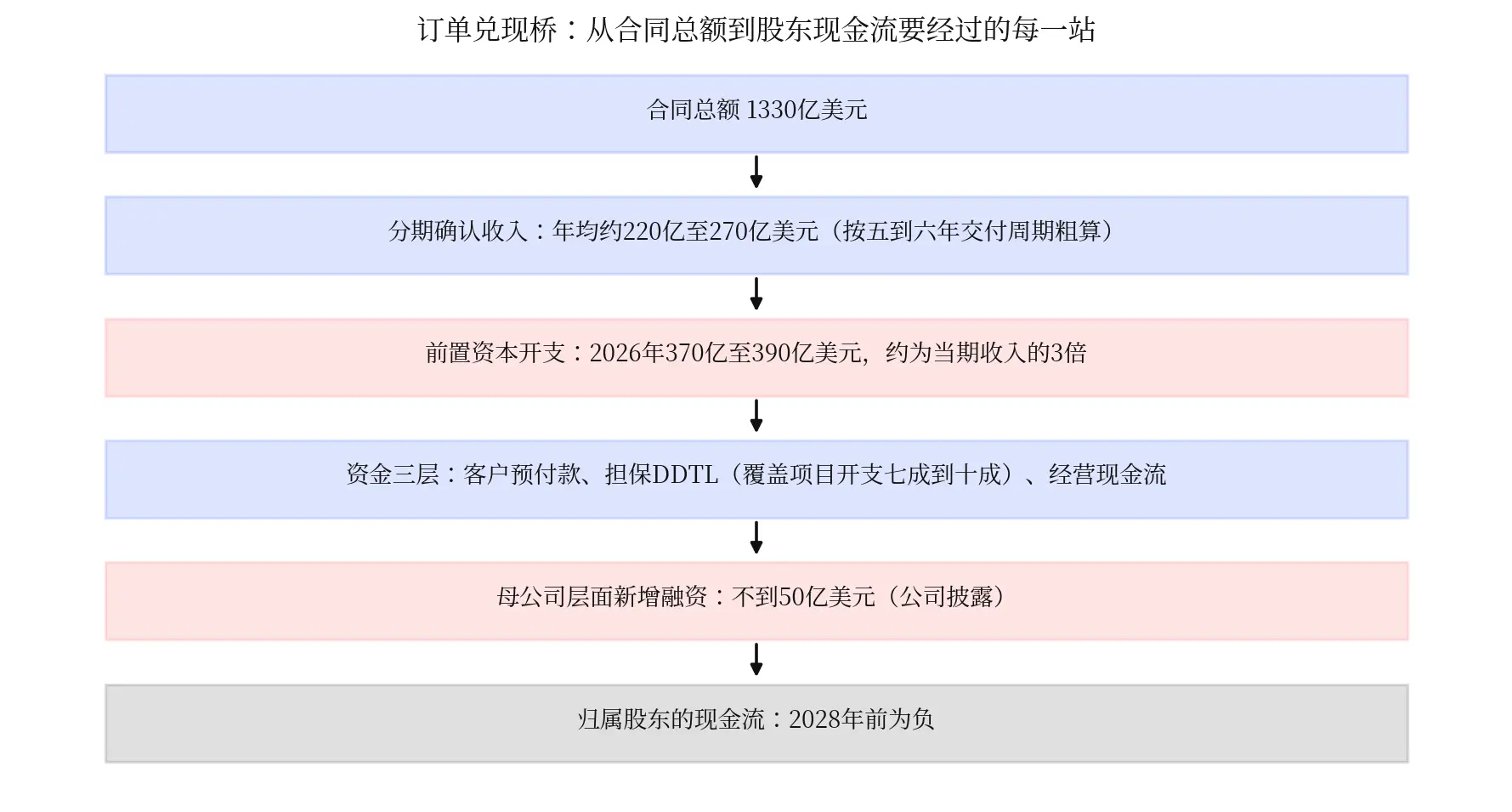
Therefore, it cannot be simply valued by dividing orders by revenue. Orders represent the total price of cash flow for the coming years, with a time lag in revenue recognition, capital expenditures occurring before revenue, and interest continuously draining cash throughout the process. What matters most for CoreWeave now is not how many more orders to sign, but how easily the already signed orders can be fulfilled. For the same $10 billion order, if the customer pays upfront, the contract is rigid, and the customer has strong credit, the risk borne by shareholders may be very low. If the company has to borrow money to build, the customer has strong renegotiation power, and financing costs are high, the larger the contract, the greater the initial funding pressure.
What matters most for CoreWeave now is not how many more orders to sign, but how much less self-funding is required to fulfill these signed orders and how stable the cash inflows are. Digging deeper, $133 billion is a range, not a single number:
The conference call clues roughly place the order quality at a neutral to optimistic position: the optimistic side is that about 70% of new contracts this year come with prepayments, the renewal prices for old computing power have increased by 30% to 50% quarter-on-quarter and exceed the original contract prices, capacity for 2027 is basically sold out, and WACD has dropped to 7.9%; the cautious side is that the five-year guaranteed loans correspond to an average of about three years for the underlying contracts, and the cancellation and renewal rates have not been disclosed, with the proportion of AI lab contracts being unclear. Balancing both sides, it is currently closer to neutral, with orders temporarily taking precedence in terms of pricing based on deadlines and credit. Future observations will focus on Nebius's prepayment and cash flow data tonight, as well as the renewal prices for the first batch of old GPUs in 2027. The market's discussions of 30-40% or 50% order discounts are only rough references and should not be taken as precise valuations.
III. Why has profit already risen, yet the bond market remains unconvinced?
The complexity of CoreWeave's financing structure arises because it does not solely rely on the parent company issuing bonds to buy GPUs. Total capital expenditures in the third quarter were about $14.5 billion, of which cash purchases of equipment were about $9.441 billion, with the remainder including equipment obtained through financing arrangements and other projects. The full-year guidance of $37 billion to $39 billion is based on cash capital expenditures, and the two calculations are based on different foundations, so it cannot simply multiply the quarterly total capital expenditures by four. Based on cash purchase numbers, the first three quarters totaled about $23.6 billion, and an additional investment of about $13.5 billion to $15.5 billion in the fourth quarter would fall within the full-year guidance range.
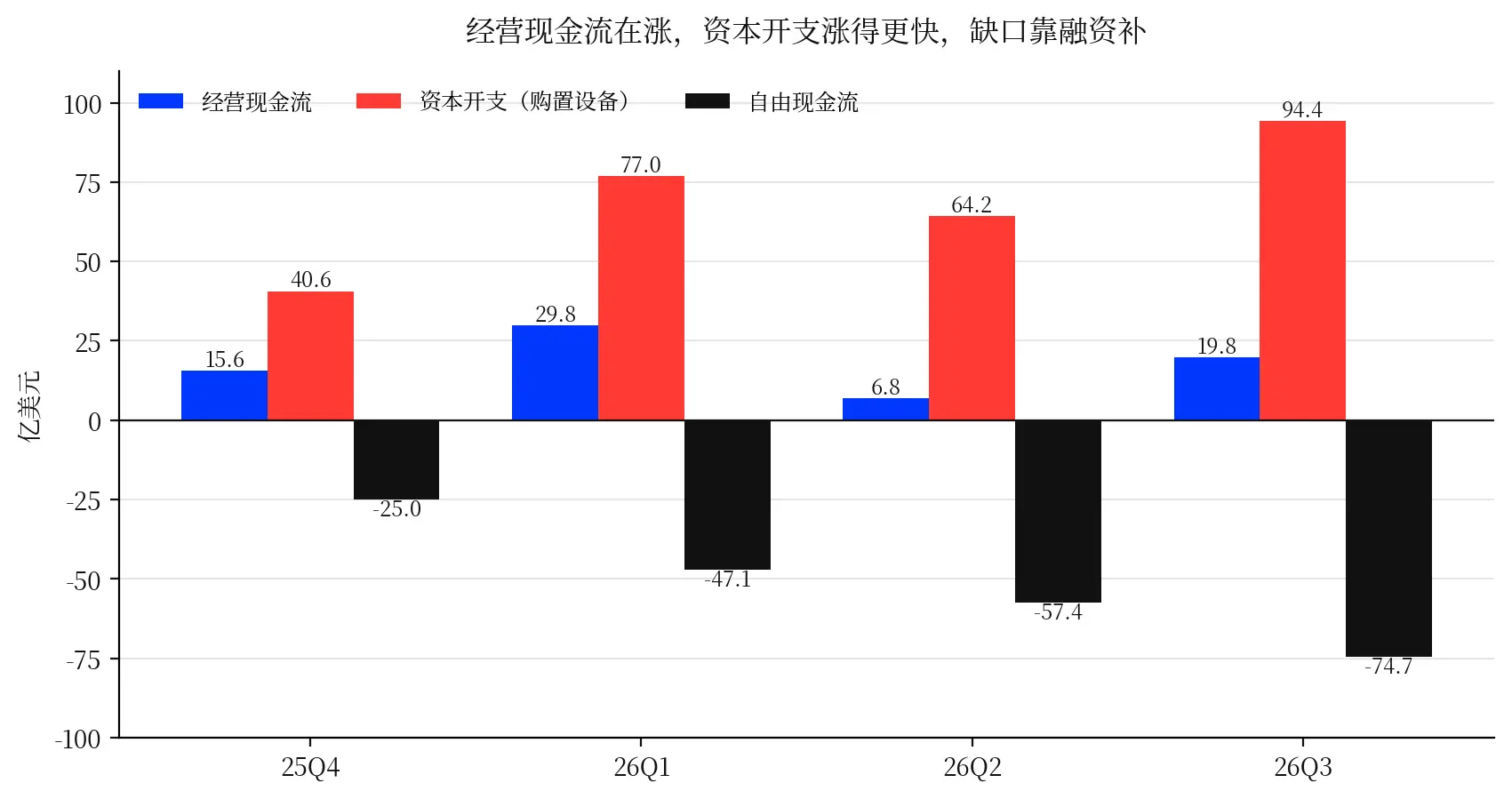
Real stress testing is not about asking whether a company has money, but rather seeing if, when one leg shrinks, the other two can compensate. Assuming a $2 billion reduction in advance payments, the gap can be buffered by unutilized DDTL limits, with a cost close to zero but consuming future capacity. If the available DDTL limit decreases by another $3 billion, the gap begins to transmit to the parent company level. If filled at an unsecured debt yield of around 15%, the annual interest would be about $450 million, equivalent to one-third of the adjusted annual operating profit guidance. If profit margins climb while being delayed by two quarters, and operating cash flow decreases by another $1.5 billion, the gap further widens. When all three worsen simultaneously, the total gap expands by about $6.5 billion, pushing the company towards expensive unsecured debt or even equity financing.
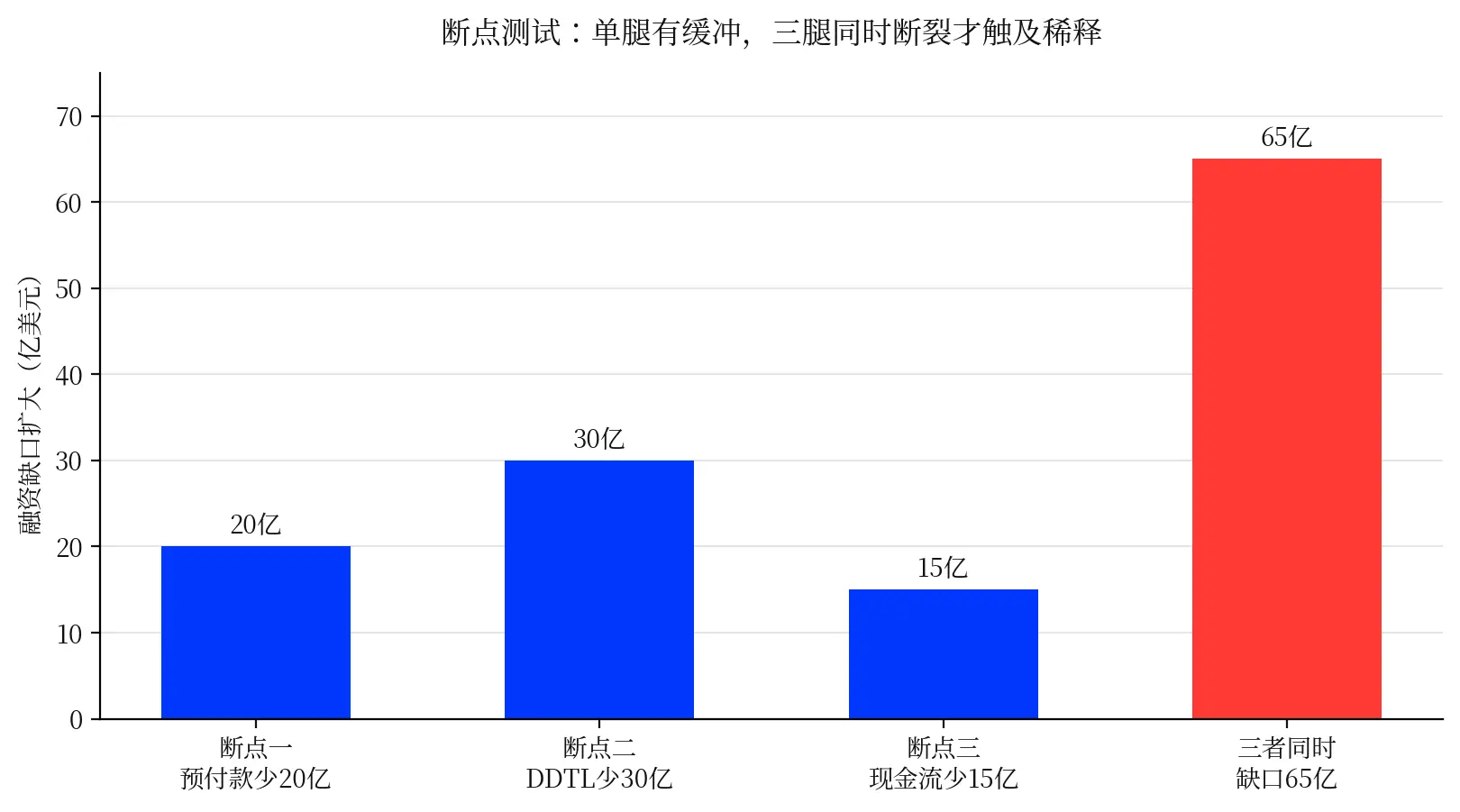
Based on the information from the third quarter report, let's arrange these breakpoints from near to far:
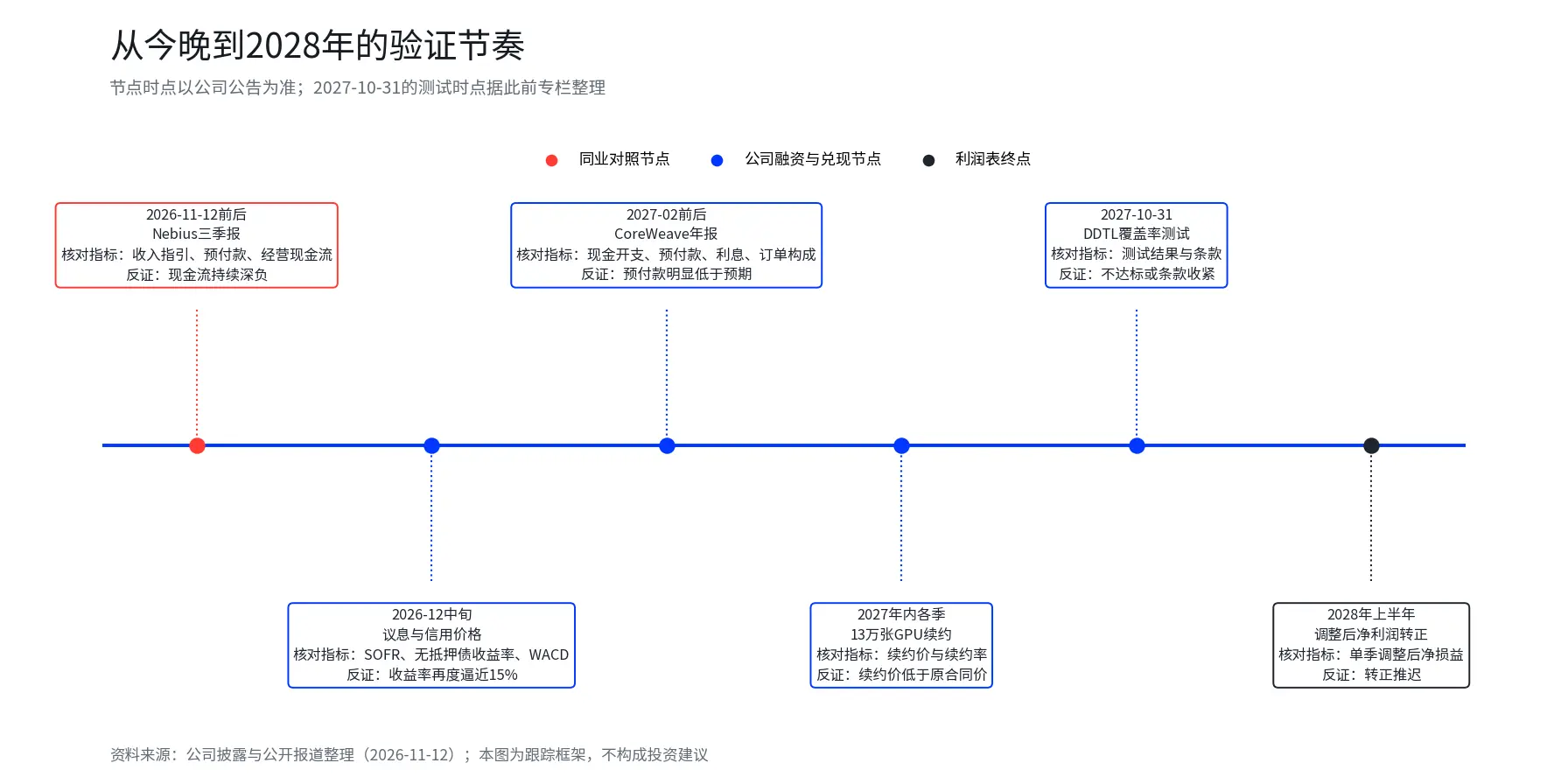
Recent: Advance payment breakpoint. The fourth quarter and the annual report in February next year will directly reveal the annual receipt situation, which is the only point that can be confirmed or refuted within the next three months.
Middle: Operating cash flow breakpoint. The triggering condition is the delay in profit margin climbing, which can only be verified in the first quarter report of 2027.
Farther: DDTL breakpoint. Coverage testing is expected around October 31, 2027.
Farthest and heaviest: All three legs breaking simultaneously. The triggering condition is issues with large customer payments or a general weakening of industry demand, for which there is currently no public evidence pointing to it.
The most critical point to watch right now is the advance payment. The bond market reacts before the stock market, and this is the reason. Stock investors look at future profit margins, while bond investors look at where the next money will come from. Whether the next money can be borrowed cheaply depends on how the parent company's credit and project credit balance out.
The adjusted operating profit for the third quarter is $379 million, against interest expenses of $846 million, covering about 0.45 times. Looking solely at the consolidated financial statements, this is not a comfortable number, and the interest guidance for the fourth quarter is expected to rise to $1.05 billion to $1.15 billion. However, CoreWeave's debt structure cannot be understood solely through the parent company's profit and loss statement: corporate credit looks at the entire company's profits, cash flow, and capital structure, while project financing looks at the specific project's own contract cash flow, collateral, and customer credit.
CoreWeave's substantial secured loans correspond to specific projects, usually backed by customer contracts, equipment collateral, and cash buffers formed by advance payments. The company discloses that such loans can cover a large proportion of the corresponding project expenses. Therefore, 0.45 times does not mean it cannot repay debt immediately; it truly indicates that the parent company's shareholder cash flow has not yet formed sufficient debt-bearing capacity, thus the company must place as much financing as possible at the project level.
This is also the most fragile link in the entire financing model: a project can borrow money based on contracts and collateral, and if the parent company's credit is slightly worse, it won't drag down every new expense; but once project financing requires the parent company to back it up, the financing system will shift from tiered pricing to overall pricing. By then, an unsecured debt yield of around 15% will truly become the cost for shareholders.
IV. CoreWeave's Most Critical Bet: Can Advance Payments and Project Financing Cover Capital Expenditures?
CoreWeave's debt does not have a uniform interest rate. Taking the second quarter debt breakdown compiled by a third party as an example, floating-rate secured debt is about $14.2 billion, with different DDTL rates varying by hundreds of basis points; the same tool called DDTL can have rates differing by over 300 basis points, with the difference not in the tool itself but in the underlying contract's credit. Cash flows from investment-grade customer contracts are more easily accepted by lenders, resulting in relatively lower financing costs, while AI lab contracts face uncertainties regarding customer credit and shorter contract renewal periods, leading lenders to demand higher risk compensation.
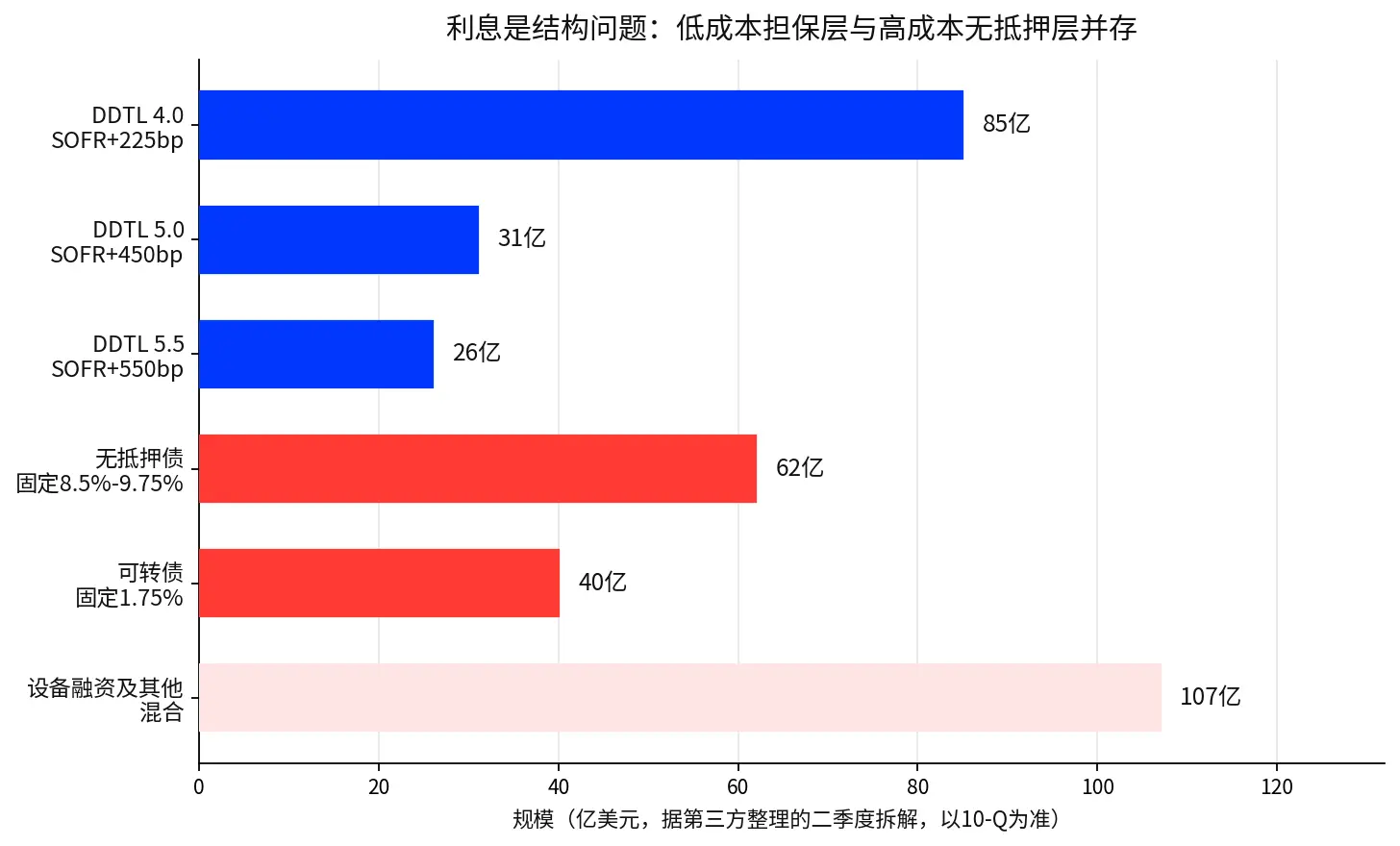
The company's disclosed WACD has already dropped to 7.9%, down about 250 basis points year-on-year, with over $4 billion repaid in advance in the third quarter, including some higher-cost DDTL. This is a positive signal because every reduction in financing costs provides an additional buffer for the cash flow left for shareholders after order fulfillment. However, WACD could also become a risk amplifier; credit deterioration could push new financing into higher interest rate brackets, increasing interest expenses and squeezing free cash flow, which means more external financing is needed. Increased financing demand would push bond yields higher, making the next financing more expensive, which in turn feedbacks into WACD.
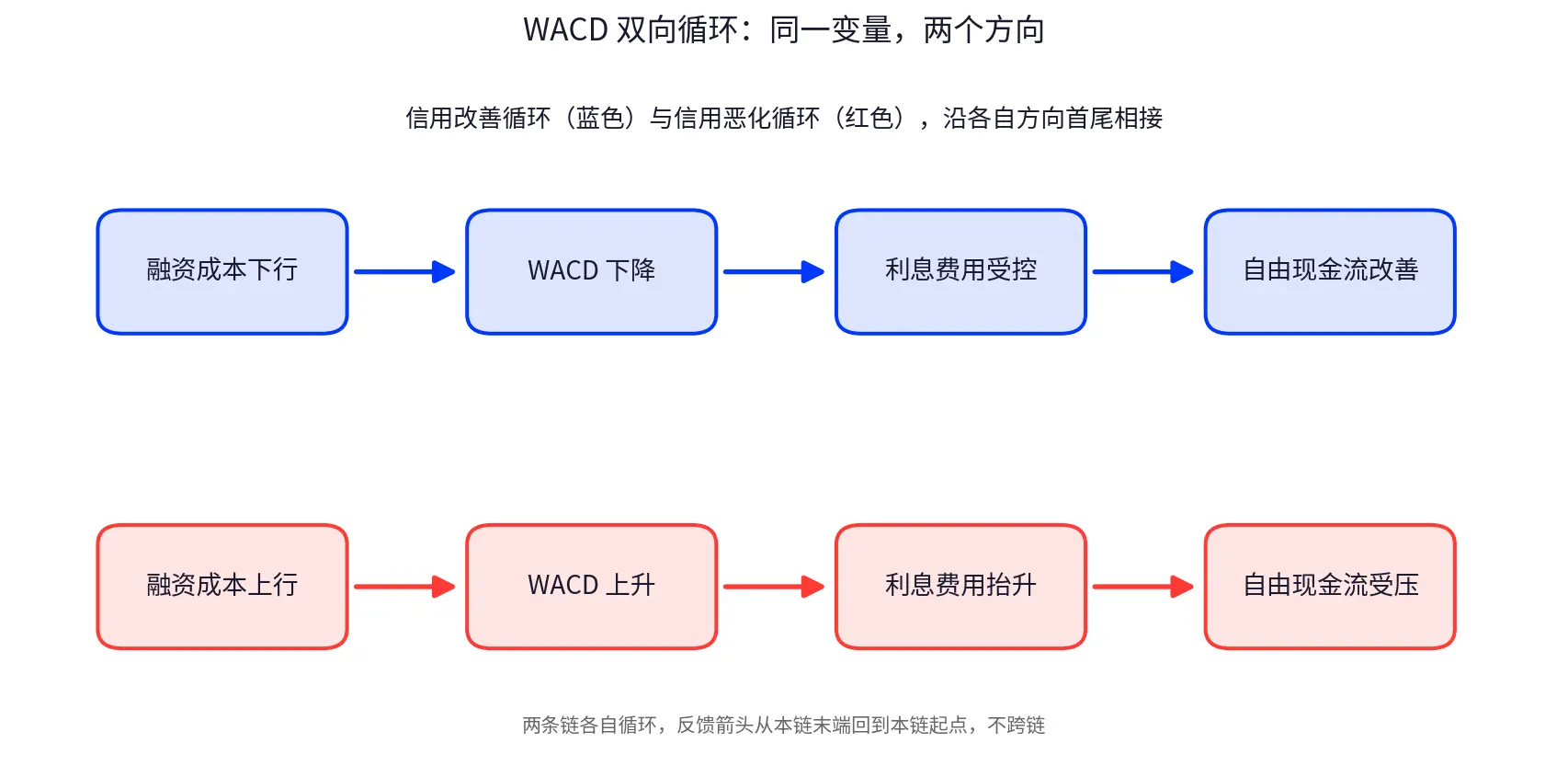
Quantitatively examining this chain: based on approximately $14.2 billion in floating-rate secured debt, for every 100 basis point increase in SOFR, annual interest increases by about $140 million, or about $35 million for every 25 basis points. If the gap is filled with unsecured debt at 15%, each $140 million gap would generate about $20 million in additional interest annually. This calculation is more meaningful than "every 100 basis points increase in total debt adds $500 million," because fixed-rate debt does not change synchronously with SOFR.
Looking ahead at CoreWeave, there is no need to guess the stock price daily. What is more worth monitoring are three things: whether WACD can continue to decline, whether new financing still falls within the secured low-interest rate bracket, and whether interest expenses begin to outpace adjusted operating profits. If all three worsen simultaneously, the bond market's concerns will shift from valuation to the profit and loss statement. Meanwhile, beyond financing costs, there is another variable that the market has not priced in much: downstream capital expenditures.
V. Tonight's Focus on NBIS: In Selling AI Computing Power, Who is Paying First for Whom?
Nebius's financial report happens to be released on the same day as this article. CoreWeave and Nebius's business models look very similar, but their financing paths are different. AI computing infrastructure can be roughly divided into four categories.
|----------------|------------|----------------|-----------| | Model | Who Pays First | Who Bears GPU Residual Value Risk | Financing Difficulty | | CoreWeave-type GPU Cloud | Company finances GPU purchases | Company | Parent company plus project financing | | Nebius-type Prepaid Cloud | Customer prepayment covers part of expenses | Customer bears more | Lighter financing pressure on parent company | | Hosting Type | Customer provides own GPU | Customer | Project lease financing | | Ultra-large Scale Cloud | Group balance sheet | Group | Relies on group credit |
The core issue behind this table is just one: who pays first. According to the closing prices on November 11 and disclosures, Nebius has a market value of about $37.1 billion, with investment-grade customers like Microsoft and Meta committing over $40 billion; CoreWeave has a market value of about $33.5 billion but carries $133 billion in orders. Both companies are proving that demand for AI computing power is strong, and on the same day, Nebius also rose by 15.4% alongside CoreWeave, but the market's valuation gap is significant: according to previous data providers, Nebius has about a 16 times forward price-to-sales ratio, while CoreWeave is about 5 times.
This gap cannot simply be attributed to the market being more optimistic about Nebius; what is more worth noting is where the capital expenditure risk lies. A high proportion of customer prepayments means the company does not have to borrow all capital expenditures upfront; strong customer credit also leads to lower project financing costs; and long contract coverage makes it easier for lenders to convert future cash flows into financing capacity. Conversely, CoreWeave finances GPU purchases itself and bears the residual value risk, so the market will naturally demand higher risk compensation.
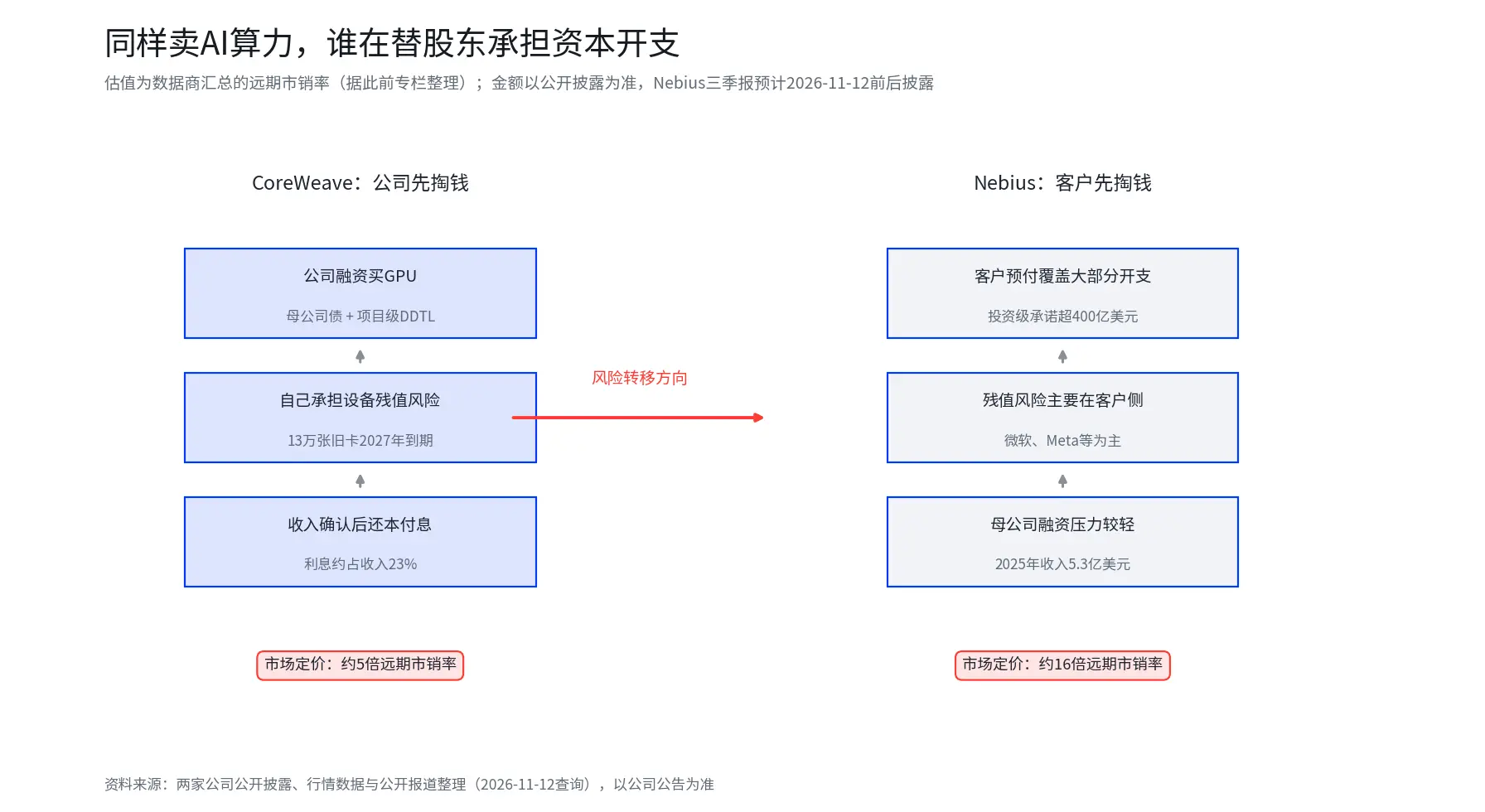
Nebius's financial report is not just about how much it earns itself, but also serves to test whether CoreWeave's valuation discount is reasonable. Ordinary investors do not need to calculate earnings per share themselves or create detailed tables; they only need to look at the three results that the market cares about most: whether customers have paid upfront, whether commitments from large customers like Microsoft and Meta have materialized, and whether the company has over-leveraged when borrowing for expansion. If Nebius expands quickly but borrows little, then CoreWeave's valuation discount has a solid business explanation; if Nebius also relies on substantial external financing to support its expansion, the valuation difference between the two is more a reflection of market sentiment. The financial report is out tonight, and the media and conference call will focus on these three points.
VI. AI Cloud Money Flows Downstream: $37 Billion Capital Expenditure, Who Will Be the First to Benefit from Rising Storage Prices?
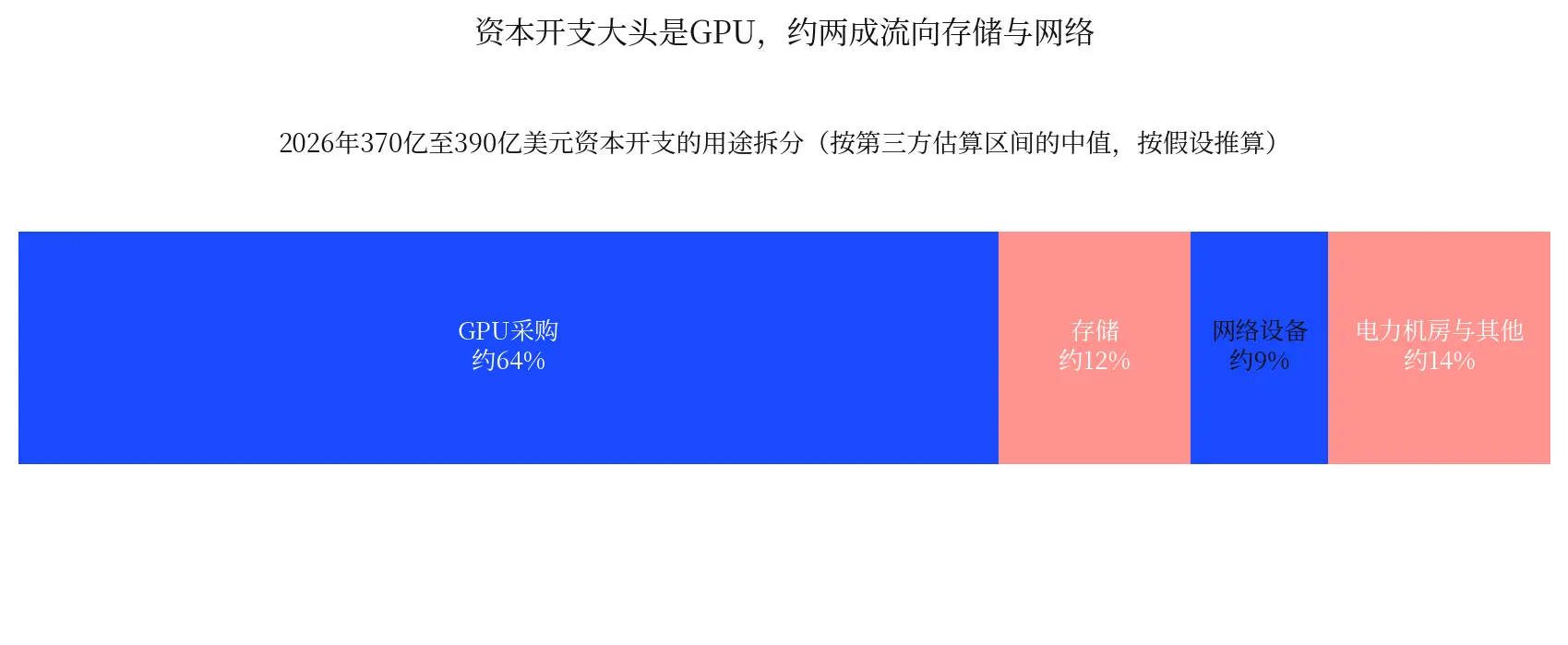
CoreWeave's capital expenditures are not just a matter of its own balance sheet; they will transmit along the supply chain. The transmission path is that AI cloud companies' GPU orders become revenue and cash flow for suppliers, and suppliers' capacity plans translate into demand for HBM and DRAM, with tight demand ultimately reflected in storage prices. Breaking down the $37 billion to $39 billion cash expenditure for 2026, the bulk is for GPU systems and networking, with storage embedded in every server, following the procurement of complete systems. The company has not separately disclosed the proportion of storage, but it can be confirmed that the procurement scale is synchronized with the number of deployed cards.
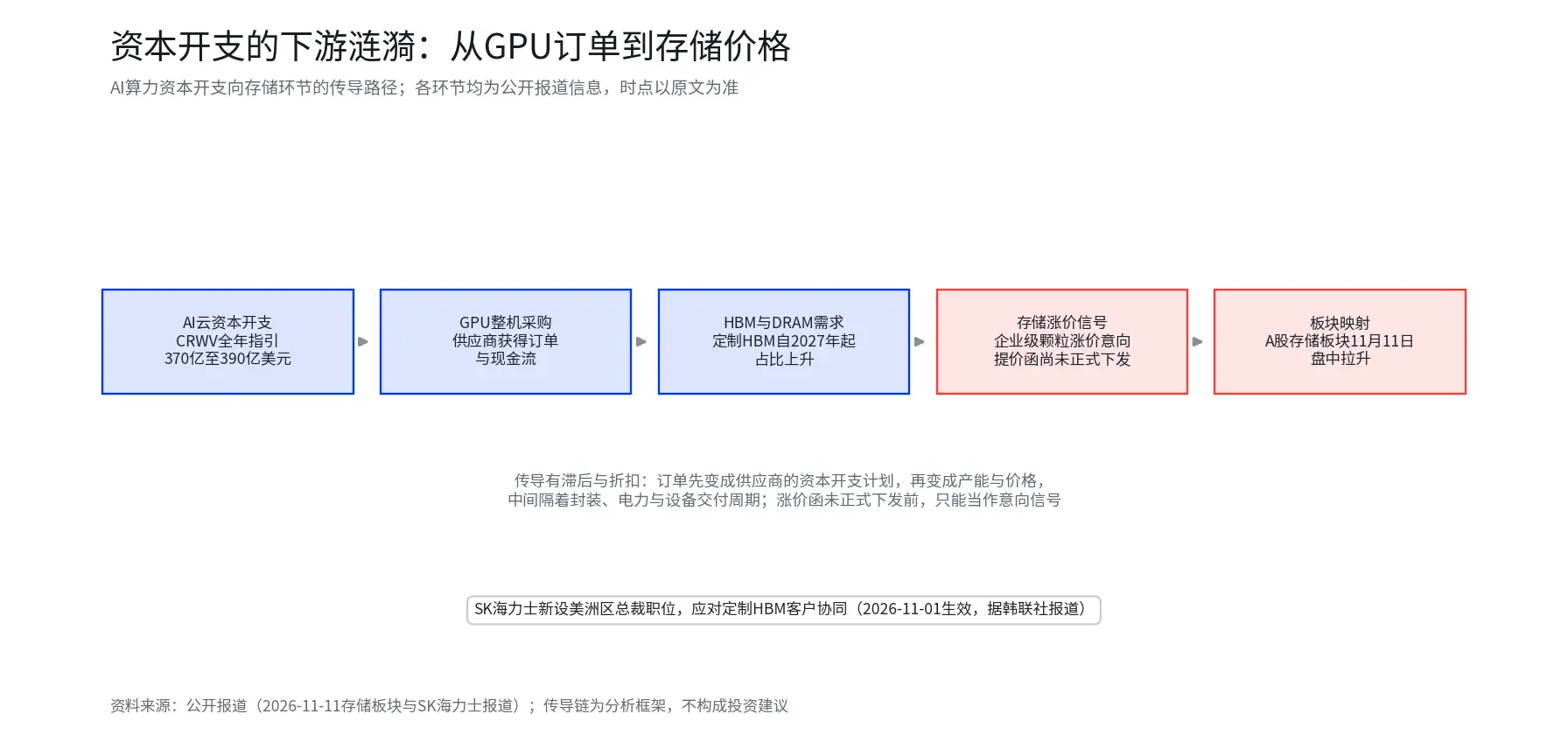
HBM is the most certain link in this chain. The information disclosed by the company carries weight: the revenue share from GPU cloud services dropped to 72% in the third quarter, with GPU procurement commitments to suppliers like NVIDIA written into the financial statements; management explained on the conference call that old cards expiring next year are mainly being renewed, with renewal prices increasing by 30% to 50% quarter-on-quarter. This portion represents real orders with agreed prices and does not require further estimation.
The supply side also has public judgments. According to TrendForce's industry analysis for the fourth quarter of 2026, the consumption of HBM will double, and supply and demand will tend to be balanced. The ramp-up of HBM4 and tight supply will drive up prices in 2027, with bargaining power leaning towards suppliers. Storage manufacturers are restructuring customer relationships around customized HBM. On the demand side, there are renewal orders disclosed by companies, and on the supply side, there is a judgment of tight balance in the industry. If both sides align, that direction is sufficient. As for the proportion of this company's procurement in the global HBM market, this article only maintains a directional judgment: the demand from a single AI cloud company is more about verifying the authenticity of AI demand rather than directly influencing storage pricing.
Recent public signals have also fallen on this chain. According to media reports, on November 11, the A-share storage chip sector rose in the afternoon, and some leading companies have verbally informed channel partners of their intention to raise prices for enterprise-grade chips, although the official price increase letters have not yet been issued. SK Hynix established a new position of President for the Americas on October 30, appointing An Hyun, who led HBM research and development, effective November 1. The background is that AI chip manufacturers are increasingly deeply involved in memory design, and customized HBM is expected to become more important starting in 2027.
To verify this chain, one must follow the order of price signals: verbal price increase intentions are just the first step, followed by the formal issuance of price increase letters, contract price adjustments, and spot price increases. With each step forward, the judgment of strong demand for AI computing power gains an additional layer of confirmation. There are delays and discounts in transmission; orders first become suppliers' capital expenditure plans, then transform into capacity and pricing, with packaging, power, and equipment delivery cycles in between. The rhythm of each stage lacks company disclosures for reference, so a rough order can be based on past public experiences of price increase cycles in the storage industry, with specific timing subject to company announcements and third-party quotes. If the price increase letters are not issued as expected within a few weeks, it indicates that the verbal intentions may just be channel tests, and the supporting evidence for storage price increases should be questioned, requiring a reassessment of the quality of CoreWeave's order fulfillment. For those reading about CoreWeave, the purpose of this chain is always cross-verification; if storage prices weaken, the quality of order fulfillment should also be reassessed.
7. From NBIS to CoreWeave, the following cash flow signals are worth monitoring
The pressures faced by CoreWeave can be divided into three transmission chains. A decline in stock prices while bond prices remain stable is more of a risk appetite issue; simultaneous declines in stocks and bonds indicate that the market is beginning to reprice the company's credit and refinancing ability. Rising interest expenses while bond prices remain low put pressure on the actual profit and loss statement. The worst-case scenario is that all three chains activate simultaneously, with the interest rate environment increasing the cost of floating-rate financing, and bond yields approaching 15%, making financing for the parent company more expensive. A contraction in risk appetite also narrows the equity financing window, at which point customer prepayments, project-level financing, and operating cash flow will all come under pressure.
If credit prices fall and WACD continues to decline, while old GPU renewal prices remain high, this round of rebound will receive more cash flow validation. Conversely, if prepayments decline, financing costs rise, and old GPU renewal prices fall simultaneously, the $133 billion order may instead become a pressure point: the company must invest more capital in advance for more orders, yet each dollar of order leaves less and less cash. The above is merely a tracking framework and does not constitute investment advice; a single indicator is insufficient to determine direction, and conclusions should be updated quarterly.
Finally: $133 billion is not the issue, who will pay for it is the issue
CoreWeave's third-quarter report proves that computing power can increase in price, and profit margins can rise rapidly; however, it has not yet proven that orders can transform into shareholder cash flow with low asset intensity. The early achievement of a profit margin above 10% is the reason for the stock market's repricing, while high interest rates and massive capital expenditures are the reasons for the bond market's continued caution.
The $133 billion is not cash in CoreWeave's hands but rather a total contract amount that requires upfront capital investment and financing costs to be paid before gradually being fulfilled. What should truly be valued is not the face value of the orders but how much free cash flow remains after the orders are fulfilled. For this company, order growth itself is not the biggest variable; rather, it is who can grow orders and financing capacity faster.
Tonight's Nebius financial report will further push this question towards the entire AI cloud sector: if customer prepayments, investment-grade contracts, and a lighter financing structure can indeed allow Nebius to use less shareholder capital during rapid expansion, then CoreWeave's valuation discount is not merely a market sentiment issue; conversely, if Nebius also needs continuous financing to fulfill orders, then what the market ultimately trades is not "who has more orders," but who has a greater ability to turn AI demand into real free cash flow.
Disclaimer: The content of this article is for general information and market commentary purposes only, compiled based on publicly available information as of the time mentioned in the article. Relevant market data, expectations, and probabilities may change with market conditions. The views and investment strategies of third-party institutions, analysts, or other individuals cited in this article represent the views of the relevant third parties at a specific time and do not represent the views or recommendations of BIT. This article does not constitute investment advice, investment research, solicitation, or recommendation of any securities, investment products, or trading strategies, nor should it be the basis for any investment decision. Financial markets carry risks, and securities prices and market performance may fluctuate. Past performance and historical market trends do not represent or guarantee future results. Investors should independently assess the relevant risks based on their own circumstances and seek professional advice when necessary.
 Risk warning Risk warning




Popular articles