Q3 cryptocurrency financing continues to cool down, with funds shifting towards later stages and strategic rounds
 Core Viewpoint


 RootData data shows that in the third quarter of 2026, there were a total of 199 financing deals in the primary cryptocurrency market, with a disclosed amount of 4.46 billion USD. The number of deals has declined for four consecutive quarters, and the amount has decreased by 74% year-on-year; funds have clearly shifted towards later-stage strategic rounds and "financial pipelines" that can charge fees and hold licenses.

Overview
In the third quarter of 2026, Bitcoin rose by about 43%, while the primary crypto market continued to cool down. RootData recorded a total of 199 financing rounds, with disclosed amounts totaling $4.46B; the number of rounds has declined for four consecutive quarters. However, the market did not come to a standstill, and the direction of funds and investors has undergone profound changes.
VC activity has significantly cooled down. The number of transactions decreased by 5% quarter-over-quarter, and the disclosed amount decreased by 24%.
Funding is shifting towards later and strategic rounds. Strategic rounds and private rounds accounted for about $1.75B, while early rounds only accounted for about $0.73B. Excluding public company follow-ons, IPOs / de-SPACs, mergers and acquisitions, token public offerings, OTC, and debt financing, this quarter saw 144 equity financing rounds with a disclosed amount of approximately $3.38B, up 12% quarter-over-quarter and 35% year-over-year; the number of rounds decreased by 14% quarter-over-quarter and 36% year-over-year. The total amount year-over-year decreased by 74%, mainly due to the high base from public company follow-ons and IPOs in the third quarter of 2025.
The median amount has rebounded, but large transactions have decreased. The median disclosed amount rose from $6.0M to $8.0M; transactions over $100M decreased from 17 to 13, and the top ten transactions' share dropped from 62% to 57%. The most significant decrease was in disclosed small transactions under $5M.
Most funds were invested in centralized financial companies such as exchanges and brokerages. CeFi recorded 31 transactions, taking 32% of the disclosed amount; DeFi had 51 transactions, the highest number, but only captured 8%.
The amount of transactions solely involving crypto-native capital decreased by nearly 60%. The disclosed amount for these transactions fell from $2.57B to $1.05B; transactions involving traditional finance or general capital saw their share rise from 39% to 45%.
The outlook for the next round of financing is pessimistic. This quarter, only three new crypto venture funds completed fundraising, totaling about $1.3B, marking the lowest number of new funds since the third quarter of 2019.
1. Cryptocurrency Prices Rise, but the Primary Market is Cooling
This quarter, RootData recorded a total of 199 financing rounds, of which 116 disclosed amounts totaling $4.46B. The number of rounds decreased by 5% compared to the second quarter, and the amount decreased by 24%; compared to a year ago, the amount decreased by 74%.
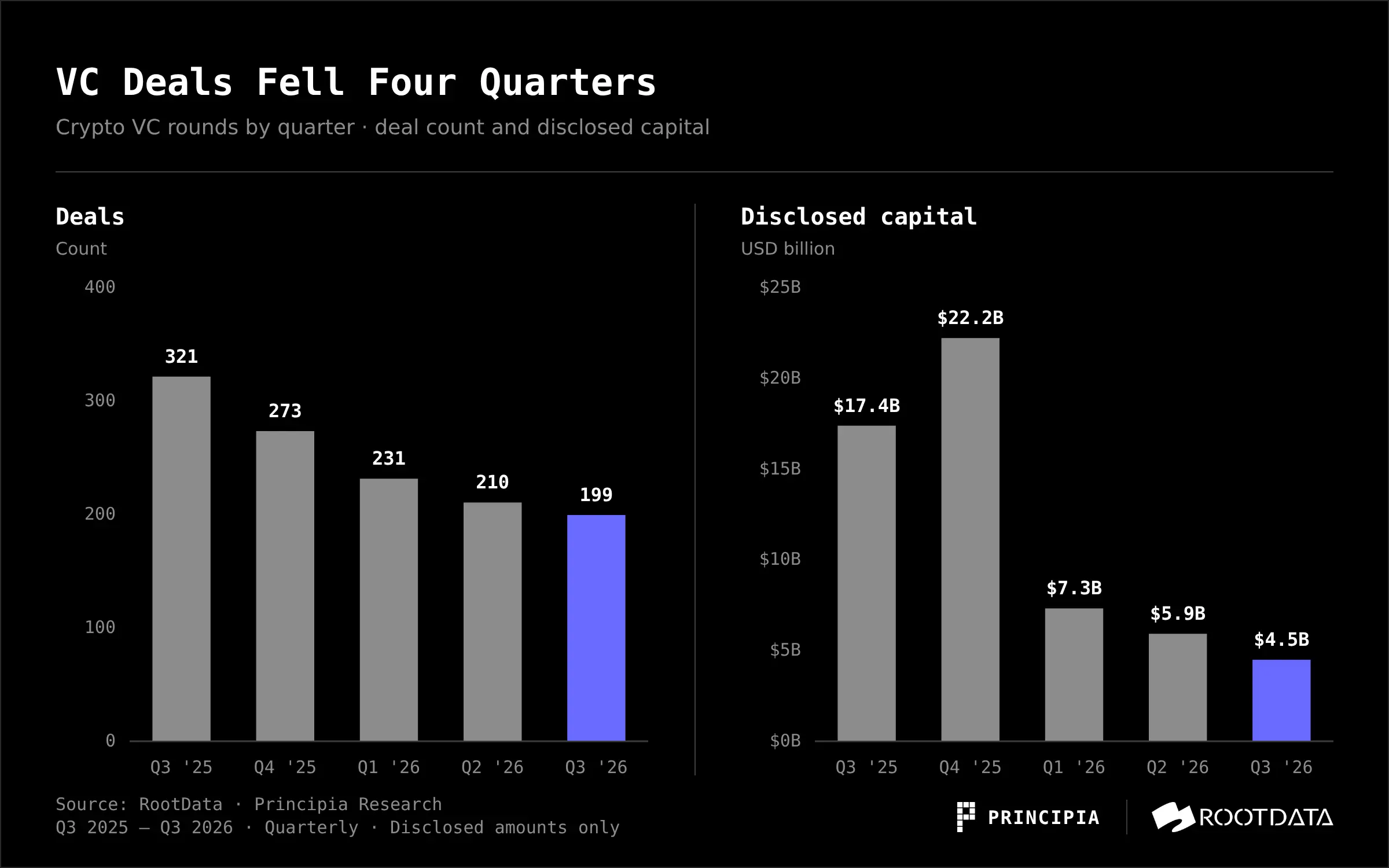
The high base in the third quarter of 2025 included a large number of public company follow-ons and IPOs: Strategy approximately $2.52B, Forward Industries approximately $1.65B, Galaxy approximately $1.40B, Bullish IPO approximately $1.11B. After this round of "coin-stock" financing receded, it saw a significant year-over-year decline of 74%. The $22.19B in the fourth quarter was similar, with nearly half coming from a single $10.3B acquisition by Dunamu.
Looking solely at equity financing, the conclusion is the opposite. Excluding public company follow-ons (Post-IPO), IPOs / de-SPACs, mergers and acquisitions (M&A), token public offerings, OTC, debt financing, and community rounds, and also excluding transactions over $100M that were verified to belong to old stock transfers, token pre-sales, public company financing, or debt, this quarter saw 144 equity financing rounds with a disclosed amount of approximately $3.38B, higher than the approximately $3.02B (168 rounds) in the second quarter and approximately $2.50B (226 rounds) in the third quarter of 2025, indicating a quarter-over-quarter increase of 12% and a year-over-year increase of 35%, while the number of rounds decreased by 14% quarter-over-quarter and 36% year-over-year. There are fewer transactions, but they are larger in size.
More noteworthy is the divergence between cryptocurrency prices and financing. Bitcoin rose from about $58.6K in early July to about $83.6K in early October, an increase of about 43%, yet the primary market did not warm up accordingly. We believe one important reason is the absorption of capital by AI: the demand for funding for AI computing power and models is enormous, and market expectations for its growth potential are also higher; with limited allocation quotas for LPs, some funds that were originally directed towards crypto venture capital are now shifting towards AI. The actions of leading crypto-native institutions also confirm this: on July 8, Paradigm announced the completion of its fourth fund at $1.2B, expanding its investment scope from crypto to AI, robotics, and other frontier fields, while stating it would continue to invest in crypto; IOSG founding partner Jocy Lin established IOSF Ventures, focusing on AI; on October 22, a16z Crypto was renamed a16z Frontier, with the new fund's investment scope expanding to AI, autonomous machines, and other cutting-edge technologies, while continuing to invest in the crypto sector.
The fluctuations within the quarter mainly stemmed from a few large transactions. July was the hottest month, with $2.37B across 72 transactions, with Crypto.com, Ionic Digital, and Securitize each receiving $400M. August was the coldest, with $0.72B across 63 transactions. September rebounded to $1.37B across 64 transactions, mainly from Polymarket's $300M and Félix's $200M.
2. Funding Shifts Towards Later and Strategic Rounds
This quarter, nearly 40% of funds were allocated to strategic and private rounds, approximately $1.75B. Early rounds had the highest number of transactions but only accounted for about one-sixth of the total amount.
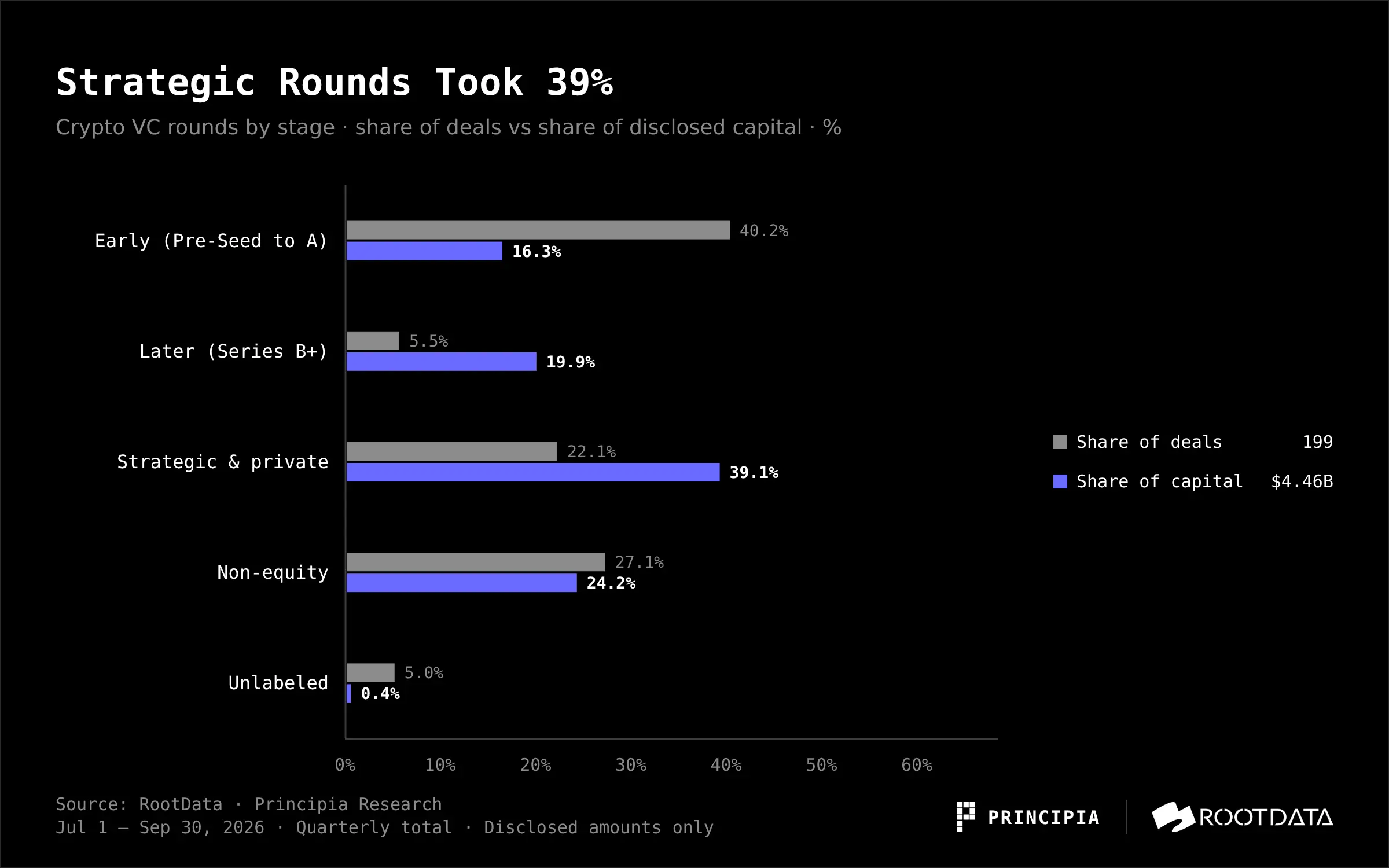
Early rounds remained the most active, with 80 transactions, accounting for 40% of all transactions, but in terms of amount, they played a secondary role: transactions outside of early rounds took approximately 84% of the disclosed amount.
In terms of single transaction size, there were 25 mid-range transactions between $20M and $100M (excluding $100M) this quarter, with a disclosed total of approximately $1.15B, up from 19 transactions and about $0.77B in the second quarter. However, this quarter, 7 transactions in this range belonged to OTC, debt financing, public company follow-ons, or mergers; looking solely at equity financing, there were 18 mid-range transactions totaling approximately $0.87B, with the number of transactions remaining the same as in the second quarter (18 transactions, approximately $0.73B), and the amount increased by about 19%, yet still lower than in the third quarter of 2025 (31 transactions, approximately $1.03B).
This not only reflects a decrease in risk appetite but is also related to changes in investors: some crypto-native investment institutions have stopped new investments, liquidated, or shifted towards AI. In December 2025, Shima Capital was sued by the SEC, and it was reported that the founder announced his departure in an internal email to invested projects and initiated an orderly liquidation of the fund. In June 2026, Arbitrum DAO's gaming investment plan AGV proposed to stop new investments and only manage the existing portfolio, with the proposal approved in early July, returning approximately 143.7 million ARB in batches to the DAO treasury. In October, Deus X Capital ceased operations and will officially liquidate on January 31, 2027, with CEO Tim Grant transitioning to CEO of AI company TensorX. At the end of the month, Verda Ventures, focused on stablecoin infrastructure, ceased new project investments due to the founder joining Tether, shifting to only servicing the existing portfolio.
Meanwhile, traditional finance and strategic capital are stepping in. Citadel Securities invested $400M in Crypto.com at a valuation of $20B; Nasdaq Ventures agreed to invest $100M in Kraken's parent company Payward, with a reported valuation of approximately $21B. 1789 Capital led a round of approximately $1B for Polymarket, contributing about $300M at a valuation of $21B. Tiger Global led Augustus's $180M Series B; SBI Holdings led EDX Markets' $76M Series C and also led Gauntlet's $125M Series C. These funds are directed towards more certain and compliant areas such as licensing, clearing, and trading entry points, rather than new narratives.
3. Sector: Funds are Buying "Financial Pipelines"
According to RootData's main tags, CeFi had 31 transactions this quarter, taking $1.44B, accounting for 32% of the disclosed amount, ranking first. DeFi had 51 transactions, the highest number, but only captured $0.37B, accounting for 8%.
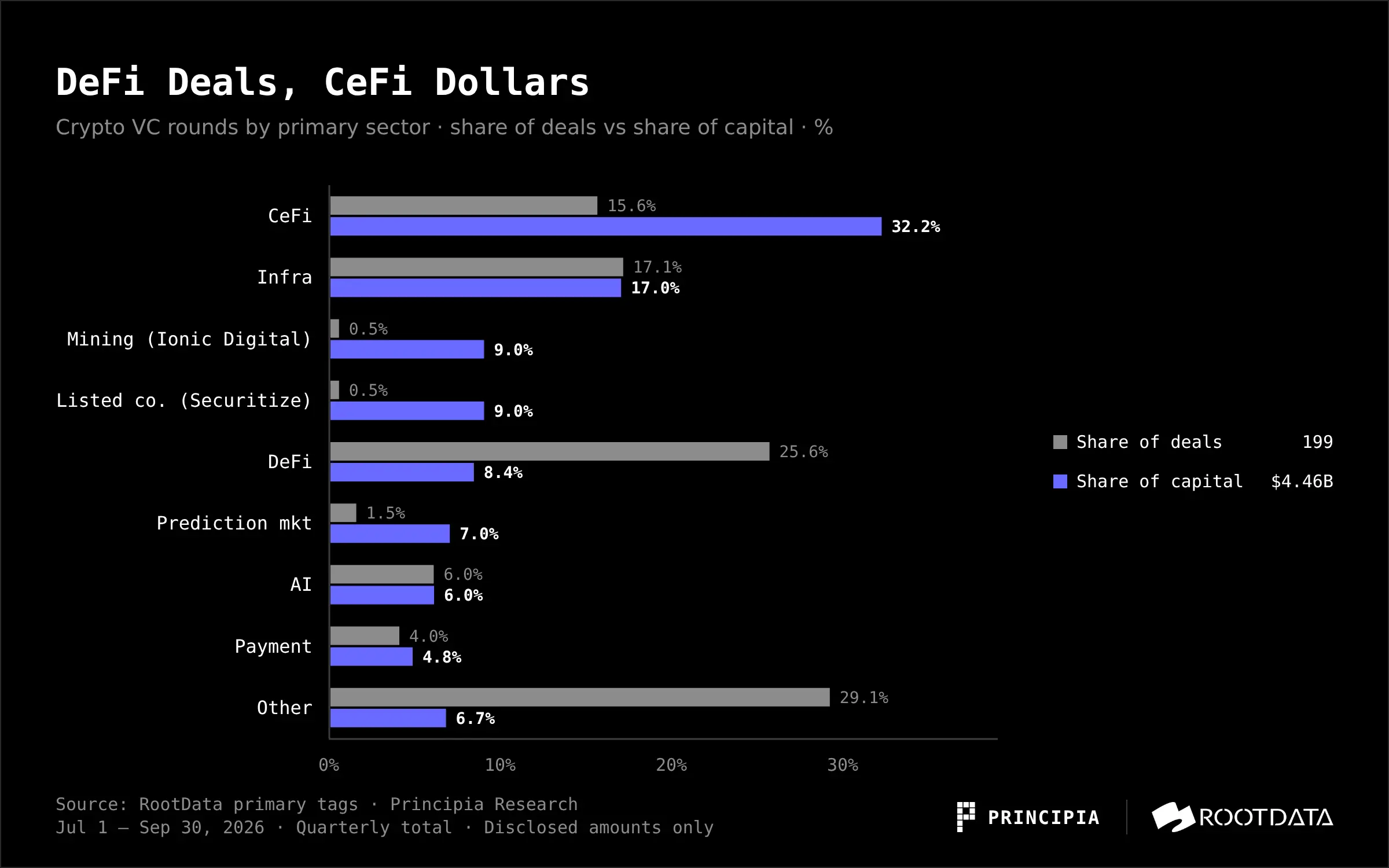
Most large transactions in CeFi were related to trading, brokerage, and clearing entry points: Crypto.com, Kraken, Augustus, Alpaca, EDX Markets. Infra ranked second, with 34 transactions totaling $0.76B, represented by Ripple (Ripple Prime $275M senior unsecured notes), Prime Intellect, and Gauntlet. Additionally, two $400M transactions each supported a separate tag: the Bitcoin mining company Ionic Digital and Securitize, which went public on the NYSE via SPAC.
DeFi's amounts are relatively low, partly due to insufficient disclosures: only 25 of the 51 transactions disclosed amounts. Even considering this, DeFi is clearly dominated by small, early, protocol-oriented transactions. The consumer category is almost empty: the gaming main tag had only 3 transactions, totaling about $5.9M.
4. The Amount of Transactions Solely Involving Crypto-Native Capital Decreased by Nearly 60%
The disclosed amount for transactions solely involving crypto-native capital this quarter fell from $2.57B in the previous quarter to $1.05B, with the share decreasing from 44% to 24%; transactions involving traditional finance or general capital saw their share rise from 39% to 45%.
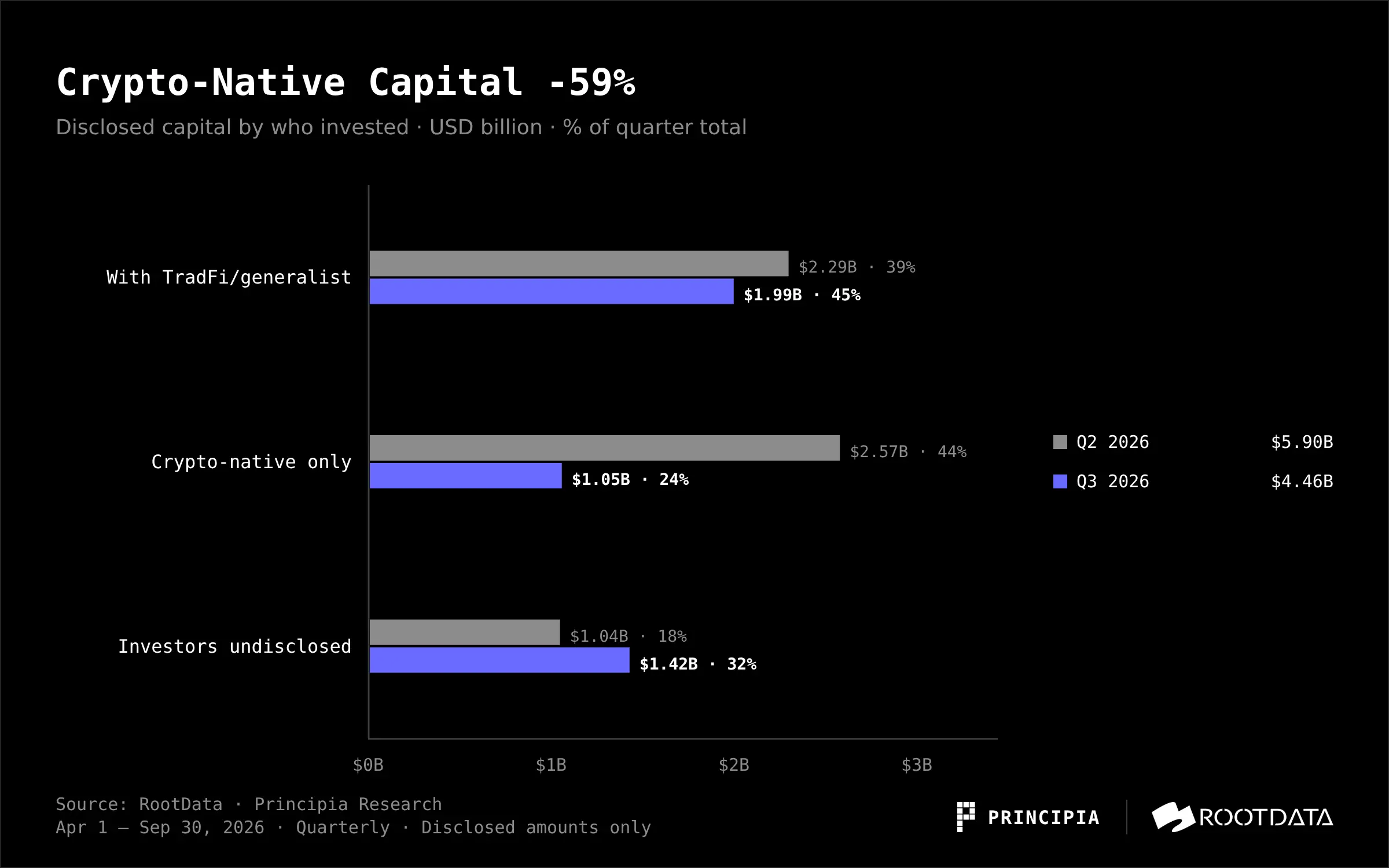
"Traditional finance or general capital" refers to banks, exchanges and market infrastructure, brokerages, asset management, tech giants, trading firms, as well as comprehensive and fintech VCs. Crypto-native capital is contracting, while the largest deals this season are backed by Citadel Securities, Nasdaq, 1789 Capital, Tiger Global, Peak XV, SBI, Intel Capital, and ICONIQ.
In terms of frequency, the picture looks different. The most active are YZi Labs and Coinbase Ventures, but both mainly focus on incubation and follow-on investments, with almost no lead investments.
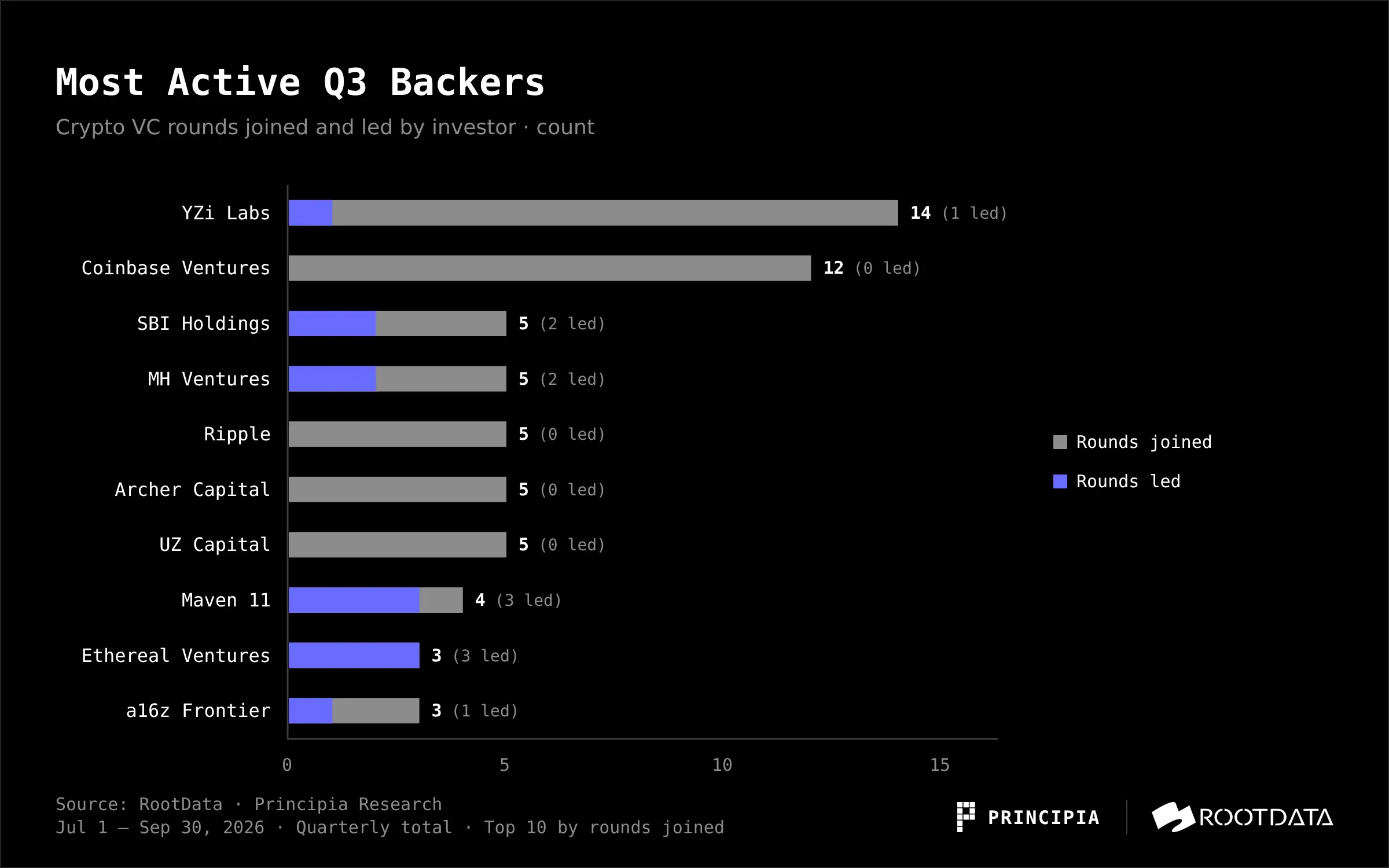
Compared to the second quarter, the leaders have changed. The most active in the second quarter were Coinbase Ventures (13 times), Animoca Brands (12 times), and a16z Frontier (formerly a16z Crypto, 8 times), with Paradigm also leading 4 deals. This season, more pricing power has been handed over to the aforementioned traditional financial institutions.
5. More New Companies, Established Companies Raising Big Money
Companies established in 2021 and earlier raised $2.30B across 51 financing rounds this season, accounting for more than half of the disclosed amount. New companies established after 2025 had the most rounds, with 67, but only raised $0.63B.
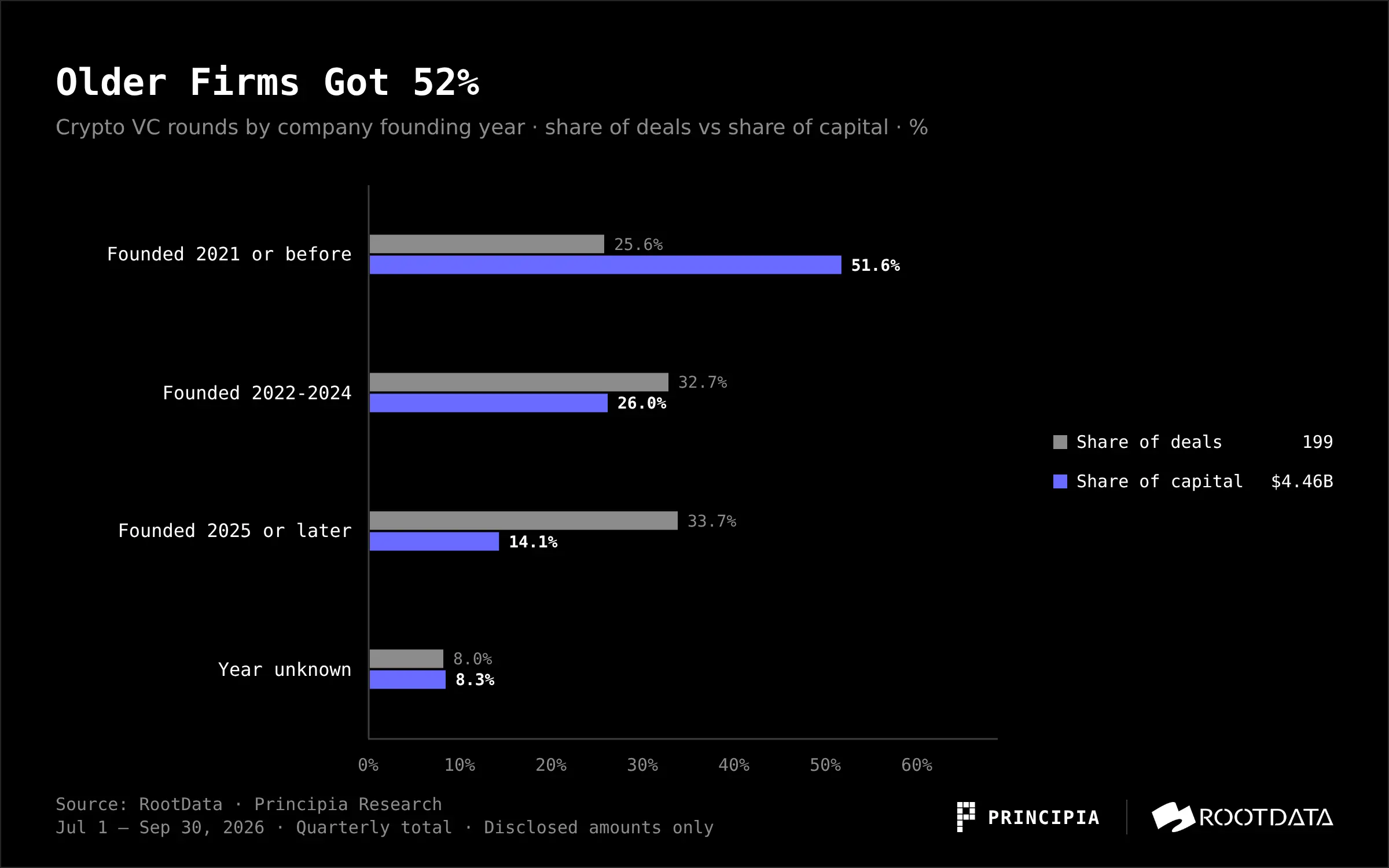
The list of established companies raising large amounts of financing is familiar: Crypto.com (established in 2016), Kraken (2011), Ripple (2013), Securitize (2017). They have revenue, licenses, and valuable businesses, which align perfectly with this season's funding preferences.
6. The U.S. Still Dominates Geographically
RootData's country field only covers 53 out of 192 projects (28%), corresponding to 55 transactions and $2.19B, about half of the total disclosed amount for the season. In this sample, the U.S. had 28 transactions totaling $1.52B; Singapore had 10 transactions totaling $444M, with Crypto.com accounting for $400M of that.
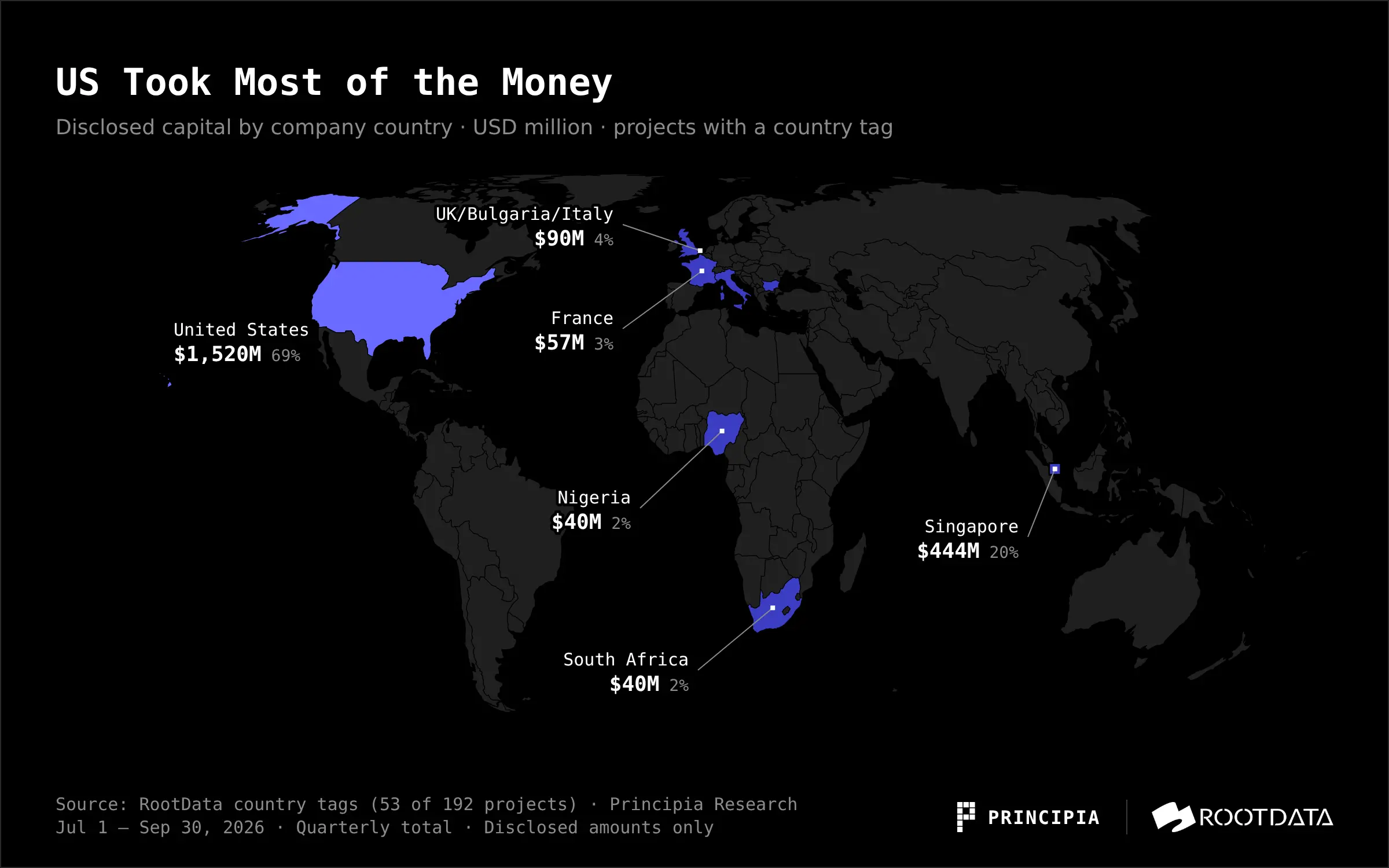
The remaining countries are quite scattered. The UK, Bulgaria, and Italy each accounted for $90M, France $57M, and Nigeria and South Africa each $40M; Hong Kong had 3 transactions, Japan 2 transactions, with amounts being very small. Despite such low coverage, it still indicates that funding remains highly concentrated in the U.S., with large transactions in Asia mainly coming from exchanges in Singapore.
7. Fundraising: Next Round of Ammunition is Tight
How much can be invested in the primary market ultimately depends on how much funds can raise. According to Galaxy Research, only 3 new crypto venture funds completed fundraising this season, totaling about $1.3B, the lowest number of new funds since Q3 2019. Annualized, this year's fundraising is about $8.2B, slightly lower than the $8.75B expected for 2025. The average fund size this year is about $386M, with a median of only $71M: most new funds are small, while a few large funds have raised the average.
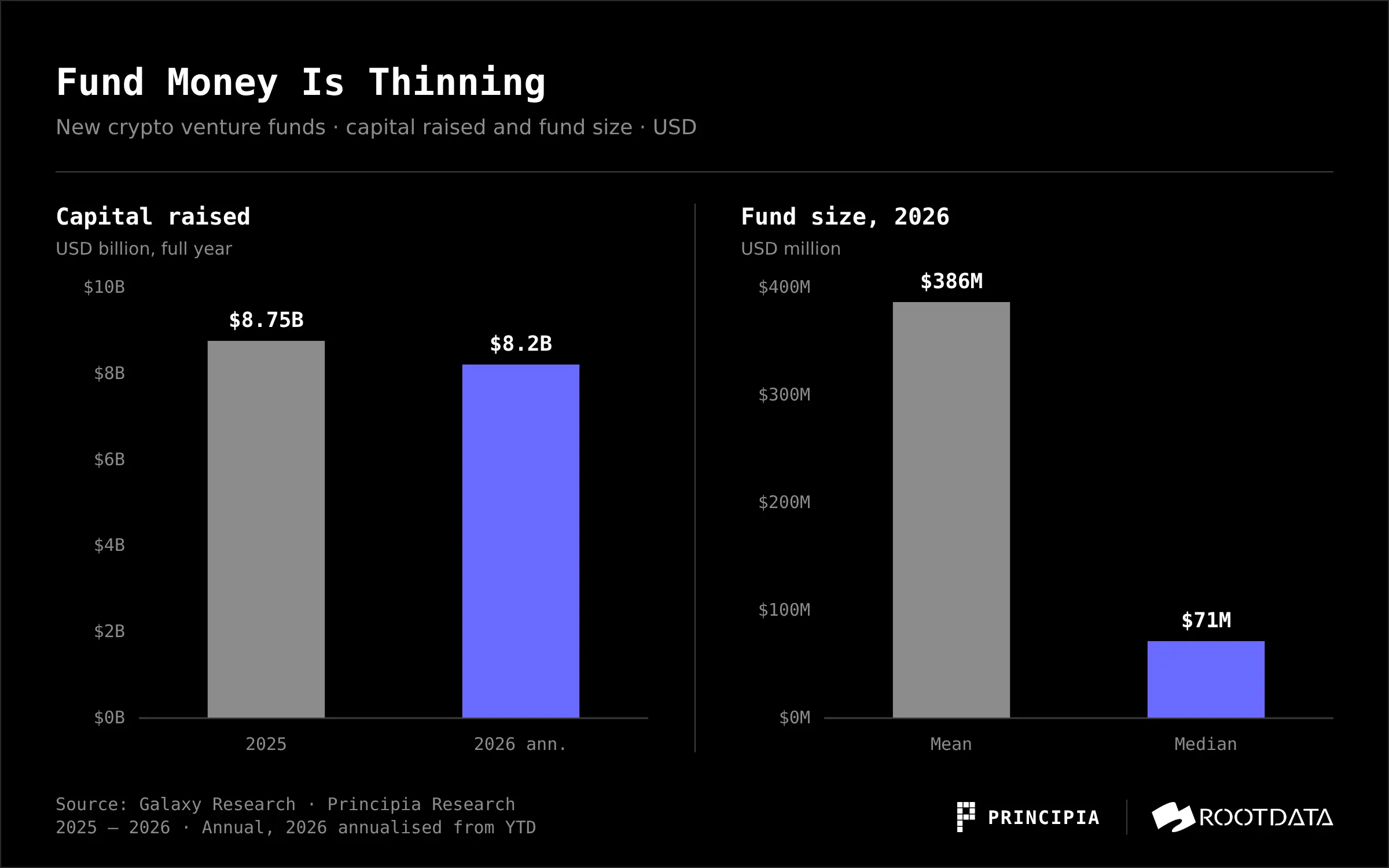
The difficulty in fundraising and the cooling of the investment side are two sides of the same coin: spot ETFs, digital asset treasury companies, and AI are all competing for LP allocation. Our judgment is that tight financing on the LP side will make GPs more cautious: prioritizing support for follow-on rounds of already invested projects and placing more bets on companies with revenue and licenses. This is exactly the trend reflected in the investment side this season.
8. Conclusion
Overall, VC investment activity cooled in Q3; funds flowed towards financial channels that can charge fees, hold licenses, and clear transactions, with pricing power increasingly handed over to traditional financial institutions; VC LP fundraising encountered a chill, and the follow-on financing situation for startups is not optimistic.
For entrepreneurs, the timing for raising large amounts of funding has become later, and the requirements are closer to those of mature companies: revenue, licenses, and distribution channels are more likely to translate into valuation than narrative. Early-stage financing has significantly decreased, VC risk appetite has lowered, and there is a need to be prepared to speak with product data and accept smaller first rounds.
For investors and LPs, the rebound in cryptocurrency prices has not automatically transmitted to the primary market. This season, Bitcoin rose about 43%, but financing continued to decline, and the old script of "rising coin prices lead to booming venture capital" has temporarily failed. The mid-range transaction amounts of $20M–100M have rebounded quarter-on-quarter, but the number of equity deals remains flat, requiring more quarters of data to confirm the trend.
What to watch in Q4:
Can traditional finance continue to participate? This season, 45% of the disclosed amounts involved them. Is this a structural change or just a coincidence of a few large deals? Q4 will provide the answer.
Can cryptocurrency prices transmit to early rounds? Only a rebound in the number of small early rounds would indicate a real recovery in the entrepreneurial side.
Policies and fundraising. The progress of the CLARITY Act and whether new funds can complete fundraising before the end of the year.
 Risk warning Risk warning



Popular articles