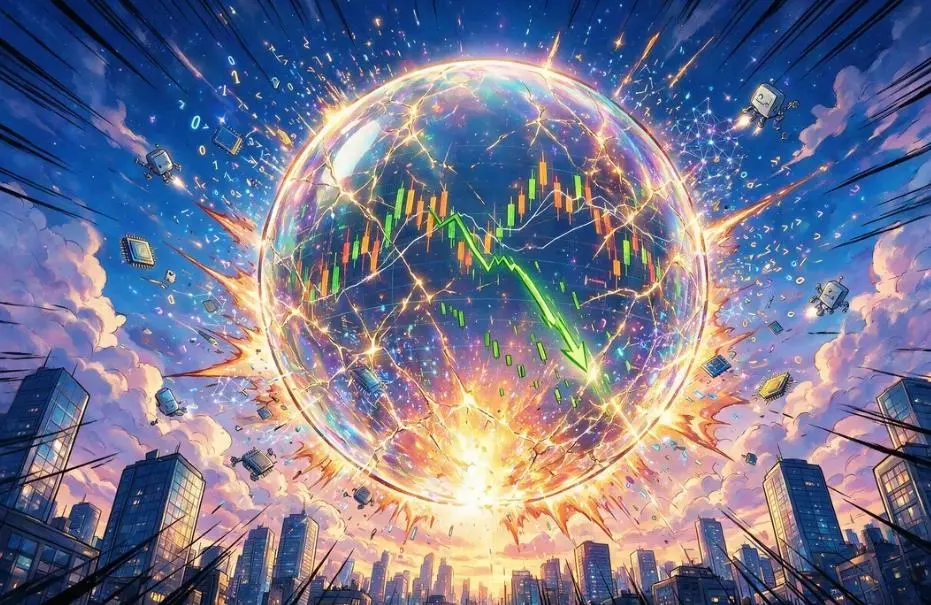
After the U.S. midterm elections, South Koreans were completely panicked
 Core Viewpoint


 Why is South Korea in a panic?
Author: Gelong
The dust has settled on the U.S. midterm elections, with the Democratic Party's "blue wave" sweeping both houses of Congress, and they also successfully took the governorships of key states for AI data centers like Texas and Georgia.
The global AI computing power sector fell sharply, with Nasdaq chip stocks bleeding heavily, and the Nikkei dropped, while A-shares and Hong Kong stocks also did not escape unscathed.
Interestingly, after the drop, the reactions of various governments were not on the same scale.
Other markets fell without emergency meetings or important officials making statements.
Only South Korea held an emergency market meeting with the Deputy Prime Minister and Finance Minister present, the Chairman of the Financial Commission in attendance, and the Deputy Governor of the Bank of Korea accompanying them, announcing afterward: the obligation to maintain a 140% guarantee ratio for brokerage credit financing is waived for three months.
On the same day, the Korea Exchange activated the Sidecar circuit breaker mechanism, suspending programmatic sell orders.
Why did South Korea panic?
Can't Handle It?
First, let's look at some data.
According to statistics from KOSCOM, a subsidiary of the Korea Exchange, in the month leading up to the crash, from October 6 to November 5, South Korean individual investors net purchased 58.3 trillion won of Samsung Electronics and 33.6 trillion won of SK Hynix.
These two figures rank first and second among all listed stocks and ETFs in South Korea.
Note the time window!
This is not a trend-following move from the beginning of the year when the AI craze just started; this is bottom-fishing on the eve of the crash.
On November 5, the KOSPI had already fallen by 5.28%, yet retail investors were still rushing in.
The next day, the KOSPI directly broke through the 5000-point mark.
What kind of money is this?
The term used by South Korean media is: Ant Army.
Behind this, a large portion is borrowed money.
South Korean retail investors are known globally for their aggressive use of leverage, with leveraged ETFs for individual stocks being their most handy tool.
In July of this year, the Financial Commission of South Korea was forced to take action:
The margin requirement for single-stock leveraged ETFs was raised from 10 million won to 30 million won in one go, new product launches were suspended, and advertising was prohibited.
By August, they intensified measures:
New entrants wanting to trade leveraged ETFs had to complete 5 days of simulated trading and accumulate 5 hours, otherwise they would not be allowed to open an account.
The urgency of the regulatory authorities in July indicates what?
It indicates that the leverage positions of retail investors have become so large that even the authorities are afraid.
Data from the Korea Capital Market Institute is even more straightforward:
As of mid-June, individual investors had net purchased a staggering 82 trillion won in single-stock leveraged ETFs, accounting for 60% of the management scale of such products.
In other words, 60% of the money in leveraged ETFs comes from retail investors.
Then came the drop in July, with the management scale of 14 leveraged ETFs tracking Samsung and Hynix shrinking from 159 trillion won at the end of June to 93 trillion won, evaporating 41%.
Four leading products lost 8.8 trillion won in valuation in less than two weeks.
This is not a correction; this is leveraged positions being buried alive.
Above the retail investors, there is another layer.
The National Pension Service of Korea, the third-largest sovereign pension fund in the world, holds the retirement savings of South Koreans.
To what extent is it heavily invested in Samsung and Hynix?
As of October 15, the market value of the 287 listed companies in which the NPS holds more than 5% of shares dropped from 515 trillion won at the end of June to 333 trillion won, a decrease of 182 trillion won, approximately 137 billion dollars.
The KOSPI had just set a historical closing high of 9114 points on June 22, and by mid-October, it had already fallen by 39%. The NPS's holdings were maintained at high levels without selling off.
So the situation the South Korean government faces is:
Millions of retail investors rushing in with leverage at high levels, while the national pension fund is deeply trapped in the same stocks, with a few stocks accounting for half of the KOSPI's market value.
At this time, news came from the U.S. that the Democratic Party intended to restrict the power and approval for data centers, potentially slowing the expansion of AI computing power, and stock prices could not hold up, leading to a negative chain reaction.
If this chain reaction cannot be cut off in time, it could lead to a liquidity squeeze.
The South Korean government's waiver of the brokerage guarantee ratio obligation is an attempt to cut off this cycle.
Why?
The South Korean stock market is essentially not just a capital market but also an amplifier of social sentiment.
The phenomenon of all South Koreans trading stocks is well-known worldwide.
Since the beginning of this year, due to precisely hitting the AI storage chip trend, millions of ordinary South Koreans have bet their years of savings, wedding funds, and even borrowed money on two national stocks.
However, this sentiment, in the political logic of South Korea, is a highly risky matter.
South Korean politicians understand better than anyone that once the stock market crashes, the resulting tsunami of public opinion is more direct than any diplomatic crisis.
There is another layer, which is the Korean won.
South Korea is a small open economy, and the won is not a safe-haven currency.
During global risk-off periods, foreign capital withdraws from the South Korean stock market faster than anyone else, simultaneously selling the won and buying dollars, causing the exchange rate to collapse.
South Korea is also a country that relies almost entirely on imports for energy and raw materials; when the won depreciates, imported inflation immediately rises.
Stock market drop + currency depreciation + rising inflation, this triple whammy is fatal for an economy of South Korea's size.
There is an additional layer of logic here, which is the importance of foreign capital to the South Korean stock market.
As of June 2026, foreign ownership of the total market value of the South Korean stock market is about 37.8% to 38.9%, with U.S. investors accounting for about 42% of foreign holdings.
Core tech stocks like Samsung Electronics and SK Hynix have long had foreign ownership exceeding 60%, and as of early August, they were still approximately 46.70% and 50.84%, respectively, until early October, when they dropped to 46.38% and 49.59%.
In terms of trading volume, this dependence is even more extreme.
As of October 14, foreign investors had net sold approximately 203.7 trillion won in the South Korean main board market this year, with Samsung Electronics and SK Hynix alone accounting for about 176 trillion won of net sales, making up 86% of the total foreign sell-off; this year, foreign capital withdrew about 131 billion dollars from the South Korean stock market, the highest among major Asian markets.
Domestic funds in South Korea are limited; without foreign capital support, it is difficult to see the kind of crazy rise in the first half of the year, but foreign capital can come in and can also leave; the Korean stock market is merely an arbitrage venue for them, not a final destination.
More seriously, the sensitivity of South Korean retail investors and institutions is slower compared to foreign capital; the latter has the ability to enter the market at low points, while the former often only enters when the market has already risen, and when foreign capital withdraws, they become high-level buyers.
Thus, when South Korean government officials speak out, they are not just addressing retail investors but also foreign investors:
Don't run, the fundamentals are fine, we can handle it!
Deep Explosion
Ultimately, the U.S. midterm elections are just a match; the structure of the South Korean economy is the fundamental reason for the uncontrollable fire.
Comparatively, Japan has automobiles, precision machinery, and general trading companies; when the Tokyo Stock Exchange index drops, Toyota and Sony do not collapse together.
The U.S. has the largest domestic market and technology ecosystem in the world; even if the Nasdaq drops, the stock prices of Apple, Microsoft, Google, and Meta are not likely to be halved simultaneously.
What about South Korea?
It is not that there are no other industries, but its dependence on semiconductors is simply too great.
In 2025, South Korea's semiconductor exports are projected to reach 173.4 billion dollars, accounting for 24.4% of South Korea's total exports.
In January 2026, the proportion of semiconductor exports in total exports will first exceed 30%, reaching 31.2%.
By May, this figure jumped to 42.3%, setting a historical high.
In early October, the proportion of semiconductors in exports further approached 47%.
In other words, South Korea's export growth is almost entirely supported by chips, while all other categories combined are shrinking.
More detailed data shows that within South Korea's semiconductor exports, memory chips account for 75%, while system semiconductors only account for 20%, and wafers and components account for 5%.
Another data point is GDP increment.
In the third quarter of 2026, South Korea's GDP grew by 1.0% quarter-on-quarter, nearly three times the central bank's previous forecast, with computers and electronic devices, including semiconductors, contributing about 60% of the GDP increment, of which 50% came from the semiconductor industry.
Half of a country's quarterly economic growth comes from one industry.
And the products of this industry are highly concentrated in memory chips, with customers highly concentrated among U.S. tech giants, and demand highly tied to the AI capital expenditure cycle.
Morgan Stanley's data shows that in South Korea's exports to the U.S., the proportion of automobiles dropped from 36% in 2024 to 13%, while the proportion of semiconductors surged from 10% to 28%.
Morgan Stanley even directly referred to South Korea's exports to the U.S. as a leading indicator of U.S. AI investment, with South Korean exports leading U.S. equipment investment indicators by one to two months.
The tighter this binding is, the greater the shock South Korea experiences when U.S. policies shift.
Conclusion
Facing similar policy headwinds, stock markets have plummeted.
But you see, other markets may drop, but trading continues, and hedging occurs.
Only in South Korea, the market dropped, and the Deputy Prime Minister held a meeting, the Financial Commission made statements, the exchange pulled the plug, and brokerages were instructed not to close positions.
This is not market rescue; this is firefighting.
The result of over-reliance on a single export industry is that when the U.S. sneezes, South Korea catches a cold.
Moreover, this time the U.S. is not just sneezing; it has kicked hard at the vital point of AI infrastructure.
If you say South Korea is not panicking, who is?
 Risk warning Risk warning