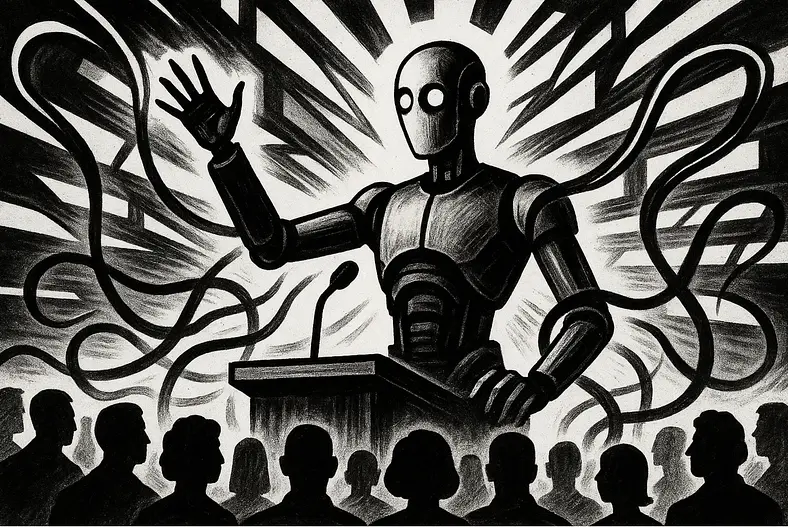
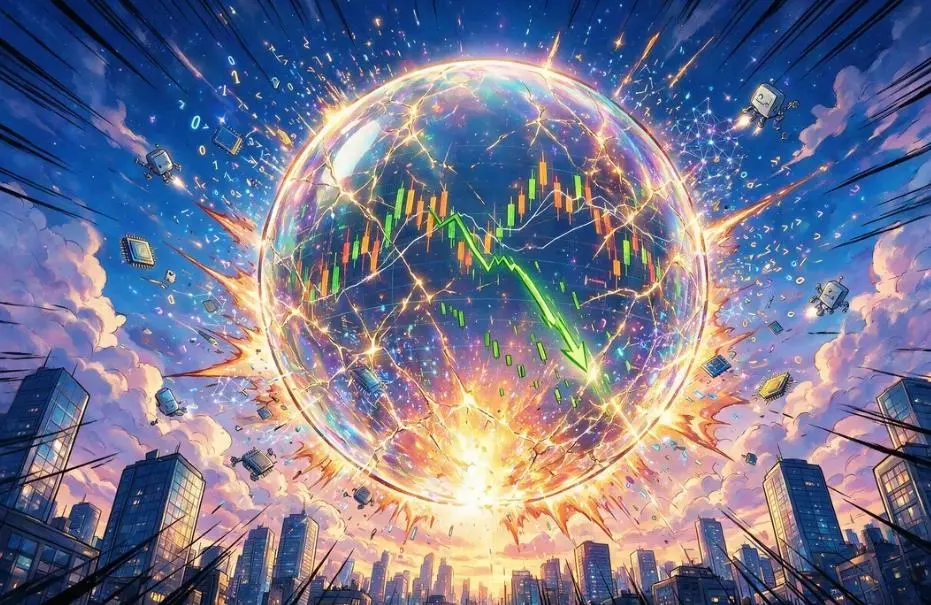
A counter-consensus logic: the anti-AI movement will not make the demand disappear, but it gives the industry more time to absorb the bubble
 Core Viewpoint


 American technology commentator Derek Thompson stated that the historical railway and internet bubbles both burst due to rapid infrastructure expansion and supply far exceeding real demand. Currently, AI computing power is still in short supply. If the anti-AI movement slows down data center construction and restricts supply expansion, it could give demand more time to catch up and reduce the risk of future overcapacity. The anti-AI movement may inadvertently become the "pressure relief valve" for the AI bubble.
Author: Bu Shuqing, Wall Street Journal
The results of the U.S. midterm elections are bringing an unexpected variable to the AI industry.
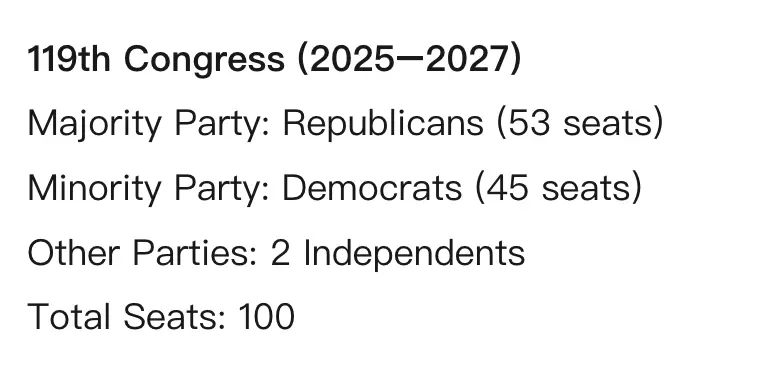
The Democratic Party won in several key states, with some candidates promising to pause or tighten the approval of data center construction. As anti-data center forces quietly rise, the market is beginning to worry that the expansion of AI infrastructure in the U.S. may face resistance, leading to significant tremors in global chip stocks, with companies like Samsung Electronics and SK Hynix facing risks from changes in demand expectations for server DRAM and high-bandwidth memory.
However, tech author Derek Thompson has proposed a counterintuitive viewpoint: The increasingly intense anti-AI politics in the U.S. may suppress AI stocks in the short term, but could help the entire industry avoid a bubble in the medium to long term. Thompson served as a staff writer for The Atlantic for 17 years, focusing on technology, economics, labor markets, and social trends. He is also a co-author of the bestselling book Abundance and currently hosts the podcast Plain English, where he continues to analyze U.S. technology and economic issues through his personal newsletter.
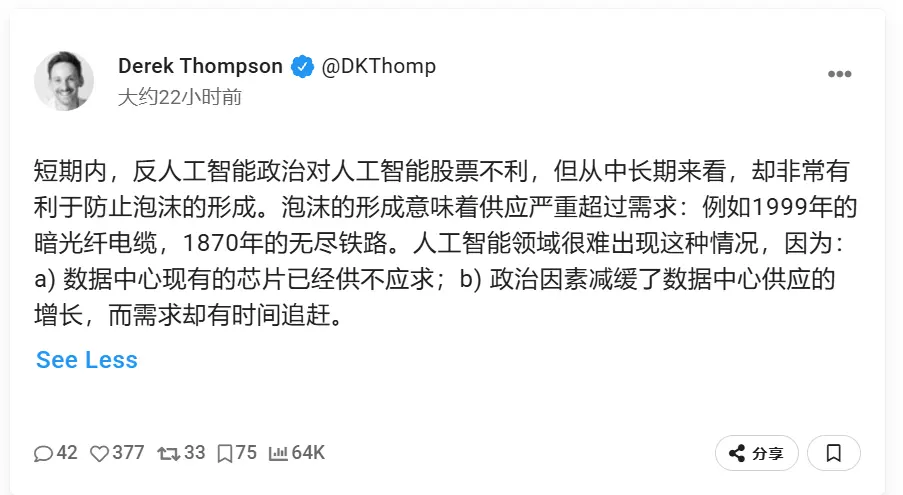
The key to this judgment lies not in the anti-AI movement making AI demand disappear, but in its potential to change the speed of AI supply expansion. Historical tech bubbles often accompany infrastructure investments that outpace real demand; currently, AI computing power is still tight. If political resistance slows down data center construction, it could give demand time to catch up with supply, and the anti-AI movement might inadvertently apply the brakes to the AI industry.
Republican Setbacks and the Rise of Anti-Data Center Forces
After the U.S. midterm elections, the political risks surrounding data center construction began to attract market attention.
The Democratic Party won in key states like Texas and Georgia, with some candidates explicitly proposing a moratorium on new data center construction. Texas is particularly noteworthy: according to GLJ Research, the state accounts for about a quarter of the data center capacity planned to be operational in the U.S. by 2030. Democrat Gina Hinojosa defeated Republican incumbent Greg Abbott, with her campaign promises including a pause on new data center approvals.
Georgia is also an important data center market. CBRE data shows that Atlanta is one of the most active markets for data center construction in the U.S. The election of Democrat Keisha Lance Bottoms as governor has led the market to begin assessing potential changes in local data center construction policies.
The anti-data center sentiment is not merely a partisan conflict. Local residents oppose projects mainly due to concerns about noise, water consumption, massive electricity demands, and the potential for data center construction to drive up residential electricity costs; meanwhile, communities also question whether the jobs and tax contributions created by data centers are sufficient to match the incentives provided by the government.
This resistance is crossing party lines. As the expansion of data centers increasingly conflicts with local electricity, land, and water resources, AI infrastructure construction is no longer just a business decision for tech companies and investors, but is also becoming a local political issue.
Market concerns arise from this: If more states implement moratoriums or raise approval thresholds, the pace of data center expansion in the U.S. may slow, which could in turn affect demand expectations for AI infrastructure supply chains, such as servers, storage chips, and high-bandwidth memory.
The Risk of an AI Bubble May Lie in Supply Expansion Being Too Rapid
However, Derek Thompson believes that the impact of anti-AI politics on the AI industry may not only have negative aspects.
His logic is based on a common lesson from tech history: The value of technology itself does not necessarily mean that the capital invested around it is reasonable. Many tech bubbles ultimately burst not because the technology lost its significance, but because the speed of infrastructure construction far exceeded real demand.
In the 1870s, railroads in the U.S. were built in areas lacking sufficient population and economic activity to support them; after the internet bubble burst, a large number of fiber optic networks remained idle for a long time. The demand growth brought about by technological revolutions ultimately failed to absorb the supply that had expanded too quickly beforehand.
Thompson believes that the current AI industry has an important distinction from these historical cases: The supply of AI computing power is still tight, and demand is continuing to grow rapidly.
In his assessment, the chips in data centers are still in a state of short supply, with demand for computing power continuing to increase. This means that the current risk for the AI industry is not necessarily a lack of demand, but rather that capital investment may be too rapid, leading to future supply exceeding actual demand.
If data center construction continues to expand at a rapid pace, the industry may invest heavily in infrastructure before demand is realized. Once the commercialization of AI applications does not meet expectations, excess capacity, equipment depreciation, and financing pressures may become concentrated.
The anti-data center politics may precisely change this process from the supply side.
Political Resistance Slows Construction, Allowing Demand to Catch Up with Supply
According to Thompson's reasoning, if local government and resident opposition leads to stricter data center approvals and extended construction cycles, the growth rate of AI infrastructure supply may slow.
This does not mean that AI demand will decline simultaneously. Model inference, AI applications, and agents may still drive growth in computing power demand. If supply expansion slows while demand continues to grow, the gap between the two may gradually narrow.
This is precisely why he believes that anti-AI politics may help avoid a bubble: it inadvertently limits the speed of capital investment, allowing the industry time to digest existing infrastructure.
From this perspective, the impact of the anti-AI movement on the AI industry may present a contrast:
In the short term, data center projects face pauses or delays, putting pressure on tech stocks and the AI supply chain; in the medium to long term, if demand continues to grow, a slowdown in supply expansion may actually reduce the risk of infrastructure oversupply.
Of course, this does not mean that obstacles to data center construction are beneficial for all companies. Chip, server, storage, and data center operators may still face pressures from project delays, order postponements, and slower revenue realization.
Anti-AI Regulation Becomes the "Manager" of the AI Bubble?
Economic historian Adam Tooze later made a sarcastic comment on Thompson's viewpoint: anti-AI regulatory politics is actually beneficial for AI because it can "manage the bubble." In his view, this is simply a spokesperson for the overall interests of capital.
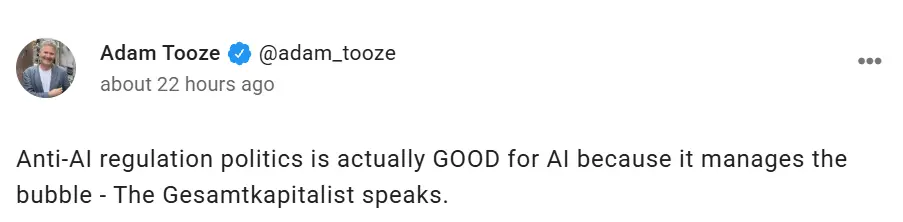
This comment highlights the most interesting aspect of this viewpoint: the original intention of the anti-AI movement may be to limit the occupation of local resources by tech giants, or even to prevent the continued expansion of the AI industry; but if it indeed slows down data center construction, it may inadvertently help capital avoid excessive investment.
This also provides another way to understand the market changes following the U.S. midterm elections. The Democratic victory and the rise of anti-data center forces may increase uncertainty in AI infrastructure construction in the short term; but from a longer time dimension, the market may need to assess not only how much demand will be lost due to the slowdown in construction, but also whether the previously rapid expansion of supply needs to cool down.
However, Thompson's viewpoint remains a hypothesis rather than a verified conclusion. How much new supply will be limited by political resistance, whether AI demand can continue to grow, and whether companies can convert computing power investments into real revenue will determine whether this logic holds.
If the core risk of the AI bubble is that supply expansion is running too fast, then could the anti-AI movement become the most unexpected brake on this capital frenzy?
 Risk warning Risk warning