Adding insult to injury, a week of technology stocks "facing reality"
 Core Viewpoint


 Intel plummeted 29% on Friday, marking the largest single-day drop on record, while the Nasdaq recorded its worst month in over a year. Google's search growth has slowed, and Amazon experienced a free cash flow outflow of $33.5 billion in a single quarter, as the logic of tech giants relying on profits to "catch the fall" begins to weaken.
Author: Gao Zhimou, Wall Street Journal
The financial reports from Google, Amazon, and Intel have disappointed the market one after another, and the cracks in AI trading have noticeably widened this week. On Friday (October 30), Intel's stock price plummeted by 29%, marking the largest single-day drop in history; the Nasdaq Composite Index fell by 2.9%, the worst day since June, and October is set to become the worst month for the Nasdaq in over a year.
In the previous months, the risks of AI trading were mainly exposed in heavily indebted small companies, while the giants stabilized Wall Street with their substantial profits. This week, the situation changed: Google's search advertising growth slowed, Amazon's free cash flow turned significantly negative, and Intel expects PC sales to remain sluggish for a long time. According to FactSet, the profit growth rate of the "Seven Giants" in the third quarter is expected to be lower than that of the other S&P 500 constituents.
The questions the market is asking have shifted from how much demand there is for AI to who will pay for AI. Rich Privorotsky, head of Goldman Sachs Delta One, wrote:
"The cost of capital has been objectively repriced, and there is no obvious solution."
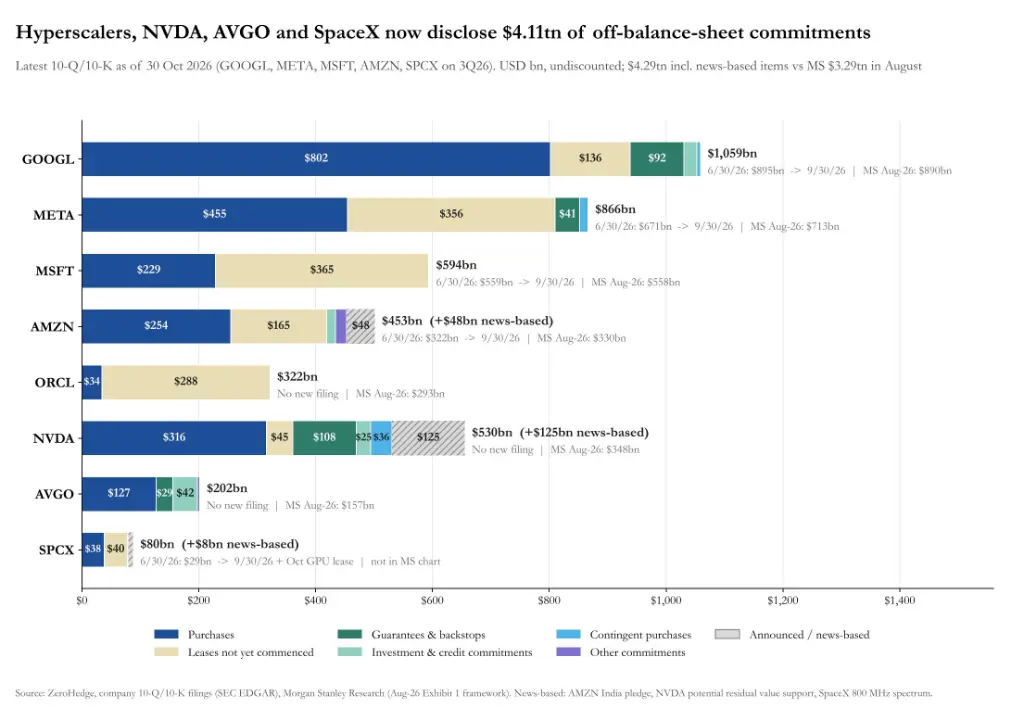
Giants' Financial Reports Fail One After Another
At the beginning of this week, the IPO filing submitted by Anthropic showed soaring revenue, briefly boosting market sentiment, but the subsequent financial reports from the giants dampened the market.
Alphabet's search advertising growth slowed, partly due to the impact of "AI model" queries, and the company also stated that capital expenditures will "significantly" increase in 2027. On Thursday, the stock price fell by 13%, marking the worst single-day performance in history, with a market value evaporating by approximately $489 billion, causing significant losses for major shareholders like Berkshire Hathaway.
Amazon reported revenue that fell short of expectations after the market closed on Thursday, with a quarterly free cash flow of -$33.5 billion, more than four times worse than expected; capital expenditures surged to $77.3 billion, with $48.1 billion in new long-term debt during the same period. The stock price fell by 7% on Friday.
Intel expects fourth-quarter revenue to be between $15 billion and $16 billion, below the market expectation of $17.29 billion, and stated that it will not achieve positive cash flow this year. The company also expects PC sales to slow down for a long time due to the AI boom driving up storage chip prices. Intel's stock fell by 29% on Friday, with an intraday drop of up to 29.7%, marking the largest intraday drop since Bloomberg began tracking data in 1982. The combined paper holdings of its two major shareholders, the U.S. government and Nvidia, evaporated by over $17 billion.
Microsoft's Azure grew by 48%, but commercial orders fell by 12%. About 12 hours after the earnings report was released, this only tech company with a AAA rating initiated a $25 billion bond issuance, the first since 2017.
On Friday, the sell-off spread across the entire tech sector: all seven giants closed lower, with storage chips, semiconductors, and emerging cloud service providers experiencing sharp declines, Reddit fell by 26%, and Bitcoin dropped over 5%. Peter Boockvar, Chief Investment Officer of OnePoint BFG Wealth Partners, said:
"The cracks may not be related, but when there are enough cracks, will the road eventually collapse?"
From "Demand Pays" to "Who Will Pay"
The giants have made enough money, and the market had previously tolerated their massive investments. Paisley Nardini, head of investment strategy at Tema ETFs, said that previously "spending money represented confidence in this round of construction and would be rewarded," but "suddenly, spending money is seen as a headwind."
The turning point began with Meta. On October 21, Meta announced fourth-quarter capital expenditures of $49 billion to $59 billion, with free cash flow negative after dividends, and warned in the filing that it would need to "raise hundreds of billions" as early as fall 2026. On October 26, Meta initiated an equity financing of up to $97.5 billion, with Nvidia, AMD, and Broadcom expressing interest in subscribing for up to $5 billion. On the same day, Anthropic submitted its S-1 filing, indicating its computing bill was about $78 billion to $81 billion. According to Bloomberg statistics, the capital expenditures of the four major tech giants this year will approach $750 billion, and "investors are no longer receiving returns as a matter of course."
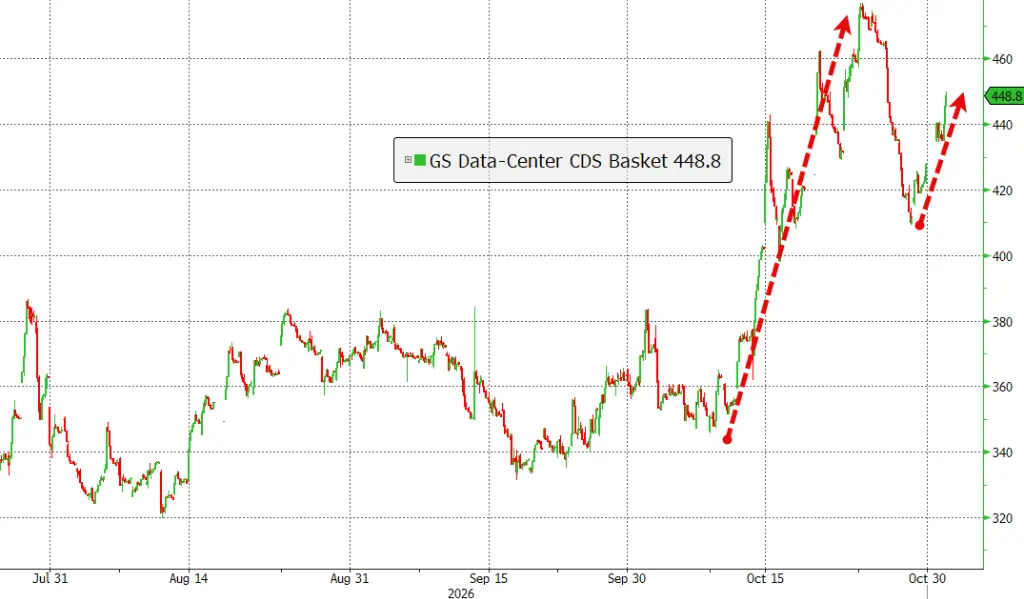
The credit market signaled earlier. From early September to mid-October, ultra-large cloud vendors and AI-related companies did not issue a single investment-grade bond, and CoreWeave's unsecured bond spread exceeded 1000 basis points. This week, the CDS of ultra-large cloud vendors hit a new high; due to Texas freezing new projects, banks have shelved plans to issue junk bonds for Anthropic's $15 billion Texas data center. Goldman Sachs credit strategists pointed out that the default risk in the AI sector has tripled since January.
Baird technology strategist Ted Mortonson said that massive financing is good for Wall Street banks but has "scared fund managers to death," adding, "My advice is to stay away for now." Keith Lerner, Chief Investment Officer of Truist Advisory Services, stated: "The bearish logic is that the peak of earnings is closer than we think."
Intense Rotation Below the Index
As of Thursday, the S&P 500 index is still up about 0.9% this month, just a few percentage points from its record high, but there is significant internal divergence. The Nasdaq 100 is down about 3.3% this month, with constituent market values evaporating by over $1.2 trillion. The seven giants have collectively fallen over 6% in October, emerging cloud service providers are down 37%, while Goldman Sachs' basket of stocks "most vulnerable to AI shocks" has risen over 15%.
On October 29, Google's plunge dragged the S&P 500 down by 0.3%, despite 406 constituent stocks rising that day. According to Bloomberg data since 1996, on previous trading days where at least 400 stocks rose, the index has never failed to close up. UBS traders noted that funds are flowing from crowded AI and growth stocks into value stocks, small-cap stocks, consumer stocks, and interest rate-sensitive cyclical stocks, without exiting the stock market.
Institutional positions are also contracting. Goldman Sachs' prime brokerage data shows that hedge funds are selling tech stocks at the fastest pace in over a decade, with net leverage in U.S. stocks dropping to its lowest level in five years. Goldman Sachs' high-beta momentum portfolio has retraced 43% from its June peak, wiping out its gains for the year. In Asia, Samsung Electronics and SK Hynix have both fallen over 16% this month.
Interest Rates, Iran, and Midterm Elections
After the Federal Reserve raised interest rates in September, the market expects further tightening; this month, the Fed paused rate hikes, but two hawkish votes opposed it. Federal Reserve Chairman Kevin Warsh stated this week: "Interest rates directly or indirectly affect almost everything… market participants are distinguishing the investments they want to make."
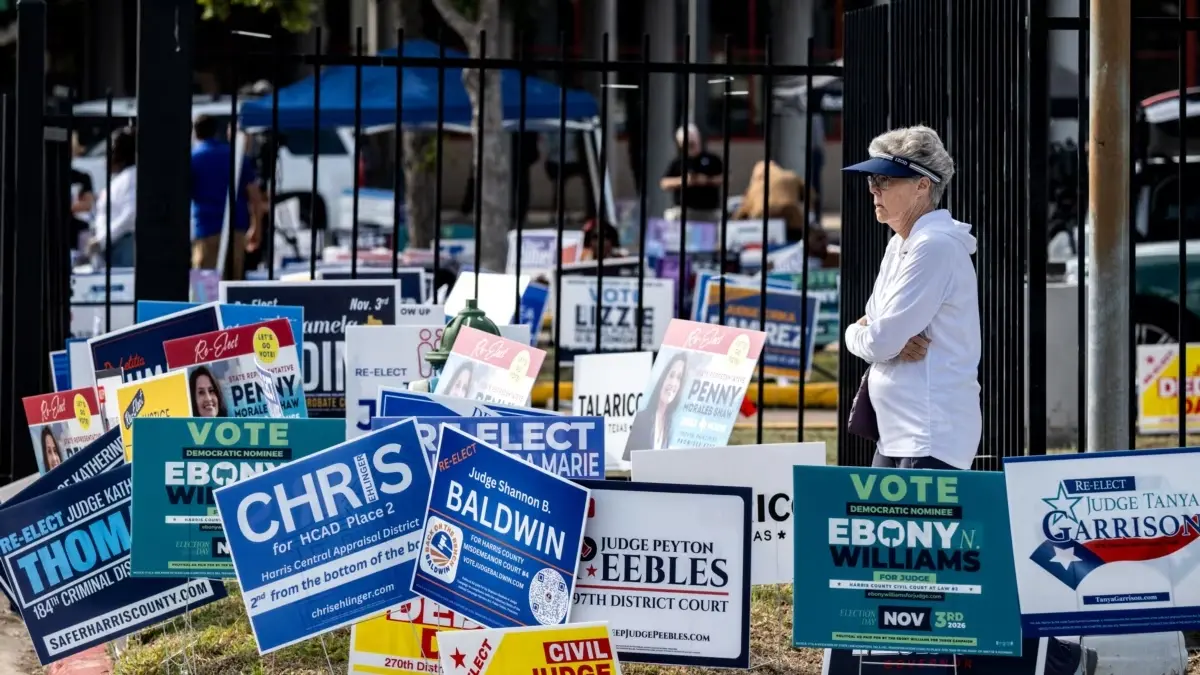
Geopolitical risks are also heating up. Trump hinted that the U.S. might initiate new military actions against Iran after next week's midterm elections. Brent crude oil futures closed at $117.64 per barrel on Friday, close to this year's high, having touched $118 during the day. U.S. Treasuries strengthened, with the 10-year yield falling below 4.9%, a six-week low, as the bond market views the surge in oil prices as a threat to economic growth. The midterm elections will also determine to what extent local opposition to data centers will translate into development restrictions.
Optimists remain. Michael Monaghan, manager of the Founders 100 ETF, believes that if the situation in the Middle East stabilizes, the market will "rise significantly"; the upcoming Anthropic IPO "is the block that supports the entire AI trade." "We are optimistic that the AI trade is not over."
But Privorotsky warns that the risk lies in financing constraints ultimately forcing the giants to control capital expenditures, "but currently, there is no sign of that in spending intentions."
 Risk warning
 Risk warning


Popular articles