IOSG: Papertrade's daily revenue is second only to Tether, a casino that refunds 90% of the rake to the losers
 Core Viewpoint


 Papertrade's daily revenue is second only to Tether, with a synthetic perpetual protocol that returns 90% of the fees to the losers. In just nine days since its launch, it has achieved a transaction volume of $13.6 trillion, with traders incurring a net loss of $63.2 million, and the price of the PAPER token has doubled.
Author | Mario Chow @IOSG
Data as of October 19, 2026, UTC 10:00, 212 hours after opening.
Summary
Papertrade is a synthetic perpetual contract on HyperEVM, launched on October 10, only trading BTC and ETH, with a maximum leverage of 1000 times. The team consists of Jez (Colin Hong, former risk partner at Standard Crypto) and anonymous developer Blurr. There was no funding, no pre-mining, and the team did not retain any shares. The only way to obtain the token PAPER is to lose money on the platform.
The headline trading volume is now $13.61 billion, all inflated by the maximum 1000 times leverage; at the same time, the total 24-hour perpetual trading on Hyperliquid is $5.2 billion. The real money is much smaller: about 23,000 addresses deposited $335 million, closed positions at a loss of $249 million, resulting in a net loss of $63.2 million for traders.
The core of this article is here. Of the net loss of $63.2 million for traders, $54.1 million (86%) was distributed to PAPER stakers. There is also $4.7 million in the LP, and developers received about $4.5 million (7%). The ones receiving dividends are the ones losing money: the top 1000 wallets hold 88% of PAPER, bear 81% of the total losses, and take home 91% of the dividends. In plain terms, this is a casino that returns the rake to the gamblers.
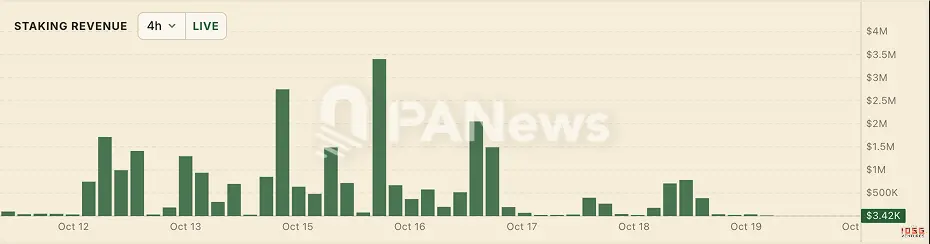
Staking income comes in waves, following the mining rewards. In the first ten hours, stakers received $24 million, from October 12 to 16, the second wave generated another $24.9 million, and on the 17th it dropped to $800,000. Additionally, PAPER has a price now. Paragon launched HIP-3 perpetual para:PAPER on Hyperliquid on October 18, opening at $0.012, spiking to $0.035 within two hours, and then hovering around $0.024. Based on 8.69 billion tokens, the market cap is $211 million, about twice the cost of mining one PAPER. PAPER itself still cannot be transferred.
Main Findings
A cashback cycle. 86% of the net losses were given to stakers, and the stakers are the wallets that are losing money: the top 1000 wallets hold 88% of PAPER, bear 81% of the losses, and take home 91% of the dividends.
Income comes in waves following the trading volume. In the first ten hours, $24 million, from October 12 to 16, $24.9 million, on the 17th when the mining rate dropped to about 12 tokens per dollar, only $800,000, and on the 18th after the perpetual launch, $2.1 million.
PAPER has a price now, but it is thin. para:PAPER is quoted at $0.024, about twice the cost of mining; this is a pre-market perpetual with a 3x leverage, with a position of about $5 million, and the underlying is still a token that no one can settle.
Solvency has always been maintained. There has never been a queue of winners; now BTC and ETH need to rise 3.7% together to empty the pool, while on the first day it only took 0.7%.
How to Play
Where the Price Comes From
Open and close positions read the price once: the contract uses HyperCore precompiled to take the mid-price of the buy and sell orders on Hyperliquid. The orders themselves do not transact on Hyperliquid. There is no order book, and individual positions are capped at $10 million, with no slippage regardless of the size of the position, and no funding rate. You are betting against a pool.
The Pool is a Water Tank
This pool (LP) is the only counterparty, and there is no one backing it. It starts from 0, outsiders cannot deposit into it, and you can think of it as a water tank with an overflow:
Losers pour in. Losses from closing positions or liquidations, 98% of the losses go into the pool.
Winners take from inside. Profits from closing positions are paid regardless of how much is left in the pool, first deducting the discounts mentioned later. If the pool runs dry, unpaid profits (margins are unaffected) go into a first-in-first-out queue, waiting for future losers to fill. There are no other guarantees.
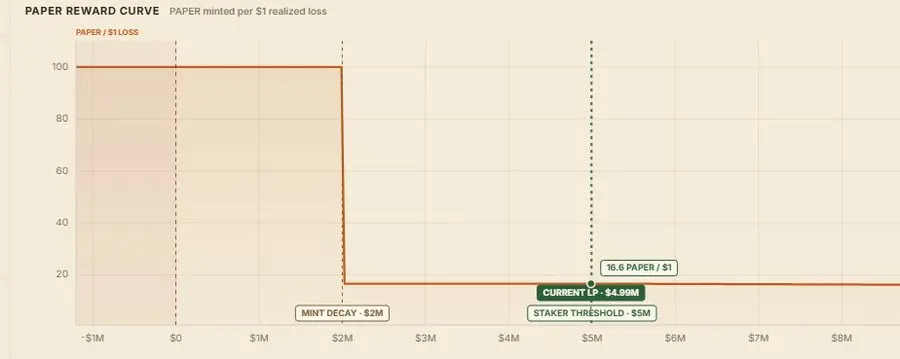
The overflow goes to stakers. Any portion of the pool exceeding $5 million is pushed to PAPER stakers. The team announced on October 17 that this line would be raised to $10 million, but as of October 19, it was still $5 million on-chain, and we found no explanation for the delay.
Each closing position, regardless of profit or loss, incurs a 2% fee, with 1% going to stakers and 1% to developers. When losing, it is deducted from the loss, so 98% goes into the pool; when winning, it is deducted from the profit. Some are exempt from fees while in the queue.
These are the rules. The money in the pool is not promised to anyone; how much ends up in the hands of winners and how much goes to stakers depends entirely on how the trades go.
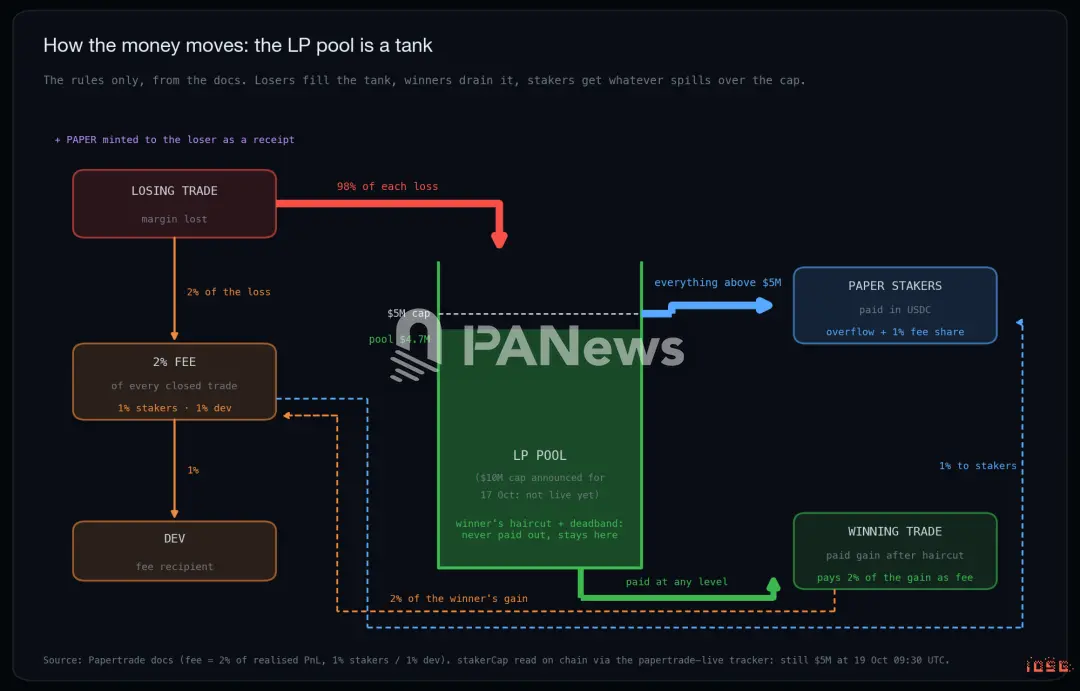
▲ How funds flow: The LP pool is a water tank
The most important point is this: this casino does not guarantee that winners can get their money. In ordinary exchanges, there is always a capital provider to pay the winners, such as market makers, insurance funds, or the operator's own balance sheet. Papertrade has none of these. The pool only contains the money left by losers, and the cap is intentionally set; any excess portion once allocated to stakers cannot be retrieved. The portion of the winners that exceeds the pool is essentially asking for payment from "those who have not lost money yet," and there is nothing in the contract that can compel these people to enter the market.
Strictly speaking, this is not a Ponzi scheme; no one has promised returns, and the house advantage is real. But from the perspective of the winners in the queue, it is no different from a Ponzi scheme: new money must keep coming in for them to get paid.
The real risk lies with the long-tail winners. A single position cannot break the pool: with a position cap of $10 million nominal value, even if a 1000 times long position is extraordinarily lucky, it would need to rise about 57% to owe $5 million. The problem is that there are no rules limiting a wallet from opening dozens of positions. 0x2025 has had about 30 ETH short positions, each at $9.9 million, totaling $297 million; under this scale, if the market moves against them by 2%, the owed amount exceeds all the money in the pool. On the first night, 0x2025 was pushing the mid-price on Hyperliquid, and in 35 minutes, winners took $2.4 million from the pool; at UTC 21:45, there was still $4.91 million, and by 22:20 only $2.48 million remained. This situation has not occurred again since.
How PAPER is Issued
When the LP is below $2 million, losing $1 mines 100 PAPER. Above $2 million, the mining rate is 100 × (120M / (120M + H))², where H is a high water level that only rises and does not fall, essentially the cumulative inflow of LP above $2 million. Currently, H is $243 million, and losing $1 can only mine 10.9 PAPER, while at launch it was 100 PAPER.
The total supply will eventually approach about 12.7 billion: on the curve, 12 billion (100 × $120 million), plus 660 million mined in the first hour when the pool was still below $2 million at a rate of 100 PAPER. So far, 8.69 billion have been issued, accounting for 69% of the cap.
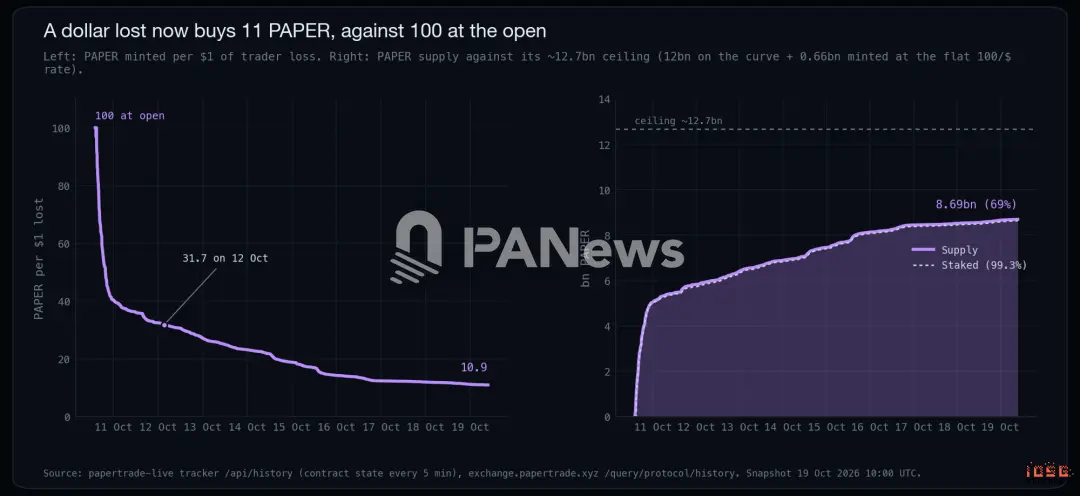
▲ PAPER mining rate and supply
Staking
Staking does not produce new coins. The threshold is 100 PAPER, with no lock-up, available for deposit and withdrawal at any time. PAPER still cannot be transferred, with 99.3% currently staked. Dividends are paid in USDC, distributed proportionally based on the amount staked, with no acceleration or tiers.
As for when stakers can truly receive money, there are three rules in the documentation:
Winners in the queue always take priority. When the pool cannot pay a certain winner, the shortfall goes into a first-in-first-out queue, making the available cash for others in the pool 0, and the fee sharing for both sides stops. New losses are recorded in a separate bucket, specifically to repay the queue. If the queue is not cleared, stakers will not receive a cent. This has not occurred so far.
The overflow is swept away in batches, not in real-time. The keeper calls pushStakerFees(), transferring the portion above $5 million into the staking contract. The swept money leaves the pool, and future winners cannot retrieve it.
Between two sweeps, whoever arrives first gets it. The profit from the closing transaction is credited immediately, while the overflow must wait for the next sweep to leave.
Where the Rake is Hidden
Apart from the 2% fee, the platform does not charge based on nominal amounts. The rake is hidden in the liquidation rules and on the profit side:
The liquidation line is set 5 basis points early. With 1000 times leverage, the margin can withstand a 0.1% fluctuation, but it will be forcibly liquidated at around 0.052%, with the entire margin taken.
Profits first have a dead zone of 0.2 basis points, then an "asymmetric impact" discount is applied, with smaller market movements resulting in harsher deductions. According to the upper limit parameters, BTC winners can take home at most 90% of the original profit; if the market moves 1%, they take about 88%, and if it moves 0.1%, they only take about 74%.
The remaining profits are then subject to a 2% fee.
The deducted money is not given to anyone; it remains in the pool, and once the pool is full, it overflows to stakers. Let's do a calculation: $100, BTC, 1000 times. Reverse 5.2 basis points, $100 is gone. Forward 5 basis points, at fair value, it should earn $50, but the actual amount received is $30.4. Since the launch, no parameter adjustments have been announced.
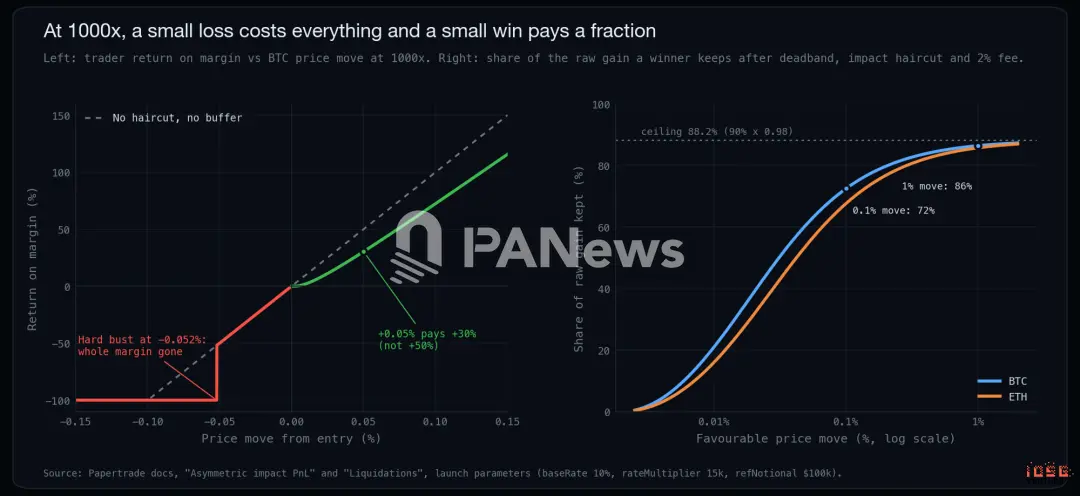
▲ Profit and loss and profit retention ratio under 1000 times leverage
Who Can Move the Switch
Opening positions, closing positions, and staking all go through Papertrade's relay, while withdrawals do not require this; users can directly withdraw their money at any time. A 2/3 multi-signature can pause opening positions, delist markets, change position limits, minimum margins, and minimum order sizes, and can also adjust impact curves and fee parameters. Contract upgrades have a 7-day time lock. The relay sorting is "adaptive," prioritizing large orders.
Account Numbers
Unless otherwise noted, data is taken from October 19, UTC 10:00, which is 212 hours after opening.
How much real money is in the $13.61 billion trading volume
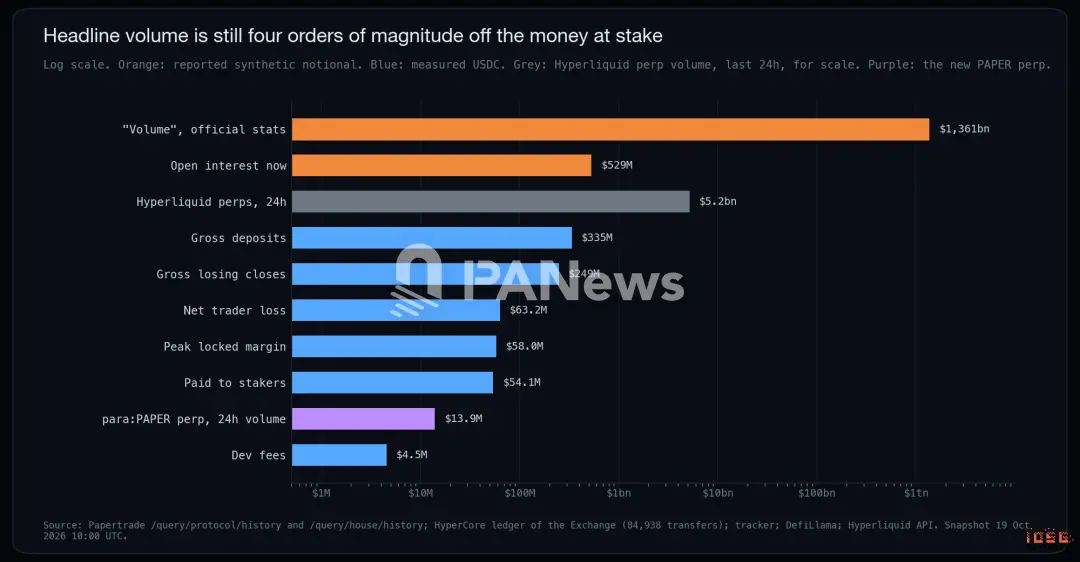
▲ Headline trading volume vs actual USDC
Peeling layer by layer:
$13.61 billion, trading volume on the platform. It seems that both opening and closing positions were counted once.
$529 million in positions, corresponding to $10.7 million in margin, averaging about 50 times. The average on the first day was about 160 times.
$335 million, the actual money that came in, from about 23,000 addresses; $271 million was withdrawn. The highest locked margin was $58 million, which appeared on the first day.
$249 million, losses from closing positions, the actual money that changed hands.
$63.2 million, net loss for traders, which is also the only layer that can be distributed to stakers.
The net loss accounts for about 0.46 basis points of the trading volume on the platform. The team earned about $4.5 million in fees.
Where Did the $249 Million Loss Go
The accumulated losses from losing positions contributed about $249 million to the pool. This is the gross amount, including all losses from closing positions, including the leg that lost in the wash trading; PAPER was extracted based on this figure. There are four destinations:
$185 million (75%) was paid to profitable positions, most of which were from the other leg of the same batch of wash trades.
$54.1 million (22%) was distributed to stakers.
$4.7 million is still in the pool, just shy of the limit.
About $4.5 million (2%) belongs to the developers.
After deducting the portion for winners, traders had a net loss of $63.2 million, of which 86% went to stakers.
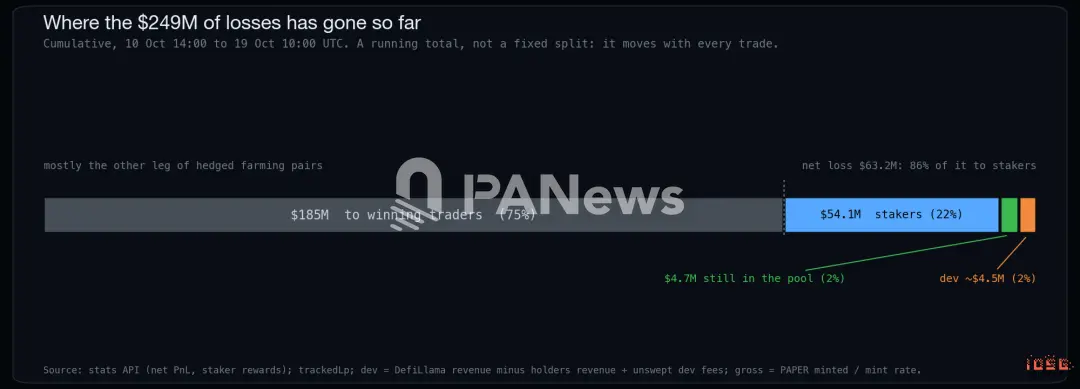
▲ Where the $249 Million Loss Went
Who Holds PAPER
16,198 wallets hold PAPER, among which 13,291 meet the staking threshold of 1,000 coins. The holdings are very concentrated, and the holders are the customers: the top 10 wallets hold 15%, the top 100 hold 52%, and the top 1,000 hold 88%. These 1,000 wallets also bear 81% of the losses from all losing wallets and took 91% of the dividends.
On average, each holder lost $0.0073 per PAPER, and after deducting dividends, only $0.0016 remains. Based on the perpetual price of $0.0243, 97% of the supply is profitable after deducting dividends. Overall, traders lost $63.2 million, retrieved $54.1 million in cash, and the PAPER they hold is valued at $211 million based on perpetual value. This valuation only turns into money when someone buys it, and currently, no one can buy PAPER itself.
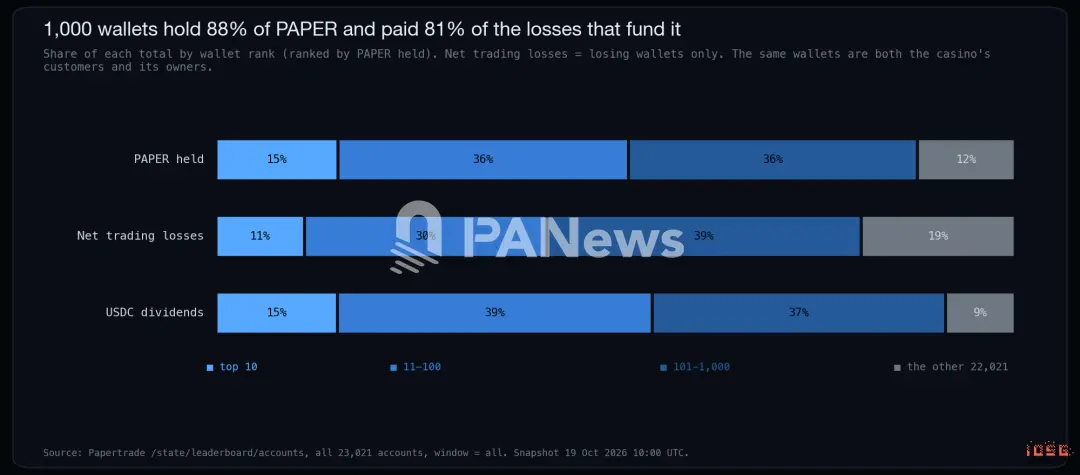
▲ Who Holds PAPER
The Vault and LP Are Not the Same Thing
The money in the vault does not belong to the market maker. It is the total USDC held by the Exchange contract, amounting to $63.1 million: traders have an available balance of about $47.6 million, locked margin of $10.7 million, LP of $4.7 million, and there is $100,000 in developer fees that have not been withdrawn. Only the LP belongs to the market maker, accounting for about 7% of the vault. The vault dropped from $138 million to around $60 million in the first two days, and then remained between $58 million and $69 million. Since October 12, the LP has remained between $4.3 million and $5.2 million, with daily deposits and withdrawals roughly offsetting each other, with each direction ranging from $5 million to $26 million.
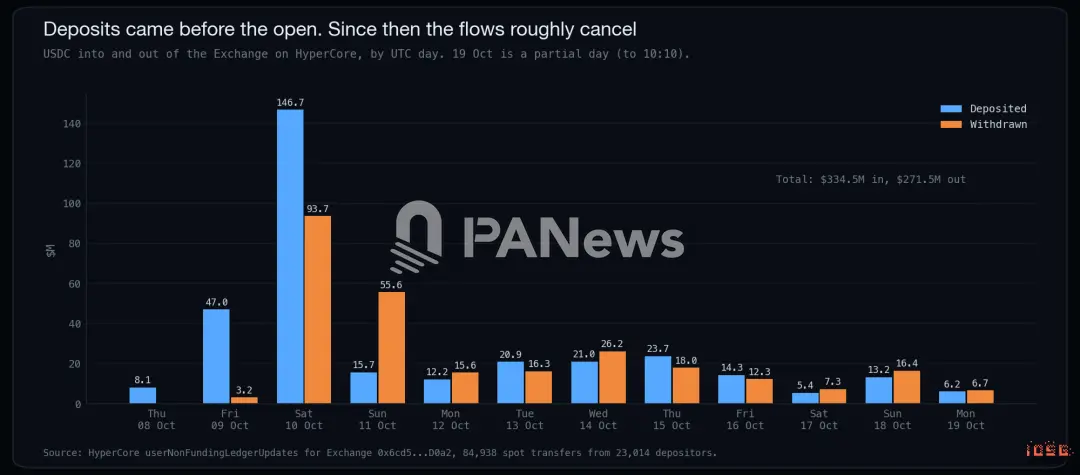
▲ Daily USDC Deposits and Withdrawals
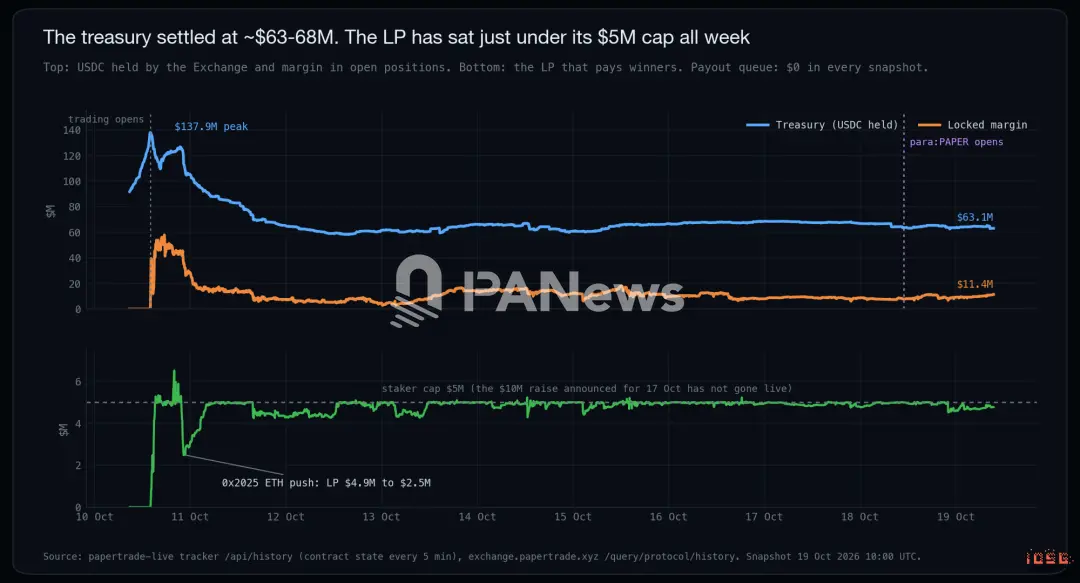
▲ Vault, Locked Margin, and LP
Daily Losses
On the first day: losses from closing positions were $75 million, net loss was $28.4 million. On the 11th and 12th: daily gross losses were about $20 million, net losses were about $4 million. Then came the second wave: gross losses rose to $27 million on the 14th, $41 million on the 15th, and daily net losses from the 13th to the 16th ranged from $4.5 million to $7.4 million. On the 17th, there was a cliff-like drop, with gross losses of $6 million and net losses of $700,000. On the 18th, gross losses returned to $11.9 million, net losses were $2.2 million, most of which occurred after the perpetual opening.
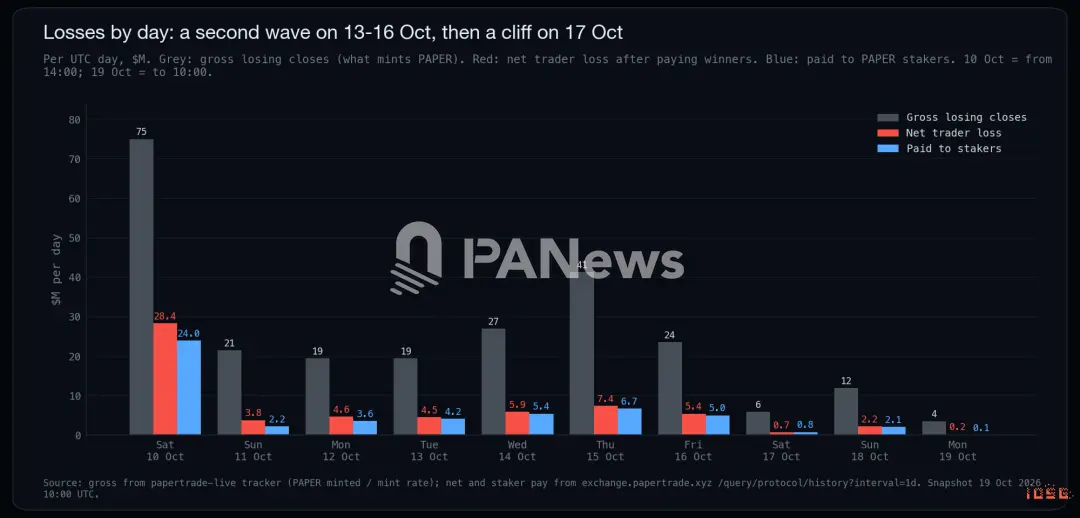
▲ Gross vs Net Trader Losses by Hour
Stakers' Accounts
How Overflow is Distributed
About 70 minutes after opening, the pool hit the $5 million limit for the first time. After the overflow at 15:45 on October 11, the pool stayed below the limit for most of the day, and on the 12th, it surged past the limit again, after which net losses kept it there until the 16th. Stakers received $3.6 million on the 12th, $4.2 million on the 13th, $5.4 million on the 14th, $6.7 million on the 15th, and $5 million on the 16th. Then on the 17th, $800,000, on the 18th, $2.1 million, and in the first ten hours of the 19th, $70,000.
The limit is an unresolved issue. The team announced on October 17 that it would double to $10 million. The tracker reads the stakerCap from the contract every five minutes, and each time it reads $5 million, including at 09:30 on the 19th. If it really goes up, the pool must first incur about $5.3 million in net losses before it can overflow again; at the rate from the 17th to the 19th, it would take four to five days without overflow.
Yield, now there is a price for comparison
Currently, directly losing money to mine 1,000 PAPER costs $91, while it was $10 at the opening. For those involved in wash trading, a set of positions only lost about 13.7% of the accounting losses, with a cost of about $12.5. The perpetual pricing for 1,000 PAPER is $24.3.
The annualized dividend in the last 24 hours is $0.086 per coin: calculated at the perpetual price, it is 352%, and based on the direct loss cost, it is 94%. In the last 7 days (including the tail end of the second wave), the annualized amount is $0.197 per coin, which calculates to 812%. This means that the perpetual price is equivalent to about 100 days of dividends from the last day or 45 days of dividends from the previous week. This gap reflects the market's judgment on the speed of income decay.
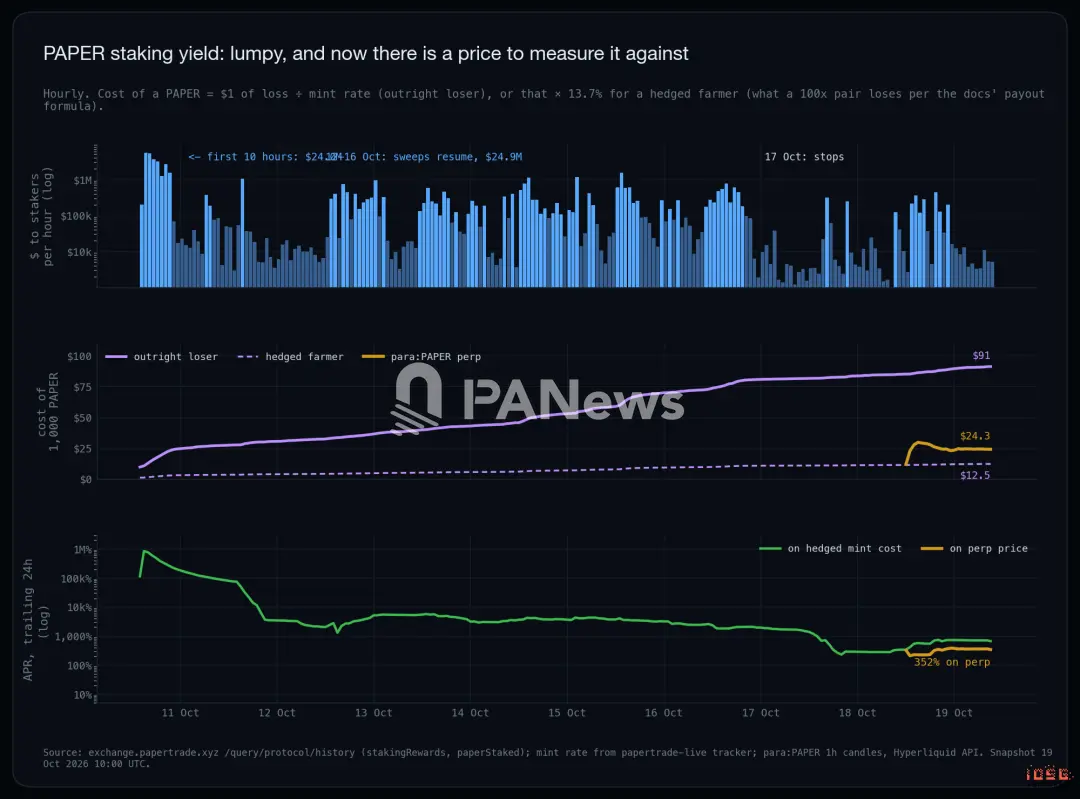
▲ PAPER Staking Yield: Comparing Mining Costs and Perpetual Price
How Long to Break Even
Looking only at cash, no one who entered on any day has broken even: those who lost money on the first day got back 0.58 times, and every batch after the 11th was at 0.15 times or below. When considering PAPER at the perpetual price, the situation changes: those who entered on the first day reached 2.2 times, and those on the 11th reached 1.0 times. After the 12th, those who directly lost money have not yet broken even, dropping from 0.83 times to 0.27 times. For those involved in wash trading, the break-even line is about 0.14 times, and every batch has crossed the line. At $0.024, the cheapest mining method can still make a profit, which is what the fourth part will discuss.
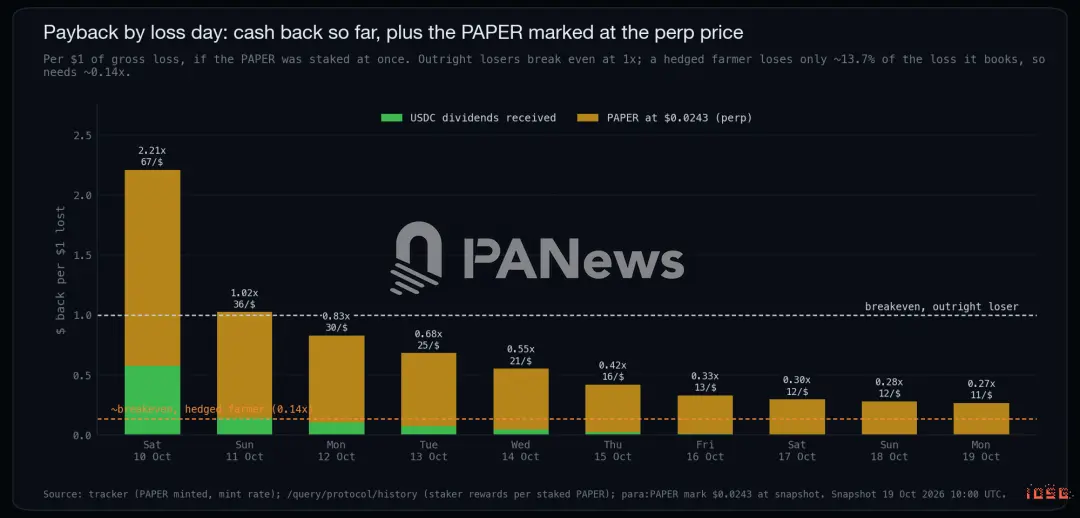
▲ Break-even Multiples by Loss Date
Reduction in Production and Activity
Activity follows the mining returns. The hourly trading volume was $56 billion in the first ten hours, $7.5 billion on the 11th and 12th, $3.6 billion from the 13th to the 16th, and $2.3 billion on the 17th. Each turning point corresponds to changes in mining returns: the second wave occurred when the mining rate dropped from about 26 to 13, just before the limit was about to increase; the drop on the 17th was exactly on the day the limit was supposed to double; the rise in perpetual price on the 18th past the mining cost led to increased volume.
The fee left per dollar traded also changed: on the first day, it was 0.50 basis points, on the 11th and 12th it was between 0.21 and 0.34 basis points, from the 13th to the 15th it was between 0.61 and 0.76 basis points, on the 17th it was 0.13 basis points, and on the 18th it was 0.37 basis points. This aligns with the mechanism of wash trading: in a set of wash trades, one leg always loses completely, while the other leg is discounted, so the more intense the trading, the higher the fee left per dollar.
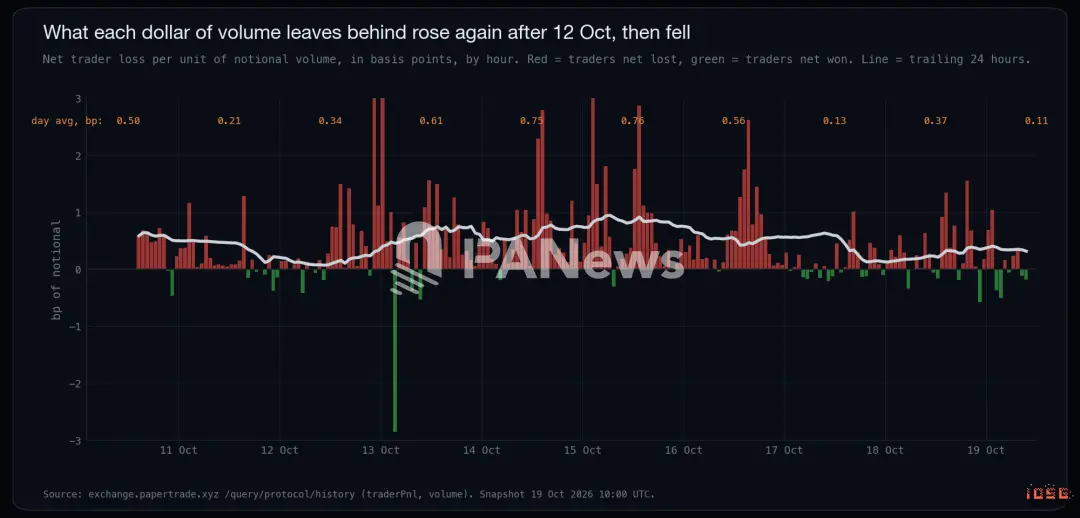
▲ Net Loss per Unit of Trading Volume
Launch of Hyperliquid
What is Launched
para:PAPER is the perpetual contract of Paragon. Paragon is the HIP-3 deployer on Hyperliquid (the DEX named para), and this market was not opened by Papertrade or officially by Hyperliquid. Paragon spent 570.98 HYPE (about $45,000) in the HIP-3 auction to acquire the PAPER code.
This is a pre-market: up to 3 times, only isolated positions, which will later convert to standard perpetual contracts.
The oracle uses its own marked price's 8-hour EMA, with an initial value set by Paragon at the reference price of $0.012.
There is no connection between it and Papertrade. PAPER cannot be transferred, no one can settle, and there is no spot to arbitrage.
Opened at 11:00 UTC on October 18, with a position of about $30,000.
Trends
After opening, it stayed at the reference price of $0.012 for an hour, just near the wash trading mining cost ($0.0125). Then it started to rise: at 13:00 it reached $0.023, peaking at $0.0352 during the hour at 13:00, dropping to a low of $0.0198 at 19:00, and then remained around $0.0243. The 24-hour trading volume was $13.9 million, accounting for 70% of Paragon's total trading. The position was 203.5 million coins, about $5 million. The funding rate was close to zero.
At $0.0243, 8.69 billion coins correspond to a market value of $211 million, and the limit of 12.7 billion coins corresponds to $308 million.
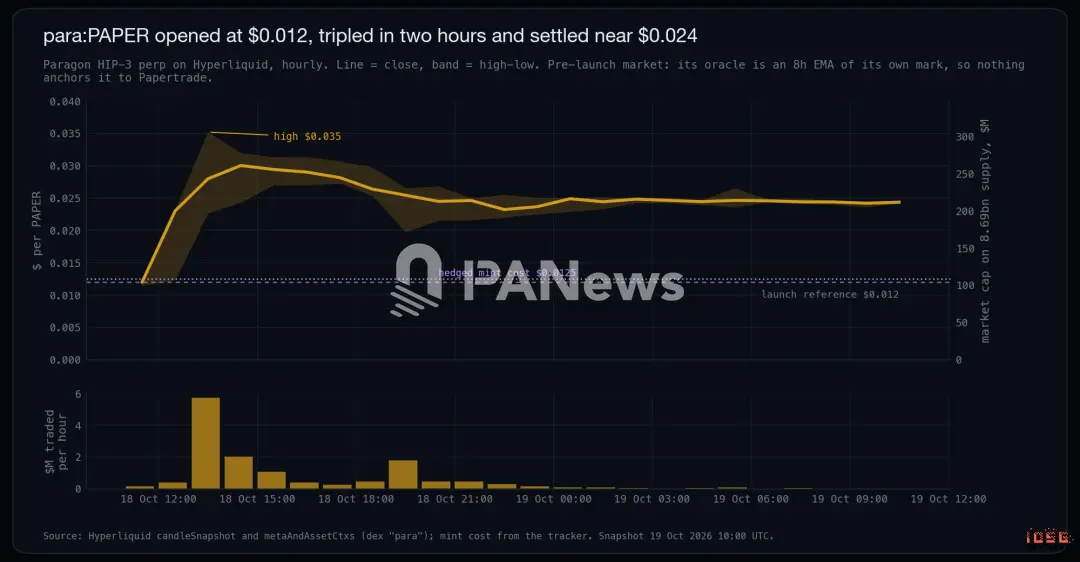
▲ para:PAPER Price and Trading Volume
Impact of Price on Mining
At $0.024, those who engage in arbitrage spend $0.0125 to mine PAPER, and the perpetual price is almost double, making mining profitable again. In the 24 hours before launch, the gross loss was $300,000 per hour, which increased to $800,000 per hour 11 hours after launch. Stakers received $800,000 on the 17th and $2.1 million on the 18th. By the 19th, the excitement had dropped back to $350,000 per hour.
This arbitrage cannot be balanced out. You can mine PAPER cheaply and short on perpetuals, but perpetuals only have about $5 million in positions, a maximum of 3x leverage, and they can never be settled. Holders also did not use it for hedging, at least not with the same wallet. Among the top 300 holders (accounting for 71% of the supply), only 6 opened short positions on para:PAPER, totaling 20 million tokens, which is about 0.3% of their holdings; another 5 opened long positions.
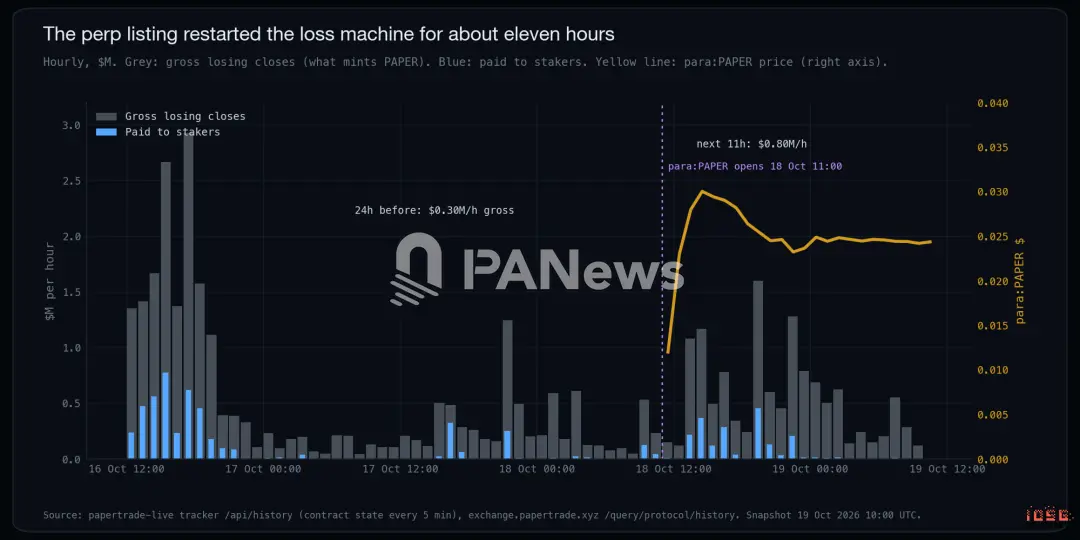
▲ Gross Loss and Staking Rewards Before and After Perpetual Launch
What This Price Means
· This is the first number that can price PAPER, indicating that PAPER is worth about twice the cost of arbitrage.
· It is thin and self-reinforcing: the oracle is the market's own EMA, with 3x leverage, and a $5 million position is pricing a $211 million token.
· It has an additional feedback loop: the higher the perpetual price, the more profitable mining becomes; the more mined, the greater the losses and staking rewards; the rewards further support the price. This loop will weaken itself because as H increases, the amount of PAPER mined per dollar lost decreases.
Bullish: Liquidity Without Principal
First, acknowledge where it has done right. This design is new, and it has continued to operate as promised for nine days. The market maker did not raise a penny and withstood a $2.5 million withdrawal on the first day. Concerns about trapping winners in a queue have not appeared even once in the snapshots taken every five minutes, and the fair launch can be verified on-chain.
The strongest reason for being bullish lies in the structure. All rules lean in the same direction: losses are total losses, profits are discounted, and liquidations happen early. As trading increases, traders overall will lose more than they win, and the pool will fill itself. The data supports this: in the 212 hours since opening, traders overall have only had 41 hours of net profits, totaling $3.7 million, while the other 171 hours were losses.
From another perspective, this is a form of liquidity that grows from trading. Other perpetual launch methods require upfront money: order books need market makers; oracle-priced pools like GMX's GLP and Jupiter's JLP require depositors to take every counterparty trade, and they need to earn; launching a HIP-3 market on Hyperliquid requires staking 500,000 HYPE, and then finding market makers. The Papertrade pool started from 0, hitting the $5 million cap about 70 minutes after opening, and since the 12th, it has never been more than $800,000 away from the cap, without seed funding or LP incentives.
Thinking one step further, it could become a template for permissionless perpetual issuance. A market only needs two things: a readable price and a pool. The documentation already states that any Hyperliquid perpetual can be launched, including HIP-3. Once deployment tools are available, with each market having its own pool, anyone can issue a perpetual just like issuing a token on pump.fun.
The ceiling is in the price source. 0x2025 only spent about $52,000 in fees to push ETH by 0.12%, and the thinner HIP-3 market is cheaper. To create a permissionless version, each market's position limit must be linked to the depth of its oracle order book.
Potential Problem Areas
· Tokens represent future losses, and losses come in waves, following mining returns. From the 12th to the 16th, stakers received $24.9 million, but only $800,000 on the 17th. The 17th was the only day we had no reason to mine, and stakers received only about one-sixth of what they got the previous day.
· The later you enter, the more expensive it gets. Currently, losing $1 only exchanges for 10.9 PAPER, while at the opening it was 100 PAPER, and 69% of the cap has already been issued. Arbitrage increases supply but does not bring cash to LPs. Once PAPER can be transferred, for anyone other than those engaging in arbitrage, buying directly will be cheaper than losing money to mine.
· The oracle only looks at one number: a single bid-ask midpoint, with no TWAP or deviation circuit breaker, while on Hyperliquid, a few million dollars can push ETH by 10 to 20 basis points. Limxn6 also mentioned that a pair of legs engaging in arbitrage encountered a price gap, equivalent to getting a straddle option for free, with this tail borne by LPs.
· Relayers can be scrutinized. They sort by order size, making it impossible to audit from the outside, and both relayers and liquidation keepers are run by the team.
· The most important price signal has no anchor. para:PAPER can change mining incentives and market narratives without any changes in Papertrade. The team’s self-announced cap adjustments have not been executed, leaving stakers unable to predict their income based on announcements.
The pool is safer than before. It currently has $529 million in positions, a net long of $64 million, and a pool of $4.7 million. BTC and ETH need to rise about 3.7% from the opening prices of these positions for the owed money to exceed the pool plus the losers' margins. On the first day, this number was 0.7%. The closest it got in the past week was 2.2% on the 15th, with BTC/ETH having a maximum hourly fluctuation of 4.3%.
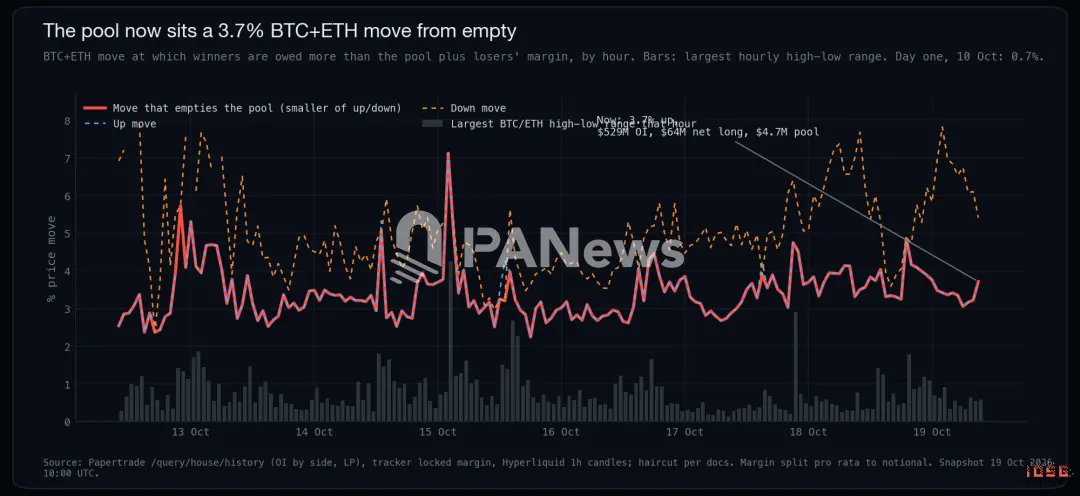
▲ Price Fluctuation Required to Empty the Pool
Conclusion
Mechanically, it has delivered on its promises. The market maker did not raise funds and has been able to pay out money for nine days, with no winners queuing up, and 86% of the net losses were returned to stakers, who are basically the wallets that are losing money.
When viewed as a yield product, PAPER represents an overflow that will surge whenever mining is profitable, along with a 1% fee sharing. It now has a price, with the thin perpetual at $0.024, about twice the cost of arbitrage mining.
As long as this price difference exists, the perpetual will pay people to lose, and the losses will feed back to the stakers. Once the price difference disappears, income will revert to the level that pure 1000x gambling can leave: the 17th was the only calm day, and stakers received $800,000 that day.
What to watch next:
· PAPER opens for transfers. This is the fourth phase of the roadmap, with no timeline. With spot trading, the perpetual will have an anchor, and those who are inflating the volume can also sell.
· $10 million cap. If it truly rises, the overflow will stop for several days.
· New markets. The documentation states that any Hyperliquid perpetual can be launched. New markets bring new losers, which is the only thing that can add water to the tank.
· Perpetual position volume. $5 million cannot support real hedging. If it rises, it can be expected that holders will go short.
· Mining rate. It is currently 10.9. For every additional $100 million in gross losses, the mining rate will drop by more than one-third, and for mining to be profitable, the price of PAPER must keep increasing.
 Risk warning


Popular articles