








Blast Shutdown: An airdrop-driven L2 that couldn't survive the "post-airdrop era"
 Core Viewpoint

 Blast announced the cessation of operations, with a monthly revenue of only 1,793 USD, and TVL plummeting from 2 billion USD to 32 million USD, marking a business stop-loss after the airdrop frenzy and the elimination wave of L2.
Author: Frank, PANews
On October 2, the official account of Blast released a brief announcement, stating that it would cease operations and urging all users to withdraw their assets back to the Ethereum mainnet by October 26.
This star Layer 2, which attracted over $1.1 billion in deposits before its mainnet launch and had a TVL that once exceeded $2 billion, saw its network revenue drop to just $1,793 last month. Behind this is airdrop-driven star project facing a business stop-loss after revenue could not cover maintenance costs.
Monthly income of less than $2,000, unable to sustain a Layer 2
The reason given by Blast for shutting down is straightforward: the ongoing costs of maintaining Blast exceed the revenue generated by the Layer 2, with no credible sustainable path in sight. This statement sounds like official jargon, but when the numbers are laid out, it tells a very specific story.
According to DeFiLlama data, Blast's network revenue peaked at around $3.5 million in June 2024. That was its most prosperous time. In the most recent month, this figure has dropped to just $1,793. The decline from $3.5 million to $1,793 represents a 99.95% drop, with monthly revenue now below $2,000.
Running a Layer 2 is not free. Development, infrastructure, and security all require ongoing investment. CoinDesk specifically mentioned in its report that recent exploit incidents have heightened the focus on security spending, while competitors like Base are converting exchange users and developer ecosystems into on-chain activities, making it harder for smaller chains to compete for developers, users, and transaction fees. With a monthly revenue of $1,793, Blast simply cannot sustain itself within this cost structure.
The revenue sources for this chain mainly come from transaction fees and earnings generated by network activities. When users stop trading, the revenue ceases. The gap from $3.5 million to $1,793 is not a matter of data discrepancies, but a direct consequence of users and funds leaving.
From $2 billion to $32 million: the exit of users and funds
Blast's TVL peaked at over $2 billion in June 2024. Now, this figure is about $32 million. It has shrunk by over 98%. Even compared to $67 million in August 2025, it has dropped by more than half.
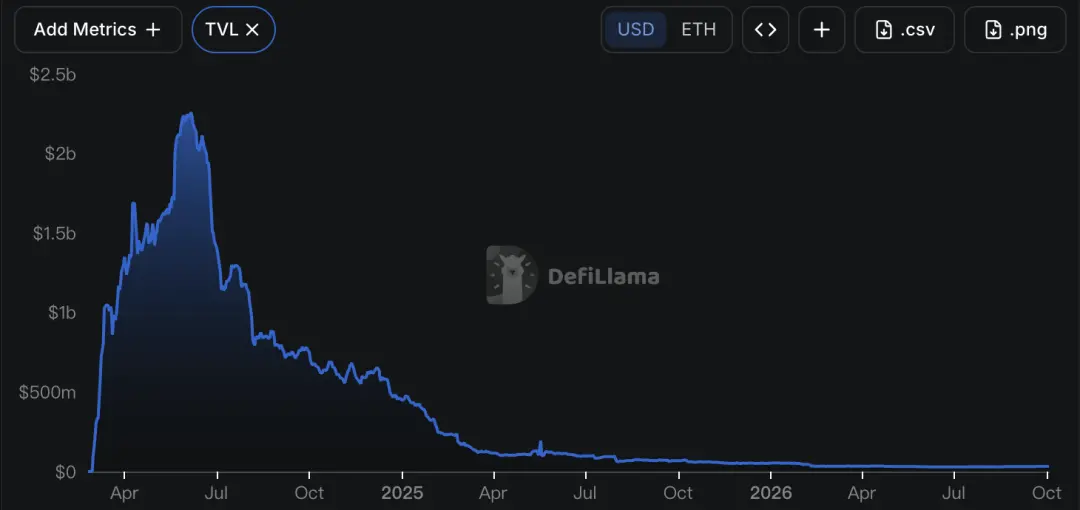
The lack of on-chain activity is even more evident. As of October 2, Blast had only 2,648 active addresses in the last 24 hours, with 48 new addresses, and a DEX trading volume of $63,766, with only $378.15 in fees paid in 24 hours. In comparison, on March 1, 2024, the day the mainnet launched, Blast had 37,000 wallets executing nearly 810,000 transactions. From 37,000 to 2,648, the number of active addresses has decreased by 92.8%.
While funds are still on the bridge, they are no longer entering DeFi. The bridged TVL is about $117.56 million, while DeFi TVL is only $32.27 million, a difference of $85.4 million. This gap at least indicates that the asset scale remaining within the Blast ecosystem is significantly higher than the actual locked scale entering DeFi protocols.
The BLAST token has cumulatively dropped by about 98% since its issuance, and after the shutdown announcement, it fell by another 19%.
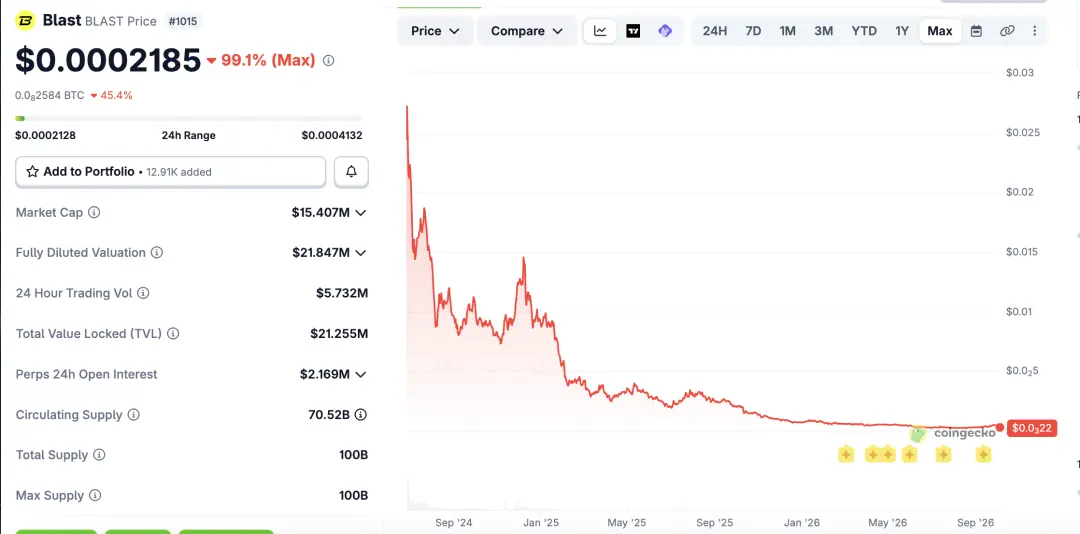
Putting these numbers together, it is clear that the Blast chain is nearing a standstill. Users are no longer trading, developers are no longer deploying, and the token price continues to decline. From $2 billion to $32 million, what has shrunk is not just the number, but all the foundations for the survival of this chain.
Once $2.3 billion in deposits, the airdrop frenzy comes to an end
Two and a half years ago, Blast was a different scene.
Founder Pacman, well-versed in internet marketing, achieved great success in the NFT space with the airdrop of the NFT trading platform Blur. He then sought to replicate this marketing playbook in the then most popular Layer 2 space. In November 2023, Blast completed a $20 million financing round, with investors including Paradigm, Standard Crypto, eGirl Capital, as well as angel investors Andrew Kang, Hasu, and Larry Cermak. Early access was opened in the same month.
Blast's positioning was very appealing: the only Layer 2 on Ethereum with native yields in ETH and stablecoins. User balances would automatically compound, ETH staking rewards would be returned to users and DApps, and stablecoins bridged would be deposited into protocols like MakerDAO, returning yields through USDB.
This design, combined with an invitation system and airdrop points, quickly created FOMO. Participants earned Blast points, and those who bridged funds within seven days could earn double points, with 50% of the airdrop allocated to developers. Huobi incubator researcher 0xLoki commented at the time that while staking assets on public chains for yields was not new, Blast could avoid "middlemen making a profit." The founder of the NFT project Weirdo Ghost Gang, Sleepy, believed that Blast's uniqueness lay in its ability to provide native yields for ETH and stablecoins, which was "eye-catching."
Before the mainnet officially launched on March 1, 2024, users had already deposited over $1.1 billion in assets, partly in anticipation of potential token airdrops. On the night of the mainnet launch, the total funds attracted reached as high as $2.3 billion, with over 60% of Blast's TVL bridged to the mainnet, and the Bridge holding over $1.46 billion in stETH, ETH, and DAI. On the day of the mainnet launch, 37,000 wallets executed nearly 810,000 transactions.
At that time, there were also dissenting voices. Former Chain News editor Liu Feng stated that Blast and Blur had "the same MLM flavor," arguing that the point system, invitation codes, and clear airdrops were standard marketing tactics of Paradigm. Investor brain genius believed that people were only participating for the airdrops, and Paradigm had gamified features that the community did not need. Looking back now, these criticisms pointed to a key issue: once the airdrops were fulfilled, how many users would actually remain.
Crypto faces a wave of shutdowns, with about 99 projects shut down by 2026
Blast is not an isolated case.
According to a RootData report, as of late July 2026, about 99 crypto projects have been listed for shutdown in 2026, covering centralized exchanges, wallets, DeFi, Layer-2, NFTs, AI, infrastructure, and more. In 2025, about 176 to 177 projects were shut down throughout the year. In the first seven months of 2026, there has been an average of about 14 projects per month, which, at this rate, will reach about 170 for the entire year, comparable to the shutdown wave of the previous year.
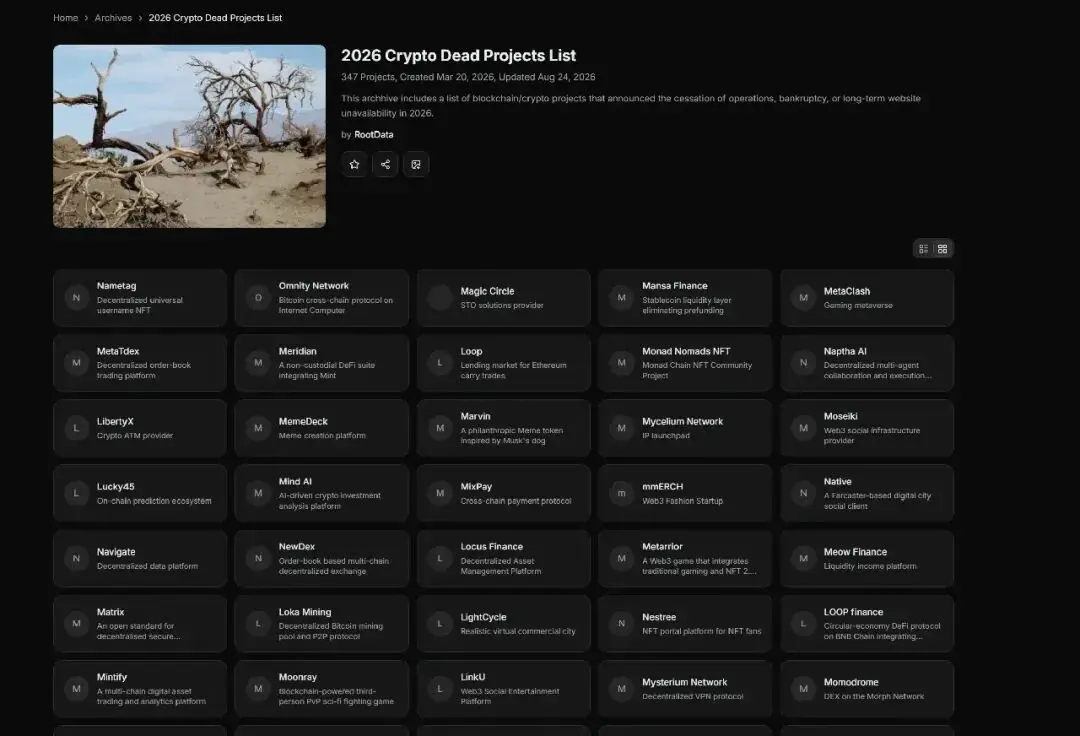
Recent shutdowns include exchanges CoinEx, BitMart, BitMEX, AscendEX, as well as Layer-2 protocol Loopring, and DeFi projects like Goldfinch and tool products like Zapper. Reasons for shutdown include: venture capital becoming more selective, unsustainable token incentive business models, declining user growth and revenue, and intensified industry consolidation. Centralized exchanges are also facing increased pressure from regulatory scrutiny and rising compliance costs.
The competitive landscape in the Layer 2 space is particularly brutal. According to L2BEAT data, Rollups have a total locked value of $34.18 billion, with Base Chain at $15.92 billion and Arbitrum One at $11.51 billion. Blast's bridged TVL of $117.56 million accounts for only 0.34% of the total locked value, equivalent to 0.74% of Base. Base is converting exchange users into on-chain activities, and Robinhood has also launched its own Layer 2 this year, continuously drawing users and developers away from smaller chains.
The shutdown of Blast is just a microcosm of this wave of eliminations. It once gathered $2.3 billion through airdrop expectations, but when the airdrops were fulfilled, users left, and revenue dropped to an average of $1,793 per month, making it impossible for this chain to continue its business. The 99 projects on the shutdown list each have different stories, but the core ledger is the same: revenue cannot cover costs, and airdrops cannot retain users.
 Risk warning


Popular articles





