MEXC AI’s All-in-One Upgrade: From Market Insights to Trade Execution

 AI is responsible for understanding requirements, forming judgments, and executing tasks, while the platform is responsible for checking permissions, constraining risks, and refusing operations when necessary. Only the security boundary can ultimately determine whether AI can truly be trusted.
AI on trading platforms now does more than answer questions about the market. It can monitor conditions set by users, while agents can access account information and execute trades. The practical test is whether these capabilities fit into the way people trade every day.
An unusual price move usually sets off a sequence of tasks. Traders investigate what happened, assess the implications for the market and their positions, then decide on the conditions for a trade. AI offers limited convenience if those steps remain disconnected from execution.
The newly launched MEXC CLI adds another way to access the exchange’s AI offering. Users can connect it to an AI agent they already use, ask for MEXC market and account information in a conversation, and access supported trading functions after confirming the action. The launch accompanies a broader upgrade to MEXC AI, bringing together tools for discovering market developments, understanding them and acting on a trading plan.
1 How AI Is Changing the Way Traders Use Their Tools
Traditional trading tools display data and charts and provide a place to buy or sell. Traders still have to find relevant information, interpret the market and configure each parameter themselves. AI is changing that division of work. In a market where prices move around the clock and news, on-chain events and social media can all affect sentiment, users can ask AI to filter what deserves attention, then follow up on a token, a market move or an existing position. The tools help organize and interpret the information they present.
Strategy setup makes the change particularly clear. Consider a request to buy after the price falls to a specified level and set a stop-loss. Previously, the trader had to select the trade direction and investment amount, then enter the price and trigger settings. With AI, the user can describe the conditions in plain language and review the rules it generates. Once the strategy is running, the system monitors those conditions, reducing the need to watch the screen while waiting for a trigger.
In practice, this changes four parts of the workflow:
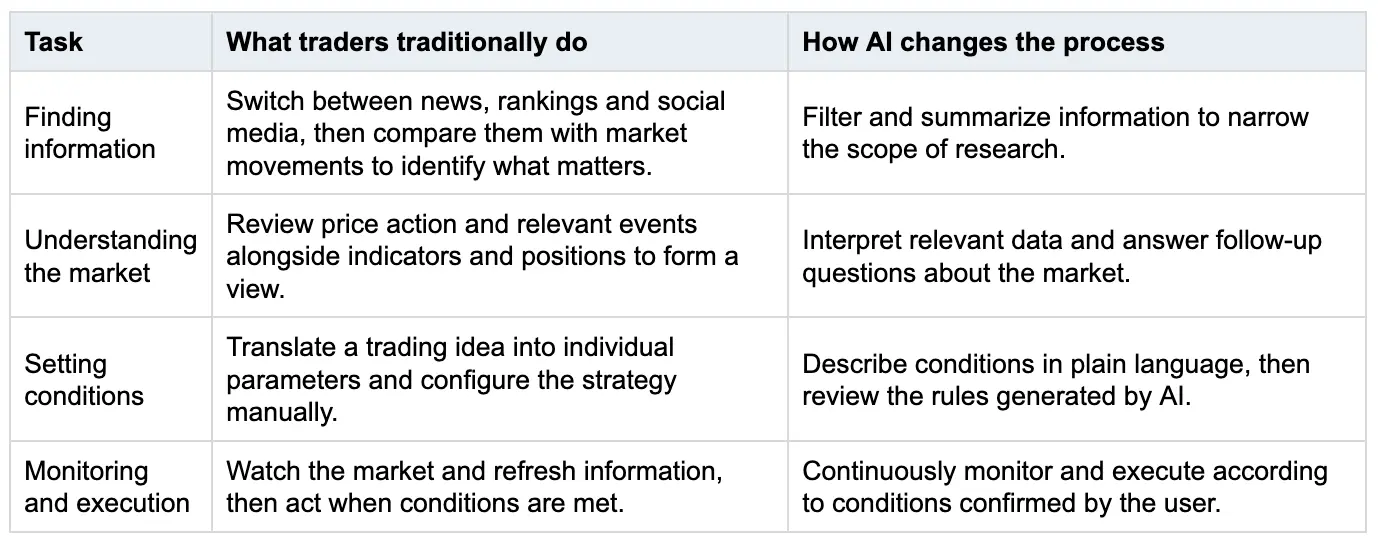
Ideally, the process is continuous: users filter information with AI, interpret what they find, turn a view into trading conditions and start a strategy. An agent can also query market and account data and call trading tools within its authorized scope. The user still decides whether to trade, how much capital to commit and how much risk to accept. MEXC AI’s upgrade follows this progression.
2 Three Questions an AI Trading Product Needs to Answer
Where Traders Use AI
Traders have little reason to interrupt what they are doing simply to open an AI tool. When reading news, they want to know which assets might be affected. On a candlestick chart, they want to understand a price move. On the account page, they want to know what it means for their positions. Having to open a separate tool and explain the asset, timeframe and position again can quickly consume the time AI was supposed to save.
MEXC places AI features within its news, rankings and trading pages, where users already spend their time. For those who research markets in an external AI agent, CLI provides another route. They can continue the same conversation to check their MEXC account or prepare a trade, without returning to separate pages to repeat the work.
Whether AI Understands the Context
“Why did this token suddenly rise?” “Does this news explain the rally?” “I already hold a position. What should I watch for?” All three questions concern the same market move, but they require different information. The first needs market data. The second calls for a comparison of news timing and price action. The third also requires an understanding of entry cost, current profit or loss and potential risk.
That context determines how useful the answer will be. MEXC AI can draw on candlestick charts within trading pages, while users can continue asking questions about the same topic. Where supported, they can also access analysis related to their positions. By taking account of the asset and page the user is viewing, the product reduces the need to repeat background information and keeps the discussion relevant to the task at hand.
How Far AI Can Take a Task
After discussing the market, a user may set out a clear plan: buy if the price falls to a certain level and attach a stop-loss. To execute it, the system still needs the trade direction, investment amount, trigger price and risk settings. MEXC AI can translate the request into specific parameters, which the user reviews and confirms before monitoring begins.
An external agent can also query market and account information and prepare supported trading operations. As AI gets closer to placing an order, its permissions need to be clearly defined, with user confirmation before execution. It can reduce configuration and monitoring work, while the decision to trade, the capital committed and the level of acceptable risk remain with the user.
Those changing needs help explain why MEXC AI consists of several tools. The assistance a trader needs evolves as a trade progresses. Each of the eight products serves a different part of that process.
3 Eight Tools Across the Trading Process
MEXC groups the tools into three stages. Discover More helps users find developments worth investigating. Understand Faster helps explain their causes and implications. Trade Smarter supports the actions that follow.
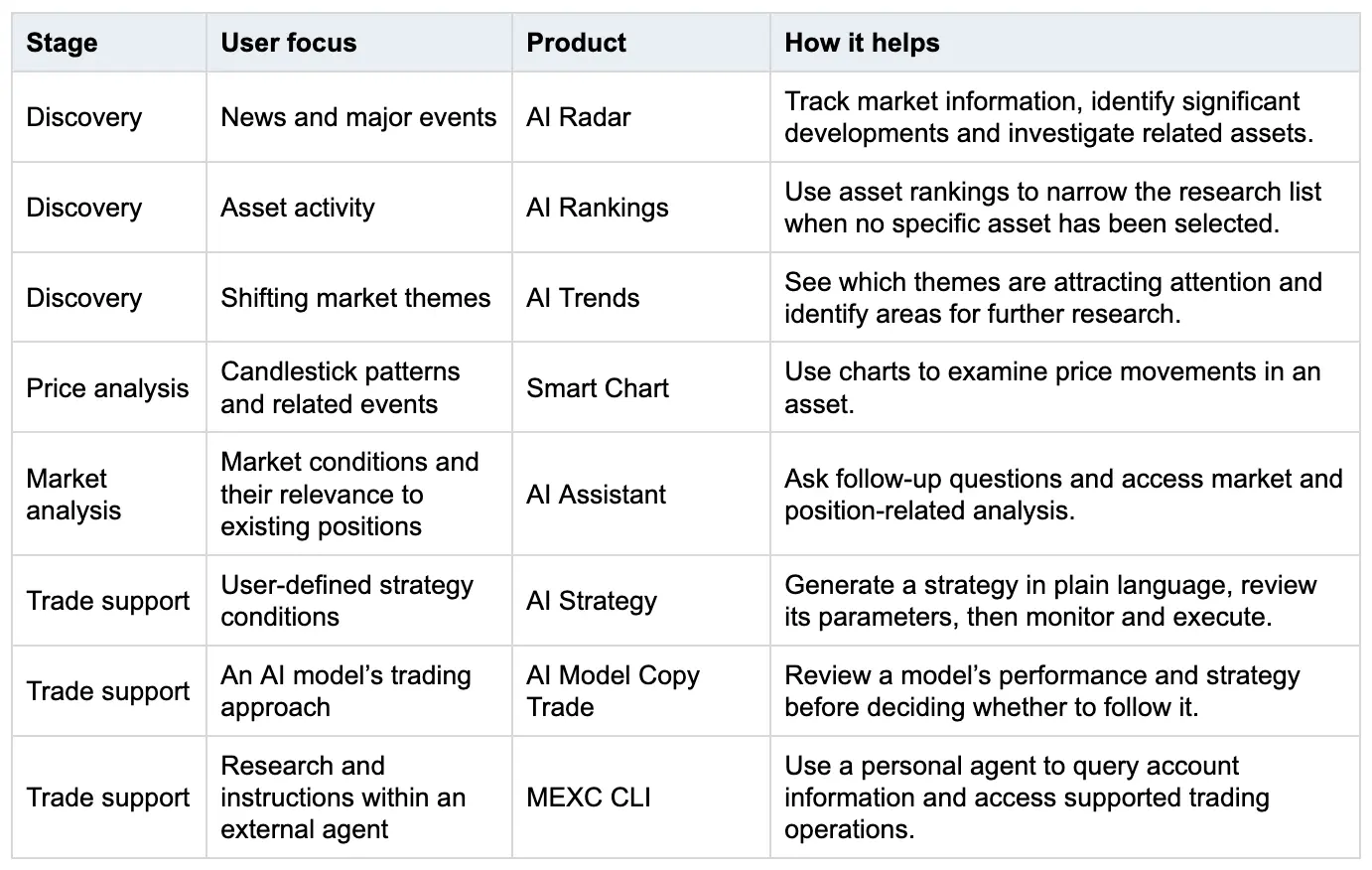
Product names and access points are subject to the official release. The three stages describe the tools’ roles; they do not imply that all eight automatically share all information.
Preparing for a Trade by Finding What Deserves Attention
A trader may notice breaking news or see a token enter a ranking without yet deciding to take a position. The immediate task is to identify what deserves attention in a constantly changing stream of information, then decide whether the development warrants further research.
AI Radar extracts leads from news and major events and identifies assets that may be affected. AI Rankings helps users spot active assets, while AI Trends shows where market attention is concentrating. Each offers a different starting point for moving from awareness of an event to a decision about what to investigate. Whether a finding becomes a trading opportunity still depends on price action, broader market conditions and the trader’s own circumstances.
Forming a View With Market and Position Context
Once an asset has been selected, the questions become more specific. What caused the price move? Does the timing fit the relevant news? What does it mean for an existing position? Smart Chart places related events alongside candlestick charts, allowing users to examine price behavior before and after the news and continue their technical analysis. They can then ask AI Assistant follow-up questions about the asset and the page they are viewing, including how their positions may be affected.
A rally looks different to someone considering an entry than to a trader who already holds a position and is watching entry cost, profit or loss and emerging risks. Within its supported capabilities, AI Assistant can use the current page and the asset being viewed to inform its analysis. With the appropriate authorization, it can also provide position-related insights. Its half-screen interface lets users keep the trading page in view, while conversation history and follow-up questions support continued research on the same topic.
Turning a Trading Plan Into Executable Conditions
After completing their research, traders may choose to wait for a price level, a technical signal or a particular news event. With AI Strategy, they can describe supported trading conditions in plain language. AI generates the strategy, and the user checks the direction, investment amount and risk settings before starting it. The system then monitors the conditions and executes when they are met.
For example, traders can monitor posts from selected X accounts instead of repeatedly refreshing social media. AI Strategy has also added Futures DCA, Enhanced DCA and Smart DCA. These support building positions at regular intervals, waiting for a meaningful market move before entering, and adjusting investment amounts according to the profit or loss on a position, respectively. The Martingale strategy adds to a position in predefined stages when the market moves against it. Users can adopt a strategy’s default settings or adjust its parameters in an AI conversation, then specify the funding amount and start the strategy. Those who prefer an existing model strategy can use AI Model Copy Trade, reviewing the model’s performance and approach before choosing to follow it.
The newly launched MEXC CLI is designed for users who already work with external AI agents. After installing CLI, they can add Skills to their agent so it knows which MEXC functions are available and how to use them. With Skills installed, the agent can query market data, candlestick charts, account balances and positions. It can also help manage spot or futures orders, set take-profit and stop-loss conditions, and look up yield products and platform events.
Users can make these requests in plain language without memorizing commands. The agent uses Skills to identify the appropriate function, then calls it through CLI. For trading operations, it presents the proposed action and parameters and waits for user confirmation before proceeding. CLI extends MEXC AI beyond the exchange’s own pages into the user’s existing agent environment.
4 Safety Becomes More Important as AI Executes Trades
MEXC CLI connects external agents to account and trading functions as the wider industry moves toward greater automation. AI is progressing from explaining markets and configuring conditions to forming judgments and acting on them. As its role expands, the ability to carry out an instruction is only one measure of its quality.
Exchanges therefore need safeguards that operate independently of the AI. Separating strategy funds in a subaccount limits the capital a strategy can affect. Requiring confirmation before execution gives users a chance to review key actions. These controls need to contain the consequences even when an AI judgment is wrong. A mature AI trading product brings both capabilities together: AI interprets requests, forms judgments and performs tasks, while the platform checks permissions, constrains risk and rejects operations when necessary. Those safeguards ultimately determine whether users can trust AI with real trading responsibilities.
This article provides industry and product commentary and does not constitute investment advice. AI analysis and automated execution do not guarantee trading returns. Specific features are subject to the official release.
 Risk warning